Your new post is loading...

|
Suggested by
Segismundo
April 18, 2012 12:44 PM
|
It is very likely that life began with some RNA (or RNA-like) molecules, self-replicating by base-pairing and exhibiting enzyme-like functions that favored the self-replication. Different functional molecules may have emerged by favoring their own self-replication at different aspects. Then, a direct route towards complexity/efficiency may have been through the coexistence/cooperation of these molecules. Ma W, Hu J (2012) Computer Simulation on the Cooperation of Functional Molecules during the Early Stages of Evolution. PLoS ONE 7(4): e35454. doi:10.1371/journal.pone.0035454
|
|
Suggested by
Segismundo
April 18, 2012 12:41 PM
|
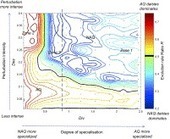
We explored competition between acquired (AQ) versus non-acquired (NAQ) character inheritance. We established that NAQ evolution rule is dominating in case of changing environment. Origins of evolution: Non-acquired characters dominates over acquired characters in changing environment. Cédric Gaucherel, Henrik Jeldtoft Jensen. Journal of Theoretical Biology Volume 304, 7 July 2012, Pages 111–120.

|
Suggested by
Charlie Brummitt
April 15, 2012 4:44 AM
|
We consider a simplified model of a social network in which individuals have one of two opinions (called 0 and 1) and their opinions and the network connections coevolve. Edges are picked at random. If the two connected individuals hold different opinions then, with probability 1 - α, one imitates the opinion of the other; otherwise (i.e., with probability α), the link between them is broken and one of them makes a new connection to an individual chosen at random (i) from those with the same opinion or (ii) from the network as a whole. The evolution of the system stops when there are no longer any discordant edges connecting individuals with different opinions. Letting ρ be the fraction of voters holding the minority opinion after the evolution stops, we are interested in how ρ depends on α and the initial fraction u of voters with opinion 1. In case (i), there is a critical value αc which does not depend on u, with ρ ≈ u for α > αc and ρ ≈ 0 for α < αc. In case (ii), the transition point αc(u) depends on the initial density u. For α > αc(u), ρ ≈ u, but for α < αc(u), we have ρ(α,u) = ρ(α,1/2). Using simulations and approximate calculations, we explain why these two nearly identical models have such dramatically different phase transitions. Graph fission in an evolving voter model
Richard Durrett et al. PNAS March 6, 2012 vol. 109 no. 10 3682-3687 http://dx.doi.org/10.1073/pnas.1200709109

|
Scooped by
Complexity Digest
April 13, 2012 3:58 AM
|
In marking Alan Turing's centenary, it's worth asking what was his most fundamental achievement and what he left for future science to take up when he took his own life in 1954. His success in World War II, as the chief scientific figure in the British cryptographic effort, with hands-on responsibility for the Atlantic naval conflict, had a great and immediate impact. But in its ever-growing influence since that time, the principle of the universal machine, which Turing published in 1937, beats even this. Beyond Turing's Machines
Andrew Hodges Science 13 April 2012: Vol. 336 no. 6078 pp. 163-164
http://dx.doi.org/10.1126/science.1218417
|
|
Scooped by
Complexity Digest
April 13, 2012 3:55 AM
|
A discussion of computational biology has to start with a pioneer of the field, Alan Turing, especially in this centennial year of his birth. He introduced us to the digital computer and proposed that much biology could be described by mathematical equations—the number of spirals in a sunflower is a Fibonacci number and pattern formation in animal skins can be described by a reaction diffusion model. Turing lacked the data and the computing power to substantiate his models. Today, the availability of vast quantities of new data, together with striking advances in computing power, is promising to give us new insights into the mechanisms of life. This special section, together with related content in Science Signaling and Science Careers, highlights recent advances and outstanding challenges. Does It Compute?
Valda Vinson, Beverly A. Purnell, Laura M. Zahn, John Travis Science 13 April 2012: Vol. 336 no. 6078 p. 171
http://dx.doi.org/10.1126/science.336.6078.171
|
|
Scooped by
Complexity Digest
April 13, 2012 3:48 AM
|
The publication and open exchange of knowledge and material form the backbone of scientific progress and reproducibility and are obligatory for publicly funded research. Despite increasing reliance on computing in every domain of scientific endeavor, the computer source code critical to understanding and evaluating computer programs is commonly withheld, effectively rendering these programs “black boxes” in the research work flow. Exempting from basic publication and disclosure standards such a ubiquitous category of research tool carries substantial negative consequences. Shining Light into Black Boxes
A. Morin et al. Science 13 April 2012: Vol. 336 no. 6078 pp. 159-160
http://dx.doi.org/10.1126/science.1218263
|
|
Scooped by
Complexity Digest
April 13, 2012 3:30 AM
|
Networks with bimodal degree distribution are most robust to targeted and random attacks. We present a model for constructing a network with bimodal degree distribution. The procedure adopted is to add nodes to the network with a probability p and delete the links between nodes with probability (1 − p). We introduce an additional constraint in the process through an immunity score, which controls the dynamics of the growth process based on the feedback value of the last few time steps. This results in bimodal nature for the degree distribution. We study the standard quantities which characterize the networks, like average path length and clustering coefficient in the context of our growth process and show that the resultant network is in the small world family. It is interesting to note that bimodality in degree distribution is an emergent phenomenon. Evolving networks with bimodal degree distribution Abhijeet R. Sonawanea, A. Bhattacharyay, M.S. Santhanam and G. Ambika Eur. Phys. J. B Volume 85, Number 4, April 2012 http://dx.doi.org/10.1140/epjb/e2012-30074-6
|
|
Scooped by
Complexity Digest
April 12, 2012 4:20 AM
|
With the increasing popularity of location-based services, we have accumulated a lot of location data on the Web. In this paper, we are interested in answering two popular location-related queries in our daily life: (1) if we want to do something such as sightseeing or dining in a large city like Beijing, where should we go? (2) If we want to visit a place such as the Birdʼs Nest in Beijing Olympic park, what can we do there? We develop a mobile recommendation system to answer these queries (...) Towards mobile intelligence: Learning from GPS history data for collaborative recommendation
Vincent W. Zheng, Yu Zheng , Xing Xie, Qiang Yang Artificial Intelligence
Volumes 184–185, June 2012, Pages 17–37
|
|
Scooped by
Complexity Digest
April 7, 2012 12:09 PM
|
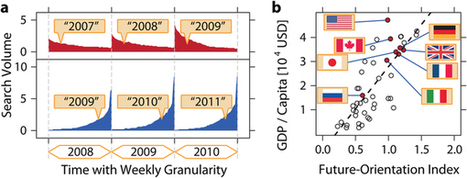
We introduce a future orientation index to quantify the degree to which Internet users worldwide seek more information about years in the future than years in the past. We analyse Google logs and find a striking correlation between the country's GDP and the predisposition of its inhabitants to look forward. Quantifying the Advantage of Looking Forward Tobias Preis, Helen Susannah Moat, H. Eugene Stanley & Steven R. Bishop
Scientific Reports 2, Article number: 350 doi:10.1038/srep00350
|
|
Rescooped by
Complexity Digest
from Content curation trends
April 5, 2012 11:59 PM
|
"On the Internet, we’ve reached a tipping point where more than 50% of all Internet traffic is no longer generated by humans – instead, it's generated by a motley mix of search engine spiders, bots, scrapers, scammers, hackers and, yes, spies. We are no longer talking about the Internet, we are talking about the Bot Net – a “bot-mediated reality” where algorithms and bots influence where we go, how long we spend there and with whom we communicate." This great pick by Sakis Koukouvis goes on to list impressive facts on how the Internet is being controlled by robots. Time to put Human Curation back into the game?
Via Sakis Koukouvis, Guillaume Decugis
|
|
Scooped by
Complexity Digest
April 3, 2012 7:02 PM
|
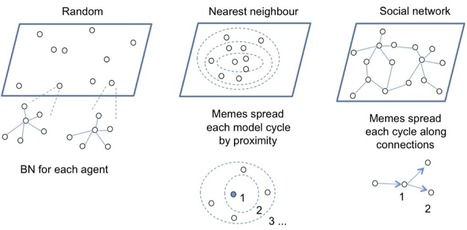
The process by which genes and memes influence behaviour is poorly understood. Genes generally may have a strong influence as predispositions directing individuals towards certain behaviours; whereas memes may have a less direct influence as information inputs to cognitive processes determining behaviour. In certain areas of medical science, knowledge has progressed towards approximate quantification of genetic influences, while social psychology can provide models of mimetic influence as the spread of attitudes. This paper describes a computational model integration of genetic and mimetic influences in a healthcare domain. It models mimetic influences of advertising and health awareness messages in populations with genetic predispositions towards obesity; environmental variables influence both gene expression and mimetic force. Sensitivity analysis using the model with different population network structures is used to investigate the relative force of meme spread and influence. Alistair Sutcliffe and Di Wang (2012) Investigating the Relative Influence of Genes and Memes in Healthcare Journal of Artificial Societies and Social Simulation 15 (2) 1

|
Suggested by
Joseph Lizier
April 3, 2012 9:39 AM
|
Common methods of causal inference generate directed acyclic graphs (DAGs) that formalize causal relations between n variables. Given the joint distribution of all these variables, the DAG contains all information about how intervening on one variable would change the distribution of the other n-1 variables. It remains, however, a non-trivial question how to quantify the causal influence of one variable on another one.
Here we propose a measure for causal strength that refers to direct effects and measure the "strength of an arrow" or a set of arrows. It is based on a hypothetical intervention that modifies the joint distribution by cutting the corresponding edge. The causal strength is then the relative entropy distance between the old and the new distribution.
We discuss other measures of causal strength like the average causal effect, transfer entropy and information flow and describe their limitations. We argue that our measure is also more appropriate for time series than the known ones.
Finally, we discuss conceptual problems in defining the strength of indirect effects. Quantifying causal influences Dominik Janzing, David Balduzzi, Moritz Grosse-Wentrup, Bernhard Schoelkopf arXiv:1203.6502
|
|
Scooped by
Complexity Digest
April 2, 2012 8:42 AM
|
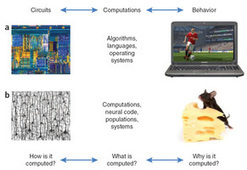
Neuroscience seeks to understand how neural circuits lead to behavior. However, the gap between circuits and behavior is too wide. An intermediate level is one of neural computations, which occur in individual neurons and populations of neurons. Some computations seem to be canonical: repeated and combined in different ways across the brain. To understand neural computations, we must record from a myriad of neurons in multiple brain regions. Understanding computation guides research in the underlying circuits and provides a language for theories of behavior. From circuits to behavior: a bridge too far? Matteo Carandini
Nature Neuroscience 15, 507–509 (2012) doi:10.1038/nn.3043
Published online 27 March 2012
|

|
Suggested by
Hiroki Sayama
April 18, 2012 12:43 PM
|
We consider voter dynamics on a directed adaptive network with fixed out-degree distribution. A transition between an active phase and a fragmented phase is observed. This transition is similar to the undirected case if the networks are sufficiently dense and have a narrow out-degree distribution. However, if a significant number of nodes with low out degree is present, then fragmentation can occur even far below the estimated critical point due to the formation of self-stabilizing structures that nucleate fragmentation. This process may be relevant for fragmentation in current political opinion formation processes. Early fragmentation in the adaptive voter model on directed networks. Gerd Zschaler, Gesa A. Böhme, Michael Seißinger, Cristián Huepe, and Thilo Gross. Phys. Rev. E 85, 046107 (2012)
|
|
Suggested by
Charlie Brummitt
April 15, 2012 4:46 AM
|
Understanding how interdependence among systems affects cascading behaviors is increasingly important across many fields of science and engineering. Inspired by cascades of load shedding in coupled electric grids and other infrastructure, we study the Bak–Tang–Wiesenfeld sandpile model on modular random graphs and on graphs based on actual, interdependent power grids. Starting from two isolated networks, adding some connectivity between them is beneficial, for it suppresses the largest cascades in each system. Too much interconnectivity, however, becomes detrimental for two reasons. First, interconnections open pathways for neighboring networks to inflict large cascades. Second, as in real infrastructure, new interconnections increase capacity and total possible load, which fuels even larger cascades. Using a multitype branching process and simulations we show these effects and estimate the optimal level of interconnectivity that balances their trade-offs. Such equilibria could allow, for example, power grid owners to minimize the largest cascades in their grid. We also show that asymmetric capacity among interdependent networks affects the optimal connectivity that each prefers and may lead to an arms race for greater capacity. Our multitype branching process framework provides building blocks for better prediction of cascading processes on modular random graphs and on multitype networks in general. Suppressing cascades of load in interdependent networks
Charles D. Brummitt, Raissa M. D’Souza, and E. A. Leicht http://dx.doi.org/10.1073/pnas.1110586109

|
Suggested by
Johan Ugander
April 14, 2012 6:20 PM
|
Structural diversity in social contagion
The concept of contagion has steadily expanded from its original grounding in epidemic disease to describe a vast array of processes that spread across networks, notably social phenomena such as fads, political opinions, the adoption of new technologies, and financial decisions. (...) We find that the probability of contagion is tightly controlled by the number of connected components in an individual's contact neighborhood, rather than by the actual size of the neighborhood. Surprisingly, once this “structural diversity” is controlled for, the size of the contact neighborhood is in fact generally a negative predictor of contagion. More broadly, our analysis shows how data at the size and resolution of the Facebook network make possible the identification of subtle structural signals that go undetected at smaller scales yet hold pivotal predictive roles for the outcomes of social processes. Structural diversity in social contagion
Johan Ugander, Lars Backstrom, Cameron Marlow, and Jon Kleinberg PNAS http://www.pnas.org/content/early/2012/03/27/1116502109.abstract
|
|
Scooped by
Complexity Digest
April 13, 2012 3:57 AM
|
Hold up both hands and spread your fingers apart. Now put your palms together and fold your two middle fingers down till the knuckles on both fingers touch each other. While holding this position, one after the other, open and close each pair of opposing fingers by an inch or so. Notice anything? Of course you did. But could a computer without a body and without human experiences ever answer that question or a million others like it? And even if recent revolutionary advances in collecting, storing, retrieving, and analyzing data lead to such a computer, would this machine qualify as “intelligent”? Dusting Off the Turing Test
Robert M. French Science 13 April 2012: Vol. 336 no. 6078 pp. 164-165
http://dx.doi.org/10.1126/science.1218350
|
|
Scooped by
Complexity Digest
April 13, 2012 3:52 AM
|
Networks that govern communication, growth, herd behavior, and other key processes in nature and society are becoming increasingly amenable to modeling, forecast, and control. Networks in motion
Adilson E. Motter and Réka Albert
Physics Today / Volume 65 / Issue 4, April 2012, page 43
http://dx.doi.org/10.1063/PT.3.1518
|
|
Scooped by
Complexity Digest
April 13, 2012 3:38 AM
|
Late nights in the lab, early morning commutes from the suburbs, Angry Birds videogame marathons into the wee hours—the demands and distractions of modern life are stealing our sleep and perhaps robbing us of our health. According to the longest sleep-limitation study to date, published this week in Science Translational Medicine, many people are on sleep and work schedules that prime them for diabetes and obesity. Sleep Study Suggests Triggers for Diabetes and Obesity
Mitch Leslie Science 13 April 2012: Vol. 336 no. 6078 p. 143
http://www.sciencemag.org/content/336/6078/143.summary ;
|
|
Scooped by
Complexity Digest
April 12, 2012 6:44 PM
|
One hundred years after Alan Turing was born, his eponymous test remains an elusive benchmark for artificial intelligence. Now, for the first time in decades, it’s possible to imagine a machine making the grade. Turing was one of the 20th century’s great mathematicians, a conceptual architect of modern computing whose codebreaking played a decisive part in World War II. His test, described in a seminal dawn-of-the-computer-age paper, was deceptively simple: If a machine could pass for human in conversation, the machine could be considered intelligent.
|
|
Scooped by
Complexity Digest
April 7, 2012 12:12 PM
|
No computer can yet pass the 'Turing test' and be taken as human. But the hunt for artificial intelligence is moving in a different, exciting direction that involves creativity, language – and even jazz AI robot: how machine intelligence is evolving
Marcus du Sautoy
The Observer, Sun 1 Apr 2012
|
|
Scooped by
Complexity Digest
April 6, 2012 12:16 AM
|
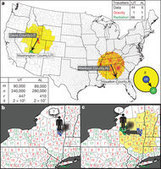
Introduced in its contemporary form in 1946 (...) the gravity law is the prevailing framework with which to predict population movement cargo shipping volume and inter-city phone calls, as well as bilateral trade flows between nations. Despite its widespread use, it relies on adjustable parameters that vary from region to region and suffers from known analytic inconsistencies. Here we introduce a stochastic process capturing local mobility decisions that helps us analytically derive commuting and mobility fluxes that require as input only information on the population distribution. The resulting radiation model predicts mobility patterns in good agreement with mobility and transport patterns observed in a wide range of phenomena, from long-term migration patterns to communication volume between different regions. Given its parameter-free nature, the model can be applied in areas where we lack previous mobility measurements, significantly improving the predictive accuracy of most of the phenomena affected by mobility and transport processes. A universal model for mobility and migration patterns Filippo Simini, Marta C. González, Amos Maritan & Albert-László Barabási
Nature 484, 96–100 (05 April 2012) doi:10.1038/nature10856
|
|
Scooped by
Complexity Digest
April 5, 2012 11:54 PM
|
The importance of adequately modeling credit risk has once again been highlighted in the recent financial crisis. Defaults tend to cluster around times of economic stress due to poor macro-economic conditions, but also by directly triggering each other through contagion. Although credit default swaps have radically altered the dynamics of contagion for more than a decade, models quantifying their impact on systemic risk are still missing. Here, we examine contagion through credit default swaps in a stylized economic network of corporates and financial institutions Derivatives and credit contagion in interconnected networks S. Heisea and R. Kühn Eur. Phys. J. B (2012) 85: 115
|
|
Scooped by
Complexity Digest
April 3, 2012 6:59 PM
|
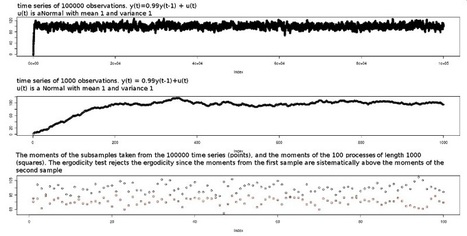
This paper illustrates the use of the nonparametric Wald-Wolfowitz test to detect stationarity and ergodicity in agent-based models. A nonparametric test is needed due to the practical impossibility to understand how the random component influences the emergent properties of the model in many agent-based models. Nonparametric tests on real data often lack power and this problem is addressed by applying the Wald-Wolfowitz test to the simulated data. The performance of the tests is evaluated using Monte Carlo simulations of a stochastic process with known properties. It is shown that with appropriate settings the tests can detect non-stationarity and non-ergodicity. Knowing whether a model is ergodic and stationary is essential in order to understand its behavior and the real system it is intended to represent; quantitative analysis of the artificial data helps to acquire such knowledge. Jakob Grazzini (2012) Analysis of the Emergent Properties: Stationarity and Ergodicity Journal of Artificial Societies and Social Simulation 15 (2) 7
|
|
Scooped by
Complexity Digest
April 3, 2012 9:00 AM
|
-Medical Students, Climate Change And Health -A Multi-Paradigmatic Framework To Manage Adaptation Of Socio-Ecological Systems: Design Considerations For An Andean Eco-Region -Emerging Community Food Production And Pathways For Urban Landscape Transitions -The Land Ethic -Emerging Sustainability: Reflections On Working In Sustainability And Health -Adjacent Opportunities: Change, Change, Change
|