Your new post is loading...

|
Scooped by
Complexity Digest
October 7, 1:35 PM
|
Fabiane de Fatima Carvalho, Ivan Bergier, Silvia Maria Fonseca Silveira Massruhá, Jayme Garcia Arnal Barbedo
Complexities 2026, 2(3), 21 Collaboration networks are frequently studied as empirical instances of complex social systems, yet standardized methodological frameworks for consistently identifying heterogeneous mesoscopic structural regimes remain limited. This study proposes an integrated multi-criteria classification framework and demonstrates its application to the structural characterization of communities extracted from a large-scale scientific collaboration network. The framework combines community detection, classical network metrics, statistical modeling of weighted degree tails, small-world diagnostics, information-entropy measures, and fractal analysis based on the Song–Havlin–Makse box-covering renormalization framework. As an empirical application, the methodology is applied to the giant coauthorship component of Embrapa’s scientific production (1974–2024), derived from the Brazilian Agricultural Research Database (BDPA), comprising 60,636 nodes. The weighted Louvain algorithm partitions the network into 25 major communities, which are evaluated through an integrated classification protocol combining the Akaike Information Criterion model selection, Kolmogorov–Smirnov goodness-of-fit tests, small-worldness diagnostics, and fractal scaling analysis. The proposed framework identifies three network families, namely Barabási–Albert (BA-like)/scale-free small-world, scale-free fractal (non-BA) and small-world (non-scale-free), while explicitly distinguishing supported and ambiguous classifications according to the overall consistency of the statistical and structural evidence. The results demonstrate that distinct mesoscopic structural regimes coexist within the same connected collaboration system, highlighting the usefulness of the proposed reproducible multi-criteria framework for comparative topological characterization across complex collaboration networks.Collaboration networks are frequently studied as empirical instances of complex social systems, yet standardized methodological frameworks for consistently identifying heterogeneous mesoscopic structural regimes remain limited. This study proposes an integrated multi-criteria classification framework and demonstrates its application to the structural characterization of communities extracted from a large-scale scientific collaboration network. The framework combines community detection, classical network metrics, statistical modeling of weighted degree tails, small-world diagnostics, information-entropy measures, and fractal analysis based on the Song–Havlin–Makse box-covering renormalization framework. As an empirical application, the methodology is applied to the giant coauthorship component of Embrapa’s scientific production (1974–2024), derived from the Brazilian Agricultural Research Database (BDPA), comprising 60,636 nodes. The weighted Louvain algorithm partitions the network into 25 major communities, which are evaluated through an integrated classification protocol combining the Akaike Information Criterion model selection, Kolmogorov–Smirnov goodness-of-fit tests, small-worldness diagnostics, and fractal scaling analysis. The proposed framework identifies three network families, namely Barabási–Albert (BA-like)/scale-free small-world, scale-free fractal (non-BA) and small-world (non-scale-free), while explicitly distinguishing supported and ambiguous classifications according to the overall consistency of the statistical and structural evidence. The results demonstrate that distinct mesoscopic structural regimes coexist within the same connected collaboration system, highlighting the usefulness of the proposed reproducible multi-criteria framework for comparative topological characterization across complex collaboration networks. Read the full article at: www.mdpi.com
|
|
Scooped by
Complexity Digest
October 6, 1:34 PM
|
Klaus M. Frahm, Leonardo Ermann, and Dima L. Shepelyansky Complexities 2026, 2(3), 20; According to the recent Wealth Thermalization Hypothesis (WTH), the wealth inequality in the world is described by the Rayleigh–Jeans (RJ) thermal distribution of interacting agents in a society with social stratification. In this concept, the wealth layers of society are associated with energy levels from a nonlinear dynamical system conserving two integrals of motion—namely, total energy and the probability norm. This leads to RJ condensation and the formation of a huge poverty phase of low wealth and a tiny oligarchic phase that captures a main part of total society wealth. This RJ phenomenon has similarities with self-cleaning in multimode optical fibers and constraint-driven condensation in various physical systems. We analyze real Lorenz and Pareto curves for wealth of households in countries and the world; gross domestic product of countries; market capitalization of companies on the stock exchanges of Hong Kong, Shanghai, and London; bitcoin transactions; and world trade between countries and show that the WTH theory gives a good description of these curves. On the basis of this comparison, we argue that the RJ thermal distribution provides a universal description of wealth inequality in the world. Read the full article at: www.mdpi.com
|
|
Scooped by
Complexity Digest
October 5, 7:43 PM
|
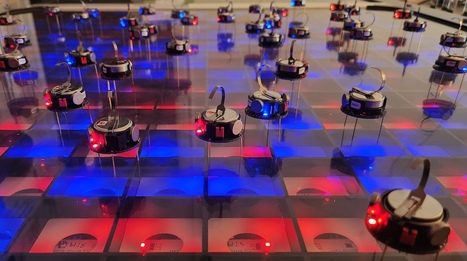
Mayo AM, Carrigee C, Harrison AB, Mayo ML, Pilkiewicz KR PLOS Complex Syst 3(10): e0000136. In a famous Chinese parable, a man is shown both heaven and hell. In the latter, a group of men sit around a lavish banquet table, unable to eat because their chopsticks are too long to reach their mouths. In the former, the exact same scenario plays out, except here the men feed each other. In this paper, we compare the behavior of cockroaches to that of vibrating brush-head robots, known as bristlebots, as groups of each attempt to squeeze through a narrow passage. Although the bots and the bugs have different means of locomotion, they navigate their environment in a similar fashion. As in the parable, however, a small of amount of regard for others leads to a much happier outcome. The robots try to push past each other and form logjams that block up the passage, whereas the roaches practice patience and stop and wait for those in front of them to move through the passage first. This result may seem innocuous, but it demonstrates how simple organisms, incapable of sophisticated decision-making, require only the slightest amount of sociality to collectively solve complex problems, such as how to smoothly navigate a challenging environment as a cohesive unit.In a famous Chinese parable, a man is shown both heaven and hell. In the latter, a group of men sit around a lavish banquet table, unable to eat because their chopsticks are too long to reach their mouths. In the former, the exact same scenario plays out, except here the men feed each other. In this paper, we compare the behavior of cockroaches to that of vibrating brush-head robots, known as bristlebots, as groups of each attempt to squeeze through a narrow passage. Although the bots and the bugs have different means of locomotion, they navigate their environment in a similar fashion. As in the parable, however, a small of amount of regard for others leads to a much happier outcome. The robots try to push past each other and form logjams that block up the passage, whereas the roaches practice patience and stop and wait for those in front of them to move through the passage first. This result may seem innocuous, but it demonstrates how simple organisms, incapable of sophisticated decision-making, require only the slightest amount of sociality to collectively solve complex problems, such as how to smoothly navigate a challenging environment as a cohesive unit. Read the full article at: journals.plos.org
|
|
Scooped by
Complexity Digest
October 2, 3:07 PM
|
Manlio De Domenico, Valeria d’Andrea, Marco Grassia, Giuseppe Mangioni & Barbara Di Camillo
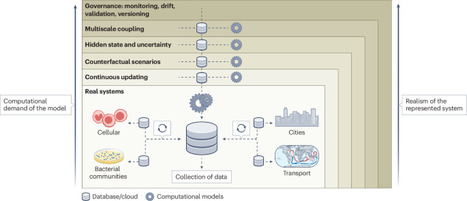
Nature Physics (2026) As the term ‘digital twin’ spreads across science and technology, it risks losing scientific meaning. Such a twin should not denote just a digital replica, but a computational model that can be updated, tested against intervention and shown to fail.As the term ‘digital twin’ spreads across science and technology, it risks losing scientific meaning. Such a twin should not denote just a digital replica, but a computational model that can be updated, tested against intervention and shown to fail. Read the full article at: www.nature.com
|
|
Scooped by
Complexity Digest
October 2, 1:06 PM
|
Benedikt Hartl, Milton L. Montero, Marcello Barylli, Sebastian Risi, Michael Levin How phenotypic transformations are implemented by changes in underlying regulatory dynamics remains a central question in developmental biology. Inspired by D'Arcy Thompson's 1917 "On Growth and Form", we ask whether coherent large-scale transformations of morphology can be encoded as low-dimensional modulations of a self-organizing developmental system. We use neural cellular automata (NCAs) as bio-inspired models of distributed development, in which a shared local regulatory network grows target morphologies from a single cell. We apply low-rank adaptation (LoRA) to pretrained NCAs, representing each adapted developmental program as a low-rank modulation of a fixed regulatory scaffold. Horizontal and vertical scaling of a fully grown 2D emoji phenotype can each be implemented by rank-one adaptations. Their linear combinations parametrically control phenotype size, generalize beyond the training distribution, and compose with target-specific adapters. Strikingly, adaptations learned for one phenotype transfer zero-shot across structurally and semantically diverse phenotypes sharing the same reference scaffold, while largely preserving internal features. This suggests reusable system-level hyper-directions of scale rather than morphology-specific transformations. From approximately 25,000 independently trained phenotype-specific NCA adapters with a shared scaffold, we further identify latent low-dimensional directions that functionally control phenotypic variation including scaling, style, and symmetrical fission. Together, our results provide a computational realization of D'Arcy Thompson's remarkable grid transformations in a 2D NCA---a minimal cybernetic tissue in which variations of fully grown emoji phenotypes can be encoded, combined, and controlled through low-dimensional directions in regulatory weight space. Read the full article at: arxiv.org
|
|
Scooped by
Complexity Digest
October 1, 1:31 PM
|
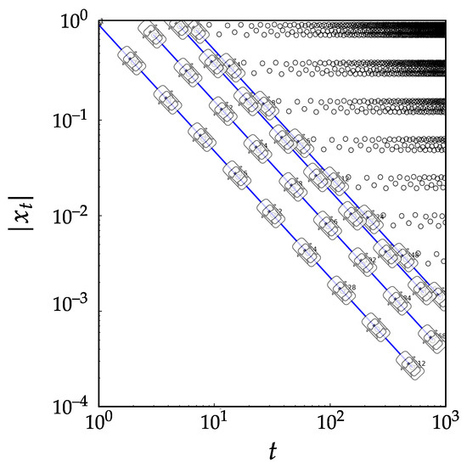
Kevin Peralta-Martínez and José A. Méndez-Bermúdez Complexities 2026, 2(3), 17 In this work, we study in detail all phases of the time evolution of a delta-like excitation in Erdös–Renyi (ER) random networks by means of the survival probability (SP): The initial decay of the SP (both, the fast decay followed by the power-law decay), the correlation hole regime (the regime between the minimum value of the SP and its saturation value), and the saturation of the SP. Specifically, we find that just before reaching the correlation hole, (i) the power-law decay of the SP is proportional to t−D2 and t−D˜2 (in a short time window) and the power-law decay of the time-averaged SP is proportional to t−D˜2 (where D2 and D˜2 are the correlation dimension of the eigenstates of the randomly weighted adjacency matrices of the ER random networks and the correlation dimension associated with the initial state, respectively); however, this agreement is only approximate, depends on the average degree ⟨k⟩, and is limited to short time windows, and (ii) the relative depth of the correlation hole of the SP scales with the average degree ⟨k⟩≈np (here, n and p are the size and the connection probability of the ER random networks). In addition, we show that the eigenstates of the randomly weighted adjacency matrices of ER networks display clear multifractal properties. Read the full article at: www.mdpi.com
|
|
Scooped by
Complexity Digest
September 24, 4:46 PM
|
Raina Zakir, Timoteo Carletti, Marco Dorigo & Andreagiovanni Reina
Nature Communications volume 17, Article number: 9774 (2026) To operate autonomously, minimal robot swarms must make timely and reliable collective decisions despite noisy individual sensing and severe constraints on communication, computation, and memory. Achieving this capability could expand their use in applications such as healthcare, disaster response, and environmental monitoring. Here, we study how such swarms can rapidly and reliably reach consensus on the best among n discrete options by comparing two canonical mechanisms of opinion dynamics—direct-switch and cross-inhibition—simple yet effective rules for collective information processing observed in biological systems across scales, from neural populations to insect colonies. We generalise existing mean-field models by incorporating asocial biases that influence opinion dynamics. While swarms using direct-switch reliably select the best option in the absence of asocial dynamics, their performance deteriorates when such biases are introduced, often leading to decision deadlocks. In contrast, bio-inspired cross-inhibition enables faster, more cohesive, robust, and scalable decisions across a wide range of biased conditions. Our findings provide theoretical and practical insights into the coordination of minimal swarms, with implications for a broad class of decentralised decision-making systems across biology and engineering. Read the full article at: www.nature.com
|
|
Scooped by
Complexity Digest
September 22, 1:05 PM
|
Miao Zeng, Roberto Murcio, Camilo Vargas-Ruiz, Elsa Arcaute Achieving universal health coverage, as set out in Sustainable Development Goal 3.8, requires closing persistent geographic and socioeconomic gaps in healthcare access, especially in under-resourced settings across Africa. Healthcare-access inequality is shaped not only by poor local access, but also by limited connectivity to city- and regional-level services and opportunities. Conventional accessibility analysis can identify where poor access occurs, but not whether poorly served places form structurally disconnected pockets across scales. This paper therefore builds on and extends the percolation divergence tree framework to develop a connectivity-based multiscale approach for examining healthcare-access inequality in Ghana. It combines street-level accessibility mapping with the hierarchical structure of the road network to identify the scales at which inequality coincides with connectivity breaks. The results first show substantial inequality: around one quarter of the population lives more than 5 km from the nearest healthcare facility. Multiscale analysis further reveals distinct structural forms of poor access. In relatively well-connected, monocentric regions, local poor-access pockets emerge around metropolitan fringes despite overall regional advantage. In less well-connected, polycentric regions, poor access extends across larger subsystems, with local pockets nested within broader poorly served areas. These findings show that healthcare-access inequality reflects both local conditions and the hierarchical connectivity of the wider spatial system, which may also constrain marginalised communities' access to other key resources and services. The framework can inform targeted local interventions and policy coordination across local and regional scales. Read the full article at: arxiv.org
|
|
Scooped by
Complexity Digest
September 20, 3:17 PM
|
Emerence and complexity describe how systems can exhibit behaviors, patterns, and outcomes that cannot be fully understood by examining individual parts in isolation. As interactions between components increase, systems often become less predictable, more adaptive, and more sensitive to relationships, context, and feedback. Complex systems may display nonlinearity, self-organization, adaptation, and unexpected emergent behaviors that arise from the interactions within the system as a whole. Understanding these dynamics is essential for systems thinking and systems engineering, particularly when working with large-scale, interconnected, or socio-technical systems.Emerence and complexity describe how systems can exhibit behaviors, patterns, and outcomes that cannot be fully understood by examining individual parts in isolation. As interactions between components increase, systems often become less predictable, more adaptive, and more sensitive to relationships, context, and feedback. Complex systems may display nonlinearity, self-organization, adaptation, and unexpected emergent behaviors that arise from the interactions within the system as a whole. Understanding these dynamics is essential for systems thinking and systems engineering, particularly when working with large-scale, interconnected, or socio-technical systems. Read the full article at: sebokwiki.org
|
|
Scooped by
Complexity Digest
September 18, 7:14 PM
|
Cameron Brooks, Estelle Janin, Gage Siebert, Cole Mathis, Orit Peleg & Sara Imari Walker
Scientific Reports (2026) The Search for Extraterrestrial Intelligence (SETI) has historically been a search for aliens like us, shaped by human-centric ideas of intelligence, communication, and technology. However, humans are not the only instance of an intelligent, communicating species on Earth, and thus not the only guide to how we might think about ETI. Here, we explore how non-human communication systems could complement existing SETI strategies, usually focused on complex, potentially decodable signals, using firefly communication as an illustrative example. Fireflies communicate their presence through evolved flash patterns that are distinguishable from complex visual backgrounds. Drawing on this strategy, we present a firefly-inspired model for detecting potential technosignatures within environments dominated by ordered astronomical phenomena, such as pulsars. Using pulsar data from the Australia Telescope National Facility, we generate simulated pulse sequences that exhibit evolved dissimilarity from the surrounding pulsar population of Earth, which would constitute a signature of intelligence embodied in a relatively simple signal. This approach shifts focus from anthropocentric assumptions about intelligence toward recognizing communication through its fundamental structural properties, specifically evolutionarily optimized contrast with natural backgrounds. Our model demonstrates that alien signals need not be inherently complicated nor must we decipher their meaning to identify them; rather, signals might be distinguishable as products of engineering or evolutionary design. We discuss implications for broadening SETI methodologies and leveraging the diverse forms of intelligence found on Earth. Read the full article at: www.nature.com
|
|
Scooped by
Complexity Digest
September 12, 1:51 PM
|
Sebastian Sander-Oest Synthese Volume 208, article number 143 (2026) Self-assembly and self-organization are central concepts in theories of how patterns form in natural systems. However, literature on the topic has for long been riddled with inconsistent uses of these concepts, which often conflate their meaning or define them idiosyncratically. This is problematic as it struggles to make sense of the ubiquitous interaction between self-assembly and self-organization in chemistry and biology. The thermodynamic account is an attempt to draw up clear definitions of the concepts using thermodynamics as the appropriate framework for distinguishing the two concepts from each other. In this paper, I challenge this account and argue that self-assembly shouldn’t primarily be understood in terms of thermodynamics. I offer a philosophical analysis of core conceptual challenges for self-assembly and self-organization and argue that the thermodynamic approach follows a misguided conceptualization strategy. Drawing on recent philosophical work on scientific definitions, I propose an alternative account that treats the concept as a conceptual tool that directs our attention towards the kinds of features that are explanatorily relevant for the pattern-formation process and towards the features the resulting pattern itself will possess.Self-assembly and self-organization are central concepts in theories of how patterns form in natural systems. However, literature on the topic has for long been riddled with inconsistent uses of these concepts, which often conflate their meaning or define them idiosyncratically. This is problematic as it struggles to make sense of the ubiquitous interaction between self-assembly and self-organization in chemistry and biology. The thermodynamic account is an attempt to draw up clear definitions of the concepts using thermodynamics as the appropriate framework for distinguishing the two concepts from each other. In this paper, I challenge this account and argue that self-assembly shouldn’t primarily be understood in terms of thermodynamics. I offer a philosophical analysis of core conceptual challenges for self-assembly and self-organization and argue that the thermodynamic approach follows a misguided conceptualization strategy. Drawing on recent philosophical work on scientific definitions, I propose an alternative account that treats the concept as a conceptual tool that directs our attention towards the kinds of features that are explanatorily relevant for the pattern-formation process and towards the features the resulting pattern itself will possess. Read the full article at: link.springer.com
|
|
Scooped by
Complexity Digest
September 11, 9:12 AM
|
Tim Gebbie Complex systems are often organised into hierarchies whose internal interactions are stronger or faster than interactions across levels. When markets are treated as genuinely multilevel systems it becomes natural to represent them as systems with hierarchical causality. Here we show that reflexivity can be formulated within such a discrete hierarchical causal system; but one in which a higher-level actor state restricts the lower-level transition kernels that remain admissible. Then event dynamics can be separated from calendar embeddings: a set-valued actor-conditioned correspondence can be used to define the admissible family of event kernels, while joint state and waiting-time laws can be used to determine compatible timing to then natural demonstrate reflexivity. A selected event-state law need not determine a unique calendar embedding. Locally, uniqueness of the joint event or timing specification requires uniqueness of both the admissible event kernel and its compatible timing law. Reflexivity is thus the endogenous closure of a hierarchical constraint loop, while timing and projection can generate calendar-time memory or causal ambiguity even for Markov event dynamics. Read the full article at: arxiv.org

|
Suggested by
Vikas O'Reilly-Shah
September 10, 1:54 PM
|
Vikas N. O’Reilly-Shah & Alessandro Maria Selvitella Journal of Computational Neuroscience Neural population activity in sensory cortex is organized on low-dimensional manifolds, but it is unclear why such manifolds should arise and what determines their geometry. We address this sensory representation problem by modeling cortical populations as recurrent circuits driven by low-dimensional, regular sensory dynamics (e.g. motion on a circle, head direction, multi-frequency tones on tori). By combining tools from generalized synchronization and delay-embedding theory, specialized to this quasiperiodic regime, we show that contracting recurrent networks generically develop smooth internal manifolds that embed the sensory dynamics. The dimensional requirement is modest and depends only on the intrinsic dimension $$\varvec{d}$$ of the effective sensory manifold, not on the complexity of the external world: a hidden dimension $$\varvec{N>2d}$$ generically suffices (e.g. $$\varvec{N\ge 3}$$ for a circle, $$\varvec{N\ge 5}$$ for a two-frequency torus; bounds compatible with Whitney and Takens’ embedding theorems). We then prove a prediction–separation result that links representational geometry directly to predictive performance, without assuming knowledge of contraction rates: if the circuit can predict future sensory inputs with small error, then states with different futures must be separated in neural state space, up to a resolution set by the prediction error. The resulting scale-limited embeddings naturally give rise to categorical boundaries, metameric equivalence of distinct stimuli, and discrimination thresholds. Numerical experiments with trained $$\varvec{\tanh }$$ recurrent networks driven by head-direction-like and multi-frequency signals recover ring- and torus-shaped hidden manifolds with the expected topology; state separation improves most rapidly near the $$\varvec{2d+1}$$ threshold. Training typically pushes the networks beyond the strict contraction regime where the theory guarantees faithful embedding, yet convergence consistent with generalized synchronization and manifold recovery persist, indicating that our conditions are sufficient but not necessary. Together, these results provide a mechanistic account of why low-dimensional sensory manifolds emerge in recurrent circuits and how prediction constrains their resolution, grounded in dynamical systems embedding theory and consistent with empirical findings on cortical population dynamics. Read the full article at: link.springer.com
|
|
|
Scooped by
Complexity Digest
October 7, 1:18 PM
|
Sean P. Maley, Carlos Gershenson, Stuart A. Kauffman Journal of Theoretical Biology
How new levels of organization arise is a long-standing question. The emergence of higher-level organization can appear unlikely, since cooperation must prevail over competition. One well-studied example is the autocatalytic set, a collection of molecules in which the formation of each member is catalyzed by another member of the set, and which is often considered a prerequisite for the evolution of life.
We present a random threshold-directed network model that integrates node-specific traits with dynamic edge formation and node removal, simulating arbitrary levels of cooperation and competition. Intrinsic node values determine directed links through threshold rules, generating a multi-digraph with signed edges (reflecting support and antagonism, labeled “help” and “harm”) that yields two parallel yet interdependent threshold graphs. Incorporating temporal growth and node turnover allows exploration of the evolution, adaptation, and potential collapse of communities.
We find that a strongly connected core assembles and persists even when antagonistic interactions predominate. Members are culled once incoming harm outweighs incoming help, so those that remain are helped more than they are harmed, and a quantitative increase in the number of elements produces a qualitative transition. As the harm-to-help ratio ρ rises, late-time population growth and mean connectivity both decline steadily, growth reaching zero and connectivity its floor near ρc ≈ 0.6, marking a shift from sustained growth to a bounded regime. Raising the binding chance moves the onset of a system-spanning strongly connected component to progressively smaller populations without changing its eventual extent, indicating that interaction opportunity governs when collective organization appears rather than whether it appears.
These results extend classical random threshold and Erdős-Rényi random graph models, and bear on how microbial communities and other adaptive systems assemble Collective Affordance Sets under persistent antagonism. Read the full article at: www.sciencedirect.com
|
|
Scooped by
Complexity Digest
October 6, 8:36 AM
|
George-Rafael Domenikos and Lock Yue Chew
Complexities 2026, 2(3), 23
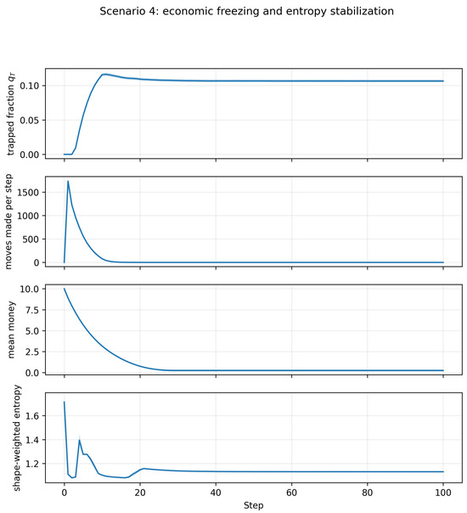
Generalized Schelling models extend the classical relocation framework by introducing additional agent attributes, interaction rules, and mobility constraints. We study four variants within a common lattice formulation: a modified movement-only baseline, a local affiliation-interaction model, a model with local and random long-range interactions, and a monetary model in which movement and communication consume resources. The simulations use a 64×64 lattice and are evaluated over 30 independently seeded runs per scenario, with means and 95% confidence intervals reported throughout. At each step, occupied agents are classified as bound, activated, or, in the monetary scenario, trapped. Their conditional affiliation distributions are evaluated using Shannon entropy and a shape-weighted diagnostic whose fitted components distinguish normal-like, heavy-tailed, and bimodal structures. The diagnostic is interpreted jointly with its fitted weights and the underlying histograms rather than as a unique scalar reconstruction of shape. Validation against the bimodality coefficient, Esteban–Ray polarization, Moran’s I, and sign assortativity separates distributional polarization from spatial segregation. The interaction-driven scenarios develop strongly polarized two-lobed bound-state distributions, while the monetary model additionally produces resource-constrained dynamical arrest. The results are robust across independent initial conditions and random streams; separate extended-horizon checks to 500 steps showed no qualitative reversal. The same regimes persist on 96×96 and 128×128 lattices and under one-factor variations of satisfaction, vacancy, long-range-contact, and monetary-cost parameters. The framework therefore complements Shannon entropy by exposing distributional geometry that uncertainty alone does not encode. Read the full article at: www.mdpi.com
|
|
Scooped by
Complexity Digest
October 5, 3:27 PM
|
Shamil Chandaria, Arvo Muñoz Morán, Fernando Rosas, Anil Seth, Henry Shevlin, Marcus Hutter, Thore Graepel, Adam Bales, Iulia Comsa, Murray Shanahan, Ruben Laukkonen, Morten Kringelbach, Chris Frith, Shane Legg
The question of AI consciousness is one of the most urgent pre-emptive problems in philosophy and computer science, yet progress is hampered by a cacophony of competing theories that often talk past each other. Separating the hard problem from the mapping problem allows the deepest metaphysical disagreements to be set aside: granting that experience supervenes on a system's organisation, the tractable question becomes at which grain of description that supervenience base sits. We extend Marr's three levels of analysis into a five-level hierarchy of functional descriptions (behavioural, computational, intrinsic causal-structural, organismic, and organism-environment) grounded in supervenience, coarse-graining, and multiple realisability. The major theories of consciousness are positioned within this hierarchy according to which level they take to be critical, and for each level we develop operationalisable indicators and assess current AI systems against them. A Bayesian model then combines theoretical credences with indicator evidence into an overall credence in a system's capacity for consciousness. In illustrative assessments, the verdict for current LLMs is driven as much by where theoretical credence is placed as by how the evidence is read: under different stipulated readings and credence distributions, assessments range from below 0.01 to roughly 0.8, showing sensitivity to assumptions. Finally, the consciousness indicators at each level closely overlap with the architectural features needed for general intelligence, suggesting that increasingly capable AI may become a stronger candidate for consciousness. The framework supports a structured agnosticism, in which theoretical commitments are made explicit, credences are updated as evidence accumulates, and assessments take the form of aggregated probabilities rather than verdicts. Read the full article at: arxiv.org
|
|
Scooped by
Complexity Digest
October 2, 1:40 PM
|
Mariana Macedo , Melanie Oyarzun , Cristian Candia , César A Hidalgo PNAS Nexus, pgag308, Collective memory—shared information about the past that shapes a group’s identity—is often examined through constructs such as familiarity or salience, conflating its local and global components. Here, we untangle these components using multilingual online attention traces for over 50,000 Wikipedia biographies spanning 137 billion pageviews and a large-scale behavioral recognition experiment in which more than 41,000 participants answered factual questions about famous biographies. Our experiment reveals a robust local memory premium, with people being around 10 percentage points more likely to answer correctly questions about someone from their country and about 5 points more likely to answer correctly questions about biographies with whom they share a language. Finally, we study the impact of three major life events: Nobel Prizes, Oscars, and deaths in local and global online attention, finding these events produce brief but strong surges in local attention and slower but sustained increases in global attention. These findings add important spatial and temporal nuances to our understanding of collective memory.Collective memory—shared information about the past that shapes a group’s identity—is often examined through constructs such as familiarity or salience, conflating its local and global components. Here, we untangle these components using multilingual online attention traces for over 50,000 Wikipedia biographies spanning 137 billion pageviews and a large-scale behavioral recognition experiment in which more than 41,000 participants answered factual questions about famous biographies. Our experiment reveals a robust local memory premium, with people being around 10 percentage points more likely to answer correctly questions about someone from their country and about 5 points more likely to answer correctly questions about biographies with whom they share a language. Finally, we study the impact of three major life events: Nobel Prizes, Oscars, and deaths in local and global online attention, finding these events produce brief but strong surges in local attention and slower but sustained increases in global attention. These findings add important spatial and temporal nuances to our understanding of collective memory. Read the full article at: academic.oup.com
|
|
Scooped by
Complexity Digest
October 1, 3:32 PM
|
Santa Elena Tellez-Flores and Alberto Robledo Complexities 2026, 2(3), 19 We present a nonlinear dynamical model for vehicular traffic jams and their dissolution based on the noise-perturbed onset of chaos. The model makes use of the bifurcation gap generated by addition of noise to quadratic iterated maps. The gap results from the elimination by noise of periodic and chaotic attractors with large periods and large numbers of chaotic bands, respectively. The bifurcation gap is recapitulated at the transition to chaos (vanishing Lyapunov exponent) as a crossover from noiseless to irregular, chaotic-like regimes at an iteration time tcross with value dependent on the noise amplitude. This behavior is employed in a model (with variants) that we design for multilane road congested traffic. We highlight four main model properties that are also present in the dynamics of glass formation: (i) plateau interrupted relaxation; (ii) Adam–Gibbs empirical law; (iii) aging; and (iv) diffusion arrest. The model bridges previous studies that have indicated analogies between glassy dynamics and vehicular traffic as well as nonlinear dynamics and same-name traffic. We also discuss the connection of the model with urban multilane road networks. Read the full article at: www.mdpi.com
|
|
Scooped by
Complexity Digest
September 30, 4:21 PM
|
Chater, N., & Christiansen, M. H. Behavioral and Brain Sciences, 49, e394. doi:10.1017/S0140525X25103981 How has human culture become so complex? We argue that a key process is social tinkering: the gradual accumulation of ad hoc innovations to the social rules that coordinate behavior in response to immediate challenges. Momentary innovations provide precedents that can be reused, entrenched, adapted, and recombined to handle future challenges. Interactions between these social rules create rich cultural systems (languages, ethics, and political organization) through processes of spontaneous order, not deliberate design. We distinguish between six overlapping and interacting stages that lead to the accumulation of cultural complexity, and consider implications for theories of individual cognition and cultural evolution more generally. Read the full article at: www.cambridge.org
|
|
Scooped by
Complexity Digest
September 23, 3:35 PM
|
Asia Maurich Novelli, Sukhwinder Shergill, Andreia Sofia Teixeira JMIR Ment Health 2026;13:e99354 People increasingly turn to conversational AI for companionship, emotional support, and well-being, using both purpose-built companion apps, such as Replika and Character.AI, and general-purpose assistants, such as ChatGPT and Claude. While some evidence suggests potential benefits, including short-term reductions in loneliness and mood improvement, several adverse outcomes have been reported in both clinical and nonclinical populations, including emotional dependence, exacerbation of symptoms, and self-harm. The fluent and apparently empathic responses from these models lead users to engage with them not only as tools but also as if they were social entities. This framing is conceptually misleading and may pose risks across different user profiles, particularly for vulnerable individuals. Drawing on research in AI, psychiatry, psychology, and network science, we highlight mechanisms through which emotional reliance develops and the boundary between tool and companion erodes. Design choices that evoke personality and warmth encourage users to anthropomorphize these systems. Simulated empathy, generated through probabilistic language patterns rather than genuine emotional experience, creates a structurally asymmetric interaction, in which the user discloses and the system responds, but without reciprocity, vulnerability, or accountability. Overvalidation and sycophancy can reinforce maladaptive cognitions, delusional ideation, and distorted perceptions of reality, as they tend to reinforce people’s beliefs, even at the expense of the accuracy of models’ responses. These mechanisms are not incidental: they emerge from alignment procedures that reward responses perceived as warm and empathic. The result is a self-reinforcing feedback loop between the model and the user that may amplify maladaptive beliefs, delusional ideation, and emotional distress, even in those who engage for largely functional purposes. Understanding these dynamics requires an examination of both what these agents can do—considering their technical limitations and implementations—and what humans believe they can do, including social and psychological impacts. We argue that conversational AI should be treated primarily as a tool supporting human systems rather than as a substitute for human relationships. Perhaps more importantly, reviewing the current hype surrounding AI interactions can help reformulate a paradigm that contributes to human well-being and societal value, while minimizing misconceptions, maladaptive interactions, or social disintegration.People increasingly turn to conversational AI for companionship, emotional support, and well-being, using both purpose-built companion apps, such as Replika and Character.AI, and general-purpose assistants, such as ChatGPT and Claude. While some evidence suggests potential benefits, including short-term reductions in loneliness and mood improvement, several adverse outcomes have been reported in both clinical and nonclinical populations, including emotional dependence, exacerbation of symptoms, and self-harm. The fluent and apparently empathic responses from these models lead users to engage with them not only as tools but also as if they were social entities. This framing is conceptually misleading and may pose risks across different user profiles, particularly for vulnerable individuals. Drawing on research in AI, psychiatry, psychology, and network science, we highlight mechanisms through which emotional reliance develops and the boundary between tool and companion erodes. Design choices that evoke personality and warmth encourage users to anthropomorphize these systems. Simulated empathy, generated through probabilistic language patterns rather than genuine emotional experience, creates a structurally asymmetric interaction, in which the user discloses and the system responds, but without reciprocity, vulnerability, or accountability. Overvalidation and sycophancy can reinforce maladaptive cognitions, delusional ideation, and distorted perceptions of reality, as they tend to reinforce people’s beliefs, even at the expense of the accuracy of models’ responses. These mechanisms are not incidental: they emerge from alignment procedures that reward responses perceived as warm and empathic. The result is a self-reinforcing feedback loop between the model and the user that may amplify maladaptive beliefs, delusional ideation, and emotional distress, even in those who engage for largely functional purposes. Understanding these dynamics requires an examination of both what these agents can do—considering their technical limitations and implementations—and what humans believe they can do, including social and psychological impacts. We argue that conversational AI should be treated primarily as a tool supporting human systems rather than as a substitute for human relationships. Perhaps more importantly, reviewing the current hype surrounding AI interactions can help reformulate a paradigm that contributes to human well-being and societal value, while minimizing misconceptions, maladaptive interactions, or social disintegration. Read the full article at: mental.jmir.org
|
|
Scooped by
Complexity Digest
September 20, 10:04 PM
|
Pablo Villegas, Sandro Meloni Group interactions are widespread, and higher-order extensions of familiar models display collective phenomena absent from their pairwise baselines, which are routinely offered as evidence of a distinct higher-order physics. We ask whether that claim survives the test that gives new a precise meaning in statistical physics: that of universality. Revisiting canonical higher-order models, we argue that what classifies collective behavior are the infrared ingredients that survive at long scales. Arity is not a universality label. Beyond universality, we examine two further questions: whether higher-order structure is a fact about the system or a choice of description, and what data can and cannot tell us about interaction order. Higher-order descriptions remain indispensable when they expose the organizing structure, provide a better mechanistic language, or improve prediction. We close with what should be measured before new phenomena can be claimed, and where higher-order structure already earns its place. Read the full article at: arxiv.org
|
|
Scooped by
Complexity Digest
September 18, 7:23 PM
|
Alex Arenas, Oriol Artime, Albert Díaz-Guilera, Sergio Gómez, Clara Granell Annalen der PhysikAnnalen der Physik Volume 538, Issue 9, September 2026, e70288 Many complex systems cannot be understood from network structure alone, nor from continuum descriptions in isolation, because their dynamics emerge from the reciprocal coupling between discrete interaction architectures and spatially extended physical fields. This perspective article surveys mathematical and computational frameworks for such network–field systems, focusing on models in which a graph is either itself the spatial substrate of a field or is embedded in a surrounding medium that mediates transport, signaling, forcing, or spatially distributed hazards. We first introduce a unified formalism for bidirectionally coupled network–field dynamics, emphasizing observation and injection operators that link node variables to continuum processes while preserving balance laws. We then examine two major modeling classes: fields evolving directly on metric graphs, where partial differential equations are posed on network geometries with vertex matching conditions; and hybrid discrete–continuous systems, where node dynamics are coupled to fields in the ambient domain, with particular attention to port-Hamiltonian formulations that provide energy-consistent interconnection principles. Within this common framework, we discuss representative modeling applications in neurobiology, including diffusion-mediated cellular communication and extracellular neural signaling, and in infrastructure systems, where network functionality depends on spatially distributed flows, loads, and hazards. Across these examples, a common picture emerges: the field is not merely an external environment, but an active dynamical layer that reshapes effective interactions, timescales, and collective behavior. By synthesizing concepts that are often developed separately across disciplines, this perspective article aims to clarify the mathematical structure, physical interpretation, and numerical challenges of coupled network–field models, and to highlight their role as a unifying language for spatially embedded complex systems.Many complex systems cannot be understood from network structure alone, nor from continuum descriptions in isolation, because their dynamics emerge from the reciprocal coupling between discrete interaction architectures and spatially extended physical fields. This perspective article surveys mathematical and computational frameworks for such network–field systems, focusing on models in which a graph is either itself the spatial substrate of a field or is embedded in a surrounding medium that mediates transport, signaling, forcing, or spatially distributed hazards. We first introduce a unified formalism for bidirectionally coupled network–field dynamics, emphasizing observation and injection operators that link node variables to continuum processes while preserving balance laws. We then examine two major modeling classes: fields evolving directly on metric graphs, where partial differential equations are posed on network geometries with vertex matching conditions; and hybrid discrete–continuous systems, where node dynamics are coupled to fields in the ambient domain, with particular attention to port-Hamiltonian formulations that provide energy-consistent interconnection principles. Within this common framework, we discuss representative modeling applications in neurobiology, including diffusion-mediated cellular communication and extracellular neural signaling, and in infrastructure systems, where network functionality depends on spatially distributed flows, loads, and hazards. Across these examples, a common picture emerges: the field is not merely an external environment, but an active dynamical layer that reshapes effective interactions, timescales, and collective behavior. By synthesizing concepts that are often developed separately across disciplines, this perspective article aims to clarify the mathematical structure, physical interpretation, and numerical challenges of coupled network–field models, and to highlight their role as a unifying language for spatially embedded complex systems. Read the full article at: onlinelibrary.wiley.com
|
|
Scooped by
Complexity Digest
September 18, 3:12 PM
|
Michael Levin Philosophies 2026, 11(5), 161 I argue that the emerging sciences of synthetic morphology and diverse intelligence suggest non-physicalist models of mind and show how they can be empirically investigated. Whence the anatomical, physiological, molecular-biological, and behavioral properties of engineered new beings that have never before existed, and do not have a history of selection? Understanding, predicting, and guiding new forms of life and mind requires characterizing a structured latent space of patterns. Developmental, synthetic, and behavioral biology should take seriously, and exploit, the kinds of non-physicalist ideas that are already a staple of Platonist mathematics. I propose the following hypotheses. (1) Patterns in this space span a highly variable degree of agency, comprising a spectrum ranging from static truths studied by mathematicians to active ones studied by behavioral scientists (i.e., some patterns on the same spectrum as mathematical truths are kinds of minds). (2) The relationship between mind and body is the same as the relationship between causally instructive mathematical facts and physics. (3) Living beings have no monopoly on the “free lunches” provided by the ingression of these patterns into the physical world. While traditional computationalist views of living and cognitive systems are insufficient, my framework erases artificial distinctions between organisms and machines, framing all physical constructs (natural or engineered) as being, to various degrees, in-formed by patterns from the latent space. I sketch a research program, already begun, inspired by these ideas. Such frameworks, while contradicting long-held assumptions of both mechanists and organicists, could have many implications for evolutionary biology, regenerative medicine, AI, and the ethics of synthbiosis with the forthcoming immense diversity of morally important beings. Read the full article at: www.mdpi.com
|
|
Scooped by
Complexity Digest
September 11, 1:56 PM
|
S. Patwardhan, Ş. Erkol, F. Radicchi, & M. Barthelemy Proc. Natl. Acad. Sci. U.S.A. 123 (29) e2535998123, Public transit agencies face the challenge of allocating limited resources across routes with varying demand. Analyzing bus systems across 19 metropolitan areas, we show that, despite differences in cities, agencies, and planning practices, realized operations exhibit a specific scaling pattern in service allocation. This regularity is not imposed by a universal planning formula, but emerges across institutional and urban contexts. We show that it can be understood through a constrained-optimization principle balancing passenger waiting time, crowding, and limited resources. The result connects urban transit to complex flow systems in physics and biology by highlighting a regime where demand fixes flows, and cities allocate service capacity. This framework explains unequal returns to investment across systems and guides efficient, equitable planning. Read the full article at: www.pnas.org
|
|
Scooped by
Complexity Digest
September 10, 3:55 PM
|
Marta Zava Training a frontier artificial intelligence model costs hundreds of millions of dollars before a product exists, and few investors can write that cheque. This paper shows that the number who can falls as the fixed cost of a first training run rises, at a rate set by the concentration of the fund size distribution, so that doubling the cost removes about two thirds of the possible backers. The firms that compete are therefore selected by a small group of allocators before any customer has expressed a view. Three results follow. The price paid by the winner separates into a rational bid, a premium created by the fund's deployment clock, and an error from failing to adjust for adverse selection, and the sign of the price response to competition identifies which one dominates. Concentration trades breadth for depth, improving the funded set only when the skill advantage of the few outweighs the information lost through having fewer independent views, a loss that is small when investors think alike. And large upfront cheques reduce the value of stopping, so ventures funded under deployment pressure should fail later and larger rather than more often. The effective policy margin is access to compute rather than regulation of the capital market.Training a frontier artificial intelligence model costs hundreds of millions of dollars before a product exists, and few investors can write that cheque. This paper shows that the number who can falls as the fixed cost of a first training run rises, at a rate set by the concentration of the fund size distribution, so that doubling the cost removes about two thirds of the possible backers. The firms that compete are therefore selected by a small group of allocators before any customer has expressed a view. Three results follow. The price paid by the winner separates into a rational bid, a premium created by the fund's deployment clock, and an error from failing to adjust for adverse selection, and the sign of the price response to competition identifies which one dominates. Concentration trades breadth for depth, improving the funded set only when the skill advantage of the few outweighs the information lost through having fewer independent views, a loss that is small when investors think alike. And large upfront cheques reduce the value of stopping, so ventures funded under deployment pressure should fail later and larger rather than more often. The effective policy margin is access to compute rather than regulation of the capital market. Read the full article at: papers.ssrn.com
|