


Alt-Ed is devoted to documenting significant initiatives relating to Massive Open Online Courses (MOOCs), digital badges, and similar alternative educational initiatives.
Via Dr. Susan Bainbridge

 Your new post is loading...
 Scoop.it! Alt-Ed is devoted to documenting significant initiatives relating to Massive Open Online Courses (MOOCs), digital badges, and similar alternative educational initiatives. Via Dr. Susan Bainbridge 
No comment yet.
Sign up to comment
Scoop.it!

UnCollege is a social movement supporting self-directed higher education.
UnCollege is a social movement designed to help you hack your education. This manifesto will show you how to gain the passion, hustle, and contrarianism requisite for success — all without setting foot inside a classroom.
Scoop.it!

KF: The rise of new information resources allows teachers and students to engage with exisitng knowledge in very different ways to the past. Monolithic tomes with equally impressive price tags are no longer (if they ever were) a prerequisite for quality information and learnign activities.
Scoop.it!

Hosting the 2012 World Open Education Resources (OER) Congress at its headquarters from 20-22 June, UNESCO will lead the debate to accelerate the development of OERs worldwide, with the participation and support of global governments, educators, NGOs, and prominent universities such as the Massachusetts Institute of Technology (MIT). OERs are any type of educational materials that are in the public domain or introduced with an open license. Anyone can legally and freely copy, use, adapt and re-share OERs, which include textbooks, lecture notes, assignments, tests, projects, audio and video. Via Mark Smithers
Scoop.it!
From
m

A million students are going to begin online courses as major universities promise a...
Scoop.it!

After posting Free tools for Teachers to Go Paperless, I got a couple of emails from some educators asking for some free cloud storage tools. Below is a list of some of the best free cloud storage tools that I deem as very important from an educational perspective. Just keep in mind that when I say free it does not necessarily mean that service is free in its entirety but that it might offer plans like a free basic plan with a limited storage and other pro ones with more storage capacity. For us in education, the free plan is generously enough and can allow you to store thousands of docs and data. Via Kathleen Cercone
Scoop.it!

With YouTube, Wikipedia, search engines, free chatrooms, blogs, wikis, and video communication, today’s self-learners have power never dreamed-of before. What does any group of self-learners need to know in order to self-organize learning about any topic? The Peeragogy Handbook is a volunteer-created and maintained resource for bootstrapping peer learning. *Self-learners: largely self-directed learners who take it upon themselves to find useful ways to learn. This project seeks to empower the worldwide population of self-motivated learners who use digital media to connect with each other, to co-construct knowledge, to co-learn. Co-learning is ancient; the capacity for learning by imitation and more, to teach others what we know, is the essence of human culture. We are human because we learn together. Today, however, the advent of digital production media and distribution/communication networks has raised the power of co-learning to a new level.
Scoop.it!

The International Review of Research in Open and Distance Learning (www.irrodl.org) is a refereed e-journal that aims to advance research, theory and best practice in open and distance education research.
Scoop.it!
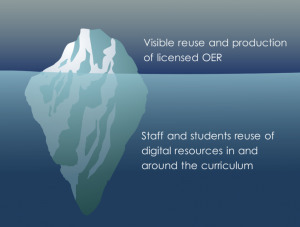
"The conversation around Open Educational Resources (OERs) , Copyright, Intellectual Property, fair use, and Creative Commons licensing is rumbling along. The outcomes seems to be reasonably inevitable to me, with those organisations that distribute, for example music, using a system that is rooted in an now outmoded business model are looking at rather a sticky end - evolve or die as the saying goes."
Scoop.it!

"With apologies to psychometricians who may read, let me set some vernacular context for additional thoughts (prompted originally by Dan Hickey‘s, and then Alex Halavais’, writing) regarding my own thinking on badges and assessment.
It is beyond argument that we cannot crack open a learner’s head, insert a magnifying glass, and make direct, error-free observations of what the learner “knows.” Since we can’t actually take a “direct” measure of what someone knows, we collect evidence that allows us to increase or decrease our beliefs about the likelihood that they know, or are able to do, something."
Scoop.it!

#OCL4Ed (2012.06) Another free professional development opportunity from the OER Foundation
Open content licensing for educators is a free online workshop designed for educators who want to learn more about open education resources, copyright, and creative commons licenses. This workshop will:Reflect on the practice of sharing knowledge in education and the permissions educators consider fair and reasonable;Define what constitutes an open education resource (OER);Explain how international copyright functions in a digital world;Introduce the Creative Commons suite of licenses and explain how they support open education approaches;Connect with educators around the world to share thoughts and experiences in relation to copyright, OER and Creative Commons.
Scoop.it!

Tools to Help 21st Century Students Achieve Their Postsecondary Education Goals
Open courseware and other open educational resources are beginning to draw the attention of higher education policymakers and other leaders. Why? Simply put, these web-based educational tools hold the promise of both reducing the cost of higher education and helping learners to complete their degrees by providing access to top quality course materials and instruction.
Scoop.it!
From
www
Open Educational Resources (OER) are a relatively new phenomenon which is fast gaining academic credibility as well as the attention of policy makers on a global scale. With increased funding by governmental and non-governmental organisations paired with generous philanthropy, the volume of rich OER available freely to the masses has grown exponentially. As with any new academic movement, the initial challenge for the OER movement was to spread this new philosophy into mainstream academia whereby the use of OER in teaching and learning becomes accepted practice. With strong advocacy by Open Distance Learning (ODL) institutions buttressed by organisations such as the Commonwealth of Learning (COL) and UNESCO, OER is currently achieving this objective and is rapidly gaining acceptance as a credible source of knowledge in many an academic community.
|
Scoop.it!

We've been following the MOOC (Massive Open Online Course) movement for a couple years now because we and our clients are all engaged in online learning at some level, be it totally online, flipped or hybrid, or just lecture capture for on-demand replay.
Scoop.it!

A typical (traditional) university education offers all the following processes within the context of a single institution and course:
- Course design – whereby a group of experts and pedagogues design a curriculum, course structure and materials - Teaching / Learning – whereby the materials created by the course designers are used to create a learning experience (often with the help of tutors / teachers) - Assessment & Certification – whereby the knowledge acquired in the learning experience is tested, and thus the learning experience is validated. Certification serves as evidence of completion of the validated learning experience - Accumulation & Recognition – Whereby a student acquires validated learning experiences, and uses them as a passport to obtain more advanced learning experience.
In an unbundled system, these processes are performed individually by separate teams, often in different institutions. This leads us to a situation where we might imagine a number of different provision scenarios. While any combination of the above can conceivably be mixed, the OERTest project studied the feasibility of a number of scenarios, and found the following six to be the most likely to be able to be implemented in the current educational landscape.
KF: This document starts to generate framework for thinking about differnet modes of open access education. Already MOOC and simialr models are under the spotlight being challenged about efficacy and user experience.
Scoop.it!

What is it like to teach a free online course to tens of thousands of students? Dozens of professors are doing just that, experimenting with a format known as Massive Open Online Courses. Via Rebecca Scriven, Peter Mellow
Scoop.it!

Can Free Online Courses Transform the Higher Education Industry? by Knowledge@Wharton, the online business journal of the Wharton School. Via Mark Smithers
Scoop.it!

Creative Commons licenses provide a flexible range of protections and freedoms for authors, artists, and educators. The 2012 World Open Educational Resources (OER) Congress is kicking off tomorrow in Paris, France.
Via Mark Smithers
Scoop.it!

A poet with a hankering to learn code recently teamed up with a Web developer who was curious about poetry as part of a new kind of teaching experience. The lessons took place at Peer 2 Peer University, a three-year-old online institution where students learn together, at no charge, using materials found on the Web. The poet, Vanessa Gennarelli, and the programmer, John Britton, taught each other online, discovering unexpected bridges between their disciplines. Via Mark Smithers
Scoop.it!

What do I like about Scoop.it? First of all, it’s easy to set up a topic and start collecting articles. You simply enter search keywords and Scoop.it searches Twitter, YouTube, Digg, Google Blogs and Google News feeds for matches. You can add any RSS feed, search a Twitter user, list or search stream. You can add a Facebook page or import an OPML file.
Scoop.it!

Recommended by Vasi Doncheva (@playnice_nz), this video offers and explanation of Open Educational Resources (OER).
Scoop.it!

During the past two days, our list of Free Online Movies has been getting some good exposure. And we\'ve got no complaints.
Read more: http://www.openculture.com/2012/06/a_master_list_of_500_free_courses_from_great_universities.html
Via Gust MEES
Scoop.it!
We want to build an open source software platform to share with local Trade School chapters around the world.
An incredible shift in the notion of crowdsourced, open education... combine this with a quality badge and RPL system and you might just see the future of learning
Scoop.it!

The History of the World since 1300, Computer Architecture, and and Statistics One are just some of the Princeton University courses you can take without ever applying to Princeton, paying tuition or even stepping on to the campus, thanks to a new partnership between the school and a new online education organization founded by two Stanford University professors.
|






