I must say I found this really interesting. I had a very 'surface' idea of what OER was all about. Of course I found out more on the wiki link that Brownwyn referred to and on Wikipedia. The main ideas that stood out for me is sharing, collaboration and accessibility. I enjoyed reading Fiona's post and her comments about 'midwifery junction', it also showed me the delicate balance of having an 'open methodology' but having to restrict it to midwives in order to manage risk (unwanted media attention). In defining OER - it definitely is a philosophy that I can see would be challenging for some and I can't help but compare this with my work I do at University (whereby no academic files are networked and only you have accesss to your own files via your own computer) compared to here at OP where there seems to be more opportunities to collaborate.
Saylor.org is a free and open collection of college level courses. There are no registrations or fees required to take our courses, and you will earn a certificate upon completion of each course. Because we are not accredited, you will not earn a college degree or diploma; however, our team of experienced college professors has designed each course so you will be able to achieve the same learning objectives as students enrolled in traditional colleges.
Open to individual educators from across the UK HE, FE, and community and skills sectors, the MOOC will aim: to increase the uptake of OERs through embedding the use of curriculum design tools, practices and approaches in individual practice and design team culture; to empower practitioners to become change agents in their local contexts; and to produce a collection of CC-licensed OER resources for wider use after the MOOC ends. Weekly activities will feature a range of presenters with a focus on foregrounding successful JISC and HEA funded UK projects and giving UK practitioners access to (and opportunity to learn from) some of the best of European initiatives.
It’s important to understand existing cultures before introducing new cultures. It’s easy for educational developers or OER specialists to lose touch or truly understand the needs and practices of its stakeholders. The role of open technologies in encouraging sharing and reuse of open content can only become a reality if the open technologies are being developed with and for the stakeholders involved. There cannot be one OER fix for all.
By Frank Catalano Schools are moving from creamy to chunky -- but not in relation to cafeteria peanut butter.
Instruction that was structured linearly, captured in books that were all-inclusive monoliths with a predetermined progression for a uniform, somewhat “creamy” consistency, is shifting to newer forms of instructional content that are more “chunky,” beginning as a scattered landscape of digital pieces that are then assembled to support full courses
California is moving closer to the realm of open education resources (OER) with passage of two bills in its state senate that would fund development of digital textbooks and courseware for free or low-cost use in higher education.
A unit overview for Curtis Bonk's Fall 2012 class at Indiana University. The site contains a complete 15 week overview of the program and details most of the resources and strategies employed.
A timely example of both the technologies an academic can use in their teaching and learning program, and a model for how to go about it.
BadgeStack is an innovative system with a game-like approach that assesses skills, recognizes learner achievement, sparks community, and excites learners of all ages.
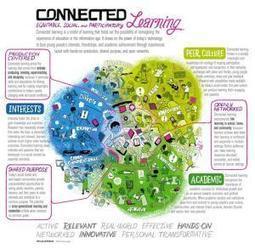
Connected Learning, a new research-driven initiative, was introduced at the Digital Media and Learning Conference 2012. We see a growing gap between the learning mediums with which young people eng...
"The big trend these days is online learning, online collaboration, and, well, online everything. In fact, self-learning has become an incredibly powerful force thanks to online technology. Udemy has just publsihed a fabulous infographic that considers self-learning the new master’s degree."
Education revolution, these are buzz words that prompted me to think about what it means, and the implications on Higher Education, K-12, and even corporate education and training. The recent bloss...
I'm happy to hear that the South African Institute of Distance Education (SAIDE) will be extensively involved in the UNESCO World OER Congress, showcasing best practices in OER policies, initiatives and experts. They have done some excellent work in OER creation, reuse and policy/ strategy
There is a link to the Master Congress Programme for the UNESCO event from this blog post. It looks like a five-star lineup of speakers in the OER world - not to be missed - it will be livestreamed from09:00 (Paris time) on Wednesday 20 June and continue through to Friday 22 June.
We grabbed five minutes with Steven Schwartz, VC at Macquarie University, to talk about the online course revolution and how the UK and Australia compare on social mobility...
The World Digital Library will make available on the Internet, free of charge and in multilingual format, significant primary materials from cultures around the world, including manuscripts, maps, rare books, musical scores, recordings, films,...
This group is open to anyone who wants to join the rich conversation sparked by the Badges for Lifelong Learning Competition. Browse through the links we've posted here, or check out Badges for Lifelong Learning Scoop.it and #dmlbadges or #openbadges on Twitter.
"Badges can help speed the shift from credentials that simply measure seat time, to ones that more accurately measure competency. We must accelerate that transition. And, badges can help account for formal and informal learning in a variety of settings."
Over the last 6 months, the potential of ‘badges’ to incent and recognize learning online has been a hot topic for many of us at Mozilla. We’re in the early stages of creating the...
There is wide agreement that we need new models of education, and not simply new models of schooling, but entirely new visions of learning better suited to the increasing complexity, connectivity, and velocity of our new knowledge society. We now have the capability to reimagine where, when, and how learning takes place.
Try Audible Now and Get A FREE Audio Book! [ad#adtop]
Free textbooks (aka open textbooks) written by knowledgable scholars are a relatively new phenomenon. Below, find a meta list of 150 Free Textbooks, and check back often for new additions. Also see our online collection of Free Courses.
To get content containing either thought or leadership enter:
To get content containing both thought and leadership enter:
To get content containing the expression thought leadership enter:
You can enter several keywords and you can refine them whenever you want. Our suggestion engine uses more signals but entering a few keywords here will rapidly give you great content to curate.


 Your new post is loading...


 Scoop.it!