


We are lucky enough to be in an age where people are taking technology into their own hands.
Via Dr. Susan Bainbridge

 Your new post is loading...
 Scoop.it! We are lucky enough to be in an age where people are taking technology into their own hands. Via Dr. Susan Bainbridge 
No comment yet.
Sign up to comment
Scoop.it!
In the spirit of my earlier post, "Scholar or Public Intellectual?," I'd like to explore the concept of what it might mean to be an "open scholar." The traditional scholar, like the scholarship he or she produces, isn't open--open-minded, hopefully, but not "open" in a public way.
Scoop.it!

The battle for the future of higher ed has landed—at least for the time being—on a concept few in academe had even heard of a year ago: the Massive Open Online Course, or MOOC. The idea of offering free courses online to tens of thousands of students has suddenly become the latest, greatest way to “fix” higher ed, promoted by education-technology entrepreneurs and bemoaned by traditional academics
Scoop.it!
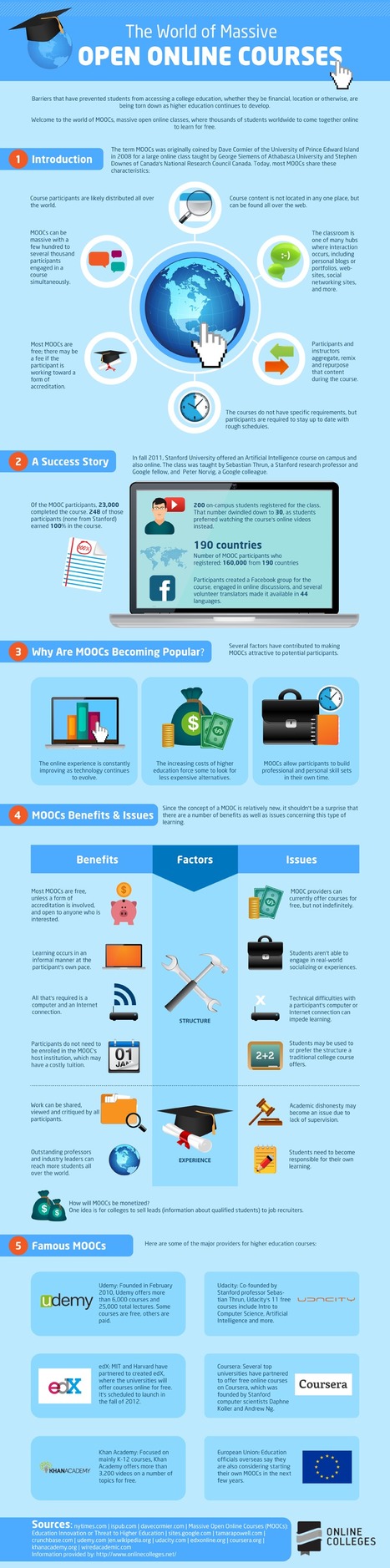
Here’s an Infographic that walks you through the dramatic changes happening in the world of online learning – the rise of the massive open online course, aka the “MOOC.” From edX at MIT and Harvard to Coursera from Stanford, top schools and shrewd entrepreneurs are getting into the business of teaching the world for free via digital technology. Take a look at how these online courses are causing a wave of disruption in education.
Scoop.it!

"Although the Open Educational Resources (OERs) movement has been developed almost a decade ago, Australian higher education sector seems to be still resisting this movement. This project intends to develop a “Feasibility Protocol” to enable and facilitate the adoption, use and management of OERs for learning and teaching within higher education (HE) institutions in Australia. This project will also explore how OERs will enhance teaching and learning, enable and widen participation for key social inclusion targets in higher education, promote lifelong learning and bridge the gap between non-formal, informal and formal learning in Australia. This is very important for the development of Australia education national and internationally because it will support educational institutions that are currently limited by the lack of guidance regarding OERs, speed up the process of appropriate adoption of OERs, and provide additional venues for universities to pursue innovative strategies to better support current students, attract new ones and be internationally recognised and competitive."
Scoop.it!
One of the most interesting and maddening issues to emerge from the debacle at the University of Virginia over the past month has been the obsession that people far removed from the actual work of teaching college and university students have for MOOCs.
Scoop.it!

This blog is about the current learning revolution and the education paradigm shift taking place globally. It is also about the role that teacherpreneurs need to play to benefit both altruistically and financially as they fully exploit the tools of the internet to meet the growing needs of the learner hungry people of the planet.
Scoop.it!

openlectures is open and we lecture. We are a group of students and former students sharing what knowledge we have. And we're doing this for free - because we enjoy it. Here at openlectures we've made everything free because we believe that effort, not money should decide success. We're dedicated to sharing the knowledge which got us through school with anyone who wants to learn.
KF: an open education initative based in Singapore. Small scale offerings at the moment but looks set to grow.
Scoop.it!

The project will design, deliver and evaluate an 8-10 week Open Learning Design Studio MOOC (Massive Open Online Course) focusing on the theme of curriculum design with OERs, to be held in Autumn 2012. Via suifaijohnmak
Scoop.it!
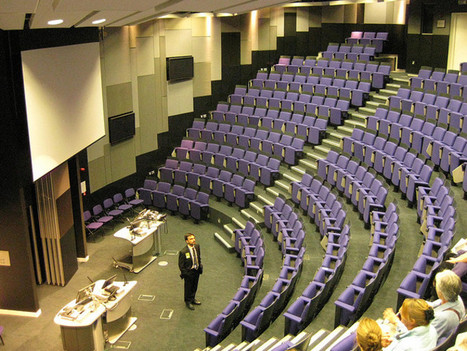
Universities are traditionally seen as exclusive institutions for the few, not the many. But that is changing as a new wave of online courses throws open the doors of academia to all. Led by world renowned American institutions like MIT and Harvard, this push to democratise learning is being taken up in Australia too. Via Mark Smithers
Scoop.it!

Offering free online classes, Academic Earth provides online learning success. Their courses online feature university lectures making education online simple.
Scoop.it!

From
cnx

A self-paced tutorial about open educational resources as alternatives to textbooks for college teachers.
Scoop.it!

Launch of OER case studies at HEA Annual Conference Date: 03-07-2012 Case studies that highlight the benefit of Open Educational Resources (OER) have been launched at the HEA's annual conference. Thirteen studies - a sample of projects from the three-year OER programme - have been distributed via memory sticks in delegate's conference packs.
The HEA is delighted to announce that the first series of case studies on Open Educational Resources are now available to download.
These studies are free to use, re-use and share as OER.
|
Scoop.it!

A joint briefing paper by The Higher Education Academy and JISC highlighting the benefits to UK universities and colleges of creating, sharing and using open educational resources (OER). Via Jenny Pesina
Scoop.it!

I suspect that I’m not the only one who has been ‘disengaged’ from the online world of online learning for the past few weeks, in my case for minor medical reasons, and in your case I hope enjoying sun, sand and socializing. So in this post I’m going to pull together a number of recent publications in the blogosphere which taken together, suggest that there are deep rumblings in North America’s public post-secondary education systems, if not outright panic in the streets. Or it may just be summer madness and too much heat. I’ll leave you to judge.
Scoop.it!

Scholarly publishing is totally broken. Not only, at present, can most of the people (taxpayers) who fund research not get access to it, but plans to fix this look set to screw over Early Career Researchers and anybody else who can’t persuade their funders to give them the up-front fees required by publishers for Open Access journals.
This guide is for academics who want to establish their own journals that are: - Peer reviewed, in a traditional pre-review model - Open Access and free in monetary terms for authors and readers - Preserved, safe and archived in the event of catastrophe or fold - Reputable: run by consensus of leaders in a field
Part 2: https://www.martineve.com/2012/07/11/starting-an-open-access-journal-a-step-by-step-guide-part-2/ Part 3: https://www.martineve.com/2012/07/12/starting-an-open-access-journal-a-step-by-step-guide-part-3/ Part: 4 https://www.martineve.com/2012/07/13/starting-an-open-access-journal-a-step-by-step-guide-part-4/
Scoop.it!

Last week another photographer posted a question on Facebook asking if it was okay to pin your own work on Pinterest. I was surprised to see that many of the photographers who commented back admonished those who pin their own work and even cited...
PM - How 'Open' are social media sites?
Scoop.it!

Katie Ash and Ian Quillen are staff writers for Education Week Digital Directions.
"By now, you've probably heard of Sal Khan, the educator who began by creating videos to explain math to his cousins, which has grown into a library of over 3,000 assorted educational clips with more than 150 million views on YouTube. The resulting Khan Academy, a nonprofit organization that aims to provide students with free access to all those resources, has received grant funding from educational philanthropy giants like the Bill & Melinda Gates Foundation."
KF: I think its important to read this with an awareness of how and why its occurred and against the backdrop of all the Khan Academy popularity. There’s areal risk that the very substantial baby will be thrown out with the relatively shallow bathwater. Many other factors come into play around the affective and conative dimensions of learning. The critique is largely on the basis of teaching - learning is domain of the learner. In a collection of resources like Sal Khan's there are bound to be the odd error - non-example is a key part of concept attainment. Video's can easily be re-recorded to remedy faults, but there is a growing body of evidence that resources like Khan Academy have had significant impact on improving student engagement. Learning isn't about "getting it right" - tha's the role of assessment.
Scoop.it!

KF: An interesting reflection on one learner's experiences across a range of open learning courses. The article highlights the motivations, the learning models, the support and the challenges that she experienced as a student in MOOC and open access education.
Scoop.it!

Practical Tips for Productive Living...
"All education is self-education. Period. It doesn’t matter if you’re sitting in a college classroom or a coffee shop. We don’t learn anything we don’t want to learn. Those people who take the time and initiative to pursue knowledge on their own are the only ones who earn a real education in this world. Take a look at any widely acclaimed scholar, entrepreneur or historical figure you can think of. Formal education or not, you’ll find that he or she is a product of continuous self-education. If you’re interested in learning something new, this article is for you. Broken down by subject and/or category, here are several top-notch self-education resources I have bookmarked online over the past few years."
Scoop.it!
Online Teaching Conference Presentation on how Open Education has changed from Open Access to Open Credentialing.
Scoop.it!

UoPeople is the first tuition free online university dedicated to the global advancement and democratization of higher education.
Scoop.it!

Khan Academy took down the video that Dave and John critiqued and replaced it with two new ones. So this has turned into kind of a big deal.
Scoop.it!

The International Review of Research in Open and Distance Learning (www.irrodl.org) is a refereed e-journal that aims to advance research, theory and best practice in open and distance education research.
Scoop.it!

From
vimeo
Concepts based on the availability of Open Education Resources...
In this video (13 mins), Emeritus Professor James (Jim) Taylor, University of Southern Queensland (USQ), gives a clear and understandable explanation of how USQ has designed an entire course based on OERs, and how they are planning to take this further in the near future. The course is called "Regional Relations in Asia and the Pacific", and has been put forward as one of the "prototype" courses for the OER university (OERu) pilot.
In the video Jim shows us the impressive list of open textbooks and journals that form the core readings for the course. He then takes us to see the "e-tivities" that have been created to get students to engage with the content. The e-tivities are based on the template from Beond Distance Research Alliance's Carpe Diem programme (http://www.le.ac.uk/carpediem).
In addition to the e-tivities, students are invited to add URLs and commentaries to a Regional Relations database which has been created for the course, and in this way the students themselves will, over time, build up a great resource bank for other students. Students are also given access to USQ's Moodle site and invited to use the Moodle wiki to personalise the resources for their own records.
This is an exceptionally appealing model for integrating OERs into the curriculum. Via Gabi Witthaus
|






