


Historically, the teaching work of a college or university has involved the combination of three fundamental elements: faculty, curriculum, and credentials. For centuries, universities have thrived in large measure because of their ability to join these distinct elements into a compelling, place-bound educational experience where students sit with faculty to study a curriculum and earn a degree. Together, these elements have comprised a value chain -- a set of interlocking services that have been transacted in such a way as to provide more value in combination than they might have independently. Recent and potentially disruptive innovations within higher education, however, suggest that new forms of value are emerging that could undo the traditional higher education value chain. Organisations like 'University of the People', 'Across World', and 'University Now' among others, are already reimagining what the higher education value chain might look like and are employing radically different business models to accomplish their work.

Open Educational Resources
6.4K views |
+0 today
sharing, collaboration and repurposing content are the hallmarks of modern education
Curated by
Learning Futures
 Your new post is loading...
 Scoop.it! 
- The Guardian, International Hub By being adaptable and accessible, OERs, have the potential to solve the global education crisis and contribute to sustainable economic growth - if governments are prepared to act... Via pdjmoo 
Scoop.it!

Khan Academy boasts almost 3,300 videos that have been viewed over 160 million times. That’s a heroic achievement.
Scoop.it!
Gooru is a free search engine for learning developed by a 501(c)(3) non-profit organization whose mission is to honor the human right to education. http://www.goorulearning.org
Gooru is a search engine for learning that allows you to explore and study over 2,600 standards-aligned and personalized study guides. Study guides cover 5th-12th grade math and science topics, and resources include digital textbooks, animations, instructor videos and more. All resources are vetted and organized by teachers or Gooru's content experts, so you don't have to sort through the mess of subpar educational resources available online yourself.
Gooru also makes it easy for you to connect with your worldwide peers to make learning a social experience. Post questions to an active community of students, teachers and experts, or find friends and peers to study with.
Best of all, Gooru adapts to you. Based on the topics you study and your performance on self-assessments, Gooru suggests resources and study guides that will help you master the concepts. You can track your study habits and monitor your performance on any of the topics you study.
Scoop.it!

Abstract The deployment of institutional repository services has focussed on the development of services for managing content within the organisation or by a trusted agency. At the same time we have seen developments to support management of the use of metadata to maximize access to content hosted in repositories. Related technical approaches, such as 'cool URIs' can also make content more discoverable by search engines such as Google. In parallel we are witnessing the increasing take-up of a range of third-party services such as LinkedIn and Academia which are being used by researchers to publish information related to their professional activities, including details of their research publications. The paper provides evidence which suggests that personal use of such services can increase the number of downloads by increasing SEO (Search Engine Optimisation) rankings through inbound links from highly ranked web sites. A survey of use of such services across Russell Group universities shows the popularity of a number of social media services. In the light of existing usage of these services this paper proposes that institutional encouragement of their use by researchers may generate increased accesses to institutional research publications at little cost to the institution. This paper concludes by describing further work which is planned in order to investigate the SEO characteristics of institutional repositories.
Scoop.it!

The formal launch has just taken place at the European Congress of Mathematicians in Krakow of the Forum of Mathematics, which to a first approximation is a new open-access electronic journal. However, the singular “journal” is misleading, because in some ways it is more like a whole set of journals. But there will be considerable interdependence between the elements of the set, so “journals” is misleading too. We need an intermediate number between singular and plural. Also, although the journal(s) is/are primarily electronic, there will be a print-on-demand option if anyone wants it.
Scoop.it!

Major universities are joining Stanford, Princeton and others to expand Coursera, a venture that offers free massive open online courses, or MOCCs.
Scoop.it!

Online education platform Coursera wants to drag elite education into the 21st century. And yesterday, the academy jumped on board.
Scoop.it!

By Jessica Owen
Scoop.it!

The best educational videos on Youtube...
Offering educational material on Youtube or Apple’s iTunes U, is the latest trend in the so called Open Courseware (OCW) movement, pioneered by the Massachusetts Institute of Technology (MIT) which offer online access to educational materials for 1,800+ classes — virtually its entire curriculum — free and open to all. Today, more than 150 universities from the whole world participate in the OCW movement, offering more than 5,000 courses for free.
Scoop.it!
Technology is paving a new way for more students to connect with some of the best teachers on the planet. From Stanford to MIT to Harvard and beyond, there are massive open online courses sprouting up everywhere. It’s never been easier to take a course (or even get a whole darn degree) online.
PM-Great inforgraphic!
Scoop.it!

The acronym MOOC is frequently used but has grown to include models that differ significantly from the original versions launched by people like George Siemens and Stephen Downes several years ago.
Via Dr. Susan Bainbridge
|
Scoop.it!
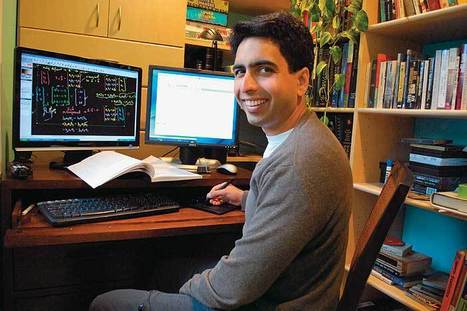
Salman Khan (credit: Khan Academy)
Traditional American universities are suddenly running scared of YouTube, Xconomy reports, along with Vimeo, 5min, iTunes U, TED and the Internet Archive. Without YouTube, Sal Khan and Khan Academy could never have reached his 4 million unique viewers a month with their 3,200 videos, viewed 170 million times. Via Jason Dargent, Kim Flintoff
Scoop.it!

ONLINE open courseware and the connected rising interest in e-portfolios for student assessment will be as much of challenge for standards as it is now for the educators looking to adapt their curricula.
ONLINE open courseware and the connected rising interest in e-portfolios for student assessment will be as much of challenge for standards as it is now for the educators looking to adapt their curricula. Griffith University vice-chancellor Ian O'Connor said changes sweeping university teaching would create new challenges for those attempting to monitor academic standards.
But it will inevitably lead to a greater focus on the assessment of student outcomes and graduate capabilities.
The growth of massive open online courses, backed by the likes of Stanford, Harvard and MIT, are impossible to ignore and universities are increasingly taking advantage of such content. Deakin University has said it will embed some of these MOOCs into its own curriculum. Others, such as University of Technology, Sydney, are looking to follow suit. At the same time, online technology is making it easier for universities to develop and share high-quality content.
Scoop.it!

By Simon Owens
"In the quiet, restrained world of research libraries, any controversies that arise are, for the most part, cordial and largely academic. So some within the industry may have been understandably surprised by the widespread attention paid when, in April, Harvard's Faculty Advisory Council sent a letter to the faculty concerning what it alleged was a crisis with its scholarly journal subscriptions....
"Though the letter's short-term impact was to inform the non-academic world of the growing tension between research libraries and journal publishers, many in the industry say its long-term effect lies in its list of recommendations for how to ameliorate the situation. Harvard implores its top researchers to "consider submitting articles to open-access journals" and to "consider resigning" from the editorial boards of journals that don't provide open-access offerings. Because an open-access journal allows anyone to easily and without cost read any of its published material, a large-scale migration to the platform would ease many of the financial burdens posed by subscription journals."
While this may seem unimportant to those on the front lines of teaching and learning, it has the potential to be quite momentous in terms of further eroding the position of the hard copy book/journal as the arbiter and foremost vessel of knowledge. -JL
Via Scott McLoed on Twitter Via Jim Lerman
Scoop.it!

From
www

What would you do if you thought you had a solution that would make a high-quality education freely available to anyone with a computer or cell phone, help instructors build new teaching skills and get credit for their accomplishments, and also greatly reduce costs for schools, families and students? You’d want to tell the world! That is just what the nearly one hundred videographers who entered the “Why Open Education Matters” video competition, co-sponsored by the U.S. Department of Education, spent part of this summer doing.
Scoop.it!
"The articles in this special issue provide an up-to-date overview of OER research and associated policy perspectives and initiatives. They describe some of the rhetoric behind the OER movement and the challenges associated with trying to realize the vision. Through a number of projects, they describe some of the ways in which researchers are attempting to bridge the gap between the rhetoric and the reality. The focus on the relationship between OER and social inclusion/exclusion is particularly valuable, given the underpinning philosophy associated with the OER movement in terms of widening participation and the assumption that education is a right that should be freely accessible for all."
KF: This special issue focusses on issues around OER and Social Inclusion. Editorial by Gráinne Conole. A global perspective.
Scoop.it!

The workshop introduces scenarios for the accreditation of learning acquired through Open Education Resources (OERs), each with different degrees of ‘unbundling’ course design, provision and assessment between different institutions and building on concepts such as “Erasmus”, “Summer School” and “Open Market”. The scenarios were developed with the aim of supporting the mainstreaming of OER addressing and overcoming perceived barriers to their large scale take-up.
Scoop.it!

A DAY after joining a prestigious national venture to offer free online courses, the University of Washington announced it would also offer credit for some of the courses - for a fee.
Scoop.it!

Coursera set to shake up higher education model after adding 12 US and European institutions including Edinburgh University...
Scoop.it!

In the same way that free open online courseware is threatening to disrupt traditional universities, open textbook initiatives such as OpenStax College from Rice University threaten to do the same to the…...
Scoop.it!

On Tuesday, Virginia is joining a group of 12 institutions that plan to open their courses to the world, free of charge, through an online platform created by the start-up company Coursera.
Scoop.it!
In the last decade in particular, the promotion, sharing and use of open educational resources (OER) have been growing exponentially. However, as with any new phenomenon or paradigm, our knowledge of OER’s ramifications and achievements to date necessarily lags behind actual developments. The concept of OER has multifaceted dimensions and implications. For educational institutions, the dimensions are legal, managerial, financial, technical, technological and pedagogical; for practising educators, at stake are ways of teaching that are normative, together with a sense of identity that is both personal and professional. It would be astonishing if research, which by its very nature must be clearly focussed, were able to keep abreast of all such aspects of OER.
Scoop.it!

Some interesting discussions below the article.
|






