


Pearson will be showcasing three solutions this week at Educause 2012 designed to foster personalized education and access to Open Educational Resources (OER).

 Your new post is loading...
 Scoop.it! Pearson will be showcasing three solutions this week at Educause 2012 designed to foster personalized education and access to Open Educational Resources (OER). 
No comment yet.
Sign up to comment
Scoop.it!

Change is constant, so obviously, our current conditions will not remain exactly the same. Rather, there are likely three possible futures related to these new affordances (this is a simplified argument but for real substance, check out Downes’ “Ten Futures“)
Scoop.it!

Discover a learning environment that goes beyond the LMS. Open to everyone. Easy to use. Completely free. Amazing.
OpenClass is a dynamic, scalable, fully cloud-based learning environment that stimulates social learning and enables the distribution of content at massive scale to students wherever they are. And did we mention it's completely FREE?
With OpenClass there are no hardware costs, licensing costs, or hosting costs. Why would we do that? Because "free" enables the widespread adoption of the most effective approaches to learning that encourage interaction within the classroom and around the world.
Scoop.it!

Make sure campus technology is accessible to everyone who needs it before you adopt it. That’s one of the takeaways from a video set to premiere today at the annual Educause higher-education technology conference.
Scoop.it!

Online classes are nothing new, but the University of Western Australia wants to take the technology one step further with the help of Stanford's recently launched Class2Go platform. Using an...
Scoop.it!

The open online course movement has taken off in a big way this year, but until now it has been limited mainly to elite universities that have struck partnerships with open-course platforms such as Coursera or edX.
That could change, however, with the launch of a new open online course network from Instructure, maker of the open-source, cloud-based learning management system (LMS) Canvas.
Even community colleges can offer free online courses (and raise their national profile) through the Canvas Network
Scoop.it!
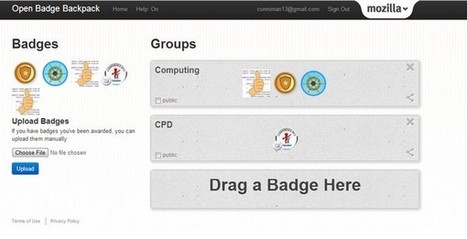
I have been interested in the concept of Open Badges for the past few months but it’s only in the past few days that I have been able to connect all aspects and actually issue a digital badge. In short, Open Badges is an open source project designed to make the accreditation of learning and achievement become a global standard. It is designed to support a broad range of different badge issuers, and allow any user to earn badges across different issuers, web sites and experiences, then combine them into a single collection tied to their identity. Note that as Open Badges is an open source project, I have refrained from referring to it as Mozilla Open Badges.
Scoop.it!

Nice animation, thanks to Stephen Harlow for finding this resource.
Scoop.it!

If there's one thing we've seen plenty of here at Techdirt, it's the damage a single DMCA takedown notice can do. From shuttering a legitimate ebook lending site to removing negative reviews to destroying a user's Flickr account to knocking a copyright attorney's site offline, the DMCA notice continues to be the go-to weapon for copyright defenders. Collateral damage is simply shrugged at and the notices continue to fly at an ever-increasing pace.
Scoop.it!

"This webinar will review the origins and status of several OER initiatives, with a focus on resources distributed via HippoCampus, a project of the Monterey Institute for Technology and Education. The goal of the project is to provide high-quality, multimedia content on general education subjects to high school and college students free of charge. Several case studies will be presented about the uses and impacts of OER in online and blended classrooms. Participants will also learn about the state of the field, specific pedagogical models, and technical contexts for better leveraging the qualities of OER and evaluating their potential impacts."
Scoop.it!

The official source for information about Google Scholar...
Scoop.it!

The open source platform to write and publish print and digital books.
Build a community around your content with social tools and use the reach of mobile, tablet and ebook technology to engage new audiences. Via Ana Cristina Pratas, Gust MEES, Zaq Mosher, Ken Morrison
Scoop.it!

While open access is certainly a noble and worthwhile endeavour, there are problems with the proposed system that few people are aware of and that could actually backfire for the scientific community.
|
Scoop.it!

Creative Commons licenses provide a flexible range of protections and freedoms for authors, artists, and educators.
Scoop.it!

Built on top of Drupal Open Source technology Adrenna Academic brings together the most powerful capabilities of today’s learning management systems at half the cost.
Scoop.it!
|

|
Scooped by
Peter Mellow
November 8, 2012 7:03 PM
|
Scoop.it!

On Wednesday, Mr. Shirky took that message to a group of higher-education-technology leaders who have been buffeted by a rapidly evolving ed-tech landscape. Mr. Shirky, in a keynote speech kicking off this year’s Educause conference, explored how technology was changing everything, from research to publishing to studying.

|
Scooped by
Kim Flintoff
November 7, 2012 8:23 PM
|
Scoop.it!
If you can’t beat them, join them.
That is Pearson’s latest approach to open educational resources (OER) — the free online learning materials that have proliferated over the last decade and a half, posing a threat to traditional publishers.
The education and media company today will unveil Project Blue Sky, a search engine to help instructors locate free materials from popular OER repositories.
|
|
Scooped by
Peter Mellow
November 1, 2012 8:03 PM
|
Scoop.it!
Here are four professional development hurdles that come up during OER rollouts on campus and a few good strategies for overcoming these issues.
|
|
Scooped by
Kim Flintoff
October 28, 2012 4:55 PM
|
Scoop.it!

This week, we celebrate open access week – an event aimed at bringing attention to this rapidly emerging form of scientific publication and its ethical imperatives.
Traditionally, knowledge breakthroughs and scientific discoveries are shared through publication in academic journals. Peer-reviewed and highly competitive, careers are made and broken on the number and impact of these publications.
With the complex, long-standing hierarchy of journal ranking, scientific publishing is big business. From a distance, one might assume that scientific publications aim to maximise the dissemination of ideas, break down barriers to science and make knowledge accessible to the masses – but this is not actually the case.
|
|
Rescooped by
Kim Flintoff
from MOOCs, SPOCs and next generation Open Access Learning
October 19, 2012 7:25 PM
|
Scoop.it!

I think that we can expect these institutions to make more mis-steps as they try to understand the new learning landscape and their roles. This includes new ideas, language, and platforms where degrees may not be the end goal for learners. The unfortunate reality is that most policy leaders are playing catchup, not leading.
|
|
Rescooped by
Kim Flintoff
from Digital scholarship
October 18, 2012 9:46 PM
|
Scoop.it!

On this Canadian Thanksgiving weekend, this issue of the Dramatic Growth of Open Access is dedicated to all of the many millions of people around the world who make open access happen - the scholars who take the time for the few keystrokes to deposit their work in an open access archive and/or publish in open access journals; the editors and peer reviewers of thousands of open access journals; the journals and publishers who make their works open access, whether immediately on publication or after a bit of a delay; and all of the librarians, repository managers, research funders and advocates around the world who constantly work for a future of open access to all of our scholarly knowledge - and apologies to anyone whose important work I may be omitting.
|
|
Rescooped by
Kim Flintoff
from Social Media for Higher Education
October 18, 2012 7:34 PM
|
Scoop.it!

Quality assurance approaches in higher education are well-established, but it is important to develop methods which are applicable to the domain of e-learning. The E-xcellence methodology (EADTU, 2009a) was therefore designed to assess the quality of e-learning in distance learning and blended learning contexts. The methodology is based around a set of benchmarks, supported by a practitioner handbook and a web-based ‘QuickScan’ self-evaluation tool. Experience shows that the E-xcellence methodology is particularly valuable for the process of improvement through collaborative internal review.

|
Rescooped by
Learning Futures
from Educational Technology in Higher Education
October 17, 2012 9:35 PM
|
Scoop.it!

If we agree that the only measure of quality of an open educational resource (OER) is "Degree to which the OER facilitates student learning" the David Wiley's table makes sense. Otherwise, we might want to reconsider. For example, an OER might facilitate learning - but of information that is known to be false (or worse: propaganda).
|
|
Scooped by
Peter Mellow
October 15, 2012 10:09 AM
|
Scoop.it!

NANTUCKET, Massachusetts -- As few as 10 years from now, quality higher education will be largely free—unless, of course, nothing much has changed. It all depends on whom you believe.





