Proposer un apprentissage individualisé aux élèves grâce au numérique, telle est la promesse de l’« adaptive learning », qui serait, selon ses adeptes, de nature à transformer radicalement l’éducation. Le point à l’occasion d’In-Fine, forum international du numérique pour l’éducation.
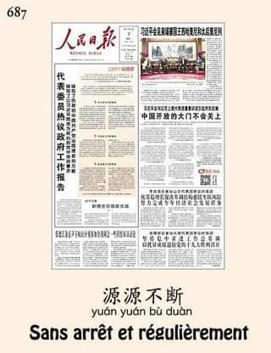
Ce chengyu signifie littéralement : un débit continuel , un flux sans fin . C'est à dire sans arrêt , sans pause, sans interruption . Il pourrait qualifier la parution de ce journal , l
Travail collaboratif, curation de contenu ou gestion personnelle de l’information, veille numérique collaborative, toutes ces pratiques qui résultent de l’usage actuel des outils numériques, ont été investies dans le cadre d’expériences d’apprentissage coactifs orientées par problème et menées avec des étudiants en information et communication. Nous tentons de comprendre en quoi le partage des ressources numériques entre les apprenants et enseignants et la contribution à l’enrichissement des enseignements par les étudiants, peuvent favoriser le renforcement des compétences numériques des apprenants, ainsi que le développement de leur esprit critique, en situation d’apprentissage par problème et plus largement d’apprentissage coactif en mode hybride. Nous interrogeons également l’intérêt du recours à des dispositifs numériques innovants issus du monde académique – voire portés par des enseignants-chercheurs en charge des enseignements eux-mêmes – par rapport à l’appui sur les dispositifs grand public tels que ceux proposés par les GAFA, aujourd’hui sous le feu de la critique pour l’opacité de leurs algorithmes autant que pour les effets pervers de leurs modèles économiques. Les dimensions sociales et ubiquitaires qui résultent de ces expériences d’apprentissage et qui allient numérique, espaces augmentés et repensés, nous font aussi envisager autrement l’enseignement. Ainsi, en tant qu’acteur de ces dispositifs, l’apprenant participe à co-construire des savoirs, à l’aide notamment, d’appareils mobiles et connectés.
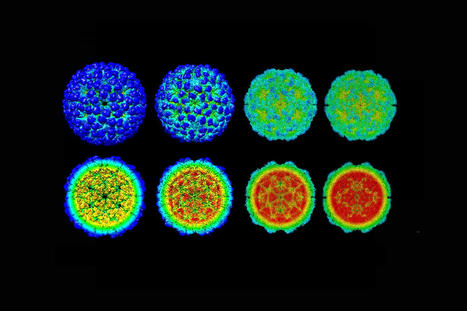
A critical process in the infection cycle of viruses has been revealed for the first time in dynamic detail using pioneering plant-based technology. Evidence about the process of virus maturation revealed in the research could help us develop new methods for treating viral infections. Maturation plays a critical role for all animal and bacterial viruses and is required to produce infectious virions or particles. Though the outlines of the process have been determined for many groups of viruses, detailed mechanistic studies have not been reported. To provide the first detailed mechanistic study of maturation, Roger Castells-Graells, a rotation Ph.D. student working in Professor. George Lomonossoff’s laboratory at the John Innes Centre infiltrated genetic material of the insect virus Nudaurelia capensis omega virus (N?V) into dwarf tobacco plants N.benthamiana. This transient expression technique uses Virus Like Particles (VLPs) which are mimics of the authentic virus. The capsid or protein coat of the virus is produced by plant cells and the research team then analyses the material purified from infiltrated leaves. The research demonstrated that maturation of procapsids – immature viral structures – can occur within plant cells to yield fully functional mature capsids. This has not been observed previously in the absence of a natural infection and is a new application for the transient expression system pioneered by Professor Lomonossoff at the John Innes Centre. Comparative cryo-EM analysis of the structures of the procapsids and mature capsids revealed the large structural rearrangements both inside and between the protein subunits of the capsid that accompany maturation. These shape changes enable the chemical reactions that are necessary for the virus to infect the host.
Professor Lomonossoff, a group leader at the John Innes Centre, said: “Most structural studies of virus particles to date have given a static picture of the particles. By isolating particles from plants that are undergoing the process of maturation, we have managed to obtain a picture of the dynamics of an essential part of a virus infection cycle.” The present study, a collaboration involving scientists at the University of Leeds, in Brazil and the USA, as well as at the John Innes Centre, reveals details of the structures at the beginning and the end of the maturation process. What is now required is an analysis of intermediate steps to get a complete understanding of the dynamics. This will enable the research team to determine the 3-D structures of intermediates in the maturation process to create a “movie.” “We have shown that maturation occurs over time within plant cells and that means we have discovered a valuable tool for studying virus maturation. We hope it will be of interest to potential collaborators and industry,” said Professor Lomonossoff. Plant-expressed virus-like particles reveal the intricate maturation process of a eukaryotic virus appears in Communications Biology
Research Published in Communications Biology (May 24, 2021):
This is the second in a series of updates to provide information on the launch of the 2021 Journal Citation Reports release. In a recent blog post we discussed refinements in this year’s forthcoming release of the Journal Citation Reports (JCR)™, describing the addition of new content and hinting at a new metric for measuring […]
*** Batul Alsaraji looks at the problems associated with an infodemic of Covid-19 related material and considers how scholarly communication in the health sciences can provide better information to the public. Batul is on Twitter @B_Alsaraji*** Introduction Recent developments in scholarly publishing in the health sciences have been partly a response to the shortcomings of the traditional model, and others a result of new possibilities owing to technological advancement. The COVID-19 pandemic has accelerated developments in scholarly communication, forced the speeding up of the dissemination process, increased multidisciplinary and global cooperation and brought about increased public interest and engagement. This essay identifies how some of the recent developments in scholarly publishing are changing how research in the health sciences is disseminated. First the essay looks briefly at the scholarly communication landscape, particularly within the field of the health sciences and identifies some of the main challenges, such as the rising cost of journal subscription, the consequences of lack of access to health science research, and the slow speed of publication. Then it argues that as a response to these issues there has been a move towards open and more transparent access to research, depositing research and preprints in institutional and subject repositories, and sharing research data, which has been accelerated by the COVID-19 pandemic. Finally, the essay looks at the implications of these developments for the library and information science services and scholarly publishers. Scholarly Communication The scholarly communication landscape is complex and influenced by the interconnected roles of the authors, the institutions they work at, the libraries that provide them with access to scholarly content, the publishing industry, funders, and policy makers (Reinsfelder, 2012). The aim of scholarly communication is the sharing of ideas in the form of high-quality enquiry, and the development of knowledge which is disseminated to the scholarly community and beyond (Carter, 2013). Beyond the advancement of knowledge, authors are motivated to have their output published in established academic journals for reasons of career advancement (McGrath, 2013). So long as this remains a deciding factor for the achievement of tenure and research funding, McGrath (2013, p. 117) argues that the journal will “endure as a key component of scholarly communication”. The author’s role also encompasses peer-reviewing the work of others to maintain quality control and academic rigour in the scholarly communication process (Jubb, 2013). The main mode of dissemination of STEM scholarly output such as in the field of the health sciences is the academic journal which has moved to an almost entirely digital format (Schonfeld, 2013). Digitisation and the internet have been the biggest catalyst for change in the way scholarly communication is disseminated which among other things, has enabled publishers to change their economic models, moving from providing access to content via the payment for print items to subscription models (Bawden and Robinson, 2012) that take up a large proportion of libraries’ budgets (Schonfeld, 2013), and opaque pricing practices (Anderson, 2018). Journal and database subscriptions in science and medical disciplines can be very costly which means that for those without access to a well-funded research or academic library this content is off limits (Anderson, 2018). In fact, even for wealthy and established institutions the continually rising cost of subscriptions and often stagnant library budgets are a matter of concern and ongoing debate (Schaffer, 2021; Anderson, 2018). As for the publishing process, the journal editors manage the peer-review process, select appropriate content for a target audience, and look out for emerging trends (McGrath, 2013). While the editors, authors, and reviewers are ordinarily not paid, publishers cite their value-added services to justify the cost, which include typesetting, indexing, distribution, IT and marketing (McGrath), as well as providing content in different formats to be accessible via various devices (Bennett, 2013). However, whether these services justify the high cost of journal subscriptions has been questioned (McGrath). Another criticism of the traditional scholarly communication model is the slow publication process (Wang et al., 2020), as there is a time lag between submission of an article and the publication of the final version to allow for editing and peer-review etc., which in the field of medicine averages at about 12 weeks (and can be much longer in other disciplines), and raises concerns that it might impede the dissemination of innovative ideas (Gasparyan et al., 2019). As a result, there has been a push from various institutions and individuals towards timely, transparent, and open access to scholarly output. The issue of accessibility has been of particular concern to research funders from a return-on investment point of view. Kiley (2013, pp. 131-132) argues that it makes little sense “for a funder to invest in research but then allow the outputs of that research – most typically the research articles published in peer-reviewed journals – to remain hidden behind publishers’ pay walls.” The Wellcome Trust for instance, a charitable foundation and funder, focused on health research based in London, was the world’s first funder to adopt an OA policy in 2005, which significantly affected the development of scholarly communication (Kiley, 2013; Wellcome.org, no date). The policy, as Kiley (2013, p. 133) explains, takes the approach that dissemination costs are research costs and provides additional funding therefor, and sets out that any research funded by the Wellcome Trust that is published in a peer-reviewed journal must be made available in PubMed Central (PMC) or UK PubMed Central (UKPMC) (open access digital repositories for medicine and life sciences) as soon as possible, and that content can be freely copied and reused, including for text and data mining. Another pertinent aspect of the policy is that is sets out to make funding decision based on the intrinsic merit of the work and not whether it is published in a prestigious journal (Kiley, 2013). Today, various OA models are available including most notably Gold OA (where content is instantly and openly available but requires the payment of Article Processing Charges, covered either by the funder or the author), Green OA (where authors publish articles in traditional journals and deposit a copy of it in institutional repositories), and the Hybrid model (where individual articles are available OA within a journal that is otherwise behind a paywall) (Anderson, 2028). Among the OA platforms that emerged in relation to health sciences are eLife, a selective, peer-reviewed open access and non-profit journal for the biomedical and life sciences (eLife, 2021), PLOS ONE, a peer-reviewed, open access journal for science and medicine (PLOS ONE, 2021), and the BMJ Open, a peer-reviewed open access medical journal (BMJ Open, 2021). One of the strongest arguments for open access to medical research output is that it is a matter of public health, and paywalls reduce the chances for researchers to have their output viewed more widely (Day et al., 2020). There is also the issue of paywalls exacerbating access inequalities between wealthier and low- to middle-income countries (Day et al., 2020). Initiatives such as HINARI – a programme initiated by the WHO and major publishers to provide low- and middle-income countries with access to an extensive range of collections of biomedical and health literature- which is part of the wider Research4Life programme are trying to address such inequalities in order to improve world health (HINARI, 2021). While there is an increasing number of OA material available, there remains the issue of slow publication cycle, as well as much content being embargoed for several months before being openly accessible (Day, et al. 2020), which is why depositing preprints in institutional and subject repositories has gained traction. Wang et al. (2020) explain that while depositing preprints was most dominant in the fields of physics and mathematics, it has been recently embraced by researchers in the life sciences to act as accelerators of scholarly publishing, such as bioRxiv (an open access preprint repository for the biological sciences). Wang et al. (2020, p. 2) argue that the main benefits of preprints “are recognized as early discovery, fast and wide dissemination, free access and early feedback”. Covid-19 However, despite the above-mentioned concerns and efforts, progress has been relatively slow and there remains much disagreement among stakeholders (Else, 2019). The Open Access Initiative has gained traction in recent years and is growing steadily now, but there remains unmet demand for open and rapid access, which is indicated by the enormous user base of the Sci-Hub website which gives pirated access to full text articles, as much high-quality research output remains behind paywalls (Piwowar et al., 2018). A study in 2018 found that just above half of biomedical research was OA, but there is great discrepancy within individual fields, as for instance, 84% of publications in tropical medicine were OA, while the proportion of pharmacy publications was only 7% (Piwowar, 2018; cited in Day et al., 2020). However, the Covid-19 pandemic has added a sense of urgency and perspective, and the acknowledgement that research into health sciences, particularly as related to diseases, is a global concern that requires an effective, transparent, and cooperative global response (Miller and Tsai, 2020). Miller and Tsai (2020) explain that the pandemic has highlighted inadequacies in traditional scholarly communication, such as its pace and the fragmentary global access to manuscripts and research data. In the field of medicine for instance, research output is ordinarily disseminated in the form of PDFs which complicates the aggregation of metadata (Miller and Tsai, 2020). Miller and Tsai (2020) further argue that the pandemic has reinforced the push for transparent and open science, as “an open exchange of ideas accelerates scientific progress towards solving humanity’s most persistent problems” (Center for Open Science, 2020, cited in Miller and Tsai, 2020). Many organisations have taken the Open COVID Pledge as a practical and moral imperative to “make our intellectual property available free of charge for use in ending the COVID-19 pandemic and minimizing the impact of the disease” (Open COVID Pledge, 2020; Miller and Tsai, 2020). This initiative was started by an international group of researchers, scientists, academics, and lawyers with the aim to accelerate the development of diagnostics, vaccines, and medical equipment among other things (Open COVID Pledge, 2020). However, it remains to be seen whether recent developments in scholarly communication as response to the pandemic will be maintained in the long term. Hayashi (2020) describes the pandemic as a tipping point for the move towards OA, and expects the initial deposition of preprints, data sharing and increased transparency to become commonplace. For instance, Rapid Reviews: COVID-19 is an open-access overlay journal that states its aim is to “accelerate peer-review of COVID-19-related research” and to counter “the dissemination of false or misleading scientific news”, which was launched in 2020 by MIT Press and University of California, Berkeley (RR:C19, 2021; Dhar and Brand, 2020). It is an effort to enable rapid and transparent peer-review of promising or controversial preprints and employs a curation network of graduate students and experts in their respective fields, as well as advanced technological tools including AI (RR:C19, 2021; Dhar and Brand, 2020). Another example of an initiative to improve scholarly communication as a direct response to the pandemic is the COVID-19 Data Index. As diverse and cross disciplinary data sets related to SARS-CoV-2 including clinical and epidemiological data have been generated on a daily basis, the COVID-19 Data Index, a metadata catalogue of Covid-19 data sets, has been developed to collect and index datasets from major data repositories and other sources in order to make them easily findable and reusable, and it is updated on a daily basis (covid19dataindex.org, no date); Ohno-Machado and Xu, 2020). On the understanding of the vital role that data curation plays in scientific research and in particular in viral outbreaks, Shankar et al. (2020, p. 280) explain that due to the pandemic, practices such as the “organisation of data for discovery and re-use, and open science and data sharing have taken on new urgency”. Shankar et al. (2020, p. 281) give as an example the Johns Hopkins University Coronavirus Resource Center, which is providing a holistic view of infection rates and statistics about the virus, such as where it is being contained and where it is spreading, by curating and publishing data from the Red Cross and other international agencies. There is also the COVID-19 Dashboard by the Center for Systems Science and Engineering at Johns Hopkins University, which is a freely accessible, interactive, web-based dashboard that tracks COVID-19 in real time (COVID-19 Dashboard, 2021). Shankar et al. (2020, p. 282) further argue that in relation to the heightened interest and demand in communicating science to the public, through media or government agencies for instance, “careful, consistent, and transparent data aggregation” and trustworthy sources are vital to maintaining pubic trust in science and health institutions. This point is particularly relevant, as it highlights the real-life implications of scholarly communication, and the life-saving effect of efficient, transparent, rapid, and open scientific communication. Nevertheless, there has also been criticism of this rapid approach of research dissemination, arguing that it can lead to the spread of misinformation, as content that has not yet been peer-reviewed or verified in any way can quickly make its way into the public sphere (Koerber, 2021). Koerber (2021) provides the recent incident, where a paper deposited in boiRxiv started circulating on social media and fuelled conspiracy theories, as a cautionary tale. The paper suggested that SARS-CoV-2 originated in the laboratory through genetic engineering; it was instantly and intensely criticised and then officially withdrawn by the authors, all of which happened within two weeks (Koerber, 2021). However, even after the paper was withdrawn the idea of an engineered virus continued circulating; thus, Koerber (2021) argues that as information can be disseminated instantly and more widely than ever before, more attention needs to be directed towards effective and reliable science communication. Implications for publishing and library and information services libraries have had an instrumental role in advocating for open access to knowledge for their patrons and the public (Anderson, 2018; Schaffer, 2021) and in setting up and managing repositories (Jubb, 2013). This is also true of health science librarians, as for instance, the Medical Library Association has long been an advocate of improved access to health information and have emphasised the importance of open access to federally funded scientific and medical research by asserting that “having access to timely, relevant, and accurate information is vital to the health of the nation and its education and research programs” (Schaffer, 2021, p. 1). The changing scholarly communication landscape, the push for depositing research in institutional or subject repositories, and the move towards OA have affected and expanded the role of librarians and what is expected of them. Ketchum (2017) explains that for librarians in the health sciences, the changing scholarly communication environment as a result of expectations from funders, publishers, institutions and the public brings with it opportunities to demonstrate their value, and puts an emphasis on data management and involvement in data repository projects. As a result, Ketchum (2017, p. 83) argues that expanding library services and increased training in research management are necessary in order to “meet the needs of the research community”. Similarly, Williamson and Minter (2019) add that librarians are increasingly expected to assist patrons with issues including funding compliance, OA, understanding copyright, working with data, finding trusted information, and disseminating research, among other things. The field of the health sciences also concerns itself with public access to content to meet the demand for consumer health information (Shaffer, 2021) which has increased considerably during the pandemic. Walker (2021) highlights the role health sciences librarians have played in the face of the pandemic, both to assist the research community as well as the general public and other members of the health community to deal with information overload and to combat the spread of unreliable and false information and confusion, or the “infodemic” as it was recently referred to by the World Health Organisation (WHO). On a similar note, Shankar et al. (2020, p. 283) add that an opportunity has presented itself for the library and information science sector to contribute to the immense data collection drive that has emerged during the pandemic, which could be a gradual process that involves data management training for library staff. Thus, Shaffer (2021) reasons that “medical librarians must apply the lessons learned from these experiences to all aspects of biomedical research to achieve our vision”. The connecting thread between these statements is the anticipation that recent developments in scholarly communication present an opportunity for the library and information science services to be valuable contributors, which would require an expansion of current services and increased staff training. Should the OA movement grow considerably, and many expect it to be a matter of when rather than if, then publishers will face having to reconsider their business model to better meet the demands of modern scholarly communication (Kiley, 2013). Editorial tasks and peer-review remain vital aspects of the scholarly communication cycle, and matters of information overload and quality control seem more pressing than ever (Miller and Tsai, 2020). As such, a carefully curated journal targeted at a specific audience is likely to remain necessary in the foreseeable future (Bennet). In the wake of the COVID-19 pandemic, some publishers have demonstrated flexibility as they have removed paywalls for COVID-19 related content (Miller and Tsai, 2020). Conclusion Recent developments in scholarly communication in the health sciences have led to a move towards rapid, transparent, and open dissemination of information, from the move towards OA, to preprint repositories and data sharing practices. The COVID-19 pandemic has accelerated this move by adding urgency and encouraging international efforts to tackle a global crisis. Many initiatives to improve scholarly communication by proving free access, real-time data updates and data sharing, and a collective effort to speed up peer-review emerged as a response. Implications for the library and information science sector include the opportunity to contribute further to the scholarly communication cycle by managing institutional repositories, assisting users with the publishing process and to help users and the public with issues of information overload and combatting the spread of unreliable and false information. While traditional journal publishers continue to play a significant role in the scholarly communication process despite the rise of OA, their role is likely to include embracing OA further and perhaps re-evaluating their business model to allow for more flexibility. It remains to be seen whether recent developments will act as a tipping point, or point of no return, for the scholarly communication cycle, or if these efforts will be soon forgotten. One of the most significant lessons from the COVID-19 crisis is that cooperation and working towards a common goal at a global level is the most efficient and effective way to progress human knowledge and scientific and medical advancement. References Anderson, R. (2018) ‘Scholarly Communication: What Everyone Needs to Know’, New York: Oxford University Press. Bawden, D. and Robinson, L. (2012) Introduction to Information Science. London: Facet. Bennet, R. (2013) ‘The changing role of the publisher in the scholarly communications process’. In The future of Scholarly communication, Shorley, D. and Jubb M. (eds). London: Facet. BMJ Open (2021) Open Access at the BMJ. Available at: https://www.bmj.com/company/openaccess/. (Accessed: 3 April 2021). Carter, M. I. (2013) ‘Changing institutional research strategies’. In The future of Scholarly communication, Shorley, D. and Jubb M. (eds). London: Facet. Center for Open Science (2020) About the Center for Open Science. Available at: Center for Open Science (cos.io). (accessed: 3 April 2021). COVID-19 Dashboard (2021) COVID-19 Dashboard by the Center for Systems Science and Engineering (CSSE) at Johns Hopkins University (JHU). Available at: https://www.arcgis.com/apps/opsdashboard/index.html#/bda7594740fd40299423467b48e9ecf6. (Accessed: 3 April 2021). covid19dataindex.org (no date) Available at: https://www.covid19dataindex.org/. (Accessed: 3 April 2021). Day, S., Rennie, S., Luo, D., and Tucker, J. D. (2020) ‘Open to the public: Paywalls and the public rationale for open access medical research publishing’, Research Involvement and Engagement, 6(1), 8-8. https://doi.org/10.1186/s40900-020-0182-y Dhar, V., and Brand, A. (2020) ‘COVID-19: Time to re-imagine academic publishing’, Nature, 584(7820), 192-192. https://doi.org/10.1038/d41586-020-02330-4 eLife (2021) eLife: Accelerating discovery. Available at: https://elifesciences.org/about. (Accessed: 3 April 2021). Else, H. (2019) ‘High-profile subscription journals critique Plan S’, Nature. Available at: https://www.nature.com/articles/d41586-019-00596-x. (accessed: 3 April 2021). Gasparyan, A. Y., Yessirkepov, M., Voronov, A. A., Koroleva, A. M., and Kitas, G. D. (2019) ‘Comprehensive approach to open access publishing: Platforms and tools’, Journal of Korean Medical Science, 34(27), e184-e184. https://doi.org/10.3346/jkms.2019.34.e184 Hayashi, K. (2021) ‘How could COVID-19 change scholarly communication to a new normal in the open science paradigm?’, Patterns, 2(1), 100191. https://doi.org/10.1016/j.patter.2020.100191 Jubb, M. (2013) ‘Introduction: Scholarly communications – disruptions in a complex ecology’. In The future of Scholarly communication, Shorley, D. and Jubb M. (eds). London: Facet. Ketchum, A. M. (2017) ‘The research life cycle and the health sciences librarian: Responding to change in scholarly communication’, Journal of the Medical Library Association, 105(1), 80-83. https://doi.org/10.5195/jmla.2017.110 Kiley, R. (2013) ‘The view of the research funder’. In The future of Scholarly communication, Shorley, D. and Jubb M. (eds). London: Facet. Koerber, A. (2020) ‘Is It Fake News or Is It Open Science? Science Communication in the COVID-19 Pandemic’, Journal of Business and Technical Communication, 35(1), 22-27. https://doi.org/10.1177/1050651920958506 McGrath, M. (2013) ‘The changing role of the journal editor’. In The future of Scholarly communication, Shorley, D. and Jubb M. (eds). London: Facet. Miller, R. C., and Tsai, C. J. (2020) ‘Scholarly publishing in the wake of COVID-19’, International Journal of Radiation Oncology, Biology, Physics, 108(2), 491-495. https://doi.org/10.1016/j.ijrobp.2020.06.048 Ohno-Machado, L., and Xu, H. (2020) ‘COVID-19: Indexed data speed up solutions’, Nature, 584(7820), 192-192. https://doi.org/10.1038/d41586-020-02331-3 Open COVID Pledge (2020) About us. Available at: About – Open Covid Pledgen. (Acceed: 3 April 2021). Piwowar, H., Priem, J., Larivière, V., Alperin, J. P., Matthias, L., Norlander, B., Farley, A., West, J., and Haustein, S. (2018) ‘The state of OA: A large-scale analysis of the prevalence and impact of open access articles’. PeerJ, 6, e4375. https://doi.org/10.7717/peerj.4375 PLOS ONE (2021) Journal Information. Available at: https://journals.plos.org/plosone/s/journal-information. (Accessed: 3 April 2021). Reinsfelder, T. L. (2012) ‘Open access publishing practices in a complex environment: Conditions, barriers, and bases of power’, Journal of Librarianship and Scholarly Communication, 1(1), 1029. https://doi.org/10.7710/2162-3309.1029 RR:C19 (no year) What is Rapid Reviews: COVID-19 (RR:C19) and how will it limit the widespread dissemination of misleading or false information about COVID-19?. Available at: https://rapidreviewscovid19.mitpress.mit.edu/faq. (Accessed: 3 April 2021). Schonfeld, C. R. (2013) ‘The library users’ view’. In The future of Scholarly communication, Shorley, D. and Jubb M. (eds). London: Facet. Shaffer, C. (2021) ‘The move to open: Medical library leadership in scholarly communication’, Journal of the Medical Library Association, 109(1), 1-12. https://doi.org/10.5195/jmla.2021.1127 Shankar, K., Jeng, W., Thomer, A., Weber, N., and Yoon, A. (2021) ‘Data curation as collective action during COVID-19’, Journal of the Association for Information Science and Technology, 72(3), 280–284. https://doi.org/10.1002/asi.24406 Walker, P. (2021) ‘The library’s role in countering infodemics’, Journal of the Medical Library Association, 109(1), 133-136. https://doi.org/10.5195/jmla.2021.1044 Wang, Z., Chen, Y., and Glänzel, W. (2020) ‘Preprints as accelerator of scholarly communication: An empirical analysis in mathematics’, Journal of Informetrics, 14(4). https://doi.org/10.1016/j.joi.2020.101097 Wellcome.org (no date) Who we are. Available at: https://wellcome.org/who-we-are. (Accessed: 3 April 2021). Williamson, P. O., and Minter, C. I. J. (2019) ‘Exploring PubMed as a reliable resource for scholarly communications services’, Journal of the Medical Library Association, 107(1), 16-29. https://doi.org/10.5195/jmla.2019.433
Beaucoup d’internautes tentent désormais de lire les publications scientifiques à la source, quitte à parfois mal les interpréter ou à prendre au sérieux des études qui n’ont rien de scientifique.
A mobile learning environment is about access to content, peers, experts, portfolio artifacts, credible sources, and previous thinking on relevant topics.
La fondatrice du réseau de partage d’articles scientifiques Sci-Hub Alexandra Elbakyan a été prévenue par Apple que ses données cloud avait fait l’objet d’une saisie par le FBI. Elle est accusée de violation de propriété intellectuelle par les éditeurs scientifiques comme Elsevier.
Come join us on a trip of Tallinn with Uku Suviste - Estonia's representative for the Eurovision Song Contest 2021. Explore the top attractions that Tallinn has to offer.
Learn about common but ineffective conventions of medical education and how to move beyond them by making evidence-based choices in your teaching practice.
To get content containing either thought or leadership enter:
To get content containing both thought and leadership enter:
To get content containing the expression thought leadership enter:
You can enter several keywords and you can refine them whenever you want. Our suggestion engine uses more signals but entering a few keywords here will rapidly give you great content to curate.


 Your new post is loading...
 Scoop.it!














le lien
https://www.goodfirms.co/blog/social-media-analytics-tools?utm_campaign=GoodFirms%20Recommends%20&utm_content=168190078&utm_medium=social&utm_source=linkedin&hss_channel=lcp-7603180