Your new post is loading...

|
Scooped by
Gilbert C FAURE
February 3, 4:52 AM
|
Peu de temps avant la sortie du rapport sur la désinformation en France de Mathieu Molimard Dominique Costagliola et Herve Maisonneuve, nous avons écrit et publié pour la revue Cités des Presses Universitaires de France avec Alexander Samuel et Séverine Falkowicz:
🧠 Obscurantisme médical à l’ère des algorithmes
Les plateformes comme X-Twitter ou Facebook favorisent mécaniquement les contenus émotionnels et sensationnalistes, maximisant l’engagement… et amplifiant des récits trompeurs, anxiogènes, parfois fondés sur de la fraude scientifique ou des lectures fallacieuses de données.
La pandémie de COVID-19 a agi comme un catalyseur, révélant une infodémie durable aux effets mesurables sur les connaissances, les décisions de santé, l’anxiété et la confiance envers la science.
Nous montrons que la désinformation médicale ne relève pas seulement de l’erreur ou de l’ignorance : elle s’appuie sur
– des biais cognitifs (preuve sociale, biais de confirmation, heuristiques rapides),
– des stratégies rhétoriques et complotistes,
– des alliances idéologiques et économiques (pseudo-médecines, extrême droite, influenceurs, intérêts commerciaux),
– et un silence institutionnel trop fréquent face aux articles problématiques, aux fraudes et aux dérives.
L’article défend une position claire :
👉 lutter contre la désinformation médicale ne peut pas reposer uniquement sur les individus.
Cela exige des institutions scientifiques plus réactives, une valorisation réelle des lanceurs d’alerte, une régulation plus transparente des plateformes, et un engagement accru des chercheurs dans la communication scientifique et la correction de la littérature.
Sans cela, le risque est majeur : perdre la notion même de consensus scientifique, au profit d’un univers pseudo-scientifique parallèle, politiquement exploitable et socialement délétère.
L'article est disponible ici: https://lnkd.in/dq3QVYAa
Espérons que le gouvernement français s'inspire enfin de ce que des centaines de chercheurs disent depuis des années et que Stephanie RIST Ministère de la Santé Ministère de l'Enseignement supérieur, de la Recherche et de l'Espace Emmanuel Macron agisse enfin contre la désinformation, notamment celles d'acteurs qui en profitent financièrement en relayant toutes les fakes news possible (FRANCE-SOIR avec son dirigeant Xavier Azalbert) ou académiquement (IHU – Méditerranée Infection et son ancien dirigeant) tout en soutenant activement les lanceurs d'alertes qui travaillent sans relâche ou reconnaissance depuis des années.
L'inaction finira par devenir criminelle.
Poke Olivier HERTEL Victor Garcia Antoine Beau Thomas C. Durand géraldine woessner Ruth KUTEMBA
|
|
Scooped by
Gilbert C FAURE
February 3, 4:36 AM
|
|
|
Scooped by
Gilbert C FAURE
February 3, 4:33 AM
|
💊 Demander un conseil médicament à un moteur de recherche n’a jamais été aussi risqué. #IAtrogénique
Une étude BMJ analyse 500 réponses d’un chatbot IA (intégré à un moteur de recherche) sur des médicaments courants.
Résultat : réponses souvent complètes et convaincantes, mais difficiles à comprendre (niveau universitaire), et surtout : 66 % des réponses jugées potentiellement dangereuses par des experts, 22 % pouvant conduire à des dommages graves ou mortels.
👉 Le danger n’est pas l’ignorance.
👉 C’est la confiance mal placée.
L’IA parle bien.
Mais en pharmacologie, bien parler ne protège pas.
🧊 Punchline IAtrogénique
En santé, une information plausible mais fausse
peut devenir un médicament toxique.
Ce post appartient à l’univers IAtrogénique × IAtus, mes deux IA complémentaires. Chaque réflexion possède son “double” : une version critique (IAtrogénique) et une version narrative (IAtus).
Abonnez-vous à la newsletter : https://lnkd.in/eENTNBWR
|
|
Scooped by
Gilbert C FAURE
February 2, 3:41 AM
|
Reading 30 articles will NOT help you find a research gap!
Unless, you read them with these 10 gaps in mind.
Remember:
No research gap = Your study is unjustified
Use this guide to understand 10 common research gaps:
> How likely you are to find each gap?
> Where to find them in an article?
> How to spot them while reading?
> How to justify your study using each gap?
Below is the list of essential research gaps you must know:
[1/10] Empirical Gap:
➡️ 90% articles have this gap.
➡️ Find in Literature Review; Results; Discussion
➡️ To justify your study, Collect new primary data or replicate studies within comparable research settings.
[2/10] Methodological Gap:
➡️ 90% articles have this gap.
➡️ Find in Methodology; Limitations
➡️ To justify your study, Apply stronger, mixed, or innovative methodologies to improve research robustness.
[3/10] Applied Gap:
➡️ 80% articles have this gap.
➡️ Find in Discussion; Implications
➡️ To justify your study, Evaluate findings through real-world applications and practice-oriented research designs.
[4/10] Population Gap:
➡️ 80% articles have this gap.
➡️ Find in Methodology; Discussion
➡️ To justify your study, Include overlooked populations using inclusive and context-appropriate strategies of sampling .
[5/10] Contextual Gap:
➡️ 80% articles have this gap.
➡️ Find in Introduction; Literature Review
➡️ To justify your study, Conduct studies across diverse contexts to test broader applicability.
[6/10] Data Gap:
➡️ 60% articles have this gap.
➡️ Find in Methodology; Limitations
➡️ To justify your study, Generate new datasets or secure access to higher-quality data sources.
[7/10] Theoretical Gap:
➡️ 50% articles have this gap.
➡️ Find in Literature Review; Theory
➡️ To justify your study, Extend, refine, or integrate theories to strengthen explanatory power.
[8/10] Conceptual Gap:
➡️ 50% articles have this gap.
➡️ Find in Literature Review; Conceptual Framework
➡️ To justify your study, Clarify constructs and propose improved conceptual frameworks for analysis.
[9/10] Geographical Gap:
➡️ 40% articles have this gap.
➡️ Find in Methodology; Discussion
➡️ To justify your study, Expand research across multiple countries or under-studied geographical regions.
[10/10] Temporal Gap:
➡️ 40% articles have this gap.
➡️ Find in Literature Review; Discussion
➡️ To justify your study, Employ recent datasets or longitudinal designs to capture temporal change.
Which one did you spot today?
♻️ Share this with someone who might find it useful.
Follow 👋 Dr. Naveed ur Rehman for
neuro-backed research strategies
you can use this week. | 11 comments on LinkedIn
|
|
Scooped by
Gilbert C FAURE
February 1, 4:49 AM
|
|
|
Scooped by
Gilbert C FAURE
January 31, 11:23 AM
|
When we look at our web metrics, we saw a 30% decline in Google search traffic from 2024 to 2025. But we also saw a 95% increase in traffic from Perplexity and a 1,240% increase in traffic referred from ChatGPT. These increases don’t come close to replacing the traffic we lost from search engines, but they hint at something larger.
|
|
Scooped by
Gilbert C FAURE
January 29, 4:57 AM
|
Writing is often said to be thinking. Based on a study of scientific writing practices, this post analyses what is lost when academic writing is outsourced.
|
|
Scooped by
Gilbert C FAURE
January 28, 10:32 AM
|
More than 40 million people use AI as a healthcare ally every day. Me included.
It is accessible, timely, and personal. Yet, not always reliable. However, my GP clinic has barriers too. There is currently a waiting time of 3-4 weeks, unless it is acute. Thus, it is difficult to get an appointment and not at all timely, even for minor ailments, although I do trust the staff highly. It leaves me with a challenge when I try to deal with my health.
So instead, I update myself on matters related to care, prevention and well-being using ChatGPT which is available when I need it and provides information in an understandable fashion. However, I am mindful that it requires a great deal of critical health literacy and AI literacy to appraise the content due to lack of its transparency.
More than 5% of ChatGPT messages globally are about healthcare. Google reports that health is one of the most common search terms too. Digital health provision is an important part of the way many of us deal with health information in a system full of bottlenecks and scarcity. For those of us with resources, insights and support, we find a way but many are still left behind due to lack of the same means.
There are many pitfalls to be aware of. Digital health literacy including AI is one of the assets, we can build to handle care, health and well-being better. Health literacy does not appear by default but requires implementation by design. Let's make sure that organizations and people are enabled to use AI sources wisely.
Check-out the report from OpenAi here: https://lnkd.in/eFB-nzMb
#HealthLiteracy #DigitalHealth #AILiteracy #DigitalHealthLiteracy #OpenAI | 16 comments on LinkedIn
|
|
Scooped by
Gilbert C FAURE
January 28, 5:52 AM
|
How do we move from sharing facts to telling stories that actually stick?
In Part 1 of a new blog series, Yiannis Mastoras digs into narrative tools from Randy Olson’s Houston, We Have a Narrative and the Dobzhansky Template, and explores how they can help science communicators build clearer, more compelling stories.
If you’ve ever struggled with turning complex science into something audiences can follow (and remember), this is a thoughtful place to start.
👉 Read the story: https://bit.ly/49TDNyf
|
|
Scooped by
Gilbert C FAURE
January 26, 10:57 AM
|
How do you Cite Papers in APA Citation Style in 2026 ?
Here is a complete guide on how to cite your papers
#phd #research | 16 comments on LinkedIn
|
|
Scooped by
Gilbert C FAURE
January 26, 5:16 AM
|
A 17-fold increase in redundant scientific publications between 2022 and 2024. That is what Maupin et al. found when they examined papers analysing the NHANES dataset.
The stakes are significant. Redundant publications waste reviewer time, distort systematic reviews, and erode trust in scientific literature.
Instead of assuming this reflects typical publication pressures, the researchers tested whether generative AI could be a contributing factor. They found that LLM-generated manuscripts scored only 14-26% on plagiarism detection, with no individual sources exceeding typical 5% warning thresholds.
What surprised me: 44% of redundant articles concentrated in just five journals, with one journal publishing 29 papers analysing identical exposure-outcome pairs.
While current detection mechanisms may be inadequate for the AI era, this opens important conversations about updated publishing guidelines and modified submission processes.
The big takeaway: Our peer review systems were not designed for an era when generating plausible academic text is nearly costless. They will need to adapt.
https://buff.ly/E8UlH8q
#ScientificPublishing #PublicHealth #GenerativeAI #ResearchIntegrity #OpenScience
|
|
Scooped by
Gilbert C FAURE
January 23, 9:52 AM
|
« Environmental Health Perspectives », née en 1972, avait cessé toute activité sur décision du gouvernement américain, et ses riches archives avaient disparu. Une société savante la reprend. Ses archives numériques, qui avaient disparu début décembre, ont pu être préservées.
|
|
Scooped by
Gilbert C FAURE
January 21, 10:41 AM
|
Publishers and societies join LeapSpace at launch, with 18+ million full-text research articles and books included
|
|
|
Scooped by
Gilbert C FAURE
February 3, 4:45 AM
|
Ces derniers mois, beaucoup d’annonces ont vanté les performances de l’IA en santé. Mais certaines publications marquent un vrai tournant, car elles ne parlent plus seulement de technologie… elles parlent de méthode clinique.
La récente étude "Towards Conversational Diagnostic AI” (Tu et al., Google Research & DeepMind, 2024) apporte un enseignement clé : la performance ne vient pas uniquement de la puissance du modèle, mais de sa capacité à reproduire une démarche médicale rigoureuse, progressive et explicable.
Autrement dit, ce qui fait la différence, c’est la qualité du dialogue, la structuration des informations et la transparence du raisonnement. AMIEgoogle
Ce qui est particulièrement marquant dans cette publication, c’est que les résultats montrent que :
- la précision diagnostique dépend fortement de la capacité à structurer l’anamnèse et à explorer les bonnes hypothèses
- les approches qui rendent visible le raisonnement améliorent la confiance et la pertinence des décisions
- les critères d’évaluation ne sont pas uniquement techniques, mais aussi humains : clarté, empathie, qualité de la communication
- les systèmes les plus performants sont ceux qui progressent dans un cadre supervisé, avec des boucles de feedback et d’amélioration continue
Ces conclusions résonnent fortement avec une conviction que je porte depuis longtemps : en santé, une IA utile n’est pas celle qui remplace le professionnel, mais celle qui renforce sa capacité d’analyse, sécurise la décision et structure la complexité.
Ce que cette convergence entre recherche académique et déploiement terrain confirme aujourd’hui, c’est que l’avenir de l’IA médicale reposera sur quelques piliers non négociables :
- des modèles explicables, capables de justifier leurs propositions
- une intégration fluide dans la pratique clinique réelle
- une supervision médicale forte
- une orientation claire vers la prévention et l’anticipation des risques
Nous entrons dans une nouvelle phase : celle où l’IA en santé cesse d’être un démonstrateur technologique pour devenir un véritable outil clinique.
La médecine augmentée ne relève plus de la projection. Elle se construit, pas à pas, avec rigueur, méthode et responsabilité.
https://lnkd.in/eMmwrhWv?
#IAenSanté #MédecineAugmentée #Prévention #RaisonnementClinique #ConfianceNumérique #InnovationSanté #Integratome
|
|
Scooped by
Gilbert C FAURE
February 3, 4:34 AM
|
Depuis le retour de Trump, les universités, les scientifiques et jusqu’à l’idée même de science font l’objet d’attaques sans précédent. Une mise au pas théorisée par un courant de pensée: les lumières obscures.
|
|
Scooped by
Gilbert C FAURE
February 3, 3:34 AM
|
Microsoft dévoile une IA quatre fois plus précise que les médecins dans les cas de diagnostic difficiles. Vers une nouvelle ère de médecine assistée par intelligence artificielle.
|
|
Scooped by
Gilbert C FAURE
February 1, 5:31 AM
|
📘 Checking methodology and statistics when reading an observational study
When reading an observational study, especially in critical care, robust conclusions depend as much on how the analysis is done as on what is reported.
In our recent editorial in Intensive Care Medicine Journal, co-written with Audrey De Jong and Romain Pirracchio, MD MPH PhD, we review key methodological and statistical aspects that readers should systematically assess when evaluating research based on observational data.
The aspects to consider are innumerable, but we deliberately focused on those that seemed to us (subjectively 😉) the most relevant for daily critical appraisal.
🔎 Key questions a reader should ask when evaluating a statistical model:
1-How were confounding variables selected for inclusion in the model?
2-Was a causal acyclic diagram (DAG) used to assess the risk of collider bias?
3-How were missing data handled?
4-Is the model at risk of overfitting?
5-In propensity score analyses, are common support and covariate balance clearly presented?
6-Were robustness checks and sensitivity analyses performed?
7-Was the potential inflation of type I error considered?
8-Were model assumptions checked and transparently reported?
9-Are the results generalizable to the target population?
📄 Read the full paper here:
👉 https://rdcu.be/eXYYR
#CriticalCare #ObservationalStudies #Methodology #Statistics #CausalInference #PropensityScore #IntensiveCareMedicine
|
|
Scooped by
Gilbert C FAURE
January 31, 11:24 AM
|
Malheureusement ce n'est pas une fak
|
|
Scooped by
Gilbert C FAURE
January 30, 6:31 AM
|
I'm looking forward to providing the virtual keynote for the iSchools Inc. 2026 conference! My talk is titled "From Information Literacies to Metaliteracy: Learner Agency in an AI-Mediated World" and will explore #metaliteracy as a comprehensive approach to learning in today's AI environment. Join me on Monday, 23 March 2026 between 9:00am - 10:30am (UTC-4 - New York). Visit the iSchools web site for details on registration and access. I'm so glad that Empire State University will be represented at this global event!
|
|
Scooped by
Gilbert C FAURE
January 28, 10:36 AM
|
Improving clinical reasoning with AI Main content start Clinical Mind AI is an international collaborative platform designed to enhance clinical reasoning skills in health professions through artificial intelligence Faculty Stories Faculty Stories Faculty Stories Faculty Stories Faculty Stories...
|
|
Scooped by
Gilbert C FAURE
January 28, 10:23 AM
|
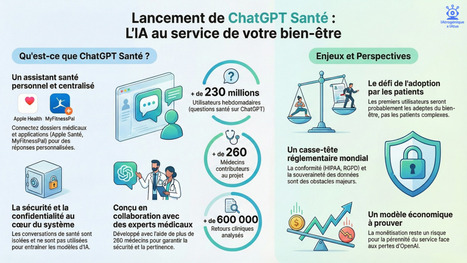
Le 7 janvier 2026 marque une date historique pour la santé numérique : OpenAI lance officiellement ChatGPT Santé (ChatGPT Health), une nouvelle fonctionnalité centrée sur l’usage des intelligences artificielles génératives appliquées aux données personnelles de santé. Cette initiative n’est pas un s
|
|
Scooped by
Gilbert C FAURE
January 28, 5:51 AM
|
Savoir lire un article scientifique, l’interpréter et transposer des résultats dans sa pratique est une source essentielle de la formation continue de nos futurs médecins au même titre que les disciplines somatiques!
#LCA #pédagogie #TaskforceLCA
Faculté de Médecine, Maïeutique et métiers de la Santé à Nancy
Nicolas GIRERD Guillaume Baudry Adrien Flahault Simona Pagliuca Stéphane ZUILY Thomas Moulinet Anne Laure Fijean
|
|
Scooped by
Gilbert C FAURE
January 26, 5:18 AM
|
Your Daily Chinese Idiom 🇨🇳✨
🎯 滴水穿石 (dī shuǐ chuān shí)
Constant effort brings success.
💡 Think of it like this:
A single drop of water may seem weak,
but if it keeps falling on a rock, over time it will make a hole.
Small, persistent efforts can achieve big results.
📚 Example:
每天练习汉语,即使只学一点点,久而久之也能滴水穿石。
Practice Chinese every day, even just a little — over time, your efforts will make a real difference!
#CHINESE #LEARNINGCHINESE #MANDARIN
|
|
Scooped by
Gilbert C FAURE
January 24, 11:59 AM
|
We Are Social, en partenariat avec Meltwater, dévoile le Digital Report France : une large étude sur les comportements des français·es en ligne.
Via Lionel Reichardt / le Pharmageek
|