


I started 2019 by delivering a TEDx talk at TEDxGCET in Vallabh Vidyanagar. This post covers a few key insights extracted from the talk. Video to be posted soon. Formal education is a launch pa


 Your new post is loading...
 Scoop.it! I started 2019 by delivering a TEDx talk at TEDxGCET in Vallabh Vidyanagar. This post covers a few key insights extracted from the talk. Video to be posted soon. Formal education is a launch pa 
No comment yet.
Sign up to comment
Scoop.it!
Unseen trends, uplifting stats, creative solutions — a new chart every day. From Information is Beautiful.
Scoop.it!

The purpose of this article is to present an overview of why annotated bibliographies are needed in higher education, especially in doctoral education programs. The necessity for emerging scholars to build an annotated bibliography is paramount to the development of their research study. However, there are numerous types of annotated bibliographies. This article will discuss the different types of annotations and which format best facilitates the development of a dissertation. Via Elizabeth E Charles
Gilbert C FAURE's insight:
in other words, curation of information...
Scoop.it!

Click on the article title to read more.
Scoop.it!
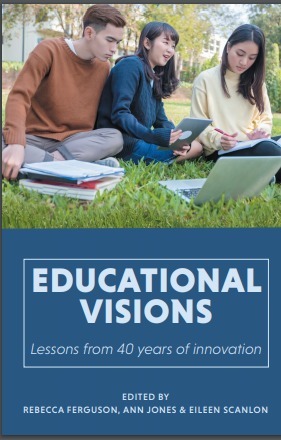
"My colleagues in IET at the Open University have published an open access book with the lovely Ubiquity Press people. It is free to download in various formats here (or you can buy the hard copy, order it for your library, etc) ..." Via Leona Ungerer
Scoop.it!

The origins of lifelong learning (LLL) can be traced back to the early 20th century when adult education was recognised as ‘a permanent national necessity, an inseparable aspect of citizenship (that) should be both universal and lifelong’ (MOR 1919). From the 1920s until the 1960s, adult education thus remained the central concept related to learning after school and university. When this was displaced in the 1970s, it was with terms such as ‘continuing education’ rather than the more expansive language of ‘lifelong learning’ that only began to assume a central role in policy debate in the 1990s after the release of the influential Delors report (UNESCO 1996). The concept of LLL recognised that whilst the value of initial training was not to be discounted, the f rontloading of skills through education and training for a single lifetime qualification was no longer sufficient, and that education and training systems of the future needed to be flexible and prepare individuals to learn continuously over their life (ILO, 2018). The concept of LLL was in part a response to concerns surrounding economic competitiveness, globalization, unemployment and the implications they held for human capital development. As noted by the ILO, education, training and lifelong learning are fundamental and should form an integral part of comprehensive economic, fiscal, social and labour market policies and programmes that are important for sustainable economic growth, employment creation and social development (ILO 2004). Debates at this time called for the introduction of ‘new and different concepts based on learning rather than education, on the integration of different learning environments and on the promotion of individual pathways between them’ (UNESCO, 1999, p. 1). Via Edumorfosis
Scoop.it!

What’s the issue? The University of Birmingham has created a free course to help teachers understand how young people use social media. The course – Optimising Social Media for Youth Health and Wellbeing – will focus on the impact of social media on mental health and wellbeing, but will also help teachers use social media …
Scoop.it!

Andrew Taylor came up with the idea because of a lack of ‘good’ sticks at the local park
Gilbert C FAURE's insight:
they deserve it
Scoop.it!

https://louisbraillecdi.wixsite.com/chercheur Dans le cadre des TraAm DOC 2019 des documentalistes s'emparent de la problématique d
Scoop.it!

Juan Domingo Farnos Miro Fuera de los muros de cristal, de las torres de marfil se está produciendo una transformación en el mundo del aprendizaje corporativo, y aquellos de nosotros en los colegios y universidades debemos prestar atención. El aprendizaje y el desarrollo corporativo, a menudo denominado L & D, es radicalmente diferente de hace… Via juandoming
Scoop.it!
Le blog Formation 3.0 fête son dixième anniversaire ! Merci à tous nos lecteurs pour leur fidélité ;)
Scoop.it!

Évolution des bibliothèques, extension des plages horaires, ouverture le dimanche... Les table-rondes organisées le 21 septembre dans le cadre de la mission Orsenna ont tenu toutes leurs promesses devant un public de professionnels et d'élus particulièrement attentif.
|
Scoop.it!

Record your screen right from the browser, without any installation.
Scoop.it!

Il n'a jamais été aussi simple pour vos équipes de créer, partager et améliorer des formations ensemble. Faites de la formation une aventure collective.
Scoop.it!

Découvrez Seekoya'Cards : notre plateforme web et son application mobile de microlearning. Créer son app de microlearning pour ses apprenants : c'est simple
Scoop.it!

At accrediting conference, panelists acknowledge that effort to measure learning outcomes has been a "hot mess" and that it's time for a better approach.
Scoop.it!

Unfortunately I am unable to attend today's Social Media for Learning in Higher Education conference at Edge Hill University. Thanks to the conference organisers for allowing me to submit a virtual presentation. The screencast can be found here and the abstract and slides for my talk are below: 'Curation, Connectivity and Creativity: Reflections on using Twitter…
Scoop.it!

The online network exclusively for higher education is now live and open to all! Share, connect and collaborate with your peers in 100 countries around the world!
Gilbert C FAURE's insight:
Wow!!! An amazing virtual presentation today by from #SocMedHE19 ...if you missed it don't worry with Paul's permission we will share it on our Connect The Social Media for Learning Network!
Scoop.it!

The 2019 Global Learning Landscape is an open source taxonomy for mapping innovation in learning and talent. Combining machine learning with a global community of experts, we analyzed over 50,000 organizations, 500,000 apps and considered the 3 million schools, colleges and universities around the world. Using the classical top-down / bottom-up design methodology, the 2019 Global Learning Landscape was built around 50 core clusters along a learning journey. From knowledge and curriculum to engagement, assessment, workforce and talent, the Global Learning Landscape is inspired by design thinking, following the learner from early childhood to lifelong learning.
Jim Lerman's insight:
A goldmine of resources for anyone who works to research and develop learning/teaching resources from "early childhood to lifelong learning." Truly an impressive and dynamic body of work. Not to be missed. Via Jim Lerman, juandoming
Gilbert C FAURE's insight:
curation inside?
Scoop.it!

Today's guest post, by Anita Bandrowski and Martijn Roelandse, highlights some of the challenges - and opportunities - of evaluating the quality of research rather than its impact.
Scoop.it!

Suivi de vols (avions en vol, arrivées, départs, historique) avec des cartes en temps réel et des photos d'avions.
Scoop.it!

Juan Domingo Farnos "In my activity-based learning, I suggested that little by little students should take charge of the choice of their activities, to develop their capacity to become self-taught. I also suggested to him how he could be in layers on top of regular learning experiences". Via juandoming
Scoop.it!
Conférence inaugurale de Bruno DeLièvre, Professeur à l'Université de Mons
Via Sandrine Decamps, juandoming

Enseignement de promotion sociale's curator insight,
December 26, 2019 3:02 PM
Numérique en formation et créativité
|






