


Follow, research and publish the best content
Get Started for FREE
Sign up with Facebook Sign up with X
I don't have a Facebook or a X account
Already have an account: Login

Nonprofit Capacity Building and Training
4.7K views |
+2 today
Training Techniques to Make Nonprofits More Effective
Curated by
Beth Kanter
 Your new post is loading...
 Your new post is loading...
Your new post is loading...
 Scoop.it!

The Stages of Personalized Learning Environments (version 2) was updated from feedback and input from educators around the world. Via Kathleen McClaskey 

Kathleen McClaskey's curator insight,
February 14, 2014 4:23 PM
The Stages of Personalized Learning Environments (PLE) needed to be updated again. Why? Because of the considerable feedback we received from participants in our 5 W's of Personalized Learning eCourse about our first and second versions of the chart. Some of the feedback was about consistency and flow across the stages. What worked in what stage? We definitely want to thank those that critiqued the stages for us and helped us with this version three that we hope will be the final version.-
See more at: http://www.personalizelearning.com/2012/05/stages-of-personalized-learning.html#sthash.gERsoWH8.dpuf
Scoop.it!

Universal Design for Learning (UDL) is used to design curriculum, lessons and instruction based on the diversity of the learners in their classroom.
How can UDL guide personalize learning to meet the Common Core?
When a teacher understands his/her learners through the UDL lens, he/she creates a flexible learning environment and provides opportunities for learner voice and choice. When lessons are designed using the UDL model, the lesson includes goals, methods, materials, tools, and assessments to reach and support the maximum amount of learners in the classroom.
Learners can use this model to help them understand how they learn best and what learning path they can take to become an independent expert learner, leveraging their natural abilities in the process. This process helps the learner create their personal learning profile that is understood by both teacher and learner.
The importance of this strategy is that both the teacher and the learner understand who the learner is and how they learn best. The learner and the teacher uses the UDL lens to personalize learning. So what does that look like?
An example of an 8th Grade unit on the Civil War serves as an example along with two students who can meet a number of CCSS when they choose and use the tools to support their learning.
Explore our new website, Personalize Learning (www.personalizelearning.com), to learn more about the research, models and educators who are personalizing learning.
Via Kathleen McClaskey

RATOMAHENINA HARRY's curator insight,
March 24, 2014 4:45 AM
Éducation / Exemplarité /Peace / Change thé World / Solidarité 
María Dolores Díaz Noguera's curator insight,
March 24, 2014 8:11 AM
UDL Guides Personalizing Learning to Meet the Common Core 
Nicky Mohan's curator insight,
March 24, 2014 3:14 PM
Personalized learning is what 21st Century Learning is all about
Scoop.it!
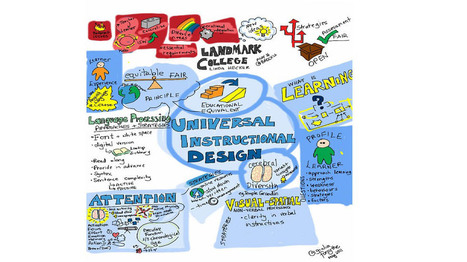
Instructional design model need to move from adopting a standard approach to developing models that could be customized to the 21st century needs of each learner. Via Dr. Susan Bainbridge
Scoop.it!

The best way to create effective, respectful relationships, when engaged in cross-cultural communications via the Internet is to adapt your style to theirs.
Scoop.it!

A professional learning community, or PLC, is a group of educators that meets regularly, shares expertise, and works collaboratively to improve teaching skills and the academic performance of students. The term is also applied to schools or teaching faculties that use small-group collaboration as a form of professional development. Shirley Hord, an expert on school leadership, came up […] Via Tricia Marty Rohloff
Scoop.it!
As part of a self-directed professional learning community, teachers at RMC in London, Ontario undertook the exploration of a range of social media tools. Th... Via Tricia Marty Rohloff
Scoop.it!

Paolo Lorenzoni, Project Lead & Business Designer at IDEO: Many lean startup practitioners have a tendency to treat everything as “pivotable.” This can be dangerous because it turns lean startup into a mechanistic trial and error exercise. The lack of intent makes it easy to get lost. To avoid this fate, it's helpful to anchor lean techniques around an observed human need, which is supplied by design thinking...
Scoop.it!
As instructors we often want to know how things are going in our course from the students' perspective. The Plus/Delta feedback tool (sometimes called Plus/Change) is a means of identifying what is going well and what needs to be changed. It is a quick and easy tool that is typically used at the end of a class period to gather information. The beauty of this tool is that it asks students to focus on what is working to advance their learning in the course and what could be improved by the teacher and the student. It helps students to think about their responsibility to the course and what they should continue doing to learn (PLUS) and what they need to change for the course to improve for them (DELTA) (Helminski & Koberna, 1995). Here's how it works. Students divide a sheet of paper or index card into quadrants. On the top left quadrant the student identifies what is working to enhance learning in the course. In the lower left quadrant the student writes what the student is doing to enhance his/her learning in the course. In the upper right quadrant the student identifies what needs to change or improve in the course or teaching to enhance learning. In the lower right quadrant the student identifies what he/she needs to change or improve in order to enhance his or her own learning. These responses may be collected, summarized, and reported back to the students at the next class session, or a four-quadrant chart can be drawn on the board and students can verbally offer responses. Or you may want to combine these two response methods. In either case, it is important to close the feedback loop and share the data with students.
Beth Kanter's insight:
As instructors we often want to know how things are going in our course from the students' perspective. The Plus/Delta feedback tool (sometimes called Plus/Change) is a means of identifying what is going well and what needs to be changed. It is a quick and easy tool that is typically used at the end of a class period to gather information. The beauty of this tool is that it asks students to focus on what is working to advance their learning in the course and what could be improved by the teacher and the student. It helps students to think about their responsibility to the course and what they should continue doing to learn (PLUS) and what they need to change for the course to improve for them (DELTA) (Helminski & Koberna, 1995). Here's how it works. Students divide a sheet of paper or index card into quadrants. On the top left quadrant the student identifies what is working to enhance learning in the course. In the lower left quadrant the student writes what the student is doing to enhance his/her learning in the course. In the upper right quadrant the student identifies what needs to change or improve in the course or teaching to enhance learning. In the lower right quadrant the student identifies what he/she needs to change or improve in order to enhance his or her own learning. These responses may be collected, summarized, and reported back to the students at the next class session, or a four-quadrant chart can be drawn on the board and students can verbally offer responses. Or you may want to combine these two response methods. In either case, it is important to close the feedback loop and share the data with students.

Leoncio Lopez-Ocon's curator insight,
July 23, 2013 2:23 PM
Util Infografia sobre teorías del aprendizaje 
Dr. Helen Teague's curator insight,
February 11, 2014 1:03 PM
nicely succinct infographic on learning theories 
Tom Short's curator insight,
February 12, 2014 7:58 PM
Nice overview of various learning theories; positioned against some new thinking about Networked learning theory.
Scoop.it!

"Critical Thinking" may sound like an obnoxious buzzword from liberal arts schools, but it's actually a useful skill. Critical thinking just means absorbing important information and using that to form a decision or opinion of your own--rather than just spouting off what you hear others say. This doesn't always come naturally to us, but luckily, it's something you can train yourself to do better. Critical thinking doesn't end. The more knowledge you cultivate, the better you'll become at thinking about it. It's navel gazing in that you're constantly thinking about thinking, but the end result is a brain that automatically forms better arguments, focused ideas, and creative solutions to problems. Via Gust MEES

Brent MacKinnon's curator insight,
February 9, 2014 8:18 AM
A very practical description with examples of ways to become better in your critical thinking. A good primer for sense making as part of the PKM framework. 
Terry Doherty's curator insight,
February 15, 2014 8:00 PM
"Navel gazing." I haven't heard that term in ages ... and don't do it near enough.

Todd Bratcher's curator insight,
February 18, 2014 6:46 PM
Critical thinking means to ask questions that need to be asked. it involves finding the significance in every piece of information you come across and formulating opinions and plans of action. You have to ask the tough questions and the best one to start with is "Why?" Critical thinking is about being curious and allowing your sense of curiosity to follow the "why".Often times following the why will lead to finding the truths and finding lies. Critical thinking is also about honing in ones BS detector. Take time to analyze information before accepting it's credibility.
Scoop.it!

Flickr is almost certainly the best online photo management and sharing application in the world. Show off your favorite photos and videos to the world, securely and privately show content to your friends and family, or blog the photos and videos you take with a cameraphone.
Beth Kanter's insight:
This report describes best practices for social media training in large or corporate environment, but could also be used for teaching social learning. http://www.slideshare.net/Altimeter/report-social-media-education-for-employees-li-terpening
Scoop.it!
![Complex Content? Chunk It Like This [Infographic] | Nonprofit Capacity Building and Training | Scoop.it](https://img.scoop.it/NQ5htRdkHzloOosVJNciSTl72eJkfbmt4t8yenImKBVvK0kTmF0xjctABnaLJIm9)
One of the main concepts that leads to successful e-Learning course design is information chunking. But what is chunking? Why is it embedded in the world of instructional design? And what kind of chunking strategies can an ... Via Dr. Susan Bainbridge, Frank J. Klein

Marisa Maiocchi's curator insight,
January 8, 2014 4:31 AM
Interesante. Pienso que, de algún modo, quienes trabajamos con e-learning ya estamos haciendo "chunking" hace tiempo. 
Noland Hoshino's comment,
January 25, 2014 1:43 PM
Like I've always said about the flood of information people put out -- you've got to "Chunk it"
Noland Hoshino's comment,
January 25, 2014 1:43 PM
Like I've always said about the flood of information people put out -- you've got to "Chunk it"
|
Scoop.it!

Hear four kids talk about motivation and Kathleen Cushman's information about the conditions for motivation in the webinar and chat.
Scoop.it!

Follow the continuum to become an expert learner. As this happens, teacher and learner roles change. Via Kathleen McClaskey
Beth Kanter's insight:
How do you help adults with this process?
Kathleen McClaskey's curator insight,
March 20, 2014 10:32 AM
An expert learner is a learner who is self-directed, self-regulated, motivated and engaged to learn. They have a purpose to learn something they are interested in. They are responsible and own their learning and monitor their progress. However, this doesn't just happen overnight or even all the time. Plus, learners may not be an expert on every concept, strategy or skill. So what we did was create a continuum to develop expert learners that provides the journey learners of all ages go through to build expertise.
Scoop.it!
In this complimentary eBook, 76 Tips for Turning Instructional Design Challenges into Successes, from The eLearning Guild, 13 learning professionals who have dealt with numerous learning disasters and challenges give us their best tips for dealing with learning-project mistakes, failures, and other challenges. Via Dr. Susan Bainbridge
Scoop.it!

Theories of Learning. Connectivism: A new type of learning for the digital age Via Dr. Susan Bainbridge

Maria Vallin's curator insight,
January 31, 2023 3:40 PM
Connectivism is one of my favorite learning theory to use in the classroom. As a Career and Technology teacher we use technology and connectivity theory allows the students to discuss to various platforms to discuss and find answers on their own. With this infographic it explain the different learning theories and connectivism, a theory that at least you have to try to implement for student engagement.
Scoop.it!
Scoop.it!

Ness Crouch's curator insight,
February 25, 2014 3:21 PM
A good document to support our current implementation. Very useful.
Scoop.it!
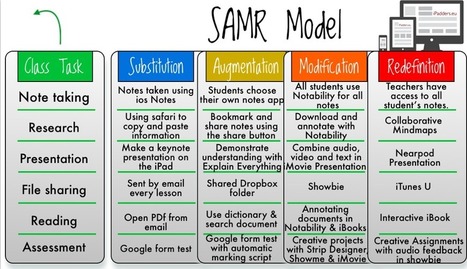
"In this quick post I want to share with you this beautiful interactive image on the SAMR model. I learned about this resource from a tweet shared by our colleague David Fife. As you can see from the image below, iPadders provided examples of how to use each classroom task according to the different SAMR categories. And in each category, a set of apps and tools are provided to help you carry out the task under study. I invite you to have a look and share with your colleagues. Enjoy" Via John Evans
Beth Kanter's insight:
Useful way to think about productivity tools

Richard Whiteside's curator insight,
February 27, 2014 6:42 PM
Explains a lot about how digital tech can help, though on investigation this seems to be a model developed seemingly from nowhere without much academic work behind it. Example of a simple model stating the obvious? Does it matter that it's origins are hazy? Having had the chance to look into it and its creator, it's interesting to note how popular it is and how accepted it is, without much critique. Is it really that great a model?! Just wondering! Raises a lot of questions. 
Grace Campbell's curator insight,
June 1, 2021 3:59 AM
Another useful scoop on the SAMR Model. I have scooped this through a fellow peers Scoop It.

Emily Easey's comment,
June 2, 2021 12:34 AM
The SAMR model is a great tool to follow when planning lessons. It doesn't matter what topic or subject you wish to teach it can be moulded and used to implement technology at all four levels!
Scoop.it!

Note: I was introduced to this idea somewhere on Hacker News a few weeks back, though I haven’t been able to find the exact discussion again [1]. I adapted the original concept to fit my own style, and it’s changed the way I approach my work. Uber Productivity – How To Knock Out More Work Than …
Scoop.it!
27 creativity & innovation tools is an overview of various commonly used techniques in creativity, innovation, research & development processes. All in one-pag
Beth Kanter's insight:
Very useful deck of methods for facilitating new ideas and creativity.

Lia Goren's curator insight,
July 7, 2013 6:08 PM
Algunas herramientas super interesantes, lo más importante: acuérdate de ucarlas!!
Scoop.it!


Gust MEES's curator insight,
February 6, 2014 11:07 AM
IMHO: Use ICT skills to find out about understanding, through blogs from the students. Make a preparation with a FlowChart about what YOU want students to know and compare it to the obtained results. Make an update of YOUR FlowChart with a new entry "IF => THEN => GO TO" and bring in a new task 2 adjust for BETTER knowledge which YOU apply then with the students. Redo again the blog with the students and find out if it worked. Discuss it with the students and ask them for collaboration as a Home-Work to become BETTER! THEY will learn to get the necessary skills with TEAM-WORK envolved, that will work ;)
Scoop.it!
Quiz questions are a vital part of e-Learning content and a great way to assess knowledge acquisition.
Scoop.it!

The culmination of my quest for more powerful learning grounded in theory and research came when recently I conducted an experiment in pushing constructionism into the digital age.
Beth Kanter's insight:
Learning by doing, but also creating
|









