


Nonprofit Capacity Building and Training
5.6K views |
+0 today
Training Techniques to Make Nonprofits More Effective
Curated by
Beth Kanter
 Your new post is loading...
 Scoop.it! 
Social media loves it some case studies. 
Scoop.it!
Beth Kanter's insight:
Well curated selected of resources
Scoop.it!
Beth Kanter's insight:
This article describes two different apps that can be used in the class for sticky note collaboration. Some additional apps that might be useful: More about how I have used sticky notes in instructional workshops.
Scoop.it!
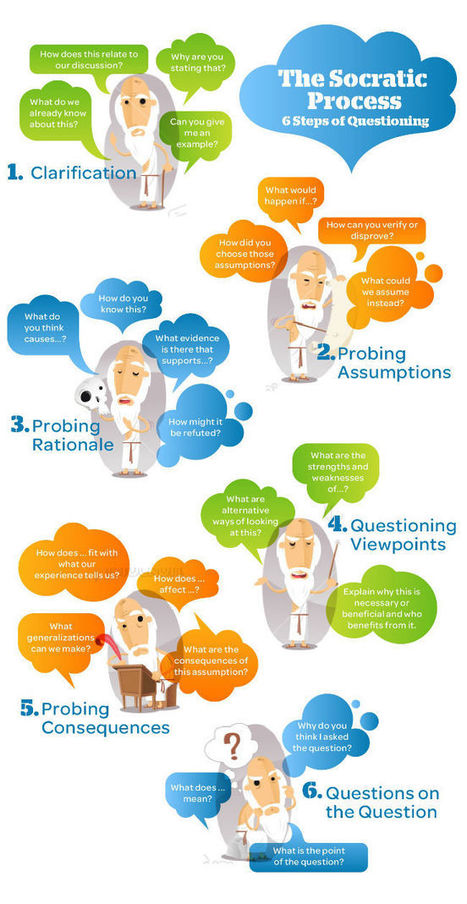
Learning is all about asking questions and finding answers to them. An inquisitive mind is one that goes beyond the status quo and probes deep below surface meanings. To foster such kind of thinking inside our classroom requires some hard work and a serious investment in time and efforts. We, as teachers and educators, need to prepare the right environment where inquisitive minds can nourish and grow. We need to water this environment with a culture of asking questions. Via Elizabeth E Charles, Lynnette Van Dyke
Beth Kanter's insight:
Example of questions and types of questions to guide learning.

Beth Kanter's curator insight,
January 12, 2014 2:10 PM
This infographic is geared for educational technique and inquiry based learned. However, I think the different of questions illustrated here are excellent for content curations to ask when reviewing resources or putting together collections. 
Louise Robinson-Lay's curator insight,
January 12, 2014 4:11 PM
An infographic showing what sorts of questions we can ask when curating.
Scoop.it!

I found this 'Ladder' of Participation from the Learner Voice Futurelab report useful to think about different dimensions of learner participation and student engagement. Please go to the Futurelab...
Scoop.it!

It's now 3 years since I published the Social Learning Handbook - and a lot has changed, so I am now working on a new version. Social Learning Handbook 2014: The Next Generation of Workplace Learni...
Beth Kanter's insight:
Looking forward to the new edition
Scoop.it!
This presentation gives an overview of the theory and practice of the validated Organizational Culture Assessment Instrument (by Cameron & Quinn) that is freely
Scoop.it!
Beth Kanter's insight:
Reflective teaching means looking at what you do in the classroom, thinking about why you do it, and thinking about if it works - a process of self-observation and self-evaluation. By collecting information about what goes on in our classroom, and by analysing and evaluating this information, we identify and explore our own practices and underlying beliefs. This may then lead to changes and improvements in our teaching. Reflective teaching is therefore a means of professional development which begins in our classroom.
Scoop.it!
Beth Kanter's insight:
Donald Schon (1983, 1987) provides a framework that not only addresses these cognitive and organizational barriers, but distinctly illuminates the practice of reflectivity as well. Models for reflective practice, based on Schon's (1983, 1987) principles, describe processes that translate theory to action for educators.
Scoop.it!

Today, we finished the second week of an interpersonal communications course. The students in the course are first term college students, a few fresh out of high school. As is my common practice,...
Beth Kanter's insight:
Learners do not just receive information only at the time it is given; they absorb information in many different ways, often after the fact, through reflection. The most powerful learning often happens when students self-monitor, or reflect. Students may not always be aware of what they are learning and experiencing. Teachers must raise students’ consciousness about underlying concepts and about their own reactions to these concepts.ETE Team
Scoop.it!

26 Ways to Improve Your Learning Infographic
Beth Kanter's insight:
Good infographic on ways to learn.
Scoop.it!

BRUNO's curator insight,
December 28, 2013 3:57 AM
Si vous ne compreniez pas pourquoi vous n'étiez pas fait pour les méthodes pédagogiques de notre système éducatif actuel... 
ORG's curator insight,
January 24, 2014 3:13 AM
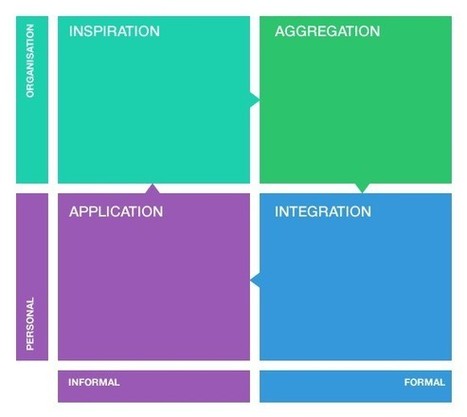
A new way of looking at the learning cycle next to the one from David Kolb. |
Scoop.it!
Beth Kanter's insight:
What enables a social purpose organization to excel at developing new ideas and practices? In many cases, the answer lies not in how people connect with the external social landscape, but in how they connect with each other.
Scoop.it!

The Bootcamp Bootleg is an overview of some of our most-used tools. The guide was originally intended for recent graduates of our Bootcamp: Adventures in Design Thinking class
Beth Kanter's insight:
The Bootcamp Bootleg is an overview of some of our most-used tools. The guide was originally intended for recent graduates of our Bootcamp: Adventures in Design Thinking class. But we’ve heard from folks who’ve never been to the d.school that have used it to create their own introductory experience to design thinking. The Bootcamp Bootleg is more of a cook book than a text book, and more of a constant work-in-progress than a polished and permanent piece. This resource is free for you to use and share—and we hope you do.
Scoop.it!

As I mentioned in part II, I found the circuit rider network to be absolutely invaluable to getting access to the right expertise in order to do my job. The environment for this was the circuit rid...
Scoop.it!
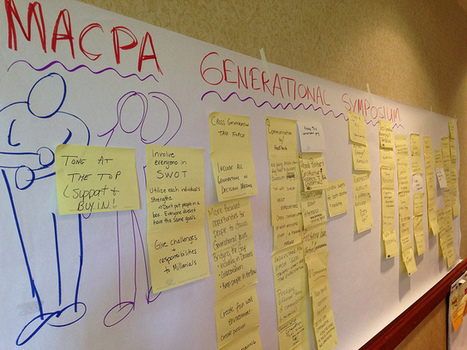
2014: The Year of the ... Sticky Note!
Beth Kanter's insight:
Sticky note facilitation ideas
Scoop.it!
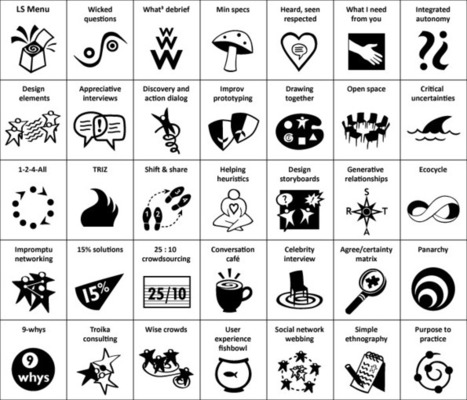
liberating structures, social invention.net, microstructures, disruptive innovation, behavior change, collaboration, social invention, diffusion of innovation, strategy, transformation, heuristics, complexity science, emergence...
Scoop.it!

WATCH global case studies from leading speakers live and OnDemand. DOWNLOAD presentation slides, white papers & MP3 audio files. UNLOCK exclusive content. GAIN a competitive advantage.
Scoop.it!

| TED (Technology, Entertainment, Design) is where the world's leading thinkers and doers gather to share ideas worth spreading.
Beth Kanter's insight:
How to translate for adults
Scoop.it!

by Shelly Terrell "Comics can be powerful learning tools. The mix of art, dialogue, character expressions, and frames engages learners and is brain-friendly. Moreover, comics break down a story’s plot and text into bite-sized chunks that are supported with visuals. This is much easier for our brain to process than reading a large amount of text on a page. Additionally, comics are an effective way to introduce your learners to digital storytelling. Many of the comic creation tools are easy to use allowing the learners to fill in their frames by clicking on a choice of characters, props, scenes, and more presented to them. Your learners will be able to quickly create a story, view it, and share it with their friends and family. Comics come in many formats and types to support and engage struggling readers as well as advanced readers. Creating comics engages students and encourages them to explore vocabulary, summarize information, and contextualize what they learn in a creative way. Creating comics is also being accepted as an effective way to teach complicated writing. Nick Sousanis, a doctoral candidate at Teachers College, Columbia University, wrote his PhD dissertation entirely in comic book form. View examples of his work on his blog, Spin, Weave and Cut. The following tips and free resources will help you engage learners with comics." Via Jim Lerman

KB...Konnected's curator insight,
December 31, 2013 3:46 PM
Here is a link to my "Cool Comic Creators" binder. It includes online creators as well as printable ones. 
Terry Doherty's curator insight,
January 2, 2014 4:21 PM
Comics or graphic novels ... whatever you call them, stories told in "panels" are a great way to not only encourage reading, but keep kids reading.
Just as we choose magazines over novels sometimes, kids want different things at different times!
Scoop.it!

Founded in 1943, ASCD (formerly the Association for Supervision and Curriculum Development) is an educational leadership organization dedicated to advancing best practices and policies for the success of each learner.
Beth Kanter's insight:
In reflective schools, there is no such thing as failure—only the production of personal insights from one's experiences. To be reflective means to mentally wander through where you have been and to try to make some sense of it. Such mental processes include
Scoop.it!
Beth Kanter's insight:
A teacher educator wiki for a course on reflective practice. Lots of useful resources here.
Scoop.it!
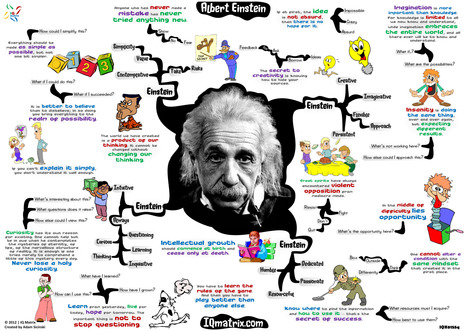
Quite a lot, it appears! Here are my top ten favourite "Einstein on KM" quotes, which I have roughly curated into a journey from information to knowledge, through to learning and simplicity, experi...
Beth Kanter's insight:
Terrific quotes about learning and knowledge management from Einstein and great infographic.
Scoop.it!
Beth Kanter's insight:
Charles Jennings writes a blog on work place learning and is the director of the 70:20:10 Forum. This peice offers three frameworks for integrating learning into work. 1. Adding Learning to Work: These are formal activities such as professional development or taking classes outside of the workplace. "They are also built on the idea that ‘first we learn and then we work’. The two activities are viewed as separate. That is not where the real strength of workplace learning lies." A lot of nonprofit learning is structured this way. 2. Embedding Learning in Work: Learning and work merge as the need to support performance at the point-of-need drives the development of high performance. It does this efficiently and in real-time. Embedding learning in work can also be achieved without sophisticated technology. There are many other ways to break free from the inertia of away-from-work training through simple job aids, to ‘sidekicks’ and ‘planners’. 3. Extracting Learning from Work: The model of ‘learn then work’ is replaced here with ‘work then learn, then work in an improved way’. Learning is not only embedded in the workflow, but new learning is continually extracted from experiences and exchanges with colleagues, customers and the entire value chain. As with embedding learning in the workflow, extracting the focus is on a continuous cycle of performance improvement. Examples of this type of workplace learning include narrating work and sharing with colleagues – often achieved by micro-blogging on a regular (possibly daily) basis; active participation in professional social networks is another example. However, just as powerful is the extraction of learning that can be achieved by taking time out of a busy team or project meeting to reflect on last week’s experiences and learning in a semi-structured way. AAR Model is also useful here. .
|






