This lesson takes a process approach to developing writing skills. It is staged so that students are guided through the processes of collecting information and deciding how they will structure it within the text before they begin to write. They are then guided through the process of drafting, editing and redrafting the text to produce a final copy. Nik Peachey, teacher, trainer and materials writer.
The tasks are designed as small scale projects. You follow the instructions with each one and it should help you to create some form of teaching materials as well as help you to develop your technical skills.
This is a manual for EFL and ESL teachers describing how to use a number of web based tools and learning technologies to assist in language development. It includes instructions on how to use the t...
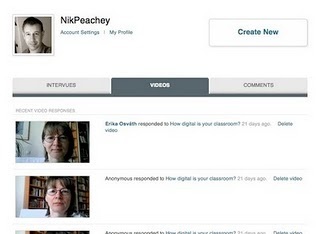
Intervue.me is a new website I have been using recently. It's another website that is based around the use of webcams. The site enables users to create questionnaires and then get the recipients of the questionnaire to leave video recorded answers. The site is very easy to use.
This is a screencast showing a wonderful site called Dust Echoes. The site has lots on interactive animation and activities as well as PDF downloads for use by teachers in the classroom. The stories are Australian folk stories.
It’s around a year since the launch of the first iPad in the UK and almost a year since I launched my first research questionnaire on mobile learning in ELT.
The original questionnaire produced some interesting and surprising results regarding teachers’ attitudes and their openness to mobile learning, the results of which were published online in the Guardian Education section at: English language teachers connect to mobile learning
I recently spotted this very interesting site called Vyou.com which exploits video to create asynchronous conversations. I find it interesting because of the simple way it creates presence. As you can see below, it looks like the person (me in this case) is waiting ready for your question.
All visitors need to do is type a question into the text line below the video and the creator will get a message with the question and post a reply. You can try it if you wish by posting a question to me. I'm not sure yet how long it will take for me to answer though.
This document has been created to supplement a presentation that I am delivering at the AVELMEC ‘Social Networking Thriving as a Community of Practice’ online conference http://www.avealmec.org.ve/... by NikPeachey in How-To Guides/Manuals, Education,...
Firstly, PLN stands for personal (or professional) learning network. That’s fine but what is a personal learning network and why would we need one? Well a PLN is a group of people, any people, that can help you to develop and learn. I think it’s very important to stress that a PLN is people, because so much talk about PLN gets tangled up in technology and websites etc, but at the heart of PLN is the concept of people who connect together to help each other grow and learn. The technology comes in because it is a tool that can help you to connect to those people and it can help you process the information you get from those people into meaningful and hopefully useful knowledge.
Having a wide vocabulary is really important to push the level of your English. This activity shows you how to push the level of your vocabulary and revise some of the words you already know while playing a simple online game similar to Scrabble.
To get content containing either thought or leadership enter:
To get content containing both thought and leadership enter:
To get content containing the expression thought leadership enter:
You can enter several keywords and you can refine them whenever you want. Our suggestion engine uses more signals but entering a few keywords here will rapidly give you great content to curate.