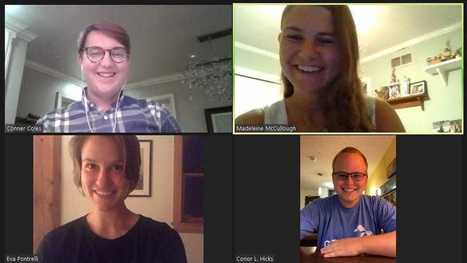
Madeleine McCullough, a political science and economics major from Newtown, said that after George Floyd’s death, she began having discussions with Eva Pontrelli, a college classmate, about how to actively talk with legislators and turn the conversation about police brutality into action and reform.
“[There were] a lot of hoops you had to jump through: identifying who your legislator is, identifying the subjects that are important to talk about, [and] figuring out what changes…will leave a lasting and tangible impact.”
On top of that, McCullough realized that even once an individual had a lawmaker on the line, they might not have the facts, context or data to have a robust conversation. “The conversation seems like a difficult one to have, and often times you don’t have the information to back up what you want to say.”
Then she realized she might have the tools to create a solution. McCullough and a team of her Boston College classmates created a website called Meet the Momentum, which aims to provide specific and objective information to link constituents with their state’s representatives and policing policies.
*****
Meet the Momentum's mission is to streamline the process of contacting state legislators for anyone who sees a need for change in the way their state approaches policing. This tool serves to channel that passion into a collective voice calling for achievable, impactful policy measures.
*****
McCullough said that she and her team launched the website “with the intention of giving everybody the tools they need to make changes in their communities.”
Since its release on July 27th, the site has had over 1,300 unique views and has also gained hundreds of followers on its accompanying social media pages on Facebook, Instagram and Twitter. McCullough said that she hopes the site will continue to educate others and help sustain a longer-term civic engagement to fight injustice.
“It’s so easy to be desensitized to tragedy…[we have to] to acknowledge that so many of these problems are things that can be avoided,” said McCullough, referring to the deaths of Floyd, Ahmaud Arbery, Breonna Taylor, and more recently, the shooting of Jacob Blake in Wisconsin, which have stirred emotional responses nationwide. “It’s a reminder to…put those feelings to work through the democratic process.”
She also believes that Meet the Momentum’s emphasis on objectivity has potential to prevent buzzwords like “defunding” from shutting down more thoughtful conversation from both sides of the aisle.
McCullough plans to continue working on this project well into the future, citing a clear need for the project: “There is a desire for this information out there…We want to give people the tools to have more fruitful, educated, open-minded conversation,” she said.
And McCullough believes Meet the Momentum is a testament to the potential for those conversations to bring people together.
“Individuals who think they and I might not have common ground—this website has given that common ground a physical presence, on the Internet.”


 Your new post is loading...




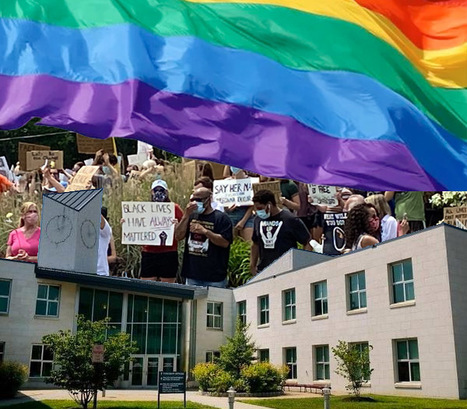











Regarding hiring diversity, Newtown Township Police Chief John Hearn assured the audience at a Town Hall meeting that the Newtown Police Department is an “equal opportunity” employer. Thirty-eight (38) Police Departments throughout Bucks County use the consortium test to find qualified candidates to fill vacancies.
Newtown Supervisor David Oxley asked if there was a way to get a more diverse group of applicants. Understanding that the Chief worked with many black officers while he was a Philadelphia cop, Mr. Oxley suggested that perhaps there is an opportunity for those officers to work in Newtown.
“Philadelphia is a whole different animal,” said the Chief. He was referring to the fact that they have a recruiting agency, which seems to be the norm for big city police forces. Unfortunately, Newtown does not have the staff and money to do the kind of recruiting that big cities do. The Chief mentioned that Newtown police jobs are listed on various social media sites and if there is no interest, he does not see a need to go out and try to pull in people who are not interested.
Census bureau data show Newtown is 87% white, whereas the Newtown police force is 100% white.