


social nSocial Network Analysis (SNA) including a tutorial on concepts and methods Social Media – Dr. Giorgos Cheliotis (gcheliotis@nus.edu.sg) Communications and Ne...

Practical Networked Leadership Skills
8.8K views |
+3 today
The soft skills you need to lead and succeed in a networked world. This includes: professional learning network, content curation for self-directed learning and professional development, professional learning networks, personal branding, training your attention, self-care and management, managing up and down.
Curated by
Beth Kanter
 Your new post is loading...
 Your new post is loading...
Your new post is loading...
 Scoop.it!

Integrating Network Mindset 
Scoop.it!

Source: Monitor Institute
Scoop.it!

Not just smart but wise – Daniel Goleman on why great leaders need to have a focus beyond the boundaries of their organizations. Via Kenneth Mikkelsen
Beth Kanter's insight:
Training your attention and being focused

Steve Bax's curator insight,
December 18, 2013 3:39 AM
Very good article on leaders needing an 'outer' focus.

Katharina Schmidt's curator insight,
December 19, 2013 2:57 AM
The ability to focus in fuzzy times has become a huge quality...the brain is a like a muscle and can be trained to focus...daily mediation helps...focus is the mental part of creating new things! 
Sandeep Gautam's curator insight,
April 25, 2014 12:48 AM
Leaders have a broader vision and wider systemic thinking!
Scoop.it!

Take free online classes from 80+ top universities and organizations. Coursera is a social entrepreneurship company partnering with Stanford University, Yale University, Princeton University and others around the world to offer courses online for anyone to take, for free. We believe in connecting people to a great education so that anyone around the world can learn without limits.
Beth Kanter's insight:
This course will use social network analysis, both its theory and computational tools, to make sense of the social and information networks that have been fueled and rendered accessible by the internet. Everything is connected: people, information, events and places, all the more so with the advent of online social media. A practical way of making sense of the tangle of connections is to analyze them as networks. In this course you will learn about the structure and evolution of networks, drawing on knowledge from disciplines as diverse as sociology, mathematics, computer science, economics, and physics. Online interactive demonstrations and hands-on analysis of real-world data sets will focus on a range of tasks: from identifying important nodes in the network, to detecting communities, to tracing information diffusion and opinion formation.
Scoop.it!

Learning leadership skills: Learn and grow as a leader by keeping a journal.
Beth Kanter's insight:
Read your goals daily - Develop a leadership notebook and create a place to store your written goals. Keep a journal - In your leadership notebook, create a journal tab. Reflect on your day and make summary notes. You can use a tool such as Evernote. Record key thoughts daily – Make it a discipline to record your thoughts daily without exception. Don’t be lengthy. Create short summary statements that are easy to write and review. Record the key revelations. Review weekly/monthly - Develop a routine of reviewing what you have written at the end of each week and at the end of each month. You are likely to be amazed at your own progress – or lack of progress. Either way, you gain clarity that is priceless. You are your own best teacher - Be open and vulnerable, as well as honest. Write to yourself. Acknowledge your own shortcomings, as well as your victories. Be open to what you are seeing. Don’t write a lot of stuff - Just jot down the key points – that’s it. Record what’s important - You don’t really know what is important and what’s not. Just write what you think is important. You can cross it off or edit it later. Set aside 15 minutes daily to write - The key concept is to calendar this item. Put down a time on your calendar to do this, or it will not happen. Set aside 30 minutes on Friday to review and record - This extended time will help you define your overall journey, as well as the incremental steps. Be faithful and think results - Faithful is showing up. Results is a mindset and focus. Read your goals daily - I said this earlier. It warrants repeating. Be in touch with your passion for the goal. That makes it work. - See more at: http://transformationalstrategist.com/grow-your-leadership-skills-by-being-a-good-student/#sthash.SIWaf6FC.dpuf
Scoop.it!
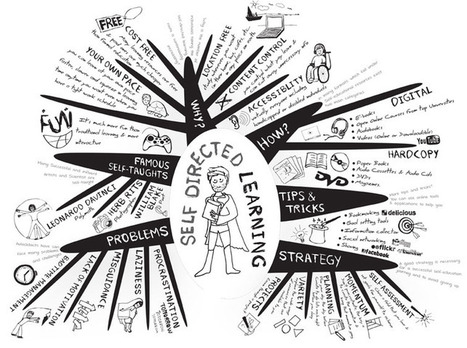
What You Need To Know About Self-Directed Learning
Scoop.it!
Beth Kanter's insight:
Leaders in a networked world understand that learning is a big skill.
Scoop.it!

Curated by Beth Kanter Networked Nonprofit professionals now how to leverage their personal professional networks for their organizations. LinkedIn is a great for this but it requires smart networking. Here's some tips. Make smart, right connections. Only the serious apply here. This is where the professional community engages, interacts, connects and refers. Start your process on LinkedIn if you want to get a company or person to notice you. Develop your profile, put up a professional head shot, link your blog, and post good content as often as you can and respond to other people’s posts.
Scoop.it!
![Top 29 Ways To Stay Creative [Infographic + Marty Note] | Practical Networked Leadership Skills | Scoop.it](https://img.scoop.it/VuQ90-B_63kAigepa19B9Dl72eJkfbmt4t8yenImKBVvK0kTmF0xjctABnaLJIm9)
Infographics on being creative in life and inspiration with top 29 ways to be creative on success and startup exploring and researching ideas and concept... My favorite ways to stay creative are: * Reading (actual BOOKS not blog posts lol). * Creating thought experiments. * Doing math in my head (I suck at it so it forces all the reserves in). * Music especially LOUD rock or jazz (Miles especially). * Taking pictures to support a story. * Watching TV (Ovation, PBS and HBO best sources of inspiration). * Working out (back when I had the energy to do that LOL). * Playing with my crazy bengal cat Lucian. * Shopping but only in musuem or art stores. * Looking at great design (effect is delayed but there). * Changing a location (traveling). * Used to read magazines, blogs don't seem to do it. * Read something HARD I don't understand (all in again). * Interview someone smarter than me. * Curate something especially across nontraditional lines. * Create a contest or a game. * Manipulate SPEED of task (speed up or slow way down). * Think about creative times in the past (working with Alton Pickens at Vassar).
Other great ways to stay creative in this infographic. Via Christino Martin, John van den Brink, Martin (Marty) Smith, Khaled El Ahmad, Beth Kanter

Martin (Marty) Smith's comment,
November 22, 2012 12:51 AM
Thanks Khaled. We are eating Turkey and watching football tomorrow. Hope things are SAFE and quiet where you are too my friend. Keep that marvelous smart head down hear. Marty

Khaled El Ahmad's comment,
November 22, 2012 1:00 AM
Yummy Save some of that giblet gravy for me :-)
All is good here, thank you for asking bro all the best and Happy Thanks Giving Day
Scoop.it!

Imagine you receive a digital camera with a built-in memory card for your birthday. You bring it on a six-month trip to Africa where you won’t have access to a computer—so all the photos
Beth Kanter's insight:
The point that resonated: why 2nd and 3rd degree connections matter. Here’s where the caveat to the Six Degrees of Separation theory comes in. Academically, the theory is correct, but when it comes to meeting people who can help you professionally, three degrees of separation is what matters. Three degrees is the magic number because when you’re introduced to a second- or third-degree connection, at least one person in an introduction chain personally knows the origin or target person. In this example: You—> Karen—> Jane—> Sarah. Karen and Jane are in the middle, and both of them know either You or Sarah—the two people who are trying to connect. That’s how trust is preserved. If one additional degree of separation is added, a person in the middle of the chain will know neither You nor Sarah, and thus have no stake in making sure the introduction goes smoothly. After all, why would a person bother to introduce a total stranger (even if that stranger is a friend of a friend of a friend) to another total stranger?
Scoop.it!
Andy Carvin used two free tools - netviz and gephi to visualize his professional network where he get sources for his reporting.
Scoop.it!

Big data from social media can give us insight into our relationships, our habits, and the things we care about.
|
Scoop.it!
Beth Kanter's insight:
SYNAPP is a web-based diagnostic tool that provides customized, actionable insights based on an analysis of an organization’s informal network. SYNAPP collects data using a brief, 10-minute survey and then generates actionable insights at Individual and
Scoop.it!
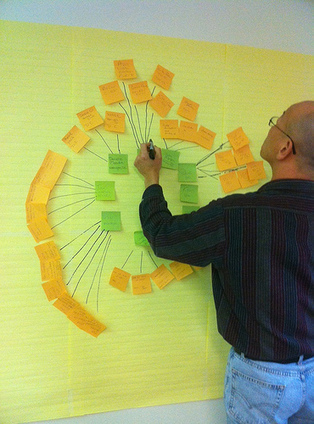
Two weeks ago, the social media maven from the National Wildlife Federation, Danielle Brigida, tweeted the above photo showing how they were mapping one of their networks with one of my favorite low tech tools: sticky notes. This got my attention because I was designing a Networked Nonpr
Scoop.it!

Network data is everywhere. From roads and supply chains to biological pathways and the internet, any items that share a common relationship can form a network. Via Ari Sahagún
Scoop.it!
Beth Kanter's insight:
I study the structure and dynamics of social and information networks, with a particular emphasis on information diffusion, expertise sharing, and online communities.
Scoop.it!

The Young Entrepreneur Council is an invite-only organization comprised of the world’s most promising young entrepreneurs. YEC recently launched StartupCol
Beth Kanter's insight:
Good list of leadership blog sources
Scoop.it!
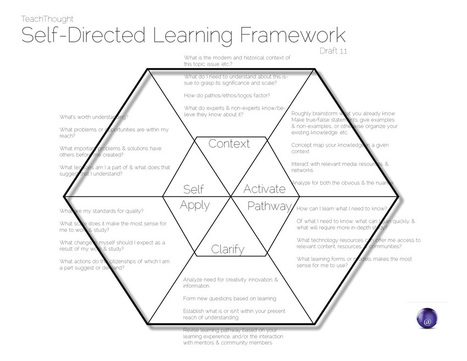
A Self-Directed Learning Model For 21st Century Learners
Scoop.it!

What is agility? It's about QUESTIONING everything. Just because you did it that way yesterday doesn't mean we should do it that way tomorrow. In the Social Age, change is constant. Doing what you ... Via Jess Chalmers
Beth Kanter's insight:
LEARNING is constant if you’re agile. If you’re not learning, you’re stagnant, lethargic, stuck. Agile learners reach into their networks and communities to create meaning. They use technology to access knowledge and refine it, filter it, to create meaning.
Scoop.it!
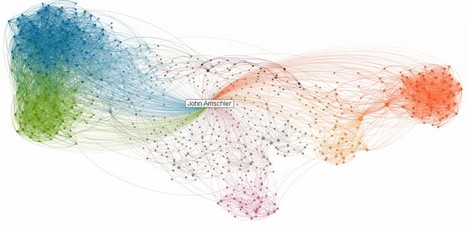
Curated by Beth Kanter Being a networked professional means cultivating your network, but how do you measure your success? Is social media and technology creating some productivity sappin bad habits? Measuring can lead to knowledge. This article summarizes some apps and other tools from a site/movement called Quantified Self Time Use, Networks/Relationships, Sleep, Diet, and Mood. Those last three are important to professional productivity and we so often ignore this ...
Scoop.it!

Social media is great for networking, but it can also feel totally overwhelming. Here are a few ways to sift through the noise and find the people and conversations that you should be engaged with.
Scoop.it!

When it comes to business relationships, it’s not quantity that matters—it’s quality. If you're an entrepreneur, read on for 25 key people to have in your network.
|









social network analysis primer - geeky