 Your new post is loading...

|
Scooped by
NatProdChem
January 12, 2016 9:09 AM
|
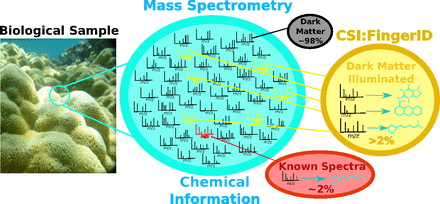
Despite the over 100-y history of mass spectrometry, it remains challenging to link the large volume of known chemical structures to the data obtained with mass spectrometers. Presently, only 1.8% of spectra in an untargeted metabolomics experiment can be annotated. This means that the vast majority of information collected by metabolomics is “dark matter,” chemical signatures that remain uncharacterized (Fig. 1). For a genomic comparison, 80% of predicted genes in the Escherichia coli genome are known. In a bacteriophage metagenome, a well-known frontier of biological dark matter, the amount of known genes is 1–30%, depending on the sample (1). Thus, one could argue that we know more about the genetics of uncultured phage than we do about the chemistry within our own bodies. Much of the chemical dark matter may include known structures, but they remain undiscovered because the reference spectra are not available in mass spectrometry databases. The only way to overcome this challenge is through the development of computational solutions. In PNAS, Dührkop et al. describe the development of such a computational tool, called CSI (compound structure identification):FingerID (2). The tool is designed to aid in the annotation of chemistries that can be observed by mass spectrometry. CSI:FingerID uses fragmentation trees to connect tandem MS (MS/MS) data to chemical structures found in public chemistry databases. Tools such as this can allow metabolomics with mass spectrometry to become as commonly used and scientifically productive as sequencing technologies have in the field of genomics.
|
|
Scooped by
NatProdChem
December 12, 2015 1:13 PM
|
A dichloromethane extract of the roots from the Panamanian plant Swartzia simplex exhibited a strong antifungal activity in a bioautography assay against a genetically modified hypersusceptible strain of Candida albicans. At-line HPLC activity based profiling of the crude extract enabled a precise localization of the antifungal compounds, and dereplication by UHPLC-HRESIMS indicated the presence of potentially new metabolites. Transposition of the HPLC reversed-phase analytical conditions to medium-pressure liquid chromatography (MPLC) allowed an efficient isolation of the major constituents. Minor compounds of interest were isolated from the MPLC fractions using semipreparative HPLC. Using this strategy, 14 diterpenes (1–14) were isolated, with seven (5–10, 14) being new antifungal natural products. The new structures were elucidated using NMR spectroscopy and HRESIMS analysis. The absolute configurations of some of the compounds were elucidated by electronic circular dichroism spectroscopy. The antifungal properties of these compounds were evaluated as their minimum inhibitory concentrations in a dilution assay against both hypersusceptible and wild-type strains of C. albicans and by assessment of their antibiofilm activities. The potential cytological effects on the ultrastructure of C. albicans of the antifungal compounds isolated were evaluated on thin sections by transmission electron microscopy.
Quentin Favre-Godal†, Stephane Dorsaz‡, Emerson F. Queiroz*†, Laurence Marcourt†, Samad N. Ebrahimi§, Pierre-Marie Allard†, Francine Voinesco⊥, Matthias Hamburger○, Mahabir P. Gupta#, Katia Gindro⊥, Dominique Sanglard‡, and Jean-Luc Wolfender J. Nat. Prod., Article ASAP DOI: 10.1021/acs.jnatprod.5b00744 Publication Date (Web): December 11, 2015
|
|
Scooped by
NatProdChem
December 12, 2015 1:10 PM
|
Understanding the biosynthesis of dinoflagellate polyketides presents many unique challenges. Because of the remaining hurdles to dinoflagellate genome sequencing, precursor labeling studies remain the only viable way to investigate dinoflagellate biosynthesis. However, prior studies have shown that polyketide chain assembly does not follow any of the established processes. Additionally, acetate, the common precursor for polyketides, is frequently scrambled, thus compromising interpretation. These factors are further compounded by low production yields of the compounds of interest. A recent report on the biosynthesis of spirolides, a group belonging to the growing class of toxic spiroimines, provided some insight into the polyketide assembly process based on acetate labeling studies, but many details were left uncertain. By feeding 13C methyl-labeled methionine to cultures of Alexandrium ostenfeldii, the producing organism of 13-desmethylspirolide C, and application of the odd–even methylation rule, the complete biosynthetic pathway has been established.
J. Nat. Prod., Article ASAP DOI: 10.1021/acs.jnatprod.5b00869
|
|
Scooped by
NatProdChem
December 2, 2015 3:52 PM
|
A terrestrial bacterium, Streptomyces sp. NZ-6, produced niizalactams A–C (1–3), unprecedented di- and tricyclic macrolactams, by coculturing with the mycolic acid-containing bacterium Tsukamurella pulmonis TP-B0596. Their complete structures, including absolute configurations, were elucidated on the basis of spectroscopic data and chemical derivatization. Their unique skeletons are proposed to be biosynthesized from a common 26-membered macrolactam intermediate by SN2 cyclization or an intramolecular Diels–Alder reaction.
J. Nat. Prod., Article ASAP DOI: 10.1021/acs.jnatprod.5b00804 Publication Date (Web): December 1, 2015
|
|
Scooped by
NatProdChem
November 30, 2015 7:41 PM
|
Exposure of the fungus Chaetomium cancroideum to an NAD+-dependent HDAC inhibitor, nicotinamide, enhanced the production of aromatic and branched aliphatic polyketides, which allowed us to isolate new secondary metabolites, chaetophenol G and cancrolides A and B. Their structures were determined using spectroscopic
Org. Biomol. Chem., 2016, Advance Article
DOI: 10.1039/C5OB01595B
|
|
Scooped by
NatProdChem
November 26, 2015 11:35 AM
|
Compound Activity Mapping provides an alternative approach to natural products drug discovery by integrating high-content biological screening and untargeted metabolomics to directly reveal the identities and biological functions of individual bioactive compounds in complex natural product libraries. This accelerated discovery pipeline addresses many of the issues that have contributed to the decline of natural products research in some areas by improving dereplication and lead prioritization strategies. The detailed structural and functional annotation offered by this tool may help to improve the integration of natural products with modern high-content, high-throughput screening and provide an additional strategy for the discovery of the next generation of natural product-inspired drug leads and chemical probes.
|
|
Scooped by
NatProdChem
November 24, 2015 2:00 PM
|
The 2015 Nobel Prize in Physiology or Medicine, shared by Professor Youyou Tu, focused worldwide attention on artemisinin, a natural product antimalarial drug inspired by traditional Chinese medicine (TCM). This is the first Nobel Prize in natural sciences presented to a Chinese scientist for her impactful research work in China in collaboration with other Chinese scientists. We are delighted to provide the background and implications of the discovery of artemisinin, along with our personal viewpoints toward the affordability of modern medicines from natural products.
Nat. Prod. Rep., 2015,32, 1617-1621
DOI: 10.1039/C5NP00133A
|
|
Scooped by
NatProdChem
November 21, 2015 1:55 PM
|
Evolution of malaria parasite drug resistance has thwarted efforts to control this deadly disease. Use of drug combinations has been proposed to slow that evolution. Artemisinin is a favorite drug in the global war on malaria and is frequently used in combination therapies. Here we show that using the whole plant (Artemisia annua) from which artemisinin is derived can overcome parasite resistance and is actually more resilient to evolution of parasite resistance; i.e., parasites take longer to evolve resistance, thus increasing the effective life span of the therapy.
- Mostafa A. Elfawala,
- Melissa J. Towlerb,
- Nicholas G. Reichc,
- Pamela J. Weathersb, and
- Stephen M. Richa,1
PNAS
doi: 10.1073/pnas.1413127112
|
|
Scooped by
NatProdChem
November 16, 2015 11:06 AM
|
Bioassay-guided fractionation of a petroleum ether extract of the roots of Stellera chamaejasme led to the isolation of seven new (stelleralides D–J, 1–7) and 12 known (8–19) daphnane diterpenoids. The structures and relative configurations of 1–7 were established on the basis of extensive spectroscopic analysis, including HRESIMS and comprehensive NMR techniques. All isolates were evaluated for anti-HIV activity in MT4 cells. All compounds tested, except 2, showed anti-HIV activity, and, especially, five 1α-alkyldaphnane diterpenoids (3, 4, 5, 10, and 11) exhibited extremely potent anti-HIV activity, with EC50 values of 0.06–1.1 nM and selectivity index values of more than 10 000.
|
|
Scooped by
NatProdChem
November 4, 2015 9:09 AM
|
Highlights
A method for phorbol, deoxyphorbol and ingenol esters profiling was developed. - •
This HPLC-MSn method was applied to ten extracts of Euphorbia species. - •
Jatrophane-type esters can display deoxyphorbol/ingenol-like fragmentation. - •
This method can be adapted to profile other types of diterpene esters. - •
Confident annotation of the diterpene-type must be confirmed by other methods.
- Louis-Félix Nothias-Scagliaa, b,
- Isabelle Schmitz-Afonsob, 1,
- Franck Renuccia,
- Fanny Roussib,
- David Touboulb,
- Jean Costaa,
- Marc Litaudonb, , ,
- Julien Paolinia, ,
- doi:10.1016/j.chroma.2015.09.092
|
|
Scooped by
NatProdChem
November 4, 2015 9:03 AM
|
The 2015 Nobel Prize in Physiology or Medicine recognised the advances made in treating neglected tropical diseases, using drugs whose origins lie in natural products.
Nat. Prod. Rep., 2015, Advance Article
DOI: 10.1039/C5NP90043C
|
|
Scooped by
NatProdChem
October 27, 2015 2:57 PM
|
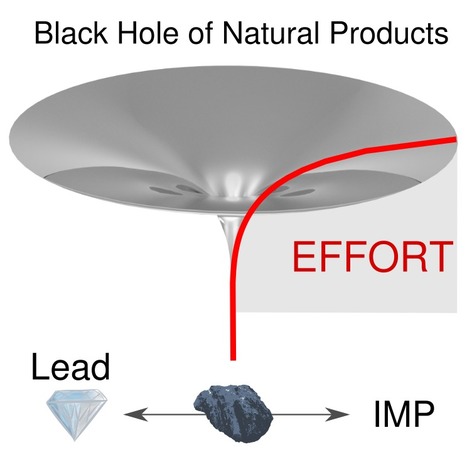
« High-throughput biology has contributed a wealth of data on chemicals, including natural products (NPs). Recently, attention was drawn to certain, predominantly synthetic, compounds that are responsible for disproportionate percentages of hits but are false actives. Spurious bioassay interference led to their designation as pan-assay interference compounds (PAINS). NPs lack comparable scrutiny, which this study aims to rectify. Systematic mining of 80+ years of the phytochemistry and biology literature, using the NAPRALERT database, revealed that only 39 compounds represent the NPs most reported by occurrence, activity, and distinct activity. Over 50% are not explained by phenomena known for synthetic libraries, and all had manifold ascribed bioactivities, designating them as invalid metabolic panaceas (IMPs). Cumulative distributions of ∼200,000 NPs uncovered that NP research follows power-law characteristics typical for behavioral phenomena. Projection into occurrence–bioactivity–effort space produces the hyperbolic black hole of NPs, where IMPs populate the high-effort base. »
†Center for Natural Product Technologies, Department of Medicinal Chemistry and Pharmacognosy and ‡Institute for Tuberculosis Research, College of Pharmacy, University of Illinois at Chicago, 833 South Wood Street, Chicago, Illinois 60612, United States § Physical Sciences Department, Rosary College of Arts and Sciences, Dominican University, River Forest, Illinois 60305, United States J. Med. Chem., Article ASAP DOI: 10.1021/acs.jmedchem.5b01009 Publication Date (Web): October 27, 2015 Copyright © 2015 American Chemical Society
|
|
Scooped by
NatProdChem
October 27, 2015 4:52 AM
|
A strategy for the dereplication of a complete or a partial structure using 1H NMR, 1H–13C HSQC and 1H–1H COSY spectral data, a molecular formula composition range and structural fragments against a massive database of about 22 million compounds is considered. As the increasing availability of public online databases containing natural products continues to grow the potential of utilizing these resources for dereplication purposes increases. This work examines approaches for NMR dereplication of natural products and includes a comparison with approaches for molecular formula and mass-based dereplication. The strategy is an application of computer-assisted structure elucidation using ACD/Structure Elucidator and data obtained from the ChemSpider database hosted by the Royal Society of Chemistry.
Org. Biomol. Chem., 2015,13, 9957-9962
DOI: 10.1039/C5OB01713K
|
|
|
Scooped by
NatProdChem
December 17, 2015 11:42 AM
|
Over the last decade, the number of studies reporting the use of electrospray ionization mass spectrometry (ESI-MS) in combination with collision cells (or other activation methods) to promote fragmentation of synthetic and natural products for structural elucidation purposes has considerably increased. However, the lack of a systematic compilation of the gas-phase fragmentation reactions subjected to ESI-MS/MS conditions still represents a challenge and has led to many misunderstood results in the literature. This review article exploits the most common fragmentation reactions for ions generated by ESI in positive and negative modes using collision cells in an effort to stimulate the use of this technique by non-specialists, undergraduate students and researchers in related areas.
Nat. Prod. Rep., 2016, Advance Article
DOI: 10.1039/C5NP00073D
|
|
Scooped by
NatProdChem
December 12, 2015 1:12 PM
|
Seven new prenylated indole alkaloids, taichunamides A–G, were isolated from the fungus Aspergillus taichungensis (IBT 19404). Taichunamides A and B contained an azetidine and 4-pyridone units, respectively, and are likely biosynthesized from notoamide S via (+)-6-epi-stephacidin A. Taichunamides C and D contain endoperoxide and methylsulfonyl units, respectively. This fungus produced indole alkaloids containing an anti-bicyclo[2.2.2]diazaoctane core, whereas A. protuberus and A. amoenus produced congeners with a syn-bicyclo[2.2.2]diazaoctane core. Plausible biosynthetic pathways to access these cores within the three species likely arise from an intramolecular hetero Diels–Alder reaction.
Angewandte Chemie International Edition Ippei Kagiyama, Hikaru Kato, Tatsuo Nehira, Jens C. Frisvad, David H. Sherman, Robert M. Williams, Sachiko Tsukamoto
|
|
Scooped by
NatProdChem
December 2, 2015 4:06 PM
|
Understanding how microbes affect health and the biosphere requires an international initiative, argue Nicole Dubilier, Margaret McFall-Ngai and Liping Zhao.
|
|
Scooped by
NatProdChem
December 2, 2015 4:02 AM
|
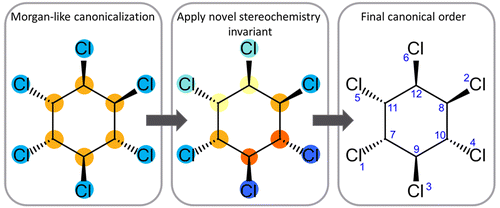
Finding a canonical ordering of the atoms in a molecule is a prerequisite for generating a unique representation of the molecule. The canonicalization of a molecule is usually accomplished by applying some sort of graph relaxation algorithm, the most common of which is the Morgan algorithm. There are known issues with that algorithm that lead to noncanonical atom orderings as well as problems when it is applied to large molecules like proteins. Furthermore, each cheminformatics toolkit or software provides its own version of a canonical ordering, most based on unpublished algorithms, which also complicates the generation of a universal unique identifier for molecules. We present an alternative canonicalization approach that uses a standard stable-sorting algorithm instead of a Morgan-like index. Two new invariants that allow canonical ordering of molecules with dependent chirality as well as those with highly symmetrical cyclic graphs have been developed. The new approach proved to be robust and fast when tested on the 1.45 million compounds of the ChEMBL 20 data set in different scenarios like random renumbering of input atoms or SMILES round tripping. Our new algorithm is able to generate a canonical order of the atoms of protein molecules within a few milliseconds. The novel algorithm is implemented in the open-source cheminformatics toolkit RDKit. With this paper, we provide a reference Python implementation of the algorithm that could easily be integrated in any cheminformatics toolkit. This provides a first step toward a common standard for canonical atom ordering to generate a universal unique identifier for molecules other than InChI.
J. Chem. Inf. Model., 2015, 55 (10), pp 2111–2120 DOI: 10.1021/acs.jcim.5b00543
|
|
Scooped by
NatProdChem
November 26, 2015 1:43 PM
|
In order to identify new anticancer compounds from nature, a prefractionated library derived from Australian endemic plants was generated and screened against the prostate cancer cell line LNCaP using a metabolic assay. Fractions from the seeds, leaves, and wood of Anopterus macleayanus showed cytotoxic activity and were subsequently investigated using a combination of bioassay-guided fractionation and mass-directed isolation. This led to the identification of four new diterpenoid alkaloids, 6α-acetoxyanopterine (1), 4′-hydroxy-6α-acetoxyanopterine (2), 4′-hydroxyanopterine (3), and 11α-benzoylanopterine (4), along with four known compounds, anopterine (5), 7β-hydroxyanopterine (6), 7β,4′-dihydroxyanopterine (7), and 7β-hydroxy-11α-benzoylanopterine (8); all compounds were purified as their trifluoroacetate salt. The chemical structures of 1–8 were elucidated after analysis of 1D/2D NMR and MS data. Compounds 1–8 were evaluated for cytotoxic activity against a panel of human prostate cancer cells (LNCaP, C4-2B, and DuCaP) and nonmalignant cell lines (BPH-1 and WPMY-1), using a live-cell imaging system and a metabolic assay. All compounds showed potent cytotoxicity with IC50 values of <400 nM; compound 1 was the most active natural product from this series, with an IC50 value of 3.1 nM toward the LNCaP cell line. The live-cell imaging assay on 1–8 showed a concentration- and time-dependent effect on the cell morphology and proliferation of LNCaP cells.
J. Nat. Prod., Article ASAP DOI: 10.1021/acs.jnatprod.5b00509
|
|
Scooped by
NatProdChem
November 25, 2015 1:32 PM
|
Around 25% of vegetable food is lost worldwide because of infectious plant diseases, including microbe-induced decay of harvested crops. In wet seasons and under humid storage conditions, potato tubers are readily infected and decomposed by anaerobic bacteria (Clostridium puniceum). We found that these anaerobic plant pathogens harbor a gene locus (type II polyketide synthase) to produce unusual polyketide metabolites (clostrubins) with dual functions. The clostrubins, which act as antibiotics against other microbial plant pathogens, enable the anaerobic bacteria to survive an oxygen-rich plant environment.
- Gulimila Shabuer1,*,
- Keishi Ishida1,*,
- Sacha J. Pidot1,2,*,
- Martin Roth3,
- Hans-Martin Dahse4,
- Christian Hertweck1,5,†
Science 6 November 2015:
Vol. 350 no. 6261 pp. 670-674 DOI: 10.1126/science.aac9990
|
|
Scooped by
NatProdChem
November 23, 2015 2:45 PM
|
- Jane Hubert
- Jean-Marc Nuzillard
- Jean-Hugues Renault
« The development of new drugs will certainly benefit from an ever improving knowledge of the living beings chemistry. However, identification of drugable molecules within the immense biodiversity of forests, soils or oceans still requires considerable investments in technical equipments, time and human resources. An important part of this process is the quick identification of known substances in order to concentrate the efforts on the discovery of new ones. A range of “dereplication” procedures are currently emerging to meet this challenge as key strategies to improve the performance of natural product screening programs. Initially defined in 1990 as “a process of quickly identifying known chemotypes”, dereplication is today a not so univocal concept and has evolved over the last years in different ways. The present review covers all dereplication-related sudies in natural product research from 1990 to 2014. Its writing brought to light five distinct dereplication workflows that can be characterized by the nature of starting materials, by the selected analytical technique, and above all by the final objective. Dereplication can be used as an untargeted workflow for the rapid identification of the major compounds whatever their chemical class in a single sample or for the acceleration of bioactivity-guided fractionation procedures. In other cases dereplication is fully integrated in metabolomic studies for the untargeted chemical profiling of natural extract collections or for the targeted identification of a predetermined class of metabolites. Finally a quite distinct dereplication approach mainly based on gene-sequence analyses is frequently used for the taxonomic identification of microbial strains. »
Phytochemistry Reviews pp 1-41 First online: 19 November 2015 © Springer International Publishing AG, Part of Springer Science+Business Media
|
|
Scooped by
NatProdChem
November 16, 2015 11:24 AM
|
Paeciloketals (1–3), new benzannulated spiroketal derivatives, were isolated from the marine fungus Paecilomyces variotii derived from the giant jellyfish Nemopilema nomurai. Compound 1 was present as a racemate and was resolved into enantiopure 1a and 1b by chiral-phase separation on a cellulose column. Compounds 2 and 3, possessing a novel benzannulated spiroketal skeleton, were rapidly interconvertible and yielded an equilibrium mixture on standing at room temperature. The relative and absolute configurations of compounds 2 and 3 were determined by NOESY analysis and ECD calculations. Compound 1 showed modest antibacterial activity against the marine pathogen Vibrio ichthyoenteri.
J. Nat. Prod., Article ASAP DOI: 10.1021/acs.jnatprod.5b00594 Publication Date (Web): November 12, 2015
|
|
Scooped by
NatProdChem
November 7, 2015 1:26 PM
|
Over the centuries, microbial secondary metabolites have played a central role in the treatment of human diseases and have revolutionised the pharmaceutical industry. With the increasing number of sequenced microbial genomes revealing a plethora of novel biosynthetic genes, natural product drug discovery is entering an exciting second golden age. Here, we provide a concise overview as an introductory guide to the main methods employed to unlock or up-regulate these so called ‘cryptic’, ‘silent’ and ‘orphan’ gene clusters, and increase the production of the encoded natural product. With a predominant focus on bacterial natural products we will discuss the importance of the bioinformatics approach for genome mining, the use of first different and simple culturing techniques and then the application of genetic engineering to unlock the microbial treasure trove.
Nat. Prod. Rep., 2016, Advance Article
DOI: 10.1039/C5NP00111K
|
|
Scooped by
NatProdChem
November 4, 2015 9:05 AM
|
While recent breakthroughs in the discovery of peptide antibiotics and other Peptidic Natural Products (PNPs) raise a challenge for developing new algorithms for their analyses, the computational technologies for high-throughput PNP discovery are still lacking. We discuss the computational bottlenecks in analyzing PNPs and review recent advances in genome mining, peptidogenomics, and spectral networks that are now enabling the discovery of new PNPs via mass spectrometry. We further describe the connections between these advances and the new generation of software tools for PNP dereplication, de novo sequencing, and identification.
Nat. Prod. Rep., 2016, Advance Article
DOI: 10.1039/C5NP00050E
|
|
Scooped by
NatProdChem
November 2, 2015 6:14 PM
|
« While recent breakthroughs in the discovery of peptide antibiotics and other Peptidic Natural Products (PNPs) raise a challenge for developing new algorithms for their analyses, the computational technologies for high-throughput PNP discovery are still lacking. We discuss the computational bottlenecks in analyzing PNPs and review recent advances in genome mining, peptidogenomics, and spectral networks that are now enabling the discovery of new PNPs via mass spectrometry. We further describe the connections between these advances and the new generation of software tools for PNP dereplication, de novo sequencing, and identification. »
Nat. Prod. Rep., 2016, Advance Article DOI: 10.1039/C5NP00050E
|
|
Scooped by
NatProdChem
October 27, 2015 4:55 AM
|
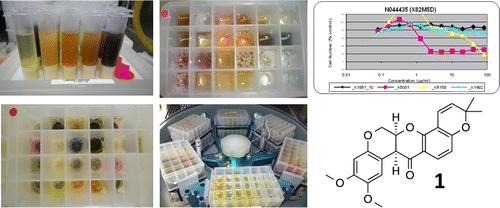
A high-throughput screening assay for modulators of Trp53/NF1 mutant astrocytoma cell growth was adapted for use with natural product extracts and applied to a novel collection of prefractionated/partially purified extracts. Screening 68 427 samples identified active fractions from 95 unique extracts, including the terrestrial plant Millettia ichthyotona. Only three of these extracts showed activity in the crude extract form, thus demonstrating the utility of a partial purification approach for natural product screening. The NF1 screening assay was used to guide purification of active compounds from the M. ichthyotona extract, which yielded the two rotenones deguelin (1) and dehydrodeguelin (2). The deguelins have been reported to affect growth of a number of cancer cell lines. They potently inhibited growth of only one of a panel of NF1/Trp53 mutant murine astrocytoma cell lines, possibly related to epigenetic factors, but had no effect on the growth of normal astrocytes. These results suggest the potential utility of deguelins as tools for further investigating NF1 astrocytoma cell growth. These bioprobes were identified only as a result of screening partially purified natural product extracts.
†Molecular Targets Laboratory, Center for Cancer Research, and §Mouse Cancer Genetics Program, Center for Cancer Research, National Cancer Institute, Frederick, Maryland 21702-1201, United States ‡ Basic Science Program, Leidos Biomedical Research, Inc., Frederick National Laboratory for Cancer Research, Frederick, Maryland 21702-1201, United States J. Nat. Prod., Article ASAP DOI: 10.1021/acs.jnatprod.5b00753
|















A powerfull insight on MS-based metabolomic challenges !