Via Roxane Harrison


 Your new post is loading...
 Your new post is loading...
Your new post is loading...
 Scoop.it!

No comment yet.
Sign up to comment
Scoop.it!
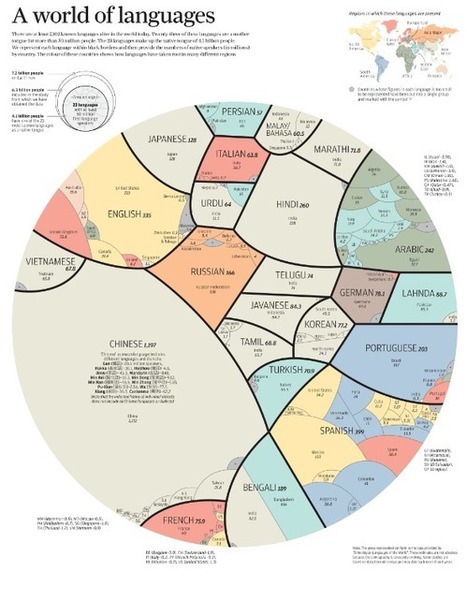
Language learning can be tricky, but this is how to make it more simple.
Scoop.it!
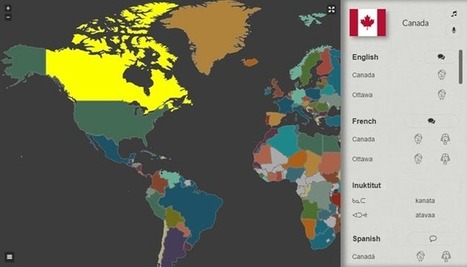
Localingual is a site for listening to and recording dialects/languages around the world
Scoop.it!

“ The best guess is that humans currently speak about 6,900 different languages. More than half the global population communicates using just a handful of them—Chinese, English, Hindi, Spanish, and Russian. Indeed, 95 percent of people communicate using just 100 languages.”
Via Rodolfo Maslias
Scoop.it!
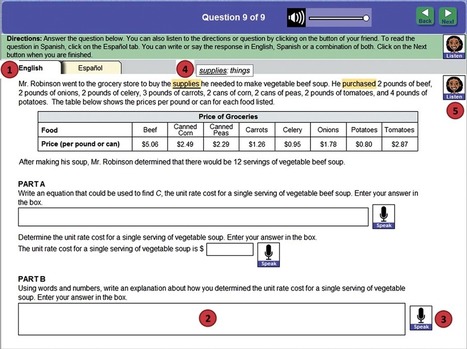
Translanguaging refers to the flexible use of the bilingual repertoire. In this report, we provide a theoretical framework to support the use of translanguaging to assess the academic conten
Scoop.it!

If you're using Twitter or Google+, half a percent of all everything you read can't be found in dictionary. The LOLs, YOLOs and OMGs, the looools and gottas, all are decidedly not according to Webster. And odds are you’ve seen someone misspell separate, embarrass, achieve or surprise. via Jim Dougherty Via John van den Brink, Berend de Jonge
Scoop.it!

2. Hairstyles Are Restricted Sure, you can smoke pot but you’re not free to style your hair at whim in North Korea. In 2013 there were 28 state-approved hair styles that citizens could choose from. Married women were ordered to keep their hair sensibly short while single ladies were allowed to wear their locks a … Via No Such Thing As The News
Dennis Swender's insight:
Note North Korean literacy rate of 100% places it in sync with three great educational achievements in history: Cherokee literacy rate of 100% over 1 year (Sequoyah), Brazilian peasant farmer literacy rate of 100% over 3 months (Freire), and African American literacy rate of 90% over 90 year time span..
Scoop.it!

“English speakers are increasingly punctuating their speech with ‘um’ rather than ‘er’, according to socio-linguists at Edinburgh University. So why the, um, shift, asks Stuart Jeffries”
Via Julie Cumming-Debrot, Louise Robinson-Lay

Louise Robinson-Lay's curator insight,
December 29, 2014 7:05 PM
Umm well, what do I say next? er, this pause gives me time to think? But why is it on the increase?
Scoop.it!

The following letter was sent to The Sunday Times by Professor Susan Bruce, Chair of University English, in response to an article published in the May 11th edition of the paper about the OCR/ EMC ...
Via Louise Robinson-Lay
Louise Robinson-Lay's curator insight,
January 8, 2015 3:26 AM
The letter linked to here gives a fine rationale for studying all forms of English, not just literary and privileged ones.
Scoop.it!

‘The abuse of language causes needless anger, hurt and offence. It’s a question of good manners. Did you really just say refute?’
Via Louise Robinson-Lay
Louise Robinson-Lay's curator insight,
May 29, 2015 6:47 AM
We all have a bit of the prescriptivist in us. Just waiting to snigger at an errant error. Are we part of a modern tribe. Or have we always been this way?
Scoop.it!
A novel teaching method informed by the brain sciences is the subject of a documentary film, “Grey Matters: Teaching the Way the Brain Learns.” The film premieres March 9th at the Johns Hopkins School of Education, with additional screenings to follow.
Via Stephania Savva, Ph.D, malek
Scoop.it!
Several weeks ago I published a post on Conditionals. In the post I tried to cover all the conditionals in one mind map and I think that I succeeded. However, the post was unnecessarily complicated fo... Via TeachingEnglish, David M
|
Scoop.it!

From
forvo

The largest pronunciation dictionary in the world. All the words in all the languages pronounced by native speakers
Scoop.it!

While taking his regular morning walk, listening to a podcast, market researcher Mike Beder stopped dead in his tracks. Via Lynnette Van Dyke
Scoop.it!
The development of effective second and foreign (L2) language learning materials needs to be grounded in two types of theories: (a) a theory of language and language use and (b) a theory of languag
Scoop.it!
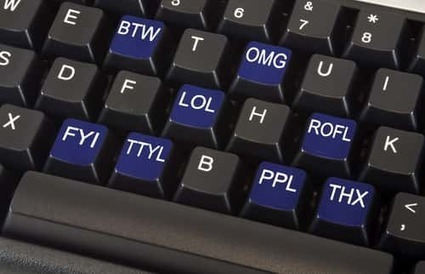
The rampant use of social media/texting slang by teenagers is largely due to increased accessibility to mobile phones. How does that effect writing skills? Via Dr. Susan Bainbridge
Scoop.it!

“ Scientists use language and logic to translate monkey sounds into English and develop linguistic rules for primate dialects.”
Via Pascual Pérez-Paredes, Louise Robinson-Lay
Louise Robinson-Lay's curator insight,
December 29, 2014 7:01 PM
Can animals use language? It is one of the questions that you have asked in class. Here is some research to help you learn more.
Scoop.it!

Martha Gill: Well, no, but the redefinition of 'literally' leaves it in a rather awkward state. Perhaps it's a word best avoided for the moment Via Louise Robinson-Lay
Louise Robinson-Lay's curator insight,
January 31, 2015 8:12 PM
Are speaking figuratively or literally when we say we 'literally fell off our chairs laughing'? Unless we actually did fall many language watchers would say the use of 'literally' is incorrect. The Dictionary now disagrees. This has caused controversy. In fact, that was a massive understatement.
Scoop.it!
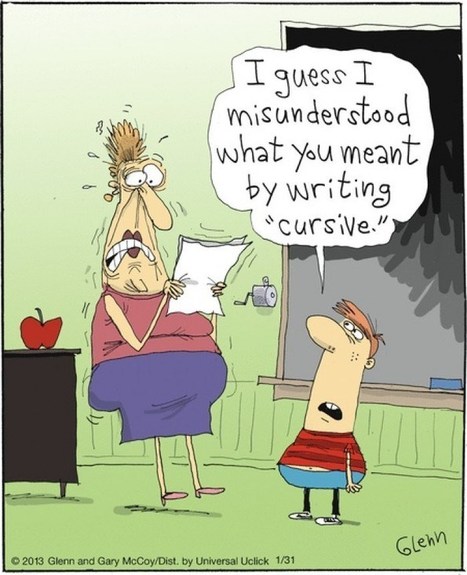
“ As my wife and I were loading our groceries into the car boot, (trunk for my US friends), a young mother was trying to get an uncooperative pre-schooler strapped into his car seat. Frustrated, a st...”
Via Louise Robinson-Lay
Scoop.it!


Lou Salza's curator insight,
November 22, 2013 11:28 AM
Just subscribed to this newsletter after hearing about it from our Lower School/ Associate Head Vanessa Diffenbacher. THe graphs illustrate the importance of thoughtful selection and analysis of texts to support reading development. Check it out!--Lou
Excerpt: "....Archaic Language—The vocabulary, usage, syntax and context for cultural reference of texts over 50 or 100 years old are vastly different and typically more complex than texts written today. Students need to be exposed to and develop proficiency with antiquated forms of expression to be able to hope to read James Madison, Frederick Douglas and Edmund Spenser when they get to college.
Here for example are the first lines of Great Expectations: My father’s family name being Pirrip, and my Christian name Philip, my infant tongue could make of both names nothing longer or more explicit than Pip. So, I called myself Pip, and came to be called Pip.” The sentences are short and simple, the words simple. On a Lexile scale this passage would score low, but the stylistic differences in a text of this vintage make it daunting to most students to say the least. And they must learn not to be intimidated by older discourse.
Non-Linear Time Sequences: In passages written exclusively for students—or more specifically for student assessments—time tends to unfold with consistency. A story is narrated in a given style with a given cadence and that cadence endures and remains consistent, but in the best books, books where every aspect of the narration is nuanced to create an exact image, time moves in fits and start. It doubles back. To Kill a Mockingbird, for example, is written from Scout’s perspective as she looks back at events from her childhood that happened when she was about 9. But some of her memories are of memories that happened earlier or later. Or that happened repeatedly during her childhood. The narrative shifts seamlessly from “One day Atticus was,” to “Atticus often did” without calling this shift to the reader’s attention. To understand the book you have to catch these subtle shifts. The only way to master such books is to have read them time and again and to be carefully introduced to them by a thoughtful teacher or parent.
Misleading/Narratively Complex—Books are sometimes narrated by an unreliable narrator- Scout, for example, who doesn’t understand and misperceives some of what happened to her. Or the narrator in Edgar Allen Poe’s “The Tell-Tale Heart” who is a madman out of touch with reality. Other books have multiple narrators such as Faulkner’s As I Lay Dying. Others have non-human narrators such as the horse that tells the story in Black Beauty. Some books have multiple intertwined and apparently (for a time) unrelated plot lines. These are far harder to read than books with a single plot line and students need to experience these as well. They define rigor at least as much as Lexiles though Lexiles clearly don’t contemplate them. So too Figurative/Symbolic Text which, like Animal Farm or The Lion the Witch and the Wardrobe or Kurt Vonnegut’s story “Harrison Bergeron” happen on an allegorical or symbolic level. Not reflected in Lexiles; critical forms of text complexity that students must experience. Finally there are Resistant Texts—texts written to deliberately resist easy meaning-making by readers. Perhaps half of the poems ever written fall into this category. You have to assemble meaning around nuances, hints, uncertainties and clues. So too a book like Garcia Marquez’ One Hundred Years of Solitude. Anyway, we’ve taken to using these “Five Plagues” as markers of text complexity and to explicitly ask our teachers to expose students to books that feature them to ensure the rigor of their reading and their preparedness for college. In my next post I’ll provide more explicit --examples from To Kill a Mockingbird that show how subtle pervasive and important the factors can be....." By Doug Lemov

Dyslexia Today's curator insight,
November 22, 2013 4:22 PM
Really Good Job Disecting Text Complexity! We hope Dyslexic's will use Assistive Technology to really get into some good books and leave their disability behind for a while!
Louise Robinson-Lay's curator insight,
December 18, 2015 3:31 PM
Text complexity goes further than vocabulary. We need to look at the structures and organisation of the text.
Scoop.it!

Adolescent-brain science findings suggest four things that middle and high school teachers should stop doing, writes psychologist Thomas Armstrong. Findings from adolescent-brain research also suggest a number of things that educators should stop doing so much of at the middle school and high school levels. For example:• Classroom teaching that focuses largely on delivering content through lectures and textbooks fails to engage the emotional brain and leaves unchanged those prefrontal regions that are important in metacognition.• Public posting of grades and test scores (a practice which in this data-driven world appears to be increasing) humiliates and shames students in front of their highly valued peers.• Locking students into a set academic college-bound program of courses takes away their ability to make decisions about what most interests them (a process that integrates the limbic system's motivational verve with the prefrontal cortex's decisionmaking capacity).
Via Mel Riddile
|