FrenchTech SAAS
33.5K views | +2 today
FrenchTech SAAS
Les news de l'univers SAAS et FrenchTech
Curated by Mickael Ruau
Your new post is loading...

Popular Tags

Scooped by Mickael Ruau
October 23, 2013 2:12 AM
Scoop.it!

SQL Monitor – Freeware to Capture Client SQL Calls - Toad for Oracle - Toad for Oracle - Toad World

SQL Monitor – Freeware to Capture Client SQL Calls - Toad for Oracle - Toad for Oracle - Toad World | FrenchTech SAAS | Scoop.it

You may already be familiar with the Toad World Exclusive Freeware area from where you can download and use really useful utilities, including:

SQL Monitor – a utility that monitors Oracle, MySQL, and DB2 Client DLL calls, allowing you to capture all SQL calls a program sends to the database via the client DLLs.Quest Calibrate – utility to quickly find wasted space and other performance metrics!Quest Error Manager - framework that will help you standardize the management of errors in a PL/SQL-based application.And many others …
Mickael Ruau's insight:

To download SQL Monitor, simply click this link .

No comment yet.
Scooped by Mickael Ruau
October 22, 2013 4:23 PM
Scoop.it!

Call for Review: Efficient XML Interchange (EXI) Format 1.0 (Second Edition) Proposed Edited Recommendation Published | W3C News

Call for Review: Efficient XML Interchange (EXI) Format 1.0 (Second Edition) Proposed Edited Recommendation Published | W3C News | FrenchTech SAAS | Scoop.it
The Efficient XML Interchange Working Group has published a Proposed Edited Recommendation of Efficient XML Interchange (EXI) Format 1.0 (Second Edition).
Mickael Ruau's insight:

The Efficient XML Interchange Working Group has published a Proposed Edited Recommendation ofEfficient XML Interchange (EXI) Format 1.0 (Second Edition).


This document is the specification of the Efficient XML Interchange (EXI) format. EXI is a very compact representation for the Extensible Markup Language (XML) Information Set that is intended to simultaneously optimize performance and the utilization of computational resources.


The EXI format uses a hybrid approach drawn from the information and formal language theories, plus practical techniques verified by measurements, for entropy encoding XML information.


Using a relatively simple algorithm, which is amenable to fast and compact implementation, and a small set of datatype representations, it reliably produces efficient encodings of XML event streams.


The grammar production system and format definition of EXI are presented. Comments are welcome through 20 November. Learn more about the Extensible Markup Language (XML) Activity.

 
No comment yet.
Rescooped by Mickael Ruau from Dev Breakthroughs
October 22, 2013 9:13 AM
Scoop.it!

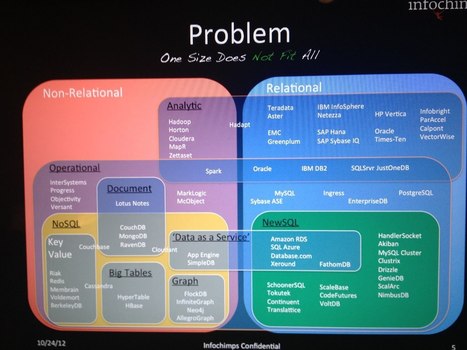
The NoSQL Landscape in Diagrams

The NoSQL Landscape in Diagrams | FrenchTech SAAS | Scoop.it

Here’s the NoSQL landscape in 3 slides.


Via Nicolas Weil
No comment yet.
Scooped by Mickael Ruau
October 22, 2013 6:17 AM
Scoop.it!

Beta Testing Begins for New MySQL 5.6 Developer and DBA Certification Exams - Automated Trader (blog)

Beta Testing Begins for New MySQL 5.6 Developer and DBA Certification Exams Automated Trader (blog) The opinions expressed by this blogger and those providing comments are theirs alone, this does not reflect the opinion of Automated Trader or any...
No comment yet.
Scooped by Mickael Ruau
October 22, 2013 6:15 AM
Scoop.it!

Using the new spatial functions in MySQL 5.6 for geo-enabled applications

Using the new spatial functions in MySQL 5.6 for geo-enabled applications | FrenchTech SAAS | Scoop.it
Geo-enabled (or location enabled) applications are very common nowadays and many of them use MySQL. The common tasks for such applications are:Find all points of interests (i.e. coffee shops) around (i.e.
No comment yet.
Rescooped by Mickael Ruau from Raspberry Pi
October 21, 2013 6:20 AM
Scoop.it!

Setup Nginx Web Server in Raspberry Pi with PHP, MySQL

Setup Nginx Web Server in Raspberry Pi with PHP, MySQL | FrenchTech SAAS | Scoop.it
Setup Nginx Web Server in Raspberry Pi with PHP, MySQL Database with this simple tutorial by Learn2Crack.

Via F. Thunus
No comment yet.
Scooped by Mickael Ruau
October 19, 2013 5:13 AM
Scoop.it!

The 10 Most Popular DB Engines (SQL and NoSQL)

The 10 Most Popular DB Engines (SQL and NoSQL) | FrenchTech SAAS | Scoop.it
How to objectively measure the popularity of a DB engine? Good question! And there’s an Austrian company (Solid IT) who claims to have the answer.
No comment yet.
Scooped by Mickael Ruau
October 18, 2013 6:42 PM
Scoop.it!

How Innodb Contention May Manifest Itself | Architects Zone

How Innodb Contention May Manifest Itself | Architects Zone | FrenchTech SAAS | Scoop.it

Even though multiple fixes have been implemented in Percona Server and MySQL 5.5, there are still workloads in which case mutex (or rw-lock) contention is a performance limiting factor, helped by ever growing number of cores available in the systems.

Mickael Ruau's insight:

The first situation often corresponds to Innodb spending a lot of CPU time running “loops” as part of spinlock implementation. In many cases busy wait is indeed more efficient than doing context switches, however sometimes there is just too much spinning and it becomes inefficient. Reducinginnodb_sync_spin_loops variable to a smaller value is known to help in some of those cases.

The second situation corresponds to a lot of context switches being done, which well may be normal – if your workload has large portion of “critical section” where only one thread can be working at a time, you should expect a lot of threads waiting and the more CPU cores you have available the less CPU utilization you can have. Sometimes though you may be wasting time with context switching because Innodb is not spinning too much, thus you can consider increasing innodb_sync_spin_loops to a higher number.

No comment yet.
Scooped by Mickael Ruau
October 18, 2013 6:39 PM
Scoop.it!

Infographic: MySQL Disasters in the Cloud | Cloud Zone

Infographic: MySQL Disasters in the Cloud | Cloud Zone | FrenchTech SAAS | Scoop.it

Anyone who works with databases knows how critical they are to business operations, and how bad it can be when something goes wrong. Millions of individuals and organizations worldwide depend on MySQL, and no one is immune to downtime and data loss – even venerable organizations such as Amazon Web Services, Github and Percona have experienced catastrophic failure of MySQL databases.

Mickael Ruau's insight:
Interested in seeing the biggest MySQL “earthquakes” of all time? The infographic below tells their stories, including the lessons learned after each database failure, from reputable sources including Wired, Slashdot, TechCrunch and ZDNet.
No comment yet.
Scooped by Mickael Ruau
October 18, 2013 6:35 PM
Scoop.it!

MySQL Bad Idea #573 | Architects Zone

MySQL Bad Idea #573 | Architects Zone | FrenchTech SAAS | Scoop.it

This is MySQL’s Bad Idea #573 (after #384, which I’ve blogged about before) I’ve just had a terrible experience with a bug report from the jOOQ User Group, related to escaping of backslashes in string literals in MySQL. First, I thought to myself, whatever. SQL doesn’t escape backslashes. The only escape character within a string literal according to the early SQL standards is the quote as in quote quote.

Mickael Ruau's insight:

But then, I’ve discovered there is a flag called NO_BACKSLASH_ESCAPES:

http://dev.mysql.com/doc/refman/5.7/en/server-sql-mode.html#sqlmode_no_backslash_escapeshttp://stackoverflow.com/questions/9428087/disable-escape-characters-in-a-mysql-query

This just reminds me of PHP’s horrible magic quotes. In fact, combine arbitrary configurations of PHP and MySQL on your server and good luck to you of ever getting string literals right.

No comment yet.
Scooped by Mickael Ruau
October 18, 2013 5:46 PM
Scoop.it!

Spawner Data Generator

Spawner is a generator of sample/test data for databases. It can be configured to output delimited text or SQL insert statements. It can also insert directly into a MySQL 5.x database. Includes many field types, most of which are configurable.

No comment yet.
Scooped by Mickael Ruau
October 18, 2013 5:39 PM
Scoop.it!

DB Sanity

DB Sanity | FrenchTech SAAS | Scoop.it
DB Sanity performs checks on a database for verifying data consistency and correctness of aplication deployments. It is invoked by command line and creates an ...
No comment yet.
Scooped by Mickael Ruau
October 18, 2013 5:17 PM
Scoop.it!

dbUnit

dbUnit is a JUnit extension targeted for database-driven projects that, among other things, puts your database into a known state between test runs.
No comment yet.
Scooped by Mickael Ruau
October 22, 2013 4:24 PM
Scoop.it!

Call for Review: XQuery 3.0, XPath 3.0, Data Model, Functions and Operators and XSLT and XQuery Serialization 3.0 | W3C News

Call for Review: XQuery 3.0, XPath 3.0, Data Model, Functions and Operators and XSLT and XQuery Serialization 3.0 | W3C News | FrenchTech SAAS | Scoop.it
The XML Query Working Group and the XSLT Working Group have published five Proposed Recommendations today: XQuery 3.0: An XML Query Language. XQuery is a domain-specific language for querying colle
Mickael Ruau's insight:

The XML Query Working Group and the XSLT Working Group have published five Proposed Recommendations today:

XQuery 3.0: An XML Query Language. XQuery is a domain-specific language for querying collections of XDM trees.XML Path Language (XPath) 3.0. XPath is a domain-specific language for referencing parts of a tree represented as an instance of the XPath and XQuery Data Model (XDM).XQuery and XPath Data Model 3.0.This specification defines the XPath and XQuery Data Model (XDM).XPath and XQuery Functions and Operators 3.0. The Functions and Operators specification defines facilities for XPath and XQuery.XSLT and XQuery Serialization 3.0. Serialization specifies how to represent an XDM instance as XML, as HTML or as text. The XDM is most often used to represent XML documents as trees, but can also represent other data formats such as JSON, RDF or relational databases.

Comments are welcome through 19 November. Learn more about the Extensible Markup Language (XML) Activity.

No comment yet.
Scooped by Mickael Ruau
October 22, 2013 11:03 AM
Scoop.it!

Hadoop 2.0

Hadoop 2.0 | FrenchTech SAAS | Scoop.it
La fondation Apache a annoncé la disponibilité générale de Hadoop 2.0, la seconde génération de son framework open source de traitement des gros volumes de données, ou Big Data.
Cette mouture  se caractérise principalement par YARN qui...
No comment yet.
Rescooped by Mickael Ruau from Big Data and NoSQL Daily
October 22, 2013 6:18 AM
Scoop.it!

Indexing Basic MySQL Queries

Indexing basic MySQL queries. (Such a beautiful hack to start the morning with! #server #performance http://t.co/mRkdy3TkUN)

Via Simon Hunanyan
Simon Hunanyan's curator insight, October 20, 2013 2:47 AM

One more practical article about how get more performance on MySQL.

Scooped by Mickael Ruau
October 22, 2013 6:17 AM
Scoop.it!

InnoDB Scalability Issues Due to Tables Without Primary Keys

InnoDB Scalability Issues Due to Tables Without Primary Keys | FrenchTech SAAS | Scoop.it
This post comes from Ovais Tariq at the MySQL Performance Blog.
Each day there is probably work done to improve performance of the InnoDB storage engine and remove bottlenecks and scalability issues.
No comment yet.
Scooped by Mickael Ruau
October 21, 2013 6:21 AM
Scoop.it!

Innotop: A real-time, advanced investigation tool for MySQL

Innotop: A real-time, advanced investigation tool for MySQL | FrenchTech SAAS | Scoop.it
GUI monitoring tools for MySQL are not always suitable for all our needs or situations. Most of them are designed to provide historical views into what happens to our database over time rather then real-time insight into current MySQL server status.
No comment yet.
Scooped by Mickael Ruau
October 21, 2013 5:17 AM
Scoop.it!

Fun with SQL Injection

Fun with SQL Injection | FrenchTech SAAS | Scoop.it
There are dozens of different ways to be a victim of an SQL injection attack. This article offers a more example-driven approach to learning about SQL Injection and how to avoid it.
No comment yet.
Scooped by Mickael Ruau
October 18, 2013 6:43 PM
Scoop.it!

6-year-old MySQL Bug is Finally Fixed in MySQL 5.6 | Javalobby

6-year-old MySQL Bug is Finally Fixed in MySQL 5.6 | Javalobby | FrenchTech SAAS | Scoop.it

I got a message this morning about a bug that has been fixed in MySQL 5.6.6… which I reported about in early 2006 when I ran MySQL 4.1. I honestly thought this issue was fixed long ago as it was indeed pretty annoying. I must say I’m very impressed with the Oracle team for going and cleaning up such very old bugs.

Mickael Ruau's insight:

Thank you, Oracle team, for finally fixing this bug (even though you’re about 6 years late). Here are two pieces of advice to prevent this error from happening:

Use consistent data types. Make sure you’re using consistent data types for the same values. Often it's just better to standardize a few and to not make a decision in every single case. I, for example, use “int unsigned not null” for positive intergers that aren't too big.

Consider using strict mode. Storing different data types when your application requests without throwing the error out is not a good idea in most cases, yet MySQL continues to be very loose by default. Consider running with sql_mode=strict_all_tables which will report the error when data is truncated, along with using transactional tables for any data you value.


No comment yet.
Scooped by Mickael Ruau
October 18, 2013 6:41 PM
Scoop.it!

2 Open Source Tools to Manage MySQL Servers Like a Champ | Javalobby

2 Open Source Tools to Manage MySQL Servers Like a Champ | Javalobby | FrenchTech SAAS | Scoop.it

Box has two great open-source tools which will help you manage your MySQL servers like the pros:Anemometer will change the way you look at query performance optimization and Rain Gauge will make sure you never miss important events. Don't miss a chance to see both in action!

No comment yet.
Scooped by Mickael Ruau
October 18, 2013 6:37 PM
Scoop.it!

MySQL Bad Idea #384

MySQL Bad Idea #384 | FrenchTech SAAS | Scoop.it
MySQL is a database of compromise. Compromise between running a production-ready relational database and being popular with all sorts of hackers - mostly the ones that don't really like SQL. And be...
Mickael Ruau's insight:

In MySQL, you can legally execute the following statement:

1234SELECT o.custid, c.name, MAX(o.payment)  FROM orders AS o, customers AS c  WHERE o.custid = c.custid  GROUP BY o.custid;

The statement was taken from here:
http://dev.mysql.com/doc/refman/5.6/en/group-by-hidden-columns.html

So what does this statement even mean? What will be returned in the c.name projection? MAX(c.name)? ANY(c.name)? FIRST(c.name)? NULL? 42? According to the documentation, ANY(c.name) would best describe what’s going on. This peculiar syntax is probably quite clever for those few that really know when this is useful. When they know exactly, that o.custid and c.name have a 1:1 correlation, and they can speed things up a little by avoiding writing things like MAX(c.name), or by adding c.name to the GROUP BY clause (“yes, saved yet another 8 characters”).

But the bulk of newbie MySQL users will be confused by this.

No comment yet.
Scooped by Mickael Ruau
October 18, 2013 6:31 PM
Scoop.it!

SSL Performance Overhead in MySQL | Javalobby

SSL Performance Overhead in MySQL | Javalobby | FrenchTech SAAS | Scoop.it

Some of you may recall my security webinar from back in mid-August; one of the follow-up questionsthat I was asked was about the performance impact of enabling SSL connections. My answer was 25%, based on some 2011 data that I had seen over on yaSSL’s website, but I included the caveat that it is workload-dependent, because the most expensive part of using SSL is establishing the connection. Not long thereafter, I received a request to conduct some more specific benchmarks surrounding SSL usage in MySQL, and today I’m going to show the results.

Mickael Ruau's insight:

So, what do we take away from this? The first thing is, of course, is that SSL overhead is a lot higher than 25%, particularly if your application uses anything close to the one-connection-per-request pattern. For a system which establishes and maintains long-running connections, the initial connection overhead becomes a non-factor, regardless of the encryption strength, but there’s still a rather large performance penalty compared to the unencrypted connection.

This leads directly into the second point, which is that connection pooling is by far a more efficient method of using SSL if your application can support it.

But what if connection pooling isn’t an option, MySQL’s SSL performance is insufficient, and you still need full encryption of data in-flight? Run the encryption component of your system at a lower layer – a VPN with hardware crypto would be the fastest approach, but even something as simple as an SSH tunnel or OpenVPN *might* be faster than SSL within MySQL. I’ll be exploring some of these solutions in a follow-up post.

And finally… when in doubt, run your own benchmarks. I don’t have an explanation for why the yaSSL numbers are so different from these (maybe yaSSL is a faster SSL library than openSSL, or maybe they used a different cipher – if you’re curious, the original 25% number came from slides 56-58 of this presentation), but in any event, this does illustrate why it’s important to run tests on your own hardware and with your own workload when you’re interested in finding out how well something will perform rather than taking someone else’s word for it.

No comment yet.
Scooped by Mickael Ruau
October 18, 2013 5:40 PM
Scoop.it!

Mad for DB

Mad for DB - The Migration Advisor for DataBases - analyzes the differences between two database schemas, automatically finds out which changes require individual migration effort and advises migrators which concrete datasets need fixing.

No comment yet.
Scooped by Mickael Ruau
October 18, 2013 5:38 PM
Scoop.it!

DATA Gen™

DATA Gen™ | FrenchTech SAAS | Scoop.it
DATA Gen™ - Test Data Generator to generate realistic test data.
Mickael Ruau's insight:
FeaturesAutomated generation of test dataAjax based Rich UI by VAADIN Framework20+ Data types supportedSQL, CSV, XML, EXCEL Data generationInstant SQL Script RunnerExport to File feature for generated DataDatabase Explorer tabConfigurable Data FormatsConfigurable Database settingsSingle sign on Database connectionTable Data Export/Import featureComplete Help and Tutorials provided
No comment yet.