Multiple sclerosis is a disease of the brain and spinal cord, caused by demyelination of nerve fibres. In simple terms: the brain and spinal cord is like transformer (brain) & wires (spinal cord). What happens in multiple sclerosis is that, the coverings (myelin) of these wires (nerves) in the brain and spinal cord is lost/removed (demyelination).
There is no standard test to identify and diagnose MS, a neurologic disease that attacks the central nervous system. Symptoms often overlap with other conditions, such as stroke, migraines, and vitamin B12 deficiency, making it difficult to diagnose correctly.
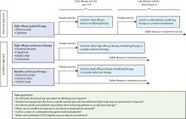
Because some oral treatments, such as cladribine, have long-lasting effects on the immune system, the cumulative effects of sequential monotherapies can resemble the effects of a concurrent combination therapy. This treatment scheme might lead to higher efficacy but also to new safety concerns. These sequential treatments were largely excluded in phase 2 and 3 trials; therefore, monitoring both short-term and long-term effects of sequential disease-modifying therapies in phase 4 studies, cohort studies, and registries will be necessary.
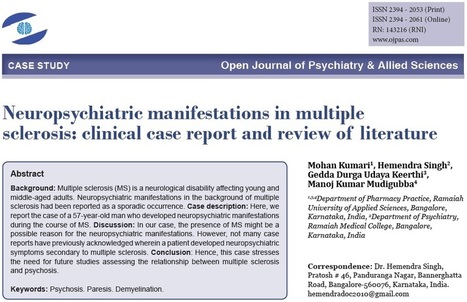
“Neuropsychiatric manifestations in multiple sclerosis: clinical case report and review of literature” by Mohan Kumari, Hemendra Singh, Gedda Durga Udaya Keerthi, and Manoj Kumar Mudigubba is the new Advance Online Publication of the Open Journal of Psychiatry & Allied Sciences (OJPAS®).
Multiple Sclerosis results in a number of cognitive and physical symptoms, from difficulty with planning, learning, and thinking in general, to issues with vis…
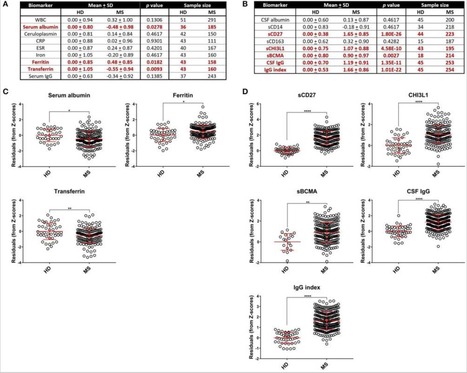
Systemic inflammation does not appear to be strongly associated with intrathecal inflammation in MS. Positive correlations between markers of intrathecal inflammation, especially of humoral immunity, with MS severity measures support a pathogenic role of intrathecal (compartmentalized) inflammation in central nervous system tissue destruction, including in Progressive MS.
Many factors guided therapeutic decision for our Italian cohort of MS patients; they are mainly related to MS disease activity, baseline EDSS, disease duration and age.
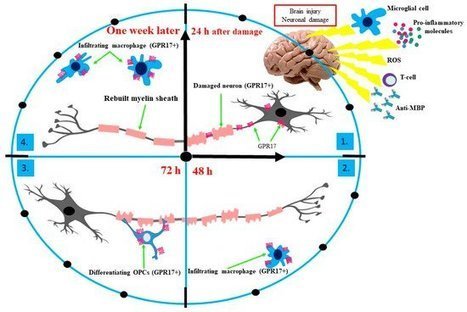
GPR17 receptors may be recognized as the potential goal in creating innovative therapies for the treatment of the neurodegenerative process in MS, based on the acceleration of the remyelination processes. This review examines the role of GRP17 in pathomechanisms of MS development.
Pain of any type and NP were both strongly linked to fatigue, depression, and disability. This link was even stronger after 4 years than at baseline. Moreover, changes in pain, depression, and fatigue were highly correlated without any of these symptoms preceding the others. Taken together, pain of any type seems to be much more frequent than NP in early nonprogressive MS. Moreover, the close relationship between pain, fatigue, and depression in MS should be considered for treatment decisions and future research on a possible common pathophysiology.
This page gives the latest guidance on coronavirus COVID-19 for people affected by multiple sclerosis. We will update this page as new information becomes available or advice changes.
In its article “Should I Tell,” the National MS Society advises: “Some people have misconceptions about MS and prejudices. Despite your best efforts, they may react negatively toward you, incorrectly viewing you as someone less competent or less able to handle stress.”
The phase 2b Multiple Sclerosis-Secondary Progressive Multi-Arm Randomisation Trial (MS-SMART) was thought to be the next best hope for finding a drug therapy to slow neurodegeneration, but it has proved to be another dead end for people with progressive multiple sclerosis (MS). So report the study’s investigators in a new article published online by The Lancet Neurology.
There is currently no sufficient evidence to support associations between standard vaccination policies and increased risk of MS. MS patients treated with immunomodulatory therapies may have a lower benefit from viral and bacterial vaccination. Despite their historical underperformance, new efforts in creating MS-based vaccines are currently ongoing. MS vaccination programs follow the set back and slow recovery which is widely seen in other fields of medicine.
People taking a drug cocktail containing one of the body’s natural immune chemicals called interferon beta 1b plus a combination HIV drug and an antiviral drug took seven days to recover from COVID-19. In comparison, it took people on only the HIV combo drug 12 days to get better, researchers report May 8 in the Lancet. Recovery included reduced shedding of virus, improvements in symptoms and discharge from the hospital.
This multiple sclerosis acupuncture case study describes a 45 year old woman who came to our clinic two years ago. She was struggling with frequent MS flares, problems walking, debilitating fatigue and weakness, balance problems, foggy brain and pain all over her body. After just a few treatments she started feeling better and was convinced that acupuncture was making a positive difference in her life.
35-year-old mother of two Kristy Cruise is slowly dying. A radical procedure could save her life but Australian doctors are refusing to treat her. So Kristy is going to Russia to be blasted with chemotherapy for days before being re-injected with her own stem cells. She hopes the treatment will stop her slow decline from multiple sclerosis. Already she's confined to a wheelchair with no feeling down her left side, suffering severe exhaustion and facing cognitive decline. The trip to Russia is physically, emotionally and financially taxing, but it's Kristy's last chance at salvaging some time with her husband and two young boys. 60 Minutes has been following Kristy on her journey and the results will send shockwaves through Australia's medical establishment.
Recent genetic evidence points towards endogenous retroviruses as playing a pivotal role in the causation of multiple sclerosis and possibly other autoimmune diseases. We discuss various ways in which this association could be brought about. Specifically, we suggest that two endogenous retroviruses, HERV-Fc1 and HERV-K13, on chromosomes X and 19, respectively, contribute to the development of autoimmune T cells by transforming them in multiple sclerosis. Partially overlapping sets of endogenous retroviruses may play a role in other autoimmune diseases. If this theory holds true, many scientists may have looked for viruses in the wrong tissue. Ir would also explain why lymphocyte-suppressive agents suppress multiple sclerosis.
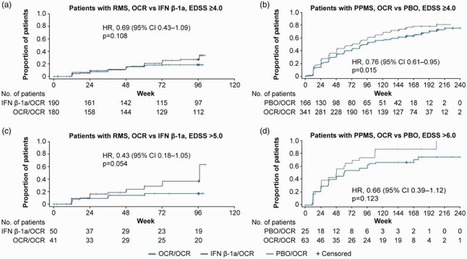
In patients with increased baseline disability, ocrelizumab reduced the risk of confirmed disability progression versus interferon β-1a in patients with relapsing-onset MS and versus placebo in patients with progression-onset MS.
Every week in the U.S., about 200 people are diagnosed with multiple sclerosis , or MS. According to the National Multiple Sclerosis Society, four times as many women have MS as men, and more and more women are developing it. Why? Is it genetics? Is it hormones or some other aspect of being female?
Multiple sclerosis is a growing neurologic auto-immune disease, and fatigue is considered one of the most common and debilitating side effects. Understanding how multiple sclerosis patients experience fatigue, the cause of their fatigue, as well as how they self-manage their fatigue will better inform healthcare providers and patients.
There are also several misconceptions surrounding MS and depression. Rehabilitation psychologist Abbey Hughes, Ph.D., works with individuals with MS and their loved ones to help clear up some of these myths and help them address and manage mood symptoms.
Johnson & Johnson's ponesimod recently beat blockbuster multiple sclerosis treatment Aubagio in a head-to-head test, and it's now hoping for an FDA approval.
As a wife and mother of two children, Annarita understands the importance of having an open dialogue with her family about her disease. This is reinforced by her work as a child psychologist, where she helps families to recognise the benefits of children actively engaging with family members who are living with a disease.
To get content containing either thought or leadership enter:
To get content containing both thought and leadership enter:
To get content containing the expression thought leadership enter:
You can enter several keywords and you can refine them whenever you want. Our suggestion engine uses more signals but entering a few keywords here will rapidly give you great content to curate.


 Your new post is loading...