Your new post is loading...

|
Scooped by
Gilbert C FAURE
April 16, 2017 4:58 AM
|
Author summary Intestinal health depends on maintaining a balanced microbial community within the highly dynamic environment of the intestine. Every few minutes, this environment is rocked by peristaltic waves of muscular contraction and relaxation through a process regulated by the enteric nervous system (ENS). We hypothesized that normal, healthy intestinal microbial communities are adapted to this dynamic environment, and that their composition would become perturbed without a functional ENS. To test this idea, we used a model organism, the zebrafish, with a genetic mutation that prevents formation of the ENS. We found that some mutant individuals without an ENS develop high levels of inflammation, whereas other mutants have normal intestines. We profiled the intestinal bacteria of inflamed and healthy mutants and found that the intestines of inflamed individuals have an overabundance of pro-inflammatory bacterial lineages, lack anti-inflammatory bacterial lineages, and are able to transmit inflammation to individuals with a normally functioning ENS. Conversely, we were able to prevent inflammation in the ENS mutants by either administering a representative anti-inflammatory bacterial strain or restoring ENS function. From these experiments, we conclude that the ENS modulates intestinal microbiota community membership to maintain intestinal health.
|
|
Scooped by
Gilbert C FAURE
April 16, 2017 4:55 AM
|
|
|
Scooped by
Gilbert C FAURE
April 14, 2017 3:29 PM
|
|
|
Scooped by
Gilbert C FAURE
April 13, 2017 1:46 PM
|
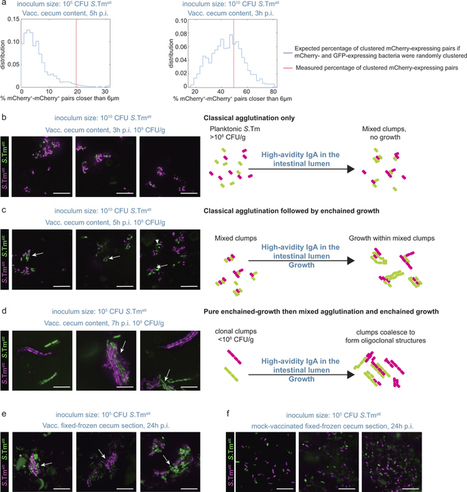
Vaccine-induced high-avidity IgA can protect against bacterial enteropathogens by directly neutralizing virulence factors or by poorly defined mechanisms that physically impede bacterial interactions with the gut tissues (‘immune exclusion’). IgA-mediated cross-linking clumps bacteria in the gut lumen and is critical for protection against infection by non-typhoidal Salmonella enterica subspecies enterica serovar Typhimurium (S. Typhimurium). However, classical agglutination, which was thought to drive this process, is efficient only at high pathogen densities (≥108 non-motile bacteria per gram). In typical infections, much lower densities (100–107 colony-forming units per gram) of rapidly dividing bacteria are present in the gut lumen. Here we show that a different physical process drives formation of clumps in vivo: IgA-mediated cross-linking enchains daughter cells, preventing their separation after division, and clumping is therefore dependent on growth. Enchained growth is effective at all realistic pathogen densities, and accelerates pathogen clearance from the gut lumen. Furthermore, IgA enchains plasmid-donor and -recipient clones into separate clumps, impeding conjugative plasmid transfer in vivo. Enchained growth is therefore a mechanism by which IgA can disarm and clear potentially invasive species from the intestinal lumen without requiring high pathogen densities, inflammation or bacterial killing. Furthermore, our results reveal an untapped potential for oral vaccines in combating the spread of antimicrobial resistance.
|
|
Scooped by
Gilbert C FAURE
April 13, 2017 11:12 AM
|
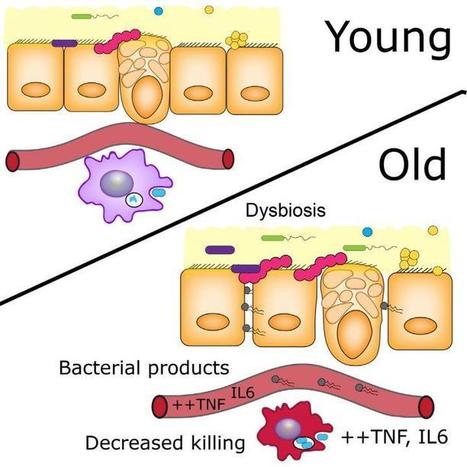
Inflammation increases with age and is a strong risk factor for death in the elderly, but the underlying cause has not been clear. A study published in Cell Host & Microbe reveals that gut microbes are one of the culprits behind age-associated inflammation and premature death in mice. Imbalances in the gut microbes in older mice cause the intestines to become leaky, allowing the release of bacterial products that trigger inflammation and impair immune function.
|
|
Scooped by
Gilbert C FAURE
April 10, 2017 1:56 PM
|
The requirement of type I interferon (IFN) for natural killer (NK) cell activation in response to viral infection is known, but the underlying mechanism remains unclear. Here, we demonstrate that type I IFN signaling in inflammatory monocytes, but not in dendritic cells (DCs) or NK cells, is essential for NK cell function in response to a mucosal herpes simplex virus type 2 (HSV-2) infection. Mice deficient in type I IFN signaling, Ifnar−/− and Irf9−/− mice, had significantly lower levels of inflammatory monocytes, were deficient in IL-18 production, and lacked NK cell–derived IFN-γ. Depletion of inflammatory monocytes, but not DCs or other myeloid cells, resulted in lower levels of IL-18 and a complete abrogation of NK cell function in HSV-2 infection. Moreover, this resulted in higher susceptibility to HSV-2 infection. Although Il18−/− mice had normal levels of inflammatory monocytes, their NK cells were unresponsive to HSV-2 challenge. This study highlights the importance of type I IFN signaling in inflammatory monocytes and the induction of the early innate antiviral response.
|
|
Scooped by
Gilbert C FAURE
April 10, 2017 1:49 PM
|
Prevotella copri, an intestinal microbe, may overexpand in stool samples from patients with new‐onset rheumatoid arthritis (RA), but it is not yet clear whether the organism has immune relevance i
|
|
Scooped by
Gilbert C FAURE
April 10, 2017 1:34 PM
|
A new study could change the lives of millions of people living with inflammatory bowel diseases (IBD) who don’t respond to the current standard of care.
|
|
Scooped by
Gilbert C FAURE
April 5, 2017 12:15 PM
|
|
|
Scooped by
Gilbert C FAURE
April 4, 2017 7:49 AM
|
Cellular and Molecular Immunology aims to report the dynamic progress being made in China and abroad in immunological research, and welcomes high-quality Research Articles, Reviews and Brief Reports across a broad range of topics including, but not limited to, clinical immunology, comparative immunology, immunobiology, immunogenetics, immunological techniques, immunopathology, immunopharmacology, infection immunology, neuroimmunology, transplantation immunology, tumor immunology, and veterinary immunology.
|
|
Scooped by
Gilbert C FAURE
April 3, 2017 4:25 AM
|
This review is concerned with a number of recent publications that contribute to current thinking on the pathogenesis of spondyloarthritis. The areas covered include the lymphocyte population in the enthesis, which is thought to drive enthesitis, and hence clinical manifestations. The debate on how HLA-B27 is implicated in inflammation is also considered, together with recent and contradictory evidence on the effects of the peptide-trimming enzyme ERAP1 on B27 expression and hence susceptibility to spondylitis. Lastly, a recent report on the role of the gut microbiome in an important model of spondyloarthritis is considered.
|
|
Scooped by
Gilbert C FAURE
April 3, 2017 1:56 AM
|
Infections in the first year of life are common and often severe. The newborn host
demonstrates both quantitative and qualitative differences to the adult in nearly
all aspects of immunity, which at least partially explain the increased susceptibility
to infection. Here we discuss how differences in susceptibility to infection result
not out of a state of immaturity, but rather reflect adaptation to the particular
demands placed on the immune system in early life. We review the mechanisms underlying
host defense in the very young, and discuss how specific developmental demands increase
the risk of particular infectious diseases. In this context, we discuss how this plasticity,
i.e. the capacity to adapt to demands observed in early life, also provides the potential
to leverage protection of the young against infection and disease through a number
of interventions.
|
|
Scooped by
Gilbert C FAURE
April 2, 2017 2:08 PM
|
Introduction Gastroenteritis is the leading cause of morbidity and mortality among young children living in resource-poor settings, majority of which is attributed to rotavirus. Rotavirus vaccination can therefore have a significant impact on infant mortality. However, rotavirus vaccine efficacy in Sub-Saharan Africa and Southeast Asia is significantly lower than in high-income countries. Maternally derived antibodies, infant gut microbiota and concomitant oral polio vaccination have been proposed as potential reasons for poor vaccine performance in low-income settings. The overall aim of this study is to compare the role of maternally derived antibodies and infant gut microbiota in determining immune response to rotavirus vaccine in high-income and low-income settings, using the same vaccine and a similar study protocol.
Methods and analysis The study is an observational cohort in three countries—Malawi, India and UK. Mothers will be enrolled in third trimester of pregnancy and followed up, along with infants after delivery, until the infant completes two doses of oral rotavirus vaccine (along with routine immunisation). The levels of prevaccination maternally derived rotavirus-specific antibodies (IgG) will be correlated with infant seroconversion and antibody titres, 4 weeks after the second dose of rotavirus vaccine. Both within-country and between-country comparisons of gut microbiome will be carried out between children who seroconvert and those who do not. The impact of oral polio vaccine coadministration on rotavirus vaccine response will be studied in Indian infants.
Ethics and dissemination Ethical approvals have been obtained from Integrated Research Application System (IRAS, NHS ethics) in UK, College of Medicine Research and Ethics Committee (COMREC) in Malawi and Institutional Review Board (IRB), Christian Medical College, Vellore in India. Participant recruitment and follow-up is ongoing at all three sites. Analysis of data, followed by publication of the results, is expected in 2018.
|
|
|
Scooped by
Gilbert C FAURE
April 16, 2017 4:56 AM
|
Previous studies on a limited number of birds suggested that the IgD-encoding gene was absent in birds. However, one of our recent studies showed that the gene was definitely expressed in the ostrich and emu. Interestingly, we also identified subclass diversification of IgM and IgY in these two birds. To better understand immunoglobulin genes in birds, in this study, we analyzed the immunoglobulin heavy chain genes in the zebra finch (Taeniopygia guttata) and Gentoo penguin (Pygoscelis papua), belonging respectively to the order Passeriformes, the most successful bird order in terms of species diversity and numbers, and Sphenisciformes, a relatively primitive avian order. Similar to the results obtained in chickens and ducks, only three genes encoding immunoglobulin heavy chain isotypes, IgM, IgA and IgY, were identified in both species. Besides, we detected a transcript encoding a short membrane-bound IgA lacking the last two CH exons in the Gentoo penguin. We did not find any evidence supporting the presence of IgD gene or subclass diversification of IgM/IgY in penguin or zebra finch. The obtained data in our study provide more insights into the immunoglobulin heavy chain genes in birds and may help to better understand the evolution of immunoglobulin genes in tetrapods.
|
|
Scooped by
Gilbert C FAURE
April 16, 2017 4:54 AM
|
American Journal of Respiratory and Critical Care Medicine, Volume 195, Issue 8, Page 1010-1021, April 15, 2017.
|
|
Scooped by
Gilbert C FAURE
April 13, 2017 1:55 PM
|
Helicobacter pylori , the dominant member of the human gastric microbiota, elicits immunoregulatory responses implicated in protective versus pathological outcomes. To evaluate the role of macrophages during infection, we employed a system with a shifted proinflammatory macrophage phenotype by deleting PPARγ in myeloid cells and found a 5- to 10-fold decrease in gastric bacterial loads. Higher levels of colonization in wild-type mice were associated with increased presence of mononuclear phagocytes and in particular with the accumulation of CD11b+F4/80hiCD64+CX3CR1+ macrophages in the gastric lamina propria. Depletion of phagocytic cells by clodronate liposomes in wild-type mice resulted in a reduction of gastric H. pylori colonization compared with nontreated mice. PPARγ-deficient and macrophage-depleted mice presented decreased IL-10–mediated myeloid and T cell regulatory responses soon after infection. IL-10 neutralization during H. pylori infection led to increased IL-17–mediated responses and increased neutrophil accumulation at the gastric mucosa. In conclusion, we report the induction of IL-10–driven regulatory responses mediated by CD11b+F4/80hiCD64+CX3CR1+ mononuclear phagocytes that contribute to maintaining high levels of H. pylori loads in the stomach by modulating effector T cell responses at the gastric mucosa.
|
|
Scooped by
Gilbert C FAURE
April 13, 2017 1:26 PM
|
Emerging Microbes and Infections (EMI) is a new open access, fully peer-reviewed journal that will publish the best and most interesting research in emerging microbes and infectious disease.
|
|
Scooped by
Gilbert C FAURE
April 12, 2017 2:38 PM
|
|
|
Scooped by
Gilbert C FAURE
April 10, 2017 1:56 PM
|
As a long-standing biomedical model, rats have been frequently used in studies exploring the correlations between gastrointestinal (GI) bacterial biota and diseases.
|
|
Scooped by
Gilbert C FAURE
April 10, 2017 1:48 PM
|
PLoS Negl Trop Dis. 2016 Jun 16;10(6):e0004753. doi: 10.1371/journal.pntd.0004753. eCollection 2016. Research Support, N.I.H., Extramural; Research Support, Non-U.S. Gov't
|
|
Scooped by
Gilbert C FAURE
April 9, 2017 2:29 PM
|
The ISME Journal: Multidisciplinary Journal of Microbial Ecology is the official Journal of the International Society for Microbial Ecology, publishing high-quality, original research papers, short communications, commentary articles and reviews in the rapidly expanding and diverse discipline of microbial ecology.
|
|
Scooped by
Gilbert C FAURE
April 5, 2017 11:24 AM
|
Mucosal Immunology is the official publication of the Society of Mucosal Immunology (SMI). It aims to provide a forum for both basic and clinical scientists to discuss all aspects of immunity and inflammation involving mucosal tissues. The journal reflects the interests of scientists studying gastrointestinal, pulmonary, nasopharyngeal, oral, ocular, and genitourinary immunology through the publication of original research articles, scholarly reviews, and timely commentaries, editorials and letters.
|
|
Scooped by
Gilbert C FAURE
April 3, 2017 1:50 PM
|
Mucosal Immunology is the official publication of the Society of Mucosal Immunology (SMI). It aims to provide a forum for both basic and clinical scientists to discuss all aspects of immunity and inflammation involving mucosal tissues. The journal reflects the interests of scientists studying gastrointestinal, pulmonary, nasopharyngeal, oral, ocular, and genitourinary immunology through the publication of original research articles, scholarly reviews, and timely commentaries, editorials and letters.
|
|
Scooped by
Gilbert C FAURE
April 3, 2017 4:25 AM
|
|
|
Scooped by
Gilbert C FAURE
April 2, 2017 2:09 PM
|
Epstein-Barr virus (EBV) is a common human herpes virus known to infect the majority of the world population. Infection with EBV is often asymptomatic but can manifest in a range of pathologies from infectious mononucleosis to severe cancers of epithelial and lymphocytic origin. Indeed, in the past decade, EBV has been linked to nearly 10% of all gastric cancers. Furthermore, recent advances in high-throughput next-generation sequencing and the development of humanized mice, which effectively model EBV pathogenesis, have led to a wealth of knowledge pertaining to strain variation and host-pathogen interaction. This review highlights some recent advances in our understanding of EBV biology, focusing on new findings on the early events of infection, the role EBV plays in gastric cancer, new strain variation, and humanized mouse models of EBV infection.
|