Your new post is loading...

|
Scooped by
Gilbert C FAURE
January 5, 2018 11:56 AM
|
Article Citation: Daniel R. Owen and David A. Owen (2018) Celiac Disease and Other Causes of Duodenitis. Archives of Pathology & Laboratory Medicine: January 2018, Vol. 142, No. 1, pp. 35-43. https://doi.org/10.5858/arpa.2016-0608-RA
|
|
Scooped by
Gilbert C FAURE
January 5, 2018 2:28 AM
|
Langerhans cells (LCs) reside in the epidermis as a dense network of immune system sentinels. These cells determine the appropriate adaptive immune response (inflammation or tolerance) by interpreting the microenvironmental context in which they encounter foreign substances. In a normal physiological, "non-dangerous" situation, LCs coordinate a continuous state of immune tolerance, preventing unnecessary and harmful immune activation. Conversely, when they sense a danger signal, for example during infection or when the physical integrity of skin has been compromised as a result of a trauma, they instruct T lymphocytes of the adaptive immune system to mount efficient effector responses. Recent advances investigating the molecular mechanisms underpinning the cross-talk between LCs and the epidermal microenvironment reveal its importance for programming LC biology. This review summarises the novel findings describing LC origin and function through the analysis of the transcriptomic programmes and gene regulatory networks (GRNs). Review and meta-analysis of publicly available datasets clearly delineates LCs as distinct from both conventional DCs and macrophages, suggesting a primary role for the epidermal microenvironment in programming LC biology. This concept is further supported by the analysis of the effect of epidermal pro-inflammatory signals, regulating key GRNs in human and murine LCs. Applying whole transcriptome analyses and in silico analysis has advanced our understanding of how LCs receive, integrate and process signals from the steady state and diseased epidermis. Interestingly, in homeostasis and under immunological stress, the molecular network in LCs’ remains relatively stable, reflecting a key evolutionary need related to tissue localisation. Importantly, to fulfil their key role in orchestrating anti-viral adaptive immune responses, LC share specific transcriptomic modules with other DC types able to cross-present antigens to cytotoxic CD8+ T cells, pointing to a possible evolutionary convergence mechanism. With the development of more advanced technologies allowing delineation of the molecular networks at the level of chromatin organisation, histone modifications, protein translation and phosphorylation, future “omics” investigations will bring in-depth understanding of the complex molecular mechanisms underpinning human LC biology.
|
|
Scooped by
Gilbert C FAURE
January 3, 2018 12:43 PM
|
The trillions of microbes living in the gut—the gut microbiota—play an important role in human biology and disease. While much has been done to explore its diversity, a full understanding of our microbiomes demands an evolutionary perspective. In this review, we compare microbiomes from human populations, placing them in the context of microbes from humanity’s near and distant animal relatives. We discuss potential mechanisms to generate host-specific microbiome configurations and the consequences of disrupting those configurations. Finally, we propose that this broader phylogenetic perspective is useful for understanding the mechanisms underlying human–microbiome interactions.
|
|
Scooped by
Gilbert C FAURE
January 3, 2018 12:41 PM
|
In this issue Ohsaki et al. (<https://doi.org/10.1084/jem.20171163>;) explain how breastfeeding can prevent the onset of food allergies in offspring by instructing T reg formation via neonatal Fc receptor (FcRn)–mediated transfer and uptake of allergen-containing IgG immune complexes (Ig-ICs) by gut dendritic cells (DCs).
|
|
Scooped by
Gilbert C FAURE
January 3, 2018 11:42 AM
|
Some gut conditions, such as inflammatory bowel disease (IBD), ulcerative colitis, and Crohn's disease (CD), are associated with imbalances in the gut microbe community. The causes of these intractable diseases have been difficult to discern. Atarashi et al. took samples from the mouths of IBD and CD patients and inoculated the extracted bacteria into germ-free mice (see the Perspective by Cao). Some of the inoculated mice showed strong proliferation of T helper 1 cells associated with the establishment of oral Klebsiella species in the colon. Klebsiella can be resistant to multiple antibiotics and are able to replace normal colon microbes after antibiotic therapy. Now we know that they probably originate from the mouth and could potentially contribute to bowel disease.
Science , this issue p. [359][1]; see also p. [308][2]
[1]: /lookup/doi/10.1126/science.aan4526
[2]: /lookup/doi/10.1126/science.aap9298
|
|
Scooped by
Gilbert C FAURE
January 2, 2018 1:09 PM
|
Accurate estimates of rotavirus incidence in infants are crucial given disparities in rotavirus vaccine effectiveness from low-income settings. Sero-surveys are a pragmatic means of estimating incidence however serological data is prone to misclassification. This study used mixture models to estimate incidence of rotavirus infection from anti-rotavirus immunoglobulin A (IgA) titres in infants from Vellore, India, and Karonga, Malawi. IgA titres were measured using serum samples collected at 6 month intervals for 36 months from 373 infants from Vellore and 12 months from 66 infants from Karonga. Mixture models (two component Gaussian mixture distributions) were fit to the difference in titres between time points to estimate risk of sero-positivity and derive incidence estimates. A peak incidence of 1.05(95% confidence interval [CI]: 0.64, 1.64) infections per child-year was observed in the first 6 months of life in Vellore. This declined incrementally with each subsequent time interval. Contrastingly in Karonga incidence was greatest in the second 6 months of life (1.41 infections per child year [95% CI: 0.79, 2.29]). This study demonstrates that infants from Vellore experience peak rotavirus incidence earlier than those from Karonga. Identifying such differences in transmission patterns is important in informing vaccine strategy, particularly where vaccine effectiveness is modest.
|
|
Scooped by
Gilbert C FAURE
January 2, 2018 1:00 PM
|
Respiratory syncytial virus–bronchiolitis is a major independent risk factor for subsequent asthma, but the causal mechanisms remain obscure. We identified that transient plasmacytoid dendritic cell (pDC) depletion during primary Pneumovirus infection alone predisposed to severe bronchiolitis in early life and subsequent asthma in later life after reinfection. pDC depletion ablated interferon production and increased viral load; however, the heightened immunopathology and susceptibility to subsequent asthma stemmed from a failure to expand functional neuropilin-1+ regulatory T (T reg) cells in the absence of pDC-derived semaphorin 4a (Sema4a). In adult mice, pDC depletion predisposed to severe bronchiolitis only after antibiotic treatment. Consistent with a protective role for the microbiome, treatment of pDC-depleted neonates with the microbial-derived metabolite propionate promoted Sema4a-dependent T reg cell expansion, ameliorating both diseases. In children with viral bronchiolitis, nasal propionate levels were decreased and correlated with an IL-6high/IL-10low microenvironment. We highlight a common but age-related Sema4a-mediated pathway by which pDCs and microbial colonization induce T reg cell expansion to protect against severe bronchiolitis and subsequent asthma.
|
|
Scooped by
Gilbert C FAURE
December 29, 2017 3:06 AM
|
This week PLOS Medicine launches the research content in our Collection on Prevention, Diagnosis, and Treatment of Sexually Transmitted Infections (STIs), advised by Guest Editors Nicola Low of the University of Bern, Switzerland and Nathalie Broutet of the World Health Organization (WHO).
|
|
Scooped by
Gilbert C FAURE
December 26, 2017 4:01 AM
|
This review focuses on the role of the lung microbiome in idiopathic pulmonary fibrosis. Although historically considered sterile, bacterial communities have now been well documented in lungs both in healthy and pathological conditions. Studies in idiopathic pulmonary fibrosis (IPF) suggest that increased bacterial burden and/or abundance of potentially pathogenic bacteria may drive disease progression, acute exacerbations, and mortality. More recent work has highlighted the interaction between the lung microbiome and the innate immune system in IPF, strengthening the argument for the role of both host and environment interaction in disease pathogenesis. Existing published data suggesting that the lung microbiome may represent a therapeutic target, via antibiotic administration, immunization against pathogenic organisms, or treatment directed at gastroesophageal reflux. Taken altogether, published literature suggests that the lung microbiome might serve in the future as a prognostic biomarker, a therapeutic target, and/or provide an explanation for disease pathogenesis in IPF.
|
|
Scooped by
Gilbert C FAURE
December 23, 2017 11:38 AM
|
The immune and metabolic systems intertwine to govern crucial physiological and pathological
processes throughout the life of an organism. Zmora et al. delineate the role of individual
endogenous and exogenous factors in shaping immune-metabolic interactions in homeostasis
and disease settings and suggest that personally tailored immune targeted approaches
may tackle metabolic disorders.

|
Suggested by
Société Francaise d'Immunologie
December 23, 2017 11:28 AM
|
Am J Respir Cell Mol Biol. 2017 Dec 21. doi: 10.1165/rcmb.2017-0236OC. [Epub ahead of print]
|
|
Scooped by
Gilbert C FAURE
December 22, 2017 1:39 PM
|
Anyone watching their waistline this holiday season may want to pay attention to what their gut bacteria are eating. It's not just calories that matter in a healthy diet -- it's fiber, which can influence weight gain, blood sugar, insulin sensitivity, and colon health. Two studies with mice, publishing Dec. 21 in the journal Cell Host & Microbe, help shed light on how and why fiber has such a powerful effect on the entire body.
|
|
Scooped by
Gilbert C FAURE
December 18, 2017 1:47 PM
|
Generation of Ag-specific humoral responses requires the orchestrated development and function of highly specialized immune cells in secondary lymphoid organs. We used a multiparametric approach combining flow cytometry, confocal microscopy, and histocytometry to analyze, for the first time to our knowledge in children, tonsils from seasonal influenza–vaccinated children. We used these novel imaging assays to address the mucosal immune dynamics in tonsils investigating the spatial positioning, frequency, and phenotype of immune cells after vaccination. Vaccination was associated with a significantly higher frequency of follicular helper CD4 T cells compared with the unvaccinated control group. The imaging analysis revealed that potential suppressor (FOXP3hi) CD4 T cells are mainly located in extrafollicular areas. Furthermore, a significantly reduced frequency of both follicular and extrafollicular FOXP3hi CD4 T cells was found in the vaccine group compared with the control group. Levels of circulating CXCL13 were higher in those vaccinated compared with controls, mirroring an increased germinal center reactivity in the tonsils. Notably, a strong correlation was found between the frequency of tonsillar T follicular helper cells and tonsillar Ag-specific Ab-secreting cells. These data demonstrate that influenza vaccination promotes the prevalence of relevant immune cells in tonsillar follicles and support the use of tonsils as lymphoid sites for the study of germinal center reactions after vaccination in children.
|
|
|
Scooped by
Gilbert C FAURE
January 5, 2018 11:53 AM
|
|
|
Scooped by
Gilbert C FAURE
January 4, 2018 2:06 PM
|
|
|
Scooped by
Gilbert C FAURE
January 3, 2018 12:42 PM
|
In a Perspective for our Collection on STI research, Janneke van de Wijgert discusses the latest on how the vaginal microbiota predisposes women to acquisition of STIs and discusses future potential for clinical intervention.
|
|
Scooped by
Gilbert C FAURE
January 3, 2018 12:38 PM
|
Summary Laboratory mice, while paramount for understanding basic biological phenomena, are limited in modeling complex diseases of humans and other free-living mammals. Because the microbiome is a major factor in mammalian physiology, we aimed to identify a naturally evolved reference microbiome to better recapitulate physiological phenomena relevant in the natural world outside the laboratory. Among 21 distinct mouse populations worldwide, we identified a closely related wild relative to standard laboratory mouse strains. Its bacterial gut microbiome differed significantly from its laboratory mouse counterpart and was transferred to and maintained in laboratory mice over several generations. Laboratory mice reconstituted with natural microbiota exhibited reduced inflammation and increased survival following influenza virus infection and improved resistance against mutagen/inflammation-induced colorectal tumorigenesis. By demonstrating the host fitness-promoting traits of natural microbiota, our findings should enable the discovery of protective mechanisms relevant in the natural world and improve the modeling of complex diseases of free-living mammals.
|
|
Scooped by
Gilbert C FAURE
January 2, 2018 1:11 PM
|
Previous study revealed that a specific lignin-carbohydrate preparation, named as lignin-rich enzyme lignin (LREL) derived from plant husk, is a novel toll-like receptor 4 ligand and shows a potent immune-stimulatory activity against dendritic cells (DCs) in vitro. In this report, we investigated immune-stimulatory activity of LREL in vivo. Single intraperitoneal (i.p.) or oral treatment of LREL elicited activation of systemic and mucosal DCs, which were accompanied by significant elevation of cell surface activation markers and ratio of IL-12p40 producing cells. In addition, LREL-fed mice showed not only mucosal DCs activation but also significant increase of IFN-γ+ CD4+ T cells in mesenteric lymph node (MLN), respectively. We further examined the effect of LREL oral immunization in combination with ovalbumin (OVA) on the activation of acquired immune system. In LREL administered group, total mucosal IgA concentration was significantly increased, while antigen-specific immunoglobulin A (IgA) concentration was not changed between groups. On the other hand, both total and antigen-specific IgG concentrations in plasma were significantly increased in the LREL administered group. Taken together, oral treatment of LREL is able to affect mucosal and systemic antibodies induction and might be useful for effective immune-stimulatory functional foods and mucosal vaccine adjuvant.
|
|
Scooped by
Gilbert C FAURE
January 2, 2018 1:08 PM
|
The role of immunosuppression in IgA nephropathy (IgAN) is controversial. In the Supportive Versus Immunosuppressive Therapy for the Treatment of Progressive IgA Nephropathy (STOP-IgAN) Trial, 162 patients with IgAN and proteinuria >0.75 g/d after 6 months of optimized supportive care were randomized into two groups: continued supportive care or additional immunosuppression (GFR≥60 ml/min per 1.73 m2: 6-month corticosteroid monotherapy; GFR=30–59 ml/min per 1.73 m2: cyclophosphamide for 3 months followed by azathioprine plus oral prednisolone). Coprimary end points were full clinical remission and GFR loss ≥15 ml/min per 1.73 m2 during the 3-year trial phase. In this secondary intention to treat analysis, we separately analyzed data from each immunosuppression subgroup and the corresponding patients on supportive care. Full clinical remission occurred in 11 (20%) patients receiving corticosteroid monotherapy and three (6%) patients on supportive care (odds ratio, 5.31; 95% confidence interval, 1.07 to 26.36; P=0.02), but the rate did not differ between patients receiving immunosuppressive combination and controls on supportive care (11% versus 4%, respectively; P=0.30). The end point of GFR loss ≥15 ml/min per 1.73 m2 did not differ between groups. Only corticosteroid monotherapy transiently reduced proteinuria at 12 months. Severe infections, impaired glucose tolerance, and/or weight gain in the first year were more frequent with either immunosuppressive regimen than with supportive care. In conclusion, only corticosteroid monotherapy induced disease remission in a minority of patients who had IgAN with relatively well preserved GFR and persistent proteinuria. Neither immunosuppressive regimen prevented GFR loss, and both associated with substantial adverse events.
|
|
Scooped by
Gilbert C FAURE
January 2, 2018 11:25 AM
|
Macrophages (Mfs) are instrumental in maintaining immune homeostasis in the intestine, yet studies on the origin and heterogeneity of human intestinal Mfs are scarce. Here, we identified four distinct Mf subpopulations in human small intestine (SI). Assessment of their turnover in duodenal transplants revealed that all Mf subsets were completely replaced over time; Mf1 and Mf2, phenotypically similar to peripheral blood monocytes (PBMos), were largely replaced within 3 wk, whereas two subsets with features of mature Mfs, Mf3 and Mf4, exhibited significantly slower replacement. Mf3 and Mf4 localized differently in SI; Mf3 formed a dense network in mucosal lamina propria, whereas Mf4 was enriched in submucosa. Transcriptional analysis showed that all Mf subsets were markedly distinct from PBMos and dendritic cells. Compared with PBMos, Mf subpopulations showed reduced responsiveness to proinflammatory stimuli but were proficient at endocytosis of particulate and soluble material. These data provide a comprehensive analysis of human SI Mf population and suggest a precursor-progeny relationship with PBMos.
|
|
Scooped by
Gilbert C FAURE
December 28, 2017 2:15 AM
|
Maternal nourishment of the fetus at early stage has remained undefined. Fu et al.
identify CD49a+Eomes+ trNK cells in the uterus that secrete growth-promoting factors
enhancing fetal growth during critical early stages of fetal development.
|
|
Scooped by
Gilbert C FAURE
December 23, 2017 11:40 AM
|
Each year there are more than three million cases of cholera worldwide, a disease transmitted through contaminated food and water that hits developing countries particularly hard. While the standard regimen for protectin
|
|
Scooped by
Gilbert C FAURE
December 23, 2017 11:29 AM
|
<b><i>Background:</i></b> Although the stem cell marker Bmi1 is overexpressed in many malignancies, its role in inflammation-associated cancer is unclear. Colitis-associated ca
|
|
Scooped by
Gilbert C FAURE
December 22, 2017 1:46 PM
|
|
|
Suggested by
Société Francaise d'Immunologie
December 21, 2017 8:42 AM
|
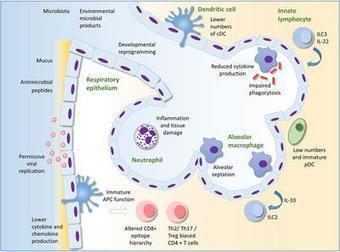
Early life is a period of particular susceptibility to respiratory infections and symptoms are frequently more severe in infants than in adults. The neonatal immune system is generally held to be deficient in most compartments; responses to innate stimuli are weak, antigen presenting cells have poor immunostimulatory activity and adaptive lymphocyte responses are limited, leading to poor immune memory and ineffective vaccine responses. For mucosal surfaces such as the lung, which is continuously exposed to airborne antigen and to potential pathogenic invasion, the ability to discriminate between harmless and potentially dangerous antigens is essential, to prevent inflammation that could lead to loss of gaseous exchange and damage to the developing lung tissue. We have only recently begun to define the differences in respiratory immunity in early life and its environmental and developmental influences. The innate immune system may be of relatively greater importance than the adaptive immune system in the neonatal and infant period than later in life, as it does not require specific antigenic experience. A better understanding of what constitutes protective innate immunity in the respiratory tract in this age group and the factors that influence its development should allow us to predict why certain infants are vulnerable to severe respiratory infections, design treatments to accelerate the development of protective immunity and design age specific adjuvants to better boost immunity to infection in the lung.
|


 Scoop.it!