Wearable Tech and the Internet of Things (Iot)
22.8K views | +14 today
Wearable Tech and the Internet of Things (Iot)
Your new post is loading...
Scooped by Richard Platt
September 25, 2015 10:38 PM
Scoop.it!

An Intel Curie-powered smart sports bra and more wearable tech at NYFW

An Intel Curie-powered smart sports bra and more wearable tech at NYFW | Wearable Tech and the Internet of Things (Iot) | Scoop.it

We know smart clothing is perfectly placed to monitor our bodies as we work out but what can it do with all that data? Sending it to your smartphone or computer isn't the only answer. This smart Aeros sports bra from Chromat is one example of wearable tech infiltrating the twice-yearly annual fashion weeks, which…
Richard Platt's insight:

We know smart clothing is perfectly placed to monitor our bodies as we work out but what can it do with all that data? Sending it to your smartphone or computer isn't the only answer.  This smart Aeros sports bra from Chromat is one example of wearable tech infiltrating the twice-yearly annual fashion weeks, which have kicked off in New York. Chromat is a New York based brand founded in 2010 by Becca McCharen and its smart bra tracks temperature, perspiration and stress levels; actually changing shape to support the wearer and optimise comfort.  The Lycra, mesh and neoprene bra uses shape memory alloy, smart metal which 'remembers' its original shape. Essentially, it transforms itself as and when you're hot and sweaty by opening and closing vents to cool you down or warm you up. This is a genuinely useful idea and one we hope moves into the mainstream quicker than some smart clothing ideas we've seen. Chromat's Aeros bra was debuted at MADE Fashion Week, part of New York Fashion Week, alongside the slightly wackier Adrenaline Dress which also uses biometric tracking to change its form.  The 3D printed, TPU and neoprene smart dress senses the wearer's adrenaline levels, like Anouk Wipprecht's protective smart dresses, and its carbon fibre framework expands into an architectural hourglass shape when stress levels rise. It's more showstopper than everyday dress clearly.   Both pieces of stylish smart clothing are powered by Intel's latest Curie module, aimed at designers, developers and makers and the focus of a wearable tech reality show airing in 2016.

No comment yet.
Scooped by Richard Platt
September 21, 2015 9:45 PM
Scoop.it!

Microsoft's Rumored Band 2 Could Have a Curved Display

Microsoft's Rumored Band 2 Could Have a Curved Display | Wearable Tech and the Internet of Things (Iot) | Scoop.it
As Microsoft's Oct. 6 press event approaches, rumors say that the company could be unveiling its next fitness wearable, the Band 2.
Richard Platt's insight:

Microsoft's Band fitness band could be getting a makeover with a new curved display and other improvements as the company prepares to unveil an assortment of new devices at its upcoming Oct. 6 press event.  Microsoft is expected to announce the sleeker, curved-display Microsoft Band 2 fitness band at the event, ushering in key changes for the Band line, according to a Sept. 21 article in Tech Times.   Several leaked images that were posted on the Internet showed a curved display that will better fit a wearer's wrist, along with a more modern appearance, the report stated. "The images also show what seems to be a metallic finish around the display, possibly to give the device a more premium look. It appears Microsoft has also decided to throw in a couple of buttons on the side of the display to help users navigate the device's elongated display more easily. The battery is also believed to have been moved from the sides of the display to underneath it."  The upcoming device will also reportedly gain the ability to track elevation, so that users can track stair climbing or walking or running up hills, the story said. The upcoming product will also reportedly be available in other countries outside the United States.

No comment yet.
Scooped by Richard Platt
September 20, 2015 7:50 PM
Scoop.it!

Google hires ex-Amazon Lab126 engineers for Wearable tech initiative called 'Project Aura'

Google hires ex-Amazon Lab126 engineers for Wearable tech initiative called 'Project Aura' | Wearable Tech and the Internet of Things (Iot) | Scoop.it
Google is working on a new wearable technology effort known as Project Aura and is hiring consumer electronics experts from Amazon's secretive Lab126.
Richard Platt's insight:

Google is working on a new wearable technology effort known as Project Aura and is hiring consumer electronics experts from Amazon's secretive Lab126 to jump-start the new group.   Project Aura appears to have gotten started in June and is focused on reviving Google's troubled Glass computer eyeglasses, as well as accelerating Google's efforts to develop related wearable technology.

Project Aura will remain within Google rather than being a standalone company under the new Alphabet holding company or being folded into the Nest smart appliances business, a source familiar with the matter told Business Insider.  Nest CEO Tony Fadell will continue to have high-level oversight of the project, though it's unclear what will happen after Nest becomes a separate Alphabet company, the source said. Ivy Ross, a fashion industry veteran that Google hired to lead the Glass team in 2014, is heading up the Aura group.  Project Aura is not be be confused with Project Ara, Google's modular phone concept.

Amazon's Lab126 Experts are Now Google's:  Dima Svetlov, whose LinkedIn profile says he worked on Amazon's TV streaming stick, joined Aura as a software development manager in May. Amir Frenke joined in June as a director of software development. Tina Chen left Lab126 in August after working on its TV streaming box and smart-home assistant, Echo, and now works as Aura's manager of technical program management.  Lab126, which makes consumer devices like Amazon's Kindle e-readers, TV streaming products, and the ill-received Fire smartphone, reportedly laid off dozens of engineers who had worked on the phone earlier this summer.  Svetlov, Frenke, and Chen, whose LinkedIn profiles don't reveal any details about Project Aura besides the description that it works on Glass "and beyond," are joining Apple veteran Max Ratner, who worked on the iPhone.

The project even has its own designated recruiter, Jessica Bailow, who has been focused on Aura since June, according to her LinkedIn profile. And Google recently posted several job openings for the Aura team, including a program manager for category development, an industrial designer and a UX designer.   Business Insider also recently reported that Adrian Wong, the former Google Glass lead electrical engineer, who had defected to Facebook-owned virtual-reality startup Oculus, quietly rejoined Google in June. His LinkedIn profile describes his new job only as "building blocks" for Alphabet/Google.


No comment yet.
Scooped by Richard Platt
September 18, 2015 8:11 PM
Scoop.it!

Sensor Opportunities in Wearable Tech

Sensor Opportunities in Wearable Tech | Wearable Tech and the Internet of Things (Iot) | Scoop.it
Sensor Opportunities in Wearable Technology | Printed Electronics World
Richard Platt's insight:

This video provides an overview of the opportunities for sensors in wearable technologies. It is given by James Hayward, a Technology Analyst at IDTechEx Research.

No comment yet.
Scooped by Richard Platt
September 17, 2015 12:16 PM
Scoop.it!

A Critical Look at Gartner's Internet of Things

A Critical Look at Gartner's Internet of Things | Wearable Tech and the Internet of Things (Iot) | Scoop.it
The end of the summer marks the return to school and a time to digest our favorite summer publication: the Gartner Hype Cycle for Emerging Technologies Chart. Every year I feel a bit confused about th
Richard Platt's insight:

So why should anyone care about this chart? Well I think when presented in aggregate it speaks volumes about what we aspire to develop over time regardless of industry reality and what we too easily dismiss.  For internet of things developers, we should take comfort in seeing that the industry has been growing and that even if the terminology is getting muddled, it's been here to stay for some time. Where it sits on the chart doesn't matter, it's the fact that it's there at all, in multiple guises, its success and growth hiding in plain sight.

Thierry Evangelista's comment, September 18, 2015 10:00 AM
Beyond IoT, it's always interesting to have a look back in the mirror and evaluate analysts reports 'a posteriori'.
Richard Platt's comment, September 18, 2015 10:14 AM
It can be an useful analysis
Scooped by Richard Platt
September 17, 2015 12:08 PM
Scoop.it!

The Internet of Things comes to the NFL

The Internet of Things comes to the NFL | Wearable Tech and the Internet of Things (Iot) | Scoop.it
Every NFL player and stadium will be equipped with RFID sensors and receivers, respectively, this football season, allowing the league to track fine-grained location data for every play.
Richard Platt's insight:

On Thursday, the defending Superbowl XLIX champion New England Patriots hosted the Pittsburgh Steelers opening the 2015 football season, each player will be equipped with a set of RFID sensors about the size of a quarter embedded in his shoulder pads, each emitting unique radio frequencies. Gillette Stadium (and every other stadium used by the NFL) has been equipped with 20 receivers to pick up those radio frequencies and pinpoint every player's field position, speed, distance traveled and acceleration in real time.   By using two sensors for each player — one embedded in the left shoulder pad and one on the right — the system will also be able to identify the facing of each player.   The NFL plans to use the data generated to power the NFL 2015 app for Xbox One and Windows 10, allowing for things like "Next Gen Replay" that will allow fans to call up stats for each player tied into highlight clips posted on the app. But that's just the beginning. The data will be fed to broadcasters, leveraged for in-stadium displays and provided to coaching staff and players.  "We've always had these traditional NFL stats," says Matt Swensson, senior director of Emerging Products and Technology at the NFL. "The league has been very interested in trying to broaden that and bring new statistics to the fans. Along the way, there's been more realization about how the data can be leveraged to make workflow more efficient around the game."   "This type of initiative really opens the doors to do more things at the venue," Swensson adds. "At the Pro Bowl last year, we had a display up that showed what players were on the field. By putting up what players were on the field in real time, it really gave fans more information."  Lincolnshire, Ill.-based Zebra Technologies is the NFL's technology partner in its IoT push. Founded in 1969, Zebra built its name on manufacturing and selling marking, tracking and printing technologies ranging from thermal barcode label and receipt printers, RFID smart label printer/encoders and card and kiosk printers. Beginning in 2013, it began pivoting into IoT and machine to machine (M2M) applications with the launch of its Zatar software platform. In the same year, it launched its MotionWorks Sports Solution, which powers the NFL initiative.


No comment yet.
Scooped by Richard Platt
September 17, 2015 11:57 AM
Scoop.it!

Acer Releases its First Wearable Tech in the U.S. – Acer Liquid Leap+

Acer Releases its First Wearable Tech in the U.S. – Acer Liquid Leap+ | Wearable Tech and the Internet of Things (Iot) | Scoop.it
Acer Releases its First Wearable Tech in the U.S. – Acer Liquid Leap+
Richard Platt's insight:

Because there aren’t enough fitness trackers in the world (Fitbit, iFit, Polar Loop 2, etc., etc.) Acer has released the Liquid Leap+, their brand of smart fitness tracker that you can slap on your wrist. Now, Acer released other versions of the Liquid Leap last year overseas but the Liquid Leap+ is the first Acer fitness tracker released in the U.S. While it’s already an over-saturated market there is room for a new and innovative design.  Unfortunately, the Acer Liquid Leap+ isn’t it. Don’t get me wrong, it works just fine but that’s where the problem lies. There’s no “reinvention of the wheel” or at the very least “creative improvement of the wheel.”   The Liquid Leap+ is pretty much what you can expect out of any other fitness tracker on the market. It tracks your number of steps, running distance, calories burned as well as minutes in the day you were active.   Its waterproof design allows you to take it in the water no deeper than a meter for a half hour. That means half hour showers are a go. If you take showers longer than 30 minutes leave the Liquid Leap+ out of it. Also re-evaluate your priorities – 30 minutes is way too long to be bathing yourself.

No comment yet.
Rescooped by Richard Platt from Objets connectés & automesure | Wearables, capteurs & quantified self — Pharmageek
September 11, 2015 1:58 PM
Scoop.it!

Top Trends Revolutionizing the Market for Wearable Devices

Top Trends Revolutionizing the Market for Wearable Devices | Wearable Tech and the Internet of Things (Iot) | Scoop.it
Whether it’s smart glasses, the smart watch, fitness trackers, or wrist bands, wearable devices are making an impact on the healthcare industry.

Via Sam Stern, Lionel Reichardt / le Pharmageek
Richard Platt's insight:

“The common thread across wearables is that the device is attached or worn on the body,” Tractica reports. “Wearables can be sensor-infused devices, clothing that is reading vital biometric data off the body, or simply a body-mounted camera or a pair of smart glasses that allows for hands-free operation. More importantly, wearables in their various shapes and forms are reinventing the way humans interact with computers, in the process getting a better understanding of their bodies and their   The United States and North America as a whole is leading the way in the wearables market while China is right behind. Additionally, the report finds one trend within the sector moving toward using analytics to study the wide range of consumer health data gathered via wearable devices.  “The wearables market is a collection of micro trends within each device segment, application area, and world region,” research director Aditya Kaul stated in a Tractica press release. “It is important to examine each of these areas closely in order to gain a comprehensive view about how the market will take shape in the years ahead.”  The Tractica report details several major wearable devices that are impacting the healthcare industry such as smart glasses, fitness trackers, body sensors, smart clothing, wearable cameras, and smart watches. When it comes to funding the wearables market, the report uncovered a key trend of crowdfunding and how it affects the development of these devices.  When it comes to virtual healthcare services including the virtual reality space, wearable devices are necessary to bring speedier medical care delivery. Wearable cameras along with smart glasses all bring benefits to physicians, such as when communicating with specialists located across the state or country.    “The wearable technology market is a combination of multiple device types, applications, and use cases. The breadth and diversity of the market makes it unique, and unlike any other consumer electronics category that has existed before,” stated the Tractica press release. “The wearables market is diversifying at an extraordinary pace. New device categories are emerging, applications are proliferating in consumer and enterprise markets alike, and business models are evolving rapidly.”

No comment yet.
Scooped by Richard Platt
September 6, 2015 4:13 PM
Scoop.it!

Wearable Computing and Human Computer Interfaces

These slides discuss how improvements in ICs, MEMS, cameras, and other electronic components are making wearable computing and new forms of human-computer int…
Richard Platt's insight:

A worthwhile read for those in the wearable design world and need some pointers

No comment yet.
Scooped by Richard Platt
September 5, 2015 4:04 PM
Scoop.it!

Ollinfit Looks to Emulate Personal Trainer Experience with Wearable Tech

Ollinfit Looks to Emulate Personal Trainer Experience with Wearable Tech | Wearable Tech and the Internet of Things (Iot) | Scoop.it
Another Canadian startup is joining the wave of hardware companies bringing wearable technology into the gym. Ollinfit has developed three
Richard Platt's insight:

Ollinfit has developed three wearable sensors and a app that allows users to get feedback on their weightlifting form as they work out.

“Basically what we’re trying to do is help new beginners that are going to the gym,” says Ibadat Bambrah, one of the startup’s three co-founders. “We monitor their form and provide live audio and vibration feedback to let them know how well they’re doing and give them some recommendations to improve their form. We also have weight advising. A lot of people aren’t sure how much they should be lifting, so we monitor their motion to see if they’re lifting too much or too little.”  The app also has workout plans that users can follow.

“We’re trying to achieve a personal training experience using today’s technology,” he says. “Our goal is to make personal training more affordable and accessible.”   The app uses an learning algorithm and it already incorporates data from users with different body-types, from different age groups and genders.  “We supply it with common errors that beginners tend to make, so every time our sensors detects motion it will compare it to the database that we’ve created,” says Hendrik Poernama, another one of the co-founders. “The more data that we get into our database … the more accurate our system is going to be.”   While the system is largely aimed at people who are new to the gym, Poernama says it’s also for people who are trying a new excises for the first time. He says he’s seen the demand.  “Sometimes people take a video of themselves doing the life and they post it on the internet to ask for feedback which is not very convenient,” he says. “Whoever benefits from a personal trainer would benefit from our product.”

No comment yet.
Scooped by Richard Platt
September 5, 2015 3:41 PM
Scoop.it!

Singapore public transport commuters test wearable tech payment

Singapore public transport commuters test wearable tech payment | Wearable Tech and the Internet of Things (Iot) | Scoop.it
SINGAPORE, Aug 31 — Two hundred public transport commuters are now using smart wristbands to pay for their bus and MRT/LRT rides as part of a six-month trial that started today.

Spearheaded by the Land Transport Authority (LTA), the trial will
Richard Platt's insight:

Spearheaded by the Land Transport Authority (LTA), the trial will allow commuters wearing the Sony SG50 SmartBands to pay for trips simply by holding their wrists up to the fare card reader on buses and at MRT/LRT stations.  The digital cards encoded in the wristbands will also allow users to make payments at retail and merchant outlets, track daily activities and sleep quality, as well as synchronise these measurements with smartphone apps.   “The combination of wearable technology that enables faster, easier and more convenient transit transactions, with mobile retail payment services and lifestyle/wellness tracking, is an exciting development for commuters,” said LTA Chief Executive Chew Men Leong.  “Insights provided by the trial will help LTA assess the performance of fare transactions using the smart band and gather feedback in assessing the potential use of wearable technology in public transit.”

No comment yet.
Scooped by Richard Platt
September 5, 2015 3:32 PM
Scoop.it!

Wearable Technology for the Animal Kingdom

Wearable Technology for the Animal Kingdom | Wearable Tech and the Internet of Things (Iot) | Scoop.it
An article detailing several inspiring new innovations; proving that wearable technology is not just limited to creatures with opposable thumbs.
Richard Platt's insight:

Micro-technology for Monitoring Beehives:  Hoping to solve the mystery of decreasing honeybee populations, researchers from Kew Gardens in London are working with new technology created by the engineers at Tumbling Dice Ltd. to track the movement of honeybees. The micro-tracking devices are attached using superglue to honeybees that have been chilled to temporarily stun them. The tracking devices then compile data on the location of each flower patch where the bees land, and will transmit data for the duration of the honeybee’s estimated lifespan. The goal is to help identify whether viruses, pesticides, rural development, or some other external factor is to blame for the population declines.  With the use of innovative new wearable technology used to study the movements and vital signs of dogs, horses, honeybees, and other species, the human race is gaining a better understanding the world around us.

No comment yet.
Scooped by Richard Platt
September 3, 2015 1:23 PM
Scoop.it!

How to Protect Your Baby Monitor From Hackers

How to Protect Your Baby Monitor From Hackers | Wearable Tech and the Internet of Things (Iot) | Scoop.it
Baby monitors offer the convenience of live-streaming videos of children straight to their parents’ smartphones and tablets. But a new report warns that the children's parents might not be the only ones watching.
The report, released Wednesday by tech security firm Rapid7, put nine different...
Richard Platt's insight:

Pay attention folks, these IoT and wearable devices haven't yet been built to be completely secure from others.  Time for a little learning on how to manage your personal / home electronic devices more than you have had to do in the past, that is until firms start designing the security built in along side of interoperability - Just saying.

No comment yet.
Scooped by Richard Platt
September 24, 2015 2:12 PM
Scoop.it!

Overview of the Smartwatch Industry

Overview of the Smartwatch Industry | Wearable Tech and the Internet of Things (Iot) | Scoop.it
Richard Platt's insight:
Market size: 40 companies have launched smartwatches in 2013. They jointly sold around 3,1 million units, generating a market volume of 700 million USD. The Top 10 companies have a market share of 82%.  Next to products which are already on the market, around 150 companies have smartwatches in their development pipeline. Besides this, hundreds of scientific institutions are experimenting with smartwatch technologies, and a big number of tech providers in the area of sensors, displays, etc is working on specific solutions for tomorrow’s smartwatch industry.  A central part of the value of smartwatches is made up by software and applications. There are currently around 20,000 smartwatch app developers in the world. Even if this represents only a few percent compared to smartphone app developers, the number is growing exponentially based on available smartwatches with suitable open-source interfaces.  Target segments of smartwatches:  While the product benefit of today’s typical smartwatches is relatively low, a successful product category has evolved in the last few years: fitness trackers. Companies such as Fitbit, Jawbone, and Nike sold millions of them in 2013. As they are starting to be equipped with displays, the latest fitness trackers can be considered smartwatches (see  definition).  While only around 1/5th of current smartwatches are targeted at health and fitness purposes, this segment made up 1/2 of all units sold in 2013. If all fitness trackers would be considered – not just the ones considered smartwatches – this relation would be even more extreme.  Tracking of physiological parameters is clearly the driver of the smartwatch industry. Many highly relevant applications will evolve out of this. However, the different market segments are quickly growing together. While “conventional” smartwatches integrate more and more physiological sensors, the fitness trackers start to include notifications.

Characteristics of today’s smartwatches: In terms of technology used, around 90% of today’s smartwatches are “companion devices”, meaning that they need the user’s smartwatch to connect to the Internet. In terms of connection between smartphone and smartwatch, Bluetooth Low Energy (BLE) has clearly made the race. Other protocols such as ANT, NFC, WiFi, or ZigBee are close to irrelevant. Some products combine BLE with conventional Bluetooth, in order to reach the needed bandwidth for audio applications.  What about standalone smartwatches with integrated mobile phone technology? While some people believe that this will be needed to make smartwatches a success, Smartwatch Group only believes that this makes sense for certain applications such as security (see Limmex and Filip). In most other cases, it makes sense to use the mobile phone as a hub: First, this device is around you almost all the time. Second, integrating BLE instead of a mobile phone technology into a smartwatch is much simpler and cheaper. Third, one mobile phone subscription is enough, reducing recurring costs.  In terms of pricing, an average smartwatch sold in 2013 cost USD $225.-. Pricing is still very much hardware-based, with a one-time upfront payment. However, recurring pricing schemes as well as payments for apps will become standard over the coming years, together with bigger price differentiation as product design becomes more sophisticated.

No comment yet.
Scooped by Richard Platt
September 20, 2015 9:10 PM
Scoop.it!

How Wearable Tech Could Spark A New Privacy Revolution

How Wearable Tech Could Spark A New Privacy Revolution | Wearable Tech and the Internet of Things (Iot) | Scoop.it
Fears over privacy are nothing new. As users began to see the sheer availability of information online, and the amount of personal data being seen and used by..
Richard Platt's insight:

Fears over privacy are nothing new. As users began to see the sheer availability of information online, and the amount of personal data being seen and used by tech companies, they became rightly concerned over how much information would be available to companies and individuals, and how that information would be used. The increasing stream of news about the scope and intensity of government-backed surveillance programs has only added to the paranoia.  As we enter a new era of technology marked by wearable devices like the Apple Watch and Google Glass, those fears — which have been simmering in the minds of consumers for years — may finally begin to boil over.  The Problem With Apps. When it comes to user privacy, there are two kinds of apps to worry about. The first kind is designed to gather information about a user. For example, social media apps go out of their way to draw as much information about their users as possible. This is advantageous for both users and companies — users get more involved with their networks, and companies get more information to sell to advertisers.

However, this can be concerning to users who do not wish their information to be sold or to be publicly available. The same is true for tracking-style apps like Xora, an app whose deletion prompted the recent firing of an employee who resented the idea of being tracked 24/7.  The second kind may seem counterintuitive: apps dedicated to preserving user privacy. Snapchat, an app supposedly dedicated to anonymity and user-data protection, was recently the victim of multiple information leaks. These types of apps are dangerous because they lull users into a sometimes-false sense of security, prompting them to allow more of their information to be used without realizing the finer details of each company’s unique privacy policy.

But the real problem with apps is in their nature. Because they’re installed on a device, and often running in the background, they can constantly draw in new information about a user. Compare this to a few generations back, when the Internet could only be accessed through a hard-wired machine for specific, designated periods of time.

No comment yet.
Scooped by Richard Platt
September 19, 2015 11:38 AM
Scoop.it!

Dark Energy brings Wearable Tech to Hunting

Dark Energy brings Wearable Tech to Hunting | Wearable Tech and the Internet of Things (Iot) | Scoop.it
Richard Platt's insight:

Dark Energy, the Provo-based hunting gear startup, is betting that hunters want wearable tech.  Currently, hunters are using archaic technology like handheld gps and flashlights, said Garrett Aida, the company’s CEO, who sees an opportunity to bring better technology to the hunting market.   Their first product, the Poseidon, is a military grade power source and light. What sets it apart from other outdoor products, is that Poseidon is drop proof, crush proof, 100 percent waterproof and 100% dust proof, Aida said.  “I’m wondering why no one has stepped in to make the entire experience more fun, easier and less burdensome,” Aida said. “There are so many things to carry. It’s extremely technical. Anything you can do to make the experience more seamless where you can connect with nature, that would be something that would be super rewarding for me and for other hunters.”   Aida tested his theory and completed two Kickstarters, the Poseidon and an energy reservoir, which raised over $270,000 on the platform.  The company has plans to replace old tools for communication, location, power, light and surveillance with new smaller and higher tech gear.   The Poseidon will be available online and in Cabela’s and Bass Pro for $119.

While the product promises big things, the company found manufacturing to be more difficult than they anticipated, Aida said. With their manufacturing in China, it has taken more time to get the product up to standards and be compact in order to compete in the market. But while it’s taken time, the company has found ways to make it happen and don’t plan on sharing how they did it.

“Being able to put everything we need into the product into a small package, that’s part of our IP,” Aida said.   Dark Energy is betting that hunting is a big market for wearable technology, and they plan on being the first ones there.

No comment yet.
Scooped by Richard Platt
September 17, 2015 1:04 PM
Scoop.it!

Google Is Assembling a Secret Team to Work on Google Glass

Google Is Assembling a Secret Team to Work on Google Glass | Wearable Tech and the Internet of Things (Iot) | Scoop.it
It'll work on other wearables too
Richard Platt's insight:

After the first version of Google Glass failed to take off the way the company hoped, it recently stopped selling the $1,500 model and reassigned the team under Tony Fadell, co-founder and CEO of connected home device company Nest, which Google acquired last year. Google recently announced the formation of a parent company, Alphabet, under which divisions like Google (its ads business, search unit, Android, and related products’ home), Nest, and Google X will be housed. Project Aura will remain as part of the Google unit, while Fadell will head Nest, according to a Business Insider source. It’s unclear how the relationship will function.  

The new team will also likely explore virtual reality, an emerging technology that companies like Facebook and Samsung have been working on. However, it’s not clear it will focus on virtual reality.   In recent months, Google’s been rumored to be working on an upcoming enterprise-focused version of Glass, an area of applications the original version found more success than among consumers. Italian luxury eyewear company Luxottica’s CEO also revealed recently that it’s been tapped to work on an upcoming version of the eyewear product.

No comment yet.
Scooped by Richard Platt
September 17, 2015 12:13 PM
Scoop.it!

Tech Report - Haptics 2016-2026: Technologies, Markets and Players

Tech Report - Haptics 2016-2026: Technologies, Markets and Players | Wearable Tech and the Internet of Things (Iot) | Scoop.it
Haptics 2016-2026: Technologies, Markets and Players: IDTechEx
Richard Platt's insight:

Worth a gander if you do technology development / new product development in this space of wearables and feedback mechanisms on flat screens.

No comment yet.
Scooped by Richard Platt
September 17, 2015 12:02 PM
Scoop.it!

The IoT Race -- Platforms Vs. Products

The IoT Race -- Platforms Vs. Products | Wearable Tech and the Internet of Things (Iot) | Scoop.it
Forbes Welcome page -- Forbes is a global media company, focusing on business, investing, technology, entrepreneurship, leadership, and lifestyle.
Richard Platt's insight:

You would be forgiven for thinking that it’s the products i.e. the Apple Watch is obviously very sexy and the Fitbit has formed an essential introduction for many of us to the concept of so-called ‘wearables’. But aren’t the platforms unpinning and connecting these technologies really the crucial factor?   Samsung Electronics is a good example of a company doing both i.e. the firm manufactures devices from smartphones to laptops, but it also works quite directly at the software end of the equation. The firm has this week announced its Tizen Software Development Kit (SDK) for its newly released Samsung Gear S2 wearable device.    NOTE: In the spirit of the new open age, the firm has confirmed support for Android phones, including (but not limited to) Samsung models.  So it’s a kind of chicken and egg situation, we need to build the devices, yes — but we also need to:

  • create the IoT device-to-network connecting intelligence
  • create the IoT device management controls
  • create and provide the data analytics services for the IoT devices
  • … and, one of any of the above without the other is comparatively useless

So it starts to become clearer, the platform and how it works with our devices is fundamental to the success of the products.  In this regard it’s worth including IBM in this conversation. Occasionally mocked as the big old elephant of the IT industry, as you can read in the piece linked here by Janakiram MSV, IBM has had a whole lot of software going on pretty much since Lou Gerstner stepped in back in the early 1990s (if not before anyway).  As discussed already on Forbes by Federico Guerrini, IBM has expanded its own IoT software platform this month (known as the IBM IoT Foundation, it’s a corporate naming thing, please don’t make fun) with a tighter integration with British technical engineering form ARM. IBM seeks to provide what it calls ‘out-of-the-box connectivity (it’s a PR naming thing, please don’t make fun) with ARM mbed-enabled devices to analytics services.

No comment yet.
Rescooped by Richard Platt from Objets connectés & automesure | Wearables, capteurs & quantified self — Pharmageek
September 14, 2015 2:44 PM
Scoop.it!

Why smart fitness wear will be a huge market

Why smart fitness wear will be a huge market | Wearable Tech and the Internet of Things (Iot) | Scoop.it
Here's why you'll be wearing 'smart' workout clothes soon

Via JP DOUMENG, Paul Epping, Lionel Reichardt / le Pharmageek
Richard Platt's insight:

Other brands besides Ralph Lauren's Polo, are also stepping into the space, too, says Stéphane Marceau, CEO of OMsignal. Co-founder of the Montreal-based maker of smart garments that partnered with Ralph Lauren on the PoloTech shirt, Marceau believes that smart athletic apparel is poised to break out, given the interest he’s seen from big brands. Physiclo’s debut campaign on a crowdfunding site exceeded its original goal and has over 800 people signed up to receive the garments as soon as they are shipped in November.

Smart athletic apparel is lapping at the edge of a growing trend in athleisure where yoga pants and hoodies are elevated by luxury brands and fabrics. According to the NPD Group, a market research firm, sales in the sector reached $35 billion last year, representing about 17% of the entire U.S. clothing market.   Function over form

Whether these wearables will catch on — including with women who have generally not warmed to the Apple watch — depends on their utility, rather than fashion, many say. “If a brand is able to produce an item that creates everyday efficiencies or solves a problem in a way that no other device can, we will get on board in droves,” says Katherine Power, cofounder and CEO of Clique, a marketing company. Rather than think about the capabilities of a dress, she posits, smart apparel makers need to start with improving a daily function through technology and then figure out how that technology can be worn in a unique and safe way.  That’s the goal at Physiclo, co-founder Frank Yao tells Fortune. Developing the sleek, black shorts and leggings took two years of trial and error, he says, even though weighted resistance workout wear has been on the market for a while. The challenge was to create a fabric with better anatomic fixation points. In other words, bands that didn’t stretch and fall down while you exercised. And ones that were capable of compressing the time spent exercising from 30 down to 20 minutes. Eventually, says Yao, the company plans to incorporate technology that will stimulate muscles and increase the efficiency of a workout. “We definitely don’t want to be seen as a late night infomercial [product],” Yao maintains, while pointing out that he and cofounder Keeth Smart, a former Olympic athlete, understand the value of collecting workout data while enhancing exercise.

AJ Webber's curator insight, September 14, 2015 4:42 PM

mHealth still on the rise. Emerging tech helps you follow your health. Doctors will have a better grasp on what's going on with the elderly as well. 

Scooped by Richard Platt
September 8, 2015 6:23 PM
Scoop.it!

LED Displays Get Wearable

LED Displays Get Wearable | Wearable Tech and the Internet of Things (Iot) | Scoop.it
A flexible, stretchable fabric-based light-emitting-diode (LED) display is built into a comfortable fabric by Imec and partners.
Richard Platt's insight:

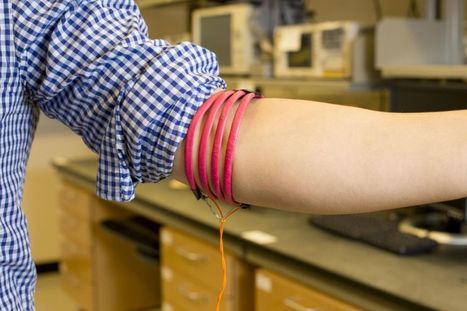
As seen in the photo, the flexible fabric is both stretchable and conformable to the body of the wearer. Laminated into the fabric are thin-film transistor (TFT) driven light emitting diodes (LEDs) on a tough polyamide substrate encapsulated into soft rubber. The fabric is both comfortable to wear, as well as washable using normal machines set, no doubt, on delicate (although no commercial clothing has yet to be made from the prototype material).  Since the research centers cooperative activities include potable medical devices, the fabric could be linked to sensors to accurately read-out health parameters that vary over the body of the wearer, such as temperature, oxygen levels, circulation, activity levels and more, providing real-time feedback—for the users themselves or for healthcare providers, according to Imec.   The collaborators hope to make the process inexpensive enough to build into everyday fabrics used in many if not all of our clothing, so that the user does not have to remember to wear his activity- or health-monitor, because they will already be built into their clothing. Fashion designers will, of course, try to make use of the color changing ability to enhance the appearance of the user. However, Imec and its collaborators want to make the fabric's active devices as unobtrusive and comfortable as possible so that people will be more inclined to wear them everyday, hence improving the long-term quality of the big-data being collected.   Imec and its collaborators are also trying to make the display integrated into the fabric interactive—like touchscreens—so their functions can be changed without separate control apparatuses. 

No comment yet.
Scooped by Richard Platt
September 5, 2015 4:28 PM
Scoop.it!

Smartwatch makers face up to their identity crisis

Smartwatch makers face up to their identity crisis | Wearable Tech and the Internet of Things (Iot) | Scoop.it
The new range of Apple Watch rivals have gone back to traditional roots. Can a dose of retro styling convince consumers to ditch their old timepiece?
Richard Platt's insight:

From cameras to audio speakers and HiFi systems, it has long been fashionable to apply retro styling to make high-tech gadgets seem more appealing. But now consumer electronics companies are taking this approach to a new category – smartwatches.   When the first generation of smartwatches emerged a couple of years ago, they were heavily criticised for lacking any sense of style, and focusing on functionality at the expense of design.  However, when Apple unveiled its Watch in September 2014, it presented it as a fashion accessory rather than a gadget. Supermodel Christy Turlington Burns fronted the advertising campaign and fashion icons from Karl Lagerfeld to Beyonce showed off their custom-made devices.

Since then, pressure is growing on electronics makers to step up their game from a design perspective.  Large circular faces, premium materials such as gold, stainless steel and leather, and faux analogue watch faces all feature heavily in the latest batch of smartwatches, and particular efforts have been made to appeal to women as well as men.

No comment yet.
Scooped by Richard Platt
September 5, 2015 3:43 PM
Scoop.it!

Coming soon: Wearable tech that uses your body to transmit the signal

Coming soon: Wearable tech that uses your body to transmit the signal | Wearable Tech and the Internet of Things (Iot) | Scoop.it
It's called "magnetic field human body communication," and the concept aims to improve upon the limits of the power-hungry Bluetooth radio.
Richard Platt's insight:

It’s called “magnetic field human body communication,” and the concept aims to improve upon the limits of the power-hungry Bluetooth radio.  First there were mobile devices such as your smartphone—rechargeable computers made for the pocket or purse.

Then there came wearables such as smart watches, glasses, or apparel—sensor-laden devices worn on the body itself, but still separate from it.  Now, a team of researchers at the University of California, San Diego led by professor Patrick Mercier have developed a new wireless communication technique that involves sending magnetic signals through the human body. The next stop: Technology that uses you, the user, to function.  Most of today’s wireless, Internet-connected devices directly communicate with each other using Bluetooth, the almost two-decade-old standard. The problem? Bluetooth radios require lots of energy, which small, “smart” devices have in extremely limited supply. (Crack one open and you’ll find that most modern “smart” devices are largely batteries, not computer chips.) Add into the mix the human body, which typically blocks radio signals and thus requires extra power to overcome, and you’ve got a serious limit to innovation.  The answer, according to electrical engineers at UC San Diego? An ultra-low-power wireless system that uses the body itself as a vehicle to deliver energy between gadgets. The researchers call it, appropriately, “magnetic field human body communication.” Because magnetic fields are able to pass freely through biological tissue, signals lose less power and therefore—with hope—incur a far smaller energy penalty. (The researchers say there aren’t serious health risks because the signal is ultra-low power, far less disruptive than, say, an MRI.)

For now, the technique is a proof of concept, so don’t get too excited. (In experiments, researchers demonstrated that magnetic communication functioned well with the body. They didn’t test power consumption.) Still, researchers estimate that magnetic field communication through the human body is 10 million times—yes, you read that correctly—more effective than that of Bluetooth radios.

No comment yet.
Scooped by Richard Platt
September 5, 2015 3:36 PM
Scoop.it!

3D Printing in the Wearable World

3D Printing in the Wearable World | Wearable Tech and the Internet of Things (Iot) | Scoop.it
92760
Richard Platt's insight:

A bunch of different articles on wearable tech where 3D printing has been used to build the devices

No comment yet.
Scooped by Richard Platt
September 5, 2015 3:14 PM
Scoop.it!

LifeLogger Tech Captures Memories, Documents Your Life

LifeLogger Tech Captures Memories, Documents Your Life | Wearable Tech and the Internet of Things (Iot) | Scoop.it
Did you know humans can only remember around 0.001% of their lives? So if you need help capturing and remembering events, check out LifeLogger’s technology…
Richard Platt's insight:

Humans apparently can only statistically remember around 0.001% of our lives?  If that shocks you, and you wish you could recall more, LifeLogger Technologies (LOGG) has you covered.  Headquartered in Palm Beach Gardens, Florida, LifeLogger is currently in the process of developing two technologies:  A True Point-of-View (POV) Wearable Camera: LifeLogger has designed, and recently prototyped, a true POV wearable camera. The camera is very small (roughly the size of a pack of gum) and extremely lightweight. It can be mounted on a helmet, above the ear at eye level, clipped onto an ear, glasses, hat, headband, or armband. It can also be worn like a necklace.  LifeLogger Tech is trying to get around the whole challenge that Google Glass faced being "Glassholes" by marketing the product as follows:

Got a Bad Memory? No Problem…
Imagine how much more of your life you could remember with this technology.

What was the name of that terrific restaurant you ate at in New York City? LifeLogger will tell you.

You’re returning to a favorite vacation spot from five years ago – but how do you get to the hotel and those landmarks again? LifeLogger will tell you.

Not to mention all manner of everyday events – sports games, parties, an evening out with old friends.

As LifeLogger stated in its most recent investor presentation, “We are empowering the way you seize your day and remember your life!”

Not only do LifeLogger’s products have a benefit in your personal life, they also have professional and educational uses.

  • Businessmen could record important meetings.
  • Salesmen could use the technology for training purposes, recording interactions with clients and reviewing them later in order to improve sales techniques.
  • Students could easily keep concise documentation of class lectures, laboratory experiments, and review sessions.

With such useful technology that applies to everyone, LifeLogger is one to watch in the wearable space, as the company continues to grow.  - We shall have to see if this product is accepted by the market in such a fashion.  I am not hopeful that their marketing strategy will work.

No comment yet.