


Missed some market news this week? Check out the Farm Futures grain market week in review to catch up (30/11/2018).
G20 summit influences markets this week, Chinese buyers not buying and basis strengthens.

 Your new post is loading...
 Scoop.it! Missed some market news this week? Check out the Farm Futures grain market week in review to catch up (30/11/2018). G20 summit influences markets this week, Chinese buyers not buying and basis strengthens. 
No comment yet.
Sign up to comment
Scoop.it!
Published by Land Degradation and Development on Dec 2018. To feed the ever increasing world population, more crops production per hectare has become a necessity. Soil salinity is one of the important factors causing land degradation leading to low soil aeration and water conductance. It adversely impacts plant growth and development. Adaption through modern molecular tools is an important strategy for alternative use for degraded land. To achieve this aim, we have cloned a novel salt responsive gene SbRPC5L (Salicornia brachiata RNA Poly III Complex 5 Like subunit) from an extreme halophyte and transformed it into tobacco for abiotic stress tolerance. The gene is intronless, 1202 bp long, membrane‐localized, encoding a protein of 196 amino acids and shows up‐regulation under salt and osmotic stress. Tobacco plants harboring SbRPC5L perform better under stress and have more water content, membrane stability and stress tolerance indices as compared to control plants. The results suggest that this novel gene has a potential to be used as a promising alternative to impart abiotic stress tolerance for climate resilient agriculture in degraded costal saline areas.
CIHEAM News's insight:
For more info, https://doi.org/10.1002/ldr.3241
Scoop.it!

Une étude concernant 36 pays, réalisée par le National Bureau of Economic Research et publiée en août dernier, estime l'impact des taxes à... Via Pôle Veille AgroParisTech
Scoop.it!

By Jayashree Bhosale, 27/11/2018 Spot maize prices have risen 7.6% over the past fortnight, driving end-users including poultry and livestock feed manufacturers to panic stocking. Feed manufacturers are heading towards Chindwada in Madhya Pradesh, the only place in the country where maize availability is currently comfortable. “We normally buy maize from Karnataka and Maharashtra. However, this year, even during the peak season, availability at these two places was not enough and neither was it of good quality,” said Latur-based Vijay Jadhav, a poultry feed manufacturer who purchased his requirements from Madhya Pradesh. Spot maize prices for Sangli delivery increased to Rs 1,647/quintal on the National Commodity & Derivatives Exchange on Monday from Rs 1,531/quintal on November 12. With the shortage developing during the crop’s peak arrival season, the feed industry is in panic mode. Maize is the third most important cereal crop in India, after rice and wheat, and accounts for about 10% of the country’s food grain production. More than half the maize produced locally is consumed as poultry feed, while the rest goes as food for humans, animal feed and industrial processing. Pune: Spot maize prices have risen 7.6% over the past fortnight, driving end-users including poultry and livestock feed manufacturers to panic stocking.
Feed manufacturers are heading towards Chindwada in Madhya Pradesh, the only place in the country where maize availability is currently comfortable. “We normally buy maize from Karnataka and Maharashtra. However, this year, even during the peak season, availability at these two places was not enough and neither was it of good q ..
Scoop.it!

By Drew Lerner (World Grain), 26/11/2018 Just a couple of years ago this meteorologist had his hands slapped for trying to make an issue out of world wheat production problems. The word was that there was too much wheat in the world and that a focus on that crop was a waste of time. Today, of course, the trade has a little different mindset. Smaller crops in Australia, Canada, Europe and Russia this year allowed the commodity “trade” winds to blow from a different direction. Now that everyone thinks there is a problem the question that begs to be answered is, “Can world wheat production potentials improve?”. This review points out the current and future difficulties occurring in the most productive regions of the world...
Scoop.it!

By UkrAgroConsult, 27/11/2018 According to the Ag Ministry’s forecast, the 2018 grain crop in Ukraine will reach its highest since the country’s independence. The record rise in grain production is accounted for by an abundant crop of corn, which is estimated by the Ministry to amount to 34.8 MMT, reports UkrAgroConsult. The corn harvest was 94% complete as of November 26, 2018. Farmers had obtained 32.9 MMT of grain (21.1 MMT in 2017) with an average yield of 7.64 MT/ha (5.35 MT/ha in 2017).
Scoop.it!

By Brennan Turner (Farm Lead), 26/11/2018 Only Wheat prices are in the green this morning for grain prices thanks to some follow-on buying that U.S. wheat is getting more competitive. Specifically, Egypt bought 240,000 MT of wheat last week, with half of it coming from American ports. It’s been suggested that Egypt may turn away from Russia as its principal wheat supplier as their amount of exportable supplies start to slow, but also there are questions about the quality coming out of their facilities. The bigger news coming out of the Black Sea this Monday though is Russia having fired upon and then captured three Ukrainian warships off the coast of Crimea, the annexed region that Russia took control of a few years ago. As it relates to grain markets, there are questions about whether or not grain exports in the Azov Sea (where the naval clash took place) will be impacted. Reports are that its business as usual right now. It’s expected that Ukraine will vote today on whether to impose martial law or not. Should wheat exports indeed be impacted, this could be a quality opportunity for wheat prices to find its footing again.
Scoop.it!

Par Terre-net, 29/11/2018 Le cours des céréales européennes évoluait sans direction jeudi à la mi-journée, alors que des informations géopolitiques ayant de fortes incidences sur les cours des matières premières mondiales se succèdent. Les cours du soja, du blé et du maïs ont progressé mercredi à la Bourse de Chicago, portés par des commentaires optimistes sur une potentielle détente dans la guerre commerciale entre les États-Unis et la Chine à quelques jours d'une rencontre entre les présidents Trump et Xi. « Les tensions entre la Russie et l'Ukraine font également l'objet de toutes les attentions, même si le blocage de l'accès à la mer d'Azov pour les exports ukrainiens n'a que peu d'incidence sur nos marchés », assure le cabinet Agritel dans une note.
Scoop.it!
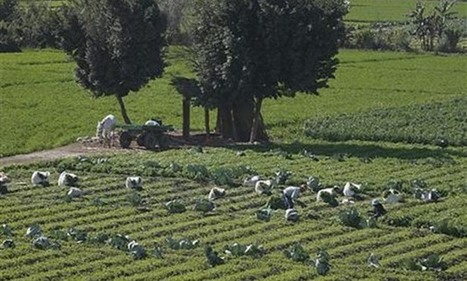
By Noha El Tawil (Egypt Today), 27/11/2018 As domestic crop supply fails to meet market needs, Business Today Egypt looks at agriculture sector and the challenges of ensuring food security. Agriculture, forestry and fishing constituted 11.5% of Egypt’ GDP (gross domestic product) last year, according to the World Bank, which may seem a significantly high number compared to developed countries like France (1.5%) and the UK (0.5). However, farmers in Egypt are suffering on various fronts. Citizens’ complaints about the prices of food have been on the rise, and a campaign was launched to boycott fruits. President Abdel Fattah al-Sisi criticized homeowners building on agricultural land. With rising costs and various violations to deal with, the agricultural sector has had alot to contend with recently.
Scoop.it!

By Hellenic Shipping News Worldwide, 20/11/2018 China’s National Development and Reform Commission (NDRC) said it had set the minimum purchasing price for wheat in 2019 at 112 yuan ($16.14) per 50 kg, or 2,240 yuan a tonne. The price is down from this year’s 2,300 yuan per tonne and the second year in a row that the government has reduced its price support for wheat growers. Beijing made the price adjustment to help whittle down the nation’s huge grain stocks, and to push farmers to grow more high quality crops, the NDRC, the country’s state economic planner, said in a separate statement published on its website on Friday. China started adjusting its minimum purchase prices scheme for its grains in 2015, part of the nation’s overhaul of its vast agriculture sector. Under the reform, Chinese farmers have grown more high-quality wheat and rice, according to the statement.
Scoop.it!

Par l'Economiste maghrébin, 08/11/2018 Selon l'INS, le déficit commercial de la Tunisie a atteint un niveau record de 15 985,5 MDT contre 13 210,6 MDT une année auparavant. Ainsi, les exportations ont augmenté de 20,2% contre 18,2% durant la même période de 2017 alors que les importations ont progressé de 20,5% contre 19,6%. En valeur, le déficit c'est accru.
Scoop.it!

By Chris Lyddon (World Grain), 12/11/2018 In its Agri Commodities Monthly Report for October, Rabobank noted short-term support for wheat futures worldwide on the basis of tightening global fundamentals. “This support is forecast until further confidence emerges with respect to new 2019-20 crop supplies,” Rabobank said, noting that Northern Hemisphere plantings were nearing completion as it was published on Oct. 19. Rabobank called the record Russian export pace, with 13.8 million tonnes exported from July to September, “unsustainable.” “As Russian exports slow or are potentially restricted, demand would predominantly shift to the U.S., Argentina or even the E.U.,” Rabobank said.
Scoop.it!

By Foodbusinessnews.net, 13/11/2018. After Australia's winter wheat production estimates were cut, the U.S. wheat complex moved higher Monday with corn and the soy complex posting small gains and losses. Chicago December wheat added 17¾c to close at $5.19¾ a bu. Kansas City December wheat added 6c to close at $4.93½ a bu, and Minneapolis December wheat advanced 9¼c to close at $5.82½ a bu. December corn was up 1½c to settle at $3.71¼ a bu. Anxiety over the health of giant technology companies sparked a broad retreat from U.S. equity markets Monday. U.S. crude oil futures edged Monday with contract shed 26c to close at $59.93 per barrel. The U.S. dollar is strengthening on Monday.
|
Scoop.it!

By Times Now News, 02/12/2018 Local wheat prices have risen more than 15 per cent in the last five months on the low rainfall levels and as depreciation in the rupee made imports more expensive. India's wheat production could fall in 2019 from record output this year as lower moisture levels and higher temperatures in key growing regions are threatening yields of the winter-sown crop, farmers and analysts told Reuters. A drop in output could lift local wheat prices and force the world's second-biggest producer to reduce import taxes on the grain to augment supply. Higher imports from India could support global wheat prices, while a local price increase could calm angry farmers in northern India.
Scoop.it!

Rome, 6 décembre 2018 - Les prix des produits alimentaires échangés dans le monde ont baissé en novembre sous l'effet de fortes baisses pour l'huile de palme et les autres huiles végétales, annonce aujourd'hui l'Organisation des Nations Unies pour l’alimentation et l’agriculture (FAO). L’indice FAO des prix des produits alimentaires s’est établi en moyenne à 160,8 points pour le mois de novembre, en baisse de 1,3% par rapport à octobre et 8,5% par rapport à l’année précédente. L’indice, indicateur de la variation mensuelle des prix internationaux d’un panier de produits alimentaires, est à présent à son plus bas niveau depuis mai 2016. L’indice FAO des prix des céréales (blé, céréales secondaires, riz) a chuté de 1,1% au cours de la même période du fait à la fois de l’importance des exportations de blé, de l’intensification de la concurrence à l’exportation du maïs et de l’arrivée de nouvelles récoltes de riz.
Scoop.it!

By Ahmed Lamloum (The Daily News Egypt), 27/11/2018 Egypt’s state grains’ buyer, the General Authority for Supply Commodities (GASC), announced the winning bid of Egypt’s first international rice buying tender on Tuesday, while it seeks to launch two vegetable oils and wheat international purchasing tenders for delivery in January. The rice tender will be approved by the Minister of Supply, Ali Moselhy, after testing rice samples that were submitted by the bidders, a source in the ministry told Daily News Egypt. The financial offers of this tender were between $419.7 and $444 per tonne. Also, Egypt is the world’s biggest wheat importer as it consumes 100bn of bread loaves annually. The Egyptian people spend EGP 5bn while the government pays EGP 60bn in subsidies for the bakery owners, according to Finance Minister Mohamed Moeit. In an interview with Ahram newspaper on Saturday, Moeit said there will be no change in “the bread subsidy system no matter how much cost the country has to bear”.
Scoop.it!

By the ICTSD (International Center for Trade and Sustainable Development), 22/11/2018 WTO members are debating how to resolve long-standing disagreements over agricultural export restrictions and their impact on humanitarian food aid, sources told Bridges, with the issue taking centre stage during an informal meeting convened on 15 November by the chair of the organisation’s agriculture negotiations. Two new submissions from food-importing countries were discussed at the session, which was called by Guyana’s Ambassador John “Deep” Ford. At the same meeting, negotiators also discussed unresolved agricultural export competition issues, which involve measures seen as analogous to export subsidies at the WTO. A paper by Singapore highlighted the impact of export restrictions on food bought by the UN’s World Food Programme (WFP) for humanitarian aid, while another paper by Japan and five other co-sponsors examined the use of export restrictions more broadly, drawing on governments’ notifications to the World Trade Organization. The US also tabled a submission on tariffs, although sources said this was not discussed in great depth by participants...
Scoop.it!

By Reuters, 28/11/2018 Chicago Board of Trade wheat futures closed higher on Monday as geopolitical tension in the Black Sea region and confirmation of US wheat sales to Egypt sparked a round of short-covering, traders said. CBOT December soft red winter wheat settled up 7-3/4 cents at $5.07-1/2 per bushel. K.C. December hard red winter wheat ended up 3-1/4 cents at $4.64-1/2 a bushel and MGEX December spring wheat rose 2-3/4 cents at $5.77. The US Department of Agriculture confirmed that private exporters sold 120,000 tonnes of US soft red winter wheat to Egypt for delivery in the 2018/19 marketing year. Escalating tension between Russia and Ukraine could slow grain exports from the Black Sea region, analysts said. Russia ignored Western calls to release three Ukrainian naval ships it had fired on and captured near Crimea over the weekend. The USDA reported export inspections of US wheat in the latest week at 252,489 tonnes, below a range of trade expectations for 350,000 to 600,000 tonnes. Ahead of the
Scoop.it!

By Bojana Gajic (ERBD), 28/11/2018 Egypt is one of the world’s biggest consumers of wheat – and one of its biggest importers. Egypt is currently producing 8 Mt of wheat every year, but consumes around 20 Mt. This huge gap is covered by imports from other markets such as Ukraine and North and South America. The role of private companies that specialise in grain import will become even more important in the future as imports are projected to increase to 27 Mt by 2025. Agribusiness companies have an untapped potential to become a crucial component of the Egyptian economy. But their growth is often hampered by lack of innovation, poor productivity and substantial skills mismatches. The EBRD helps companies to modernise their operations and improve productivity, like Medsofts, a family-run company, today one of the biggest importers and suppliers of grains and oilseeds for the local market.
Scoop.it!

Par Arvin Donley, Baking Business, 27/11/2018 World wheat flour trade for 2018-19 was revised downward by 100,000 tonnes of wheat equivalent (less than 1%) by the International Grains Council but is still in line with last year’s estimated total of 17.1 million tonnes. The I.G.C. released its quarterly forecast on Nov. 22 as part of its monthly Grain Market Review report. In August, the I.G.C. forecast 2018-19 global flour trade at 17.2 million tonnes. “Although only a limited amount of information is so far available, volumes by the main flour exporters (mostly covering June through September) are generally below last season, particularly to sub-Saharan Africa and Pacific Asia,” the I.G.C. said. In the war-torn Middle East, imports are trending upward, the I.G.C. noted. “In contrast, tonnage shipped to (the Middle East) is slightly higher year on year, where local agricultural production and flour processing continue to be affected by conflict in some countries,” the I.G.C. said.
Scoop.it!

By Piper Delholm (The Flinders News), 29/11/2018 The Primary Industry and Regions SA (PIRSA) crop and pasture report for spring has been released and the results are saddening for our local farmers. After a year filled with drought like conditions and with some areas thriving, the health of crops and pastures across the state is a varied result. The 2018-19 harvest has fallen to an estimated 4.9 million tonnes, this was grown from 3.5 million hectares and is well below the long-term average of 7.9 million tonnes for South Australia. The Minister for Primary Industries and Regional Development Tim Whetsone says that the below average rainfall season had an even larger impact on drought affected areas. “This year we’re experiencing quite a patchy situation- some areas are experiencing very good seasons, while others are experiencing very difficult seasons”, he said.
Scoop.it!

Two organizations, Crop Trust and The International Rice Research Institute, announce funding in perpetuity of the world’s largest rice collection. Via Système de veille
Scoop.it!

By Jonathan Riley (Farmers Weekly), 15/11/2018 Maize imports, ethanol plant closures and the looming potential of a no-deal Brexit are putting pressure on wheat prices, according to grain traders. Maize imports are up by one-third and have broken the 540,000t mark since July, HMRC figures show. In the first three months of this year’s season (July-September 2018) the UK imported 544,000t of maize. “Because wheat and maize purchases are already on the books, imports will continue to arrive through to next April,” Mr Bright said. “It means we will have gone from a tight supply to an exportable surplus,” he suggested.
Scoop.it!

Par Fayza Senhaji (le360.ma), 18/11/2018 Avec les pluies qu’a connues le Maroc depuis le début de la saison agricole, l’optimisme est de rigueur quant à la réalisation d’une campagne exceptionnelle cette année. Cela fait au moins 25 ans que le Maroc n’a pas connu un niveau de pluviométrie aussi important à cette période de l'année. De quoi présager une campagne agricole exceptionnelle cette année? Pour L’Economiste dans son édition paraissant lundi 19 novembre, c’est surtout le fait que les précipitations soient généralisées à l’ensemble des régions qui fait naitre l’optimisme.
Scoop.it!

By UkrAgroConsult, 13/11/2018 Black Sea wheat traded using blockchain Monday in a pilot deal between Solaris and Transoil International via the Cerealia Platform, the platform's developer said. A Russian 25,000 mt parcel of 11.5% protein wheat on a FOB basis at Novorossiisk for December delivery traded for an undisclosed price. The platform developer said it was the first such Black Sea wheat deal. Blockchain is a mechanism that allows the chronological and public display of transactions that have taken place on the platform. The goal is to minimize risk and any conflict that may arise by storing all related data on blockchain to settle disputes smoothly, should they arise. "The next stage is to support emerging market traders in their local domestic currencies using fintech," Cerealia CEO and co-founder Andrei Grigorov said.
|




