Your new post is loading...

|
Scooped by
CIHEAM News
January 4, 2019 11:18 AM
|
|
|
Scooped by
CIHEAM News
January 2, 2019 3:55 AM
|
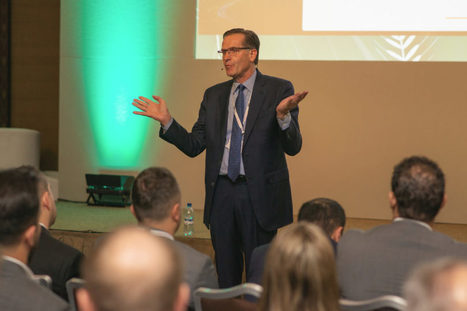
By Chris Lyddon (World Grain), 27/12/2018. The world’s grain markets face a year of challenges and uncertainty, with weather and politics likely to drive trade flows and prices, said the keynote speaker at the Global Grain Conference in Geneva, Switzerland. The trade war between the United States and China has changed the landscape and, if settled, could once again mean massive changes, said Dan Basse, president, AgResource, Chicago, Illinois, U.S. Huge government debt, the likelihood of interest rate increases, and volatile currencies are among the potential threats the market faces. He added that demographic changes mean the demand growth focus is shifting to Africa. Basse described the market ahead as “a more vibrant market and more vibrant opportunity forthcoming.” He noted that over 80% of trade in Chicago is now non-human. “Today we see the world wheat stocks-to-use ratio at a record low. That makes 2019 a very, very important year for world production.” At the same time, weather patterns are changing. “This last year we saw a very dramatic drought in Argentina,” he said. “Australians are seeing their second drought in a row. We have problems in Europe. Climate change is real.” New drivers are emerging in the wheat market. “World wheat trade has increased nearly 90 million tonnes in just the last eight or nine years,” he said. “This is a big change.”
|
|
Scooped by
CIHEAM News
December 24, 2018 8:35 AM
|
17/12/2018 (Reuters) - The European Union has become a net importer of grain for the first time in more than a decade following a drought-affected wheat harvest, strong competition in exports from Russia and a record pace of maize imports.As of Dec. 16, the EU has imported a net 13.15 Mt of grain so far in the 2018/19 season, compared with net exports of 12.64 Mt in the same period last season, European Commission data showed on Monday. The last time the EU was a net grain importer was the 2007/08 season, when the harvest was also damaged by drought, data compiled by Reuters shows. The EU is one of the world's largest grain exporters, mainly of wheat where it competes with Black Sea countries and the United States. It has traditionally been a net importer of maize (corn). The balance this season has been altered by a sharp slowdown in wheat exports, linked to a poor harvest damaged by hot, dry summer weather and brisk Russian shipments, and massive maize imports after a poor crop. EU soft wheat exports so far in 2018/19 totalled 7.5 Mt as of Dec. 16, down 25% from 9.9 Mt at the same stage of last season, the Commission data showed. Barley exports had reached 2.5 Mt, down 1 % from a year earlier. Maize imports, meanwhile, stood at 9.9 Mt, up 41 % from 7.0 Mt a year earlier.
|
|
Scooped by
CIHEAM News
December 21, 2018 4:59 AM
|
Par Khaled Bel (Observ'Algérie), 18/12/2018 La France perd le marché algérien. Cette conclusion faites par les spécialistes est tirées des nouvelles stratégies de l'Algérie visant à diversifier ses sources d’approvisionnement. Ainsi, le monopole des français sur plusieurs secteurs d’importations algériennes, notamment les céréales, relève du passé. Si la Russie affiche sa volonté de déboulonner la France du marché algérien des céréales, l’Argentine entre en jeu grâce à ses avantages concurrentiels. En effet, l’Algérie a acheté une cargaison de 40 000 tonnes de blé argentin. L’Office algérien des Aliments du Bétail (ONAB) a lancé un appel d’offre visant un total de 80 000 tonnes de blé, réparti sur deux cargaisons, pour le mois de décembre. La démarche de l’Algérie visant sortir de son dépendance vis-à-vis du fournisseur français est en marche. Des négociations avec les autorités russes ont été initiées par le ministère de l’Agriculture concernant l’importation de blé tendre russe.
|
|
Scooped by
CIHEAM News
December 20, 2018 4:05 AM
|
Dans les Scientific Reports de Nature de novembre 2018, une équipe internationale analyse sur le long terme les rendements des principales cultures en France, mettant en évidence une stagnation depuis la fin de la décennie 1990. De précédents travaux avaient fait ressortir une stagnation des rendements de blé depuis 1996. Ici, les chercheurs se sont intéressés à la fois aux céréales (blé, maïs, orge, avoine), aux oléagineux (tournesol, colza), aux betteraves sucrières, aux pommes de terre et à la vigne. Pour chacune des cultures étudiées, ils ont eu recours aux données de la Statistique agricole annuelle, au niveau départemental, sur plus d'un siècle (1900 à 2016). Pour suivre les rendements de ces cultures, sur chaque département et au niveau national, les chercheurs ont développé un modèle linéaire dynamique (DLM), qui permet d'estimer la tendance d'évolution des rendements sans avoir à établir d'hypothèses fortes au préalable. À l'échelle de la France, les évolutions ainsi identifiées sont illustrées ci-dessous.
|
|
Scooped by
CIHEAM News
December 19, 2018 8:03 AM
|
FAO News, 12/12/2018
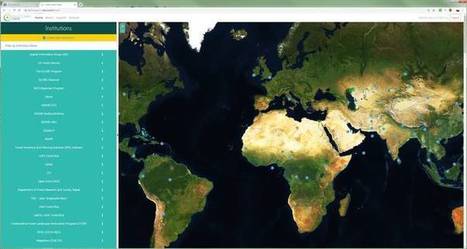
Seeing both forests and trees is about to get easier, thanks to a new open-access tool developed by US National Aeronautics and Space Administration (NASA) and the UN's Food and Agriculture Organization (FAO), with support from the Google Earth Engine Team and the US Government's SilvaCarbon Program - allowing anyone to track land-use and landscape changes anywhere. Collect Earth Online (CEO) amplifies the power of FAO's Open Foris Collect Earth tool, which for the past few years has enabled the collection of data on land use, deforestation and for other purposes with the help of satellite imagery. CEO will become a central technology supporting FAO's global Remote Sensing Survey. The new platform is web-based, free of charge, open to all, requires no downloads or installation, and allows users to systematically inspect any location on the Earth with satellite data. The next generation tool makes it easier to conduct surveys, collect samples and use crowdsourcing techniques. CEO can be accessed by simply clicking on a link http://collect.earth/ and registering on the platform.
|
|
Scooped by
CIHEAM News
December 19, 2018 4:57 AM
|
Premiere event of the Black Sea region, recognized by global leaders of grain & oilseed industry. Get involved and benefit from valuable content and great networking opportunities.
|
|
Scooped by
CIHEAM News
December 19, 2018 4:29 AM
|
Libération Maroc, 17/12/2018 Une journée d’étude sur le thème ‘’La filière des céréales dans la région Fès-Meknès : production, financement et commercialisation’’ a été organisée récemment à Fès, avec la participation de professionnels du secteur, d’agriculteurs et d’acteurs économiques.
Cette rencontre vise à débattre de la situation de la filière céréalière dans la région, et ce en application des hautes orientations de SM le Roi Mohammed VI qui n’a eu de cesse de mettre l’accent sur la nécessité d’ériger l’agriculture en levier majeur du développement et des politiques économiques du Royaume, a indiqué Mohand Laenser, président du conseil régional Fès-Meknès, qui a initié cette journée, en collaboration avec la direction régionale de l’agriculture. La place de choix accordée au secteur agricole dans les plans régionaux de l’aménagement du territoire et de développement régional est motivée par la volonté de créer un pôle agricole à deux dimensions : un pôle agricole stratégique au niveau national destiné à l’agriculture intensive dans la plaine de Saïss, lequel devrait être renforcé par des activités de transformation, et consolidé par ‘’une dimension qualitative’’ au niveau des provinces, avec une production des produits du terroir et biologiques.
|
|
Scooped by
CIHEAM News
December 14, 2018 10:53 AM
|
Sébastien Abis, Economy & Territory (IEMed, Mediterranean Year Book 2018) There has always been a close connection between geopolitics and food security. Though this conflict dynamic is not new, it could intensify in the future. Such a world-wide observation takes on an exacerbated dimension in the Mediterranean Basin. To understand the interactions between agriculture, food and security, it is useful to put the challenges posed into perspective over time and recall certain factors. Sébastien Abis (Director of the Club DEMETER and Research Fellow at the French Institute for International and Strategic Affairs (IRIS)), gives us his perspective in this new article.
|
|
Scooped by
CIHEAM News
December 13, 2018 11:58 AM
|
By Ben Conner, USW Vice President of Policy, 13/12/2018. To Ag. That is obviously the answer. The question is if the trade negotiations between the United States and the European Union should include agriculture at all. We already covered that in August after the two governments agreed to begin negotiations. This week, the U.S. Wheat Associates (USW) submitted comments to the U.S. Trade Representative on wheat growers’ priorities for the negotiations. One of the priority, of course, is that the negotiations should cover agricultural products like wheat. That would avoid running afoul of WTO rules requiring free trade agreements to cover substantially all trade. It would also avoid a likely quick death in the U.S. Congress should an agreement without agriculture be presented to it. Assuming those issues are addressed, USW wants to see protective EU wheat tariffs eliminated. Most EU imports from the United States are duty-free, but only for wheat that meets certain quality thresholds. Full tariff elimination would benefit buyers in the EU who may see opportunities to import U.S. wheat with different qualities. The most significant challenges U.S. wheat growers currently face in the EU are non-tariff barriers also designed primarily to protect EU wheat producers. Pesticide residue and plant breeding regulations, phytosanitary tests and labeling requirements can disrupt U.S. wheat imports and create additional market uncertainty. A comprehensive agreement with the EU is long overdue and should end this sea of troubles.
|
|
Scooped by
CIHEAM News
December 11, 2018 5:24 AM
|
Par Hamza Marzouk (L'économiste Magrhébin), 30/11/2018 Lassaad Labidi, PDG du CEPEX, est revenu sur l’état des lieux des exportations tunisiennes, et ce, lors d’un déjeuner débat sur le thème “Exportations : les conditions d’un décollage” réussi. Alumini IHEC Carthage l’a organisé récemment au siège de l’Institut arabe des chefs d’entreprises (IACE). Zoom sur les exportations en Tunisie. Le PDG du CEPEX a rappelé que l’export est l’un des moteurs de la croissance de l’économie, en plus de la consommation et de l’investissement. Parmi les secteurs ayant contribué à l'amélioration de la situation depuis 2017 figurent l’agriculture, l’industrie agroalimentaire (+60%) boosté par les exportations de l’huile d’olive, des dattes et des produits de la pêche.
|
|
Scooped by
CIHEAM News
December 10, 2018 5:12 AM
|
By Egypt Today, 01/12/2018 The size of wheat cultivated areas increased to 1.5 million feddans at the beginning of this year's winter season as there is a target to reach 3.4 million feddans, according to a report by the Ministry of Agriculture. The ministry told press on Saturday that subsidized fertilizers are provided to farmers cultivating wheat, and that it is running awareness campaigns to encourage more wheat cultivation. The ministry has also launched inspection campaigns on vegetable crops, especially tomato and potato crops, to follow up on productivity, provide needed guidelines and instructions, and avoid the repercussions of climate change.
|
|
Scooped by
CIHEAM News
December 8, 2018 5:14 AM
|
The report of the International Water Management Institute (IWMI) investigates best practices in food sustainability across the world. It uses the three pillars—sustainable agriculture, nutritional challenges, and food loss and waste—of the Food Sustainability Index (FSI) as a framework. Changes to farming systems do not always come without trade-offs. For example, solar power can transform livelihoods for smallholder farmers by providing free electricity, which enables them to tap into groundwater for irrigation. “There’s been a huge expansion in solar irrigation, especially in India,” says Sri Lanka-based Soumya Balasubramanya, senior researcher in environmental and development economics at the International Water Management Institute. “But there’s a trade-off. In the longer term, you’re going to have a problem of groundwater depletion.”
|
|
|
Scooped by
CIHEAM News
January 2, 2019 3:59 AM
|
By Arvin Donley (World Grain), 27/12/2018 — A group of European researchers have found that current breeding programs and cultivar selection practices in Europe do not provide the needed resilience to climate change. The authors state in a paper recently published in PNAS (Proceedings of the National Academy of Sciences) that the response diversity of wheat on farmers’ fields in most European countries has worsened in the past 5 to 15 years, depending on the country. Researchers predict that greater variability and extremeness of local weather conditions will lead to...
|
|
Scooped by
CIHEAM News
December 27, 2018 8:58 AM
|
Algérie 360, 19/12/2018 – Plusieurs mesures ont été prises pour la promotion de la filière agricole et agroalimentaire dont l’élaboration d’une cartographie du potentiel agricole stable à l’export, a indiqué mardi à Alger un haut responsable du ministère de l’Agriculture. Ces mesures portent notamment sur l’élaboration par ce ministère de la cartographie des produits agricoles et du potentiel stable à l’export, du calendrier des productions agricoles par région, ainsi que la promotion des produits bio et du terroir », a fait savoir le secrétaire général du ministère de l’Agriculture, Chérif Omari, lors d’un panel dédié à l’exportation des produits agricoles et agro-alimentaires, organisé dans le cadre de la rencontre nationale sur la promotion des exportations. Il s’agit également d’encourager les projets d’investissement agricole et agroalimentaire dédiés à l’export, notamment les plateformes logistiques, et d’inciter les exportateurs des produits agricoles et agroalimentaires à mieux s’organiser.
|
|
Scooped by
CIHEAM News
December 22, 2018 8:48 AM
|
EU releases, 11/12/2018 - Flooding and water scarcity in Europe will increase in the coming decades, but to a much lesser extent if the objectives of the Paris Agreement on climate change are met. A new JRC study looks at the impact of the changing climate, land use and water usage on Europe's water resources. "We used a water resources model to estimate the impact of the changing climate under two 30-year scenarios. In one scenario, the targets of the Paris Agreement to keep global temperature rise below 2˚C are met. In the other, global temperatures increase by more than 2˚C. We modelled the consequences on Europe's water resources under these two scenarios", said JRC researcher Ad De Roo. Researchers concluded that while the impacts would be substantially less severe if the Paris Agreement targets were met, flooding and summer water scarcity are projected to increase under both scenarios. "To minimise future consequences, it is essential that the targets of the Paris Agreement are met sooner rather than later, and it is even better if we manage to stay well below those targets. We also believe that mitigation alone is not enough but that adaptation strategies such as water saving and efficiency measures will also be needed to cope with the future climate change impacts", Ad De Roo said.
|
|
Scooped by
CIHEAM News
December 20, 2018 5:46 AM
|
By Chris Lyddon (World Grain), 13/12/2018.
Brazil is one of the world’s biggest agricultural exporters, with the focus on its massive soybean crop as well as a large corn crop. A weak currency has helped Brazilian exporters remain profitable, while China’s tariffs on U.S. soybeans have diverted demand to the South American country. The International Grains Council (IGC) forecasts Brazil’s total grains production in 2018-19 at 103.8 million tonnes, up from 88.2 million the year before. Production of wheat is put at 5.4 million tonnes, up from 4.3 million the previous . . .
|
|
Scooped by
CIHEAM News
December 19, 2018 8:47 AM
|
AgriMaroc, 13/12/2018 - Les exportations de produits agricoles russes au Maroc ont été multipliées par 2,5 pour atteindre 86,5 millions de dollars, principalement en raison de la croissance des exportations de blé et d'huiles végétales. Le ministre russe de l’Agriculture Dmitri Patrouchev, a déclaré en octobre dernier , aux journalistes que les échanges entre la Russie et le Maroc s’étaient élevés au cours de la première moitié de 2018 à 900 millions de dollars, soit 20% de plus que l’année dernière à la même période. Selon Sputnik, l’ambassadeur russe à Rabat, Valerian Shouvaev, a annoncé un changement concernant la taxe sur les céréales importées au Maroc depuis la Russie. «Nos amis marocains ont déjà abaissé la taxe sur les céréales à zéro pour nous […]. Bien sûr, c’est une bonne nouvelle parce que les exportations de céréales au Maroc sont l’une des principales exportations russes au Maroc. Cela nous donne davantage de possibilité d’augmenter le volume des livraisons et, en général, de développer nos échanges commerciaux», a souligné l’ambassadeur.
|
|
Scooped by
CIHEAM News
December 19, 2018 5:57 AM
|
Par EcoActu, 11/12/2018 La Commission économique pour l’Afrique des Nations Unies (CEA, Bureau pour l’Afrique du Nord) et l’Organisation des Nations Unies pour l’Alimentation et l’Agriculture (FAO, Bureau Maroc) ont initié le 10 décembre à Rabat (Maroc), un atelier national de formation de trois jours sur le suivi de la sécurité alimentaire dans le contexte de l’Agenda de développement durable à l’horizon 2030. « Les ODD sont désormais la principale référence pour les politiques et les programmes de développement au niveau national, mais leur suivi et mise en œuvre requièrent encore un immense effort. Cet atelier vise à répondre à une demande d’appui technique précise du gouvernement, en particulier en ce qui concerne la production de données suffisantes et fiables pour la mesure des indicateurs liés à la sécurité alimentaire », a indiqué Florence Marie Rolle, Représentante de la FAO au Maroc.
|
|
Scooped by
CIHEAM News
December 19, 2018 4:53 AM
|
AFP, 17/12/2018 Les cours des céréales étaient en hausse, lundi à la mi-journée, alors que les opérateurs prévoient une baisse des exportations russes et une détérioration des récoltes en Argentine. La fermeté des cours origine mer Noire se propage sur l'ensemble des marchés, et les récentes pluies sur l'Argentine laissent craindre une dégradation qualitative des blés sur cette origine, qui deviendra notre principal compétiteur en début d'année 2019 sur la destination Maghreb notamment », indique le cabinet Agritel dans une note. Par ailleurs, à la Bourse de Chicago, de nouvelles rumeurs de baisse des exportations russes ont offert la semaine passée un soutien au blé américain, susceptible d'être rendu plus attractif si cette hypothèse se confirmait. Vers 12h30 (11h30 GMT) sur le marché à terme européen Euronext, la tonne de blé était en hausse de 1 euro à 207,75 euros, et de 1,25 euro sur l'échéance de mai à 209 euros, avec un peu moins de 10 200 lots échangés. À la même heure, la tonne de maïs gagnait 1 euro à 176,50 euros sur l'échéance de janvier, et 1,75 euro sur celle de mars à 179,25 euros, pour 660 lots échangés.
|
|
Scooped by
CIHEAM News
December 14, 2018 10:58 AM
|
By MedAgri News, 06/12/2018 Spain is one of the main grain importers in the Mediterranean region. As such, the country has a wealth of experience to offer to its North African neighbor on the other side of the sea who faces similar challenges managing the increasing demand for grain. A high-level public-private Egyptian delegation consisting of government representatives and members of the Egyptian Grain Suppliers Association (EGSA) travelled to Spain for a week-long study tour organized by the European Bank for Reconstruction and Development (EBRD) and the Food and Agriculture Organization of the United Nations (FAO), as part of the Public-Private Policy Dialogue in the Egyptian Grain Sector Project. The trip included visits in Madrid to the Ministry of Agriculture, Fisheries and Food of Spain and private grain associations, and to the ports of Tarragona and Malaga. Egypt currently imports over 23 million tonnes of grain, oilseeds, and protein meals and is forecast to increase to 27 million tonnes by 2025.
|
|
Scooped by
CIHEAM News
December 13, 2018 12:13 PM
|
By Pauline Chivenge and Bjoern Ole Sander (Rice Today), 10/12/2018. Is it possible to sequester carbon in rice soils while reducing greenhouse gas emissions? What are the trade-offs and synergies between soil organic carbon sequestration and greenhouse gas emissions? Soil organic carbon is an important component of the global carbon cycle as it constitutes the largest pool of terrestrial carbon, which is approximately two and three times that in the atmosphere and vegetation, respectively. Intensive cropping systems are typically depleted of soil organic carbon, containing 25-75% of that in natural ecosystems. Hence, there is vast potential and need to increase storage, i.e., the sequestration of carbon, in these systems through the implementation of best-fit management practices depending on local conditions. The sequestration of carbon in soils is generally considered a win-win situation because it mitigates greenhouse gases in the atmosphere. Additionally, soil organic carbon is a measure of soil quality and gives an indication of sustainability in cropping systems. Soil organic carbon is a major component of soil organic matter, which is important for the supply of plant nutrients.
|
|
Scooped by
CIHEAM News
December 13, 2018 7:41 AM
|
Agreste, 01/12/2018 La sole de céréales d’hiver atteindrait 7 millions
d'hectares, en hausse de 2,7 % en 2019 mais en baisse
de 1 % par rapport à la moyenne 2014-2018.
Céréales d’hiver : une sole en progression malgré
une baisse marquée du blé dur
La sole de blé tendre d’hiver atteindrait 5 millions
d’hectares, en progression de 3,5 % sur un an et de
0,4 % par rapport à la moyenne 2014-2018. Une partie de
cette hausse pourrait s'expliquer par la substitution de
colza n’ayant pu être semé par du blé tendre.
Les surfaces de blé dur seraient en fort recul à 308
milliers d'hectares (-11,1 % sur un an ; -8,4 % par rapport
à 2014-2018), retrouvant le niveau bas de 2015. La
sécheresse, la très mauvaise récolte de 2018 dans le sud
et des prix bas contribueraient à ce recul.
La sole d’orges d’hiver augmenterait de 3,3 % en 2019
mais diminuerait de 2,5 % par rapport à la moyenne 2014-
2018. A l'image du blé tendre, la hausse des surfaces
s'expliquerait notamment par un remplacement de colza
par de l'orge. Par rapport à 2018, les soles d'avoine, de
seigle et de triticale évolueraient respectivement de +
3,3 %, -1,4 % et + 2,8 %.
|
|
Scooped by
CIHEAM News
December 10, 2018 8:16 AM
|
AMIS Crop Monitor released on 6 December 2018 As of the end of November, conditions are generally favourable for all four crops with most seasons drawing to a close in the northern hemisphere. Winter wheat in the southern hemisphere is entering harvest under generally favourable conditions with the exception of Australia. In the northern hemisphere winter wheat is going into dormancy with some areas of concern in China and Europe. Maize sowing in the southern hemisphere is progressing under favourable conditions, albeit with some dryness in South Africa. Rice in Asia is generally favourable with some mixed conditions in Thailand and the Philippines. Soybean conditions are favourable as sowing progresses in Brazil and Argentina.
|
|
Scooped by
CIHEAM News
December 9, 2018 8:13 AM
|
Procédé acoustique de détection précoce et de prévention de l'infestation des céréales stockées par les insectes
Une sonde acoustique portable a été réalisée pour améliorer les techniques de détection existantes, peu précises et/ou fastidieuses et chronophages. Cette sonde est équipée de capteurs passifs à haute résolution et bien adaptés à la transduction du spectre de fréquence des bruits de déplacement des charançons dans la masse de grains ou des bruits de grignotage des larves d’insectes cachées à l’intérieur du grain. Les signaux captés par la sonde sont numérisés pour être authentifiés grâce à une base de données de signatures acoustiques des principales espèces nuisibles des céréales stockées qui sert de référence de comparaison. La validation de l’influence de la température sur l’intensité de l’activité des insectes a été faite par expérimentation en cellule pilote, ce qui a permis d’incorporer un modèle d’évolution de la densité de population des insectes en fonction du temps et du nombre de signaux recueillis par la sonde par unité de temps de scrutation. La manipulation de la sonde est facilitée par un logiciel intégré servant d’aide à la décision simplifiée.
|