Your new post is loading...

|
Scooped by
CIHEAM News
September 25, 2019 8:41 AM
|
World Grain, 09/09/2019 - Argentina is one of the world’s largest exporters of grains and oilseeds but those industries have been buffeted by factors outside agriculture, notably changing government policy, currency devaluation, and the U.S.-China trade dispute that is shifting the direction of its exports. In an annual grains report dated April 25, the U.S. Department of Agriculture (USDA) attaché said that a peso devaluation in 2018 means that production costs, particularly those denominated in local currency, will be lower. “Farmers will have access to quality seed from last year and new wheat varieties that are high-yielding and in strong demand by local flour mills,” the attaché said. The imposition of a four peso per dollar export tax on grain in September 2018 meant that exporters had to absorb an additional 9.3% cost, which is passed back to the farmer. “Argentine grain producers, keenly aware of the impact of government policies on their bottom line, will be monitoring the upcoming presidential elections in October 2019 and incorporating potential policy shifts into their planting decisions,” the attaché said...
|
|
Scooped by
CIHEAM News
September 25, 2019 8:30 AM
|
UkrAgroConsult, 09/09/2019 - According to preliminary data, in July 2019, Russia exported 18.5 KMT of flour. This is 7% more than in July 2018, and the largest volume for this month over the past nine years, reports UkrAgroConsult.
China and Syria were the largest importers in July (there were no export shipments to Syria in the 2018/19 season). The demand from Tajikistan, Georgia and Iran also increased in the new season.
As a reminder, in the 2018/19 season, Russia exported 283.3 KMT of flour.
|
|
Scooped by
CIHEAM News
September 25, 2019 8:26 AM
|
UkrAgroConsult, 25/09/2019 - If the topsoil contains 5-8 mm of productive moisture at the planting time, winter grains fail to emerge; if its content equals 10 mm, they emerge just partially and their seedlings are sparse; 11-20 mm provide for fair conditions for crop emergence; moisture content above 20 mm leads to even seedlings. Wheat production is revised down. Other news: Black Sea wheat exports from Russian ports is 31.5 percent behind where it was at the same time a year ago. Despite that, Black Sea wheat overall is seeing significant export opportunities. Officials from Russia and Kazakhstan are expecting export opportunity to China to open up soon. Despite a 1.5 MMT reduction in Kazakhstan’s wheat harvest, its president says they expect to triple their wheat exports to neighboring China. Saudi Arabia opened its wheat tenders to offers from the Black Sea this week. Some traders estimated that wheat from the Black Sea would make up as much as 60 percent of the tender.
|
|
Scooped by
CIHEAM News
September 25, 2019 8:06 AM
|
Reuters, 16/09/2019 - Euronext wheat futures rose to a one-month high on Thursday as confirmation that Morocco will launch its import season next month boosted export sentiment in France after disappointment this week over Algerian demand. “Argentine wheat is still a bit more expensive so that could leave France with more room in North and West Africa.” Morocco’s confirmation on Thursday that it will cut its customs duty on soft wheat to 35% from 135% from Oct. 1 heralded the start of the country’s annual import campaign as it adjusts to a sharp fall in domestic grain production...
|
|
Scooped by
CIHEAM News
September 25, 2019 5:13 AM
|
WASDE Report of September 12, 2019. The global outlook for wheat this month is for lower supplies, reduced consumption and exports, and higher ending stocks. Supplies are reduced primarily on lower production forecasts for Australia and Kazakhstan on continued dry conditions. Australia’s production is lowered 2 million tons to 19.0 million, mainly on the second consecutive year of drought in New South Wales and Queensland. Kazakhstan’s wheat production is lowered 1.5 million tons to 11.5 million on further deteriorating conditions, and this would be its lowest output since 2012/13. This reduction in global production is tempered by higher carry-in stocks, which results in global supplies less than 1 million tons lower this month. World exports are decreased by 1.8 million tons to 180.8 million on reductions for Australia and Kazakhstan. Global consumption is lowered 1.9 million tons, led by declines for Indonesia, Russia, Uzbekistan, and Ukraine. Despite a reduction this month in global supplies, 2019/20 ending stocks are projected record large at 286.5 million tons with China comprising 51 percent of the total...
|
|
Scooped by
CIHEAM News
August 22, 2019 4:08 AM
|
World Grain, 15/08/2019 — Strategie Grains has revised its forecast higher for European Union soft wheat production and exports based on strong harvest expectations in France and Britain as well as increasingly competitive E.U. export prices. In its monthly report, Strategie Grains projected 2019-20 soft wheat production in the E.U. at 142.9 million tonnes, up from 140.6 million tonnes in July and 12% above last year’s crop. The French consultancy said it expects soft wheat production in France to rise to about 39 million tonnes, Soft . . .
|
|
Scooped by
CIHEAM News
August 19, 2019 8:35 AM
|
Real Agriculture, 17/08/2019 - Grain markets in the second half of this week battled to recoup its losses from the first half after the USDA said there was way more corn planted and its yields would be better, basically contradicting everything that the market was expecting. The biggest surprise from the USDA on Monday was acres. Everyone and their mother was expecting corn acres to drop, yet the USDA basically suggested that said every farmer and their mother planted corn in June as corn prices rallied. More specifically, the USDA said that total planted corn acres this year were 90M, well above the 88M that the market was expecting. This, despite it being the worst planting season ever as 11.5M acres of corn were categorized as Prevent Plant. This basically means that U.S. farmers intended to plant 101.2M acres of corn this year. University of Illinois ag economist Scott Irwin made some really healthy points following the WASDE report release, suggesting that acres could be right, but yields are likely wrong. More specifically, basically 2/3s of the U.S. corn crop was planted after May 15th, the usual cut-off date for optimal yield potential. This included more than 1/3 of the crop that was planted after June 1st. Thus, if a significant amount of corn was planted after optimal yield dates, how can the USDA justify corn yields of 169.5 bushels per acre, or just 7 bushels less than last year’s 176.4 bpa. Put another way, we didn’t have near-optimal planting conditions like seen last year and so it’s scientifically possible that corn yields are only marginally lower than last year’s near-record yields? Conversely, a private crop tour via Pro Ag Marketing estimated their corn yield at 159.9 bushels per acre...
|
|
Scooped by
CIHEAM News
August 19, 2019 8:07 AM
|
Amazing Herald, July 2019 - In this report, Agriculture market has been broken down by major regions, with complete market estimates on the basis of products/applications on a regional basis. Wheat seed refers to the seed of wheat, one of the most widely cultivated and consumed cereal crops worldwide. Commonly, there are two sources of wheat seed, one is selected and saved by famers from harvested wheat and the other is breed and produced by commercial enterprises. In this report, we will only have analysis on the market, enterprises and other information about commercial wheat seed. Seed enterprises consider wheat seed to be of secondary importance, since it is a self-pollinating crop and the grain can be used as seed, farmers tend to replant their own seed. Currently, the commercial rate of wheat is not that high, there is quite large market potential.
|
|
Scooped by
CIHEAM News
August 19, 2019 7:55 AM
|
WTO, 15/08/2019 - The growth of world merchandise trade volumes is likely to remain weak in the third quarter of 2019 according to the WTO’s Goods Trade Barometer, released on 15 August. The latest reading of 95.7 from the barometer, formerly the World Trade Outlook Indicator (WTOI), is lower than the previous release and signals that stronger trade growth is not yet in sight. The latest reading continues to fall well below the baseline value of 100 for the index of the renamed barometer, which features a design revamp ahead of the launch of a new Services Trade Barometer in September. The loss of momentum in goods trade has already been confirmed in previous quarters where official data are available. The barometer suggests that below-trend expansion in merchandise trade will persist in the coming months...
|
|
Scooped by
CIHEAM News
August 19, 2019 6:21 AM
|
Terre-net 16/08/2019 - Le GASC a lancé un nouveau tender, et a contractualisé des bateaux russes et ukrainiens. Le marché international reste dominé par les origines mer Noire. La séance de ce jeudi a été marquée par un nouvel appel d’offres égyptien. L’ensemble des offres proposées au Gasc ont été d’origines mer Noire, et le tender s’est donc conclu sur l’achat de 175 kt de blé russes et 120 kt d’origines ukrainiennes à un prix moyen de 218 $/t C&F. La mer Noire continue ainsi d’imposer son rythme au marché international, avec des prix Fob qui qui se réduisent de semaine en semaine.Les exports ukrainiens restent toujours aussi dynamiques, avec 638 kt chargées cette semaine. Depuis le début de la campagne, les exports nationaux ont déjà atteint...
|
|
Scooped by
CIHEAM News
August 19, 2019 6:15 AM
|
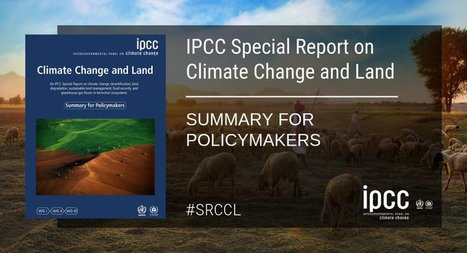
IPCC Report, 12/08/2019 - “Many findings are important for us and for policy makers around the world. The report shows that land is both a source and a sink of greenhouse gases. Currently, land absorbs 22% of our greenhouse gas emissions and such absorption has increased as our emissions have increased. Therefore, we are receiving a free subsidy from nature as the land is reducing the negative climate impacts of our own actions. The report also shows that this subsidy will not go on indefinitely, and the continuous land and soil degradation are major threats to the biosphere and the continued absorption of carbon dioxide.”
|
|
Scooped by
CIHEAM News
August 19, 2019 5:56 AM
|
Sputnik France, 10/08/2019 - Un humain sur quatre vit aujourd’hui dans un pays confronté à un stress hydrique «extrêmement élevé», indique l’Institut des ressources mondiales dans un rapport rendu public le 6 août. Sur les 17 pays ressentant un stress hydrique «très élevé», où vit un quart de la population mondiale, 12 se trouvent au Moyen-Orient et en Afrique du Nord (MENA). L’Algérie et la Tunisie font partie pour leur part des pays au taux de stress hydrique «élevé», tout comme le Maroc qui, sur un total de 164 pays, se classe 22e. En effet la région du MENA, chaude et sèche, est par nature faiblement approvisionnée en eau et les changements climatiques compliquent encore plus la situation. Ainsi, selon la Banque mondiale, la région essuierait les pertes économiques les plus importantes dues à la pénurie d’eau liée au climat, estimée entre 6 et 14 % du PIB d’ici 2050.
|
|
Scooped by
CIHEAM News
August 19, 2019 5:43 AM
|
Le Monde, 08/08/2019 - Une délégation des 195 pays a approuvé le texte des experts de l’ONU, qui fait le point sur l’état des terres et les impacts des changements climatiques à venir. Au terme d’une session marathon, les Etats ont approuvé, mercredi 7 août, à Genève (Suisse) le rapport du Groupe d’experts intergouvernemental sur l’évolution du climat (GIEC) qui porte sur l’utilisation des terres. Il doit être rendu public jeudi, avec, en toile de fond, la nécessité d’assurer la sécurité alimentaire d’une population mondiale croissante et la lutte contre le réchauffement. En clair : comment le réchauffement climatique affecte les terres consacrées aux cultures, à l’élevage ou encore les forêts, et par ricochet la sécurité alimentaire, mais aussi comment les pratiques agricoles ou la déforestation agissent sur le climat.
|
|
|
Scooped by
CIHEAM News
September 25, 2019 8:36 AM
|
World Grain, 10/09/2019 — Prospects for Australian winter crop production in 2019–20 deteriorated over the winter due to unfavorable growing conditions in several key production regions, according to the September report from the Australian Bureau of Agricultural and Resource Economics and Sciences (ABARES). Although winter crop production is forecast to rise by 11% in 2019–20 to 33.9 million tonnes, it is a downward revision of 7% from the forecast ABARES published in June. Forecast production is around 16% below the 10-year average. Wheat production is forecast to increase by . . .
|
|
Scooped by
CIHEAM News
September 25, 2019 8:28 AM
|
UkrAgroConsult, 24/09/2019 - Due to drought in Kazakhstan’s key grain growing regions, the grain crop in the country may fall to a five-year low. This drought has hit primarily the northern regions. Kostanay region, which hosts 26% of total acreage of grains (mostly wheat), suffered to the greatest degree. Due to dry weather in July, grain yield in the region plummeted by 43% from last year. In addition, protracted rains that fell on the peak of harvest (August 25 to September 10) have already deteriorated the quality of grain and may increase its losses while conditioning. This year’s wheat crop will contain a larger share of feed grain. According to UkrAgroConsult’s forecast, this will in turn lead to a more substantial drop in wheat and flour exports from Kazakhstan, because it is Kazakh milling wheat that traditionally attracts demand from importers.
|
|
Scooped by
CIHEAM News
September 25, 2019 8:20 AM
|
La Terre de Chez Nous, 20/09/2019 - FranceAgriMer se montre optimiste pour la campagne commerciale céréalière 2019/2020 malgré la vive concurrence des pays de la mer Noire sur le marché mondial. L'enquête qualité des blés 2019 menée par FranceAgriMer et l’institut Arvalis, présentée le 11 septembre à l’issue du conseil spécialisé grandes cultures de l’organisme public, confirme les premières estimations optimistes du mois d’août. Pour le blé tendre, les analyses révèlent notamment des poids spécifiques (PS) exceptionnels, avec une moyenne nationale à 79,5 kg/hl, soit la deuxième meilleure performance des 20 dernières années après 2015. En ce qui concerne les teneurs en protéines, la moyenne hexagonale s’établit à 11,5 %. Ajoutons à ce tableau une teneur en eau moyenne de 12,1 % qui devrait garantir de bonnes conditions de conservation et des indices de chute de Hagberg à un très bon niveau, avec 92 % des volumes collectés au-delà des 300 secondes. 82 % des blés tendres de bonne qualité meunière
Sur le plan de la qualité technologique...
|
|
Scooped by
CIHEAM News
September 25, 2019 5:29 AM
|
Global and foreign wheat production in 2019/20 are projected 2.5 million tons lower this month to 765.5 and 711.6 million, respectively. Even with this reduction, the projection for wheat output is still 34.7 million tons higher than estimated for the previous year (table A). Larger wheat planting combined with favorable weather has boosted wheat production prospects in a number of countries, with the lion’s share of the growth coming from major wheat exporters. The combined wheat output of the eight major exporting countries/regions—Argentina, Australia, Canada, European Union (EU), Kazakhstan, Russia, Ukraine, and the United States—is projected to increase 26.5 million tons relative to a year ago. Predictably lower wheat prices encouraged importers to purchase wheat not only for immediate, but also delayed, consumption, with wheat importers’ stocks up more than 9 million tons on the year, while the stocks of major exporters are virtually unchanged.
Relative to last month, production prospects are revised for six wheat producers and exporters this month—Australia, Canada, Kazakhstan, Russia, EU, and India, with India being one of the largest wheat producers but usually not a major exporter.
|
|
Scooped by
CIHEAM News
September 25, 2019 5:02 AM
|
USDA Progress Report of September 22: 29% mature corn only vs 57% 2014-2018 average. 87% of spring wheat hervested vs 97% 2014-2018 average, 22% of winter wheat planted vs 24% 2014-2018 average.
|
|
Scooped by
CIHEAM News
August 22, 2019 4:06 AM
|
World Grain, 15/08/2019 — The International Rice Research Institute (IRRI) is working to decrease crop loss from pest and diseases with an interactive crop diagnostic tool. Rice Doctor is a tool developed to cater to the needs of the extension and advisory service providers and farmers as primary users to identify insect pests, diseases, nutrient deficiencies, toxicities, and agronomy related problems of the crops. It provides information on these problems as well as recommendations to address them. It also can be useful for researchers, students . . .
|
|
Scooped by
CIHEAM News
August 19, 2019 8:16 AM
|
Terre-net, 15/08/2019 - Le maïs a enregistré une troisième séance de baisse consécutive mercredi, toujours affecté par un rapport révisant à la hausse les chiffres sur la récolte aux Etats-Unis et miné par les incertitudes économiques mondiales. Le soja a reculé et le blé a progressé. Le marché du maïs continue de réagir au rapport du ministère américain de l'agriculture», a indiqué Dan Cekander de DC Analysis. Dans son rapport mensuel sur les estimations de production mondiale de céréales et d'oléagineux (Wasde), publié lundi, l'USDA a prévu une récolte de maïs plus importante que prévu auparavant pour l'exercice 2019/2020 aux Etats-Unis. Le ministère table sur une production de 353,1 millions de tonnes (Mt) et sur une baisse des exportations, conduisant à des stocks finaux plus importants que prévu.
|
|
Scooped by
CIHEAM News
August 19, 2019 8:00 AM
|
Prairie Post, 15/08/2019 - There is a federal election coming this October. Members of Parliament and candidates are canvassing their constituents at barbecues, golf tournaments and eventually all-candidate debates. Now is the time for farmers to push for policies that will allow agriculture to deliver economic growth. Agriculture is a driver of the Canadian economy. The last twenty years have seen a push for reduced tariffs and increased market access through broad trade agreements. Agricultural trade liberalization has been successful for Canada. During the last twenty years (1999-2018) earnings from farming have been on a steady upward trend. In fact, farming cash receipts in 2018 were more than double the level in 1999. At the same time, farmers’ utilization of agricultural safety net programs has been cut in half. What is the economic impact of growing world protectionism? Italy was once the largest market for Canadian durum, the wheat used to make pasta. But Italy has adopted protectionist country of origin labelling requirements that have reduced our durum exports by about sixty percent. This has happened after the agricultural provisions of the Comprehensive Economic Trade Agreement with Europe was negotiated. India was once our leading export market for pulse crops like lentils and peas. Non-tariff and tariff trade barriers have slashed these export opportunities...
|
|
Scooped by
CIHEAM News
August 19, 2019 7:52 AM
|
Le Matin Maroc, 16/08/2019 - La première conférence UE-Afrique du Nord prévue en novembre à Marrakech La société internationale de la recherche en agriculture biologique (ISOFAR) et l’Institut national de la recherche agronomique Maroc (INRA) organisent la première conférence UE-Afrique du Nord sur l’agriculture biologique. Prévue à Marrakech les 11 et 12 novembre prochain, cette rencontre entend répondre à la question : comment la recherche peut-elle contribuer à combler le fossé actuel entre l’Afrique et l’Europe en ce qui concerne l’agriculture biologique ?
Des scientifiques et des chercheurs de haut niveau feront partie de cette conférence pour discuter autour de l’innovation et le financement de la recherche organique. Objectif : formuler des recommandations afin de les présenter aux différents organismes de certification et de réglementation.
Ce rendez-vous a pour finalité de fusionner une masse critique de capacités scientifiques et des compétences de l’Europe et de l’Afrique pour proposer des solutions durables. Le deuxième objectif est relatif au renforcement de l’initiative «Alternatives biologiques pour l’Afrique» et enfin trouver des solutions pour combler l’écart actuel entre l’Afrique et l’Europe en ce qui concerne l’agriculture biologique.
|
|
Scooped by
CIHEAM News
August 19, 2019 6:18 AM
|
Terre-net, 12/08/2019 - La récolte ukrainienne d'orge confirme son excellent potentiel et les exportations de ce pays ont bondi. A l'inverse, les exports européens ont fondu de moitié par rapport à l’an dernier. Le ministère ukrainien de l'agriculture confirme l'excellent potentiel de la récolte d'orge cette année. Les rendements sont en nette progression par rapport à l'an dernier. La moisson de 8,2 Mt est en progression de 900 kt en un an. Les exports du pays ont ainsi bondi à 945 kt depuis le début de la campagne ! En revanche, les exports européens ont fondu de moitié par rapport à l’an dernier (357 kt), la Roumanie représente en outre une très grande partie de ces volumes, tandis que les chargements dans les ports français sont, eux, encore marginaux.
|
|
Scooped by
CIHEAM News
August 19, 2019 6:02 AM
|
Terre-net, 14/08/2019 - La campagne de commercialisation 2018-2019 s’est achevée fin juin 2019 avec un piteux bilan mensuel. En valeur, les exportations de céréales sont en baisse de 94 M€ sur un an. Néanmoins, le solde commercial en produits bruts du premier semestre 2019 a augmenté de 400 M€ par rapport à 2018. « En juin 2019, le déficit des échanges de produits agricoles bruts se creuse de 55 M€ par rapport à juin 2018. Cette évolution résulte principalement de la diminution de l’excédent avec l’UE (- 36 M€ sur un an) mais aussi avec les pays tiers (- 19 M€). Les exportations (1 milliard d’euros) reculent de 122 millions d’euros (- 10 % par rapport à juin 2018). En particulier, la valeur des expéditions de céréales, principalement de blé tendre et dans une moindre mesure de maïs, diminue sur un an de 94 millions d’euros (- 19 %) parallèlement à des quantités exportées en recul d’une année sur l’autre (- 0,7 million de tonnes pour le blé tendre et - 0,1 million de tonnes pour le maïs). Les importations (près de 1,1 Md€) diminuent de 67 millions (- 6 % par rapport à juin 2018). » Néanmoins, « sur le premier semestre 2019, le solde commercial en produits bruts a augmenté de 0,4 milliard par rapport à 2018. Cette évolution est pour une large part la conséquence de l’amélioration des échanges avec les pays tiers (80 %). »
|
|
Scooped by
CIHEAM News
August 19, 2019 5:48 AM
|
Huffpost Maghreb, 07/08/2019 - ‘‘L’Algérie peut cette année se passer de l’importation de l’orge’’, a annoncé mardi soir à Constantine le ministre de l’Agriculture, du Développement rural et de la Pêche, Cherif Omari, après une récolte céréalière historique estimée à 27 millions de quintaux. ‘‘Le marché algérien est suffisamment approvisionné en orge et tous les indicateurs relèvent que le pays se passera de l’importation de ce produit’’, a indique le ministre lors d’un point de presse, en marge d’une visite dans la forêt de Djebel El Ouahch touchée en début de ce mois par un incendie. S’agissant de la production du blé dur, le ministre a indiqué que l’Algérie a pu assurer une ‘‘autosuffisance de 10 mois en la matière’’ assurant que cet effort est ‘‘à consolider par le suivi et l’accompagnement de cette filière pour des résultats meilleurs’’. M. Omari a, par ailleurs souligné que la production du blé tendre continue de faire l’objet ‘‘d’un chantier ouvert au ministère de l’Agriculture avec la perspective de conforter le rendement de cette filière’’ relevant que la consommation du blé tendre, aliment de base dans beaucoup de produits alimentaires notamment le pain est ‘‘à revoir’’. Il a dans ce sens avancé que ‘‘pas moins de 10 millions de petits pains sont jetés quotidiennement’’.
|