Your new post is loading...

|
Scooped by
CIHEAM News
October 2, 2019 10:11 AM
|
Terre-net Média, 30/09/2019 - La sécheresse qui sévit en Argentine menace la production de blé. Le pays rejoint notamment le Canada et l’Australie, où les conditions climatiques posent également problème. L’offre en deuxième partie de campagne pourrait donc être plus limitée que prévu. En Argentine, le climat beaucoup trop sec pourrait pénaliser la production de blé d’autant que le déficit hydrique, qui affecte maintenant 22,5 % des cultures selon la bourse de commerce de Buenos Aires, s’est accentué ces deux dernières semaines dans une bonne partie du pays. Les plantes sont à un stade critique de développement et le potentiel de rendement pourrait être entamé si les précipitations attendues dans les prochains jours, surtout dans le nord, restent insuffisantes. Les conditions climatiques ne s’améliorent pas non plus en Australie (sécheresse persistante) et l'hiver fait ses premiers approches au Canada et aux USA.
|
|
Scooped by
CIHEAM News
October 2, 2019 5:21 AM
|
L'Economiste Maghrébin, 28/09/2019 - La récolte finale des céréales en Tunisie a atteint au cours de la saison 2018/2019 un record près de 24 millions de quintaux contre 14 en 2017/2018. Cela comprend selon le Ministère de l'agriculture, des ressources hydrauliques et de la pêche, 12,6 Mq de blé dur, 1,8 Mq de blé tendre, 9,1 Mq d'orge. La productivité des céréales s'élève à ...
|
|
Scooped by
CIHEAM News
October 2, 2019 4:35 AM
|
Business recorder, 19/09/2019 - The cut aims at ensuring regular supplies and guaranteeing the stability of the soft wheat price at 260 dirhams per quintal. Morocco announced a cereals harvest of 5.2 million tonnes, down 49% from a year earlier because of a lack of rainfall. Morocco will cut its customs duty on soft wheat to 35% from 135% from Oct. 1, government spokesman Mustapha El Khalfi announced on Thursday after a cabinet meeting. “This is also a social measure that is aimed at boosting national reserves and protecting the purchasing power of citizens,” said El Khalfi. “Keeping customs duty at 135% will lead to higher prices,” he said. Reuters on Tuesday cited a government source as saying that Rabat had decided to cut soft wheat duty. Wheat supply is key to Morocco’s stability as bread and semolina make up staples for the population of 35 million.
|
|
Scooped by
CIHEAM News
October 2, 2019 4:20 AM
|
Successfull Farming, 01/10/2019 - More and more bullish news continues to come out of the grain complex as we pursue harvest. It’s October. So far, producers have dodged the frost bullet for now, an extremely positive development for northern growers but also a bearish development for the market. Crops will likely mature or get close to it in many northern areas, at least most of the crop in North Dakota, South Dakota, and Minnesota. However, questions remain about the size of the 2019 crop given the late planting and late development so far. For example, an Illinois grower who planted his corn on...
|
|
Scooped by
CIHEAM News
October 2, 2019 4:08 AM
|
Reuters, 30/09/2019 - Dryness in Argentina is hitting the outlooks for wheat and corn crops, local climate experts said, while low-cost soy is being supported by growers looking to hedge their bets with political uncertainty rising ahead of October's presidential vote. While large regions of the grain exporter's Pampas farm belt are in good condition, around one-fifth of the growing area has been hit by arid weather over recent weeks, said Eduardo Sierra, meteorologist at the University of Buenos Aires. Sierra, climate consultant to the highly referenced Buenos Aires Grains Exchange, has cut his 2019/20 wheat crop forecasts to 17 million tonnes from 20 million tonnes previously and his corn crop outlook for this season by a fifth to 40 million tonnes. His soy projection has edged down to 50 million tonnes. "You have 80% of the grains belt in good condition and 20% in mediocre to bad condition," he said, adding these areas had about 30% of Argentina's wheat, 20% of its soy and 25% of its corn crop. The dryness has hurt wheat yields and slowed corn sowing, as growers pile into safe-haven soybeans, Argentina's main cash crop. Uncertainty is rife in the recession-hit economy with left-leaning Peronist Alberto Fernandez expected to win the Oct. 27 presidential election.
|
|
Scooped by
CIHEAM News
October 1, 2019 5:16 AM
|
World Grain, 24/09/2019 - Chinese importers purchased about 10 boatloads of U.S. soybeans on Sept. 23 following deputy-level trade talks in Washington, D.C., U.S., last week, Reuters reported. The soybean deals were among the largest by private Chinese importers since China raised import tariffs by 25% on U.S. soybeans in July 2018 in retaliation for U.S. duties on Chinese goods, according to Reuters. News of the purchase sent benchmark U.S. soybean futures on the Chicago Board of Trade about 1.5% higher on Monday, the market’s . . .
|
|
Scooped by
CIHEAM News
October 1, 2019 4:59 AM
|
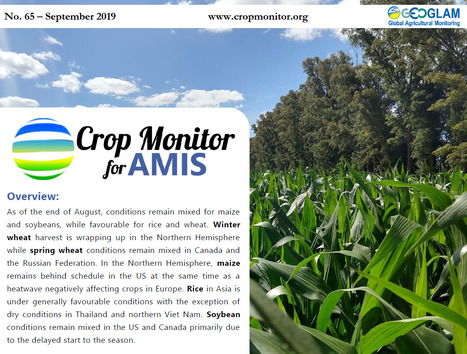
September 2019 Crop Monitor for AMIS countries. As of the end of August, conditions remain mixed for maize and soybeans, while favourable for rice and wheat. Winter wheat harvest is wrapping up in the Northern Hemisphere while spring wheat conditions remain mixed in Canada and the Russian Federation. In the Northern Hemisphere, maize remains behind schedule in the US at the same time as a heatwave negatively affecting crops in Europe. Rice in Asia is under generally favourable conditions with the exception of dry conditions in Thailand and northern Viet Nam. Soybean conditions remain mixed in the US and Canada primarily due to the delayed start to the season.
|
|
Scooped by
CIHEAM News
September 26, 2019 5:20 AM
|
FAO release, 05/09/2019 - Global cereal supplies in 2019/20 are expected to be higher than earlier anticipated following this month’s rise in the world cereal production forecast. Nonetheless, world inventories would still need to be drawn down, albeit less significantly than predicted at the start of the season, in order to meet the expected increase in utilization in 2019/20. FAO’s new forecast for global cereal production in 2019 stands at 2 708 million tonnes, 23 million tonnes higher than the forecast made in July and now 55.4 million tonnes (2.1 percent) above the 2018 outturn. Almost the entire monthly increase is on account of an upward revision made to the forecast for world maize production, now pegged at 1 124 million tonnes, 2.0 percent higher than in July and up 0.7 percent from 2018. These more buoyant expectations mostly stem from improved yield prospects in the United States, despite excessive rainfall through much of the planting season. Additionally, with the maize harvest nearing completion in Brazil, the country’s 2019 production forecast was lifted recently, further augmenting global prospects. These positive revisions outweighed an ...
|
|
Scooped by
CIHEAM News
September 26, 2019 5:09 AM
|
Business Matters, 16/09/2019 - Europe is at war. Not conventional military conflict, but a battle against an unprecedented, rampant virus. An epizootic some are calling ‘pig Ebola’, officially known as African swine fever (ASF), has already laid waste the Chinese pig industry, and soon it will have European pig farms in its clutches. Or certainly, that is how things are looking, given the current readiness levels in Europe and the rapid escalation of Eastern European outbreaks of infection. The main concern for Europe’s pork producers is that the virus has reached Belgium: specifically, the French border with Belgium. France is planning a segregation fence for this reason; Denmark has already started building its own, this one on the border with Germany. Each of these nations aims to block the migration of wild boar which also carry the virus and are often responsible for the transmission of infections across borders. The disease is devasting to domesticated pig populations, killing 90 percent of animals infected. While the virus only affects pigs, the consequences of large-scale contraction in a country are being demonstrated in harrowing fashion in China. There have been recorded outbreaks of ASF in every province in the country, with the first cases having emerged in August last year. The government has admitted to culling 2 million animals so far, however, analyst have posited that this is a massive undercount. Researchers are placing estimates of animals dead by the end of the year at 200 million, or roughly half of all Chinese pigs. The scale is shocking, particularly as China is home to more than half of the global pig population. “It’s historic; there’s never been...
|
|
Scooped by
CIHEAM News
September 26, 2019 3:41 AM
|
CIMMYT release, 23/09/2019 - Scientists identified significant new chromosomal regions for wheat yield and disease resistance, which will speed up global breeding efforts. Using the full wheat genome map published in 2018, combined with data from field testing of wheat breeding lines in multiple countries, an international team of scientists has identified significant new chromosomal regions for wheat yield and disease resistance and created a freely-available collection of genetic information and markers for more than 40,000 wheat lines. Reported today in Nature Genetics, the results will speed up global efforts to breed more productive and climate-resilient varieties of bread wheat, a critical crop for world food security that is under threat from rising temperatures, rapidly-evolving fungal pathogens, and more frequent droughts, according to Philomin Juliana, wheat scientist at the International Maize and Wheat Improvement Center (CIMMYT) and first author of the new study.
|
|
Scooped by
CIHEAM News
September 25, 2019 11:47 AM
|
African Manager, 23/09/2019 - Les importations des céréales de l’Algérie ont reculé de 12,54% durant les sept premiers mois de 2019 pour atteindre près de 1,62 milliard de dollar, a appris APS auprès de la direction générale des Douanes (DGD). De janvier à juillet derniers, les importations des céréales ont atteint 1,617 milliard de dollar, contre 1,849 milliard durant la même période de l’année dernière, enregistrant ainsi une baisse de -12,54%, selon les données statistiques de la direction des études et de la prospective des Douanes (DEPD). A noter que cette tendance baissière des importations des céréales est appelée à se poursuivre durant les prochains mois, encouragée par une importante production nationale enregistrée durant la saison 2018-2019. A ce propos, le ministère de l’Agriculture, du Développement rural et de la Pêche, Cherif Omari avait annoncé récemment une “nette amélioration” du rendement de la filière céréalière, qui permettra à “l’Algérie de se passer de l’importation notamment d’orge et de blé dur”.
|
|
Scooped by
CIHEAM News
September 25, 2019 9:11 AM
|
The Financial Post, 23/09/2019 — Brazil plans to introduce a 750,000-tonne tariff-free quota for wheat imports from countries outside of the South American Mercosur trade bloc in November, a government official said on Monday. Flavio Bettarello, the agriculture ministry’s assistant secretary for trade and foreign relations, told an industry conference that enforcing the new tariff-free quota could help Brazil add new suppliers, including the United States and Russia. The government is still pondering how to implement the quota in November, he told Reuters on the sidelines of the conference, explaining that it could be introduced via an order from the Special Secretariat for Foreign Trade and International Affairs (Secint) or from the Executive Secretariat of Foreign Trade (Camex). The Brazilian millers’ association Abitrigo welcomed the new quota, which was announced as part of a series of measures to open up Brazil’s economy and increase the country’s share of global agricultural trade...
|
|
Scooped by
CIHEAM News
September 25, 2019 8:49 AM
|
Lettre Info Riz de FranceAgriMer, 20/09/2019 - En dépit d’une baisse de ses ventes vers les pays d’Afrique de l’Ouest, l’Inde, premier exportateur mondial, a enregistré une hausse des prix à l’exportation, cette semaine. La variété étuvée 5 % de brisures est passée de 370 $/t à 376$/t.
La faible demande a maintenu les taux vietnamiens au plus bas niveau des douze dernières années alors même que le pays cherche à encourager les investissements privés à rendre son riz plus compétitif. Le Viet 5 % de brisures continue de maintenir un prix de 325 $/t, son niveau le plus bas depuis 2007. Le manque de nouvelles offres a pesé sur le marché vietnamien, avec des prix inférieurs d'environ 13 % à ceux du début de l’année.
En Thaïlande, les cours du Thaï 5 % de brisures sont restés inchangés, se situant entre 400 et 418 $/t, en raison du manque de demande et du taux de change entre le baht et le dollar américain.
Avec une moyenne de 409 $/t, le riz thaïlandais était toujours près de son plus haut niveau depuis juin 2018. La demande reste stable car la hausse
des prix semble avoir dissuadé les acheteurs. Un baht fort a maintenu les taux élevés par rapport aux concurrents depuis le début de l'année.
Toutefois, les inondations dans le nord-est de la Thaïlande continuent d'inquiéter sur l'offre, (dommages estimés à plus de 240 000 ha à la suite des inondations causées par la tempête tropicale Podul.
|
|
|
Scooped by
CIHEAM News
October 2, 2019 10:08 AM
|
Les Eco Maroc, 27/09/2019 - Le Conseil économique, social et environnemental (CESE) a tiré jeudi la sonnette d’alarme au sujet de la sécurité hydrique, cette dernière "gravement menacée par un usage intensif", le conseil a appelé ainsi tous les acteurs à entreprendre des mesures urgentes. Ceci vient alors que le royaume se prépare à accueillir le Sommet international sur la sécurité hydrique qui se tiendra du 1 au 3 octobre à Marrakech. La situation de pénurie hydrique au Maroc est alarmante puisque ses ressources en eau sont actuellement évaluées à moins de 650 m3/habitant/an, contre 2500 m3 en 1960, et devraient baisser en deçà de 500 m3 à l’horizon de 2030, a prévenu le CESE dans un communiqué, ajoutant que des études internationales indiquent que les changements climatiques pourraient provoquer la disparition de 80% des ressources d'eau disponibles au Royaume dans les 25 prochaines années. Malgré l’extrême gravité de la situation, la surexploitation des ressources en eau, notamment des nappes souterraines, s'accentue, faisant fi des autorisations imposées par la loi, alors que les pouvoirs publics sont dans l’incapacité de mettre en place des moyens de contrôle efficaces, a noté la même source. Dans ce cadre, le CESE a mis en avant la nécessité d’agir en urgence pour assurer la sécurité hydrique du Maroc, précisant que ...
|
|
Scooped by
CIHEAM News
October 2, 2019 5:16 AM
|
Publication release, Science Advances, May 2019 - Since its domestication in the Fertile Crescent ~8000 to 10,000 years ago, wheat has undergone a complex history of spread, adaptation, and selection. To get better insights into the wheat phylogeography and genetic diversity, we describe allele distribution through time using a set of 4506 landraces and cultivars originating from 105 different countries genotyped with a high-density single-nucleotide polymorphism array. Although the genetic structure of landraces is collinear to ancient human migration roads, we observe a reshuffling through time, related to breeding programs, with the appearance of new alleles enriched with structural variations that may be the signature of introgressions from wild relatives after 1960.
|
|
Scooped by
CIHEAM News
October 2, 2019 4:31 AM
|
Bloomberg Opinion, 24/09/2019 -- This year’s U.S. corn crop isn’t looking great. Soggy spring weather in many parts of the Midwest delayed planting, and warmer-than-normal temperatures lately have been posing their own problems.(1)Still, while the 13.8-billion-bushel corn harvest currently projected by the US Department of Agriculture would be the smallest since 2015, it’s about 40% more than U.S. corn farmers were bringing in just two decades ago, and more than three times the average harvest in the 1960s. Corn is the biggest U.S. crop by volume, acres harvested and value (the most valuable agricultural product is cattle and calves, which are usually fed a lot of corn in the latter stages of their lives). That’s not even counting corn for silage — an animal feed of fermented, chopped-up corn plants — and the sweet corn that we eat off the cob. Silage and sweet corn are measured differently, which is why they’re not included in the above chart, and they are also much less widely grown, with 6 million acres of silage and 473,100 acres of sweet corn harvested last year to just under 82 million acres of corn for grain. That acreage is higher than it was a few decades ago, which accounts for some of the production boom. But this acreage increase followed even bigger declines in the mid-20th century — grain-corn acreage hit its all-time high of 110.9 million in 1917. The main reason the U.S. produces much more corn than it used to is because U.S. corn farmers have become much, much more productive.
|
|
Scooped by
CIHEAM News
October 2, 2019 4:16 AM
|
Reuters, 29/09/2019 - The Australian government said on Sunday its financial assistance to drought-affected farmers did not contravene the country's free-trade agreements. Prime Minister Scott Morrison said on Friday an additional A$100 million ($68 million) would be made available for drought-striken farmers, with lower eligibility standards so more could access the previously committed A$7 billion in aid. Agriculture Minister Bridget McKenzie said the support was not a farm subsidy that could jeopardise Australia's obligations under its free-trade agreements. "As an exporter of 70% of what we produce, we don't want to be doing anything here at home that puts at risk our ability to trade," McKenzie told Sky News. Parts of Australia's east coast are suffering under the worst drought in living memory and the weather bureau has forecast another three months of dry weather. Australia's east coast accounts for close to a third of its wheat output, and the grain is the country's largest and most lucrative rural crop for one of the world's top 10 exporters of wheat.
|
|
Scooped by
CIHEAM News
October 1, 2019 5:24 AM
|
World Grain, 25/09/2019 — Millers in Lebanon are warning that the country’s flour production is being threatened by low wheat reserves stemming from currency issues, Reuters reported. In statement released on Sept. 24, the Lebanese millers’ association urged officials to find a solution for dollars to be supplied at the official price, “so owners of the mills can resume their work and import the country’s wheat need.” Dollars and pounds are legal tender in Lebanon, and the Lebanese pound has been pegged against the dollar at a level of 1,507.5 pounds for more than two decades. It said the wheat reserve at the mills “has fallen to a level that represents a danger, and this may expose the country to a supply crisis if the U.S. dollar problem is not resolved.” Lebanon is very dependant on wheat imports to supply millers and produce flour in need. . . .
|
|
Scooped by
CIHEAM News
October 1, 2019 5:11 AM
|
EU DG AGRI release, Cereal Market and balance situation. Here are the Highlights of the main changes compared to last year are: •Production forecast : above average (311,2 million tonnes, + 7,2% y/y) based on:
+ Areas communicated by Member States
+ Yield Forecast (MARS)
oIncrease of total EU cereal area (56,1 million ha, 1,9% y/y)
•Decrease of the total imports, in particular for maize
•Increase of the total exports
•Increase of ending stocks
|
|
Scooped by
CIHEAM News
September 26, 2019 5:23 AM
|
World Grain, 16/09/2019 - A sharp upward revision in the U.S. Department of Agriculture’s forecast in the Aug. 12 World Agricultural Supply and Demand Estimates for the U.S. 2019-20 maize crop sent prices lower in mid-August. In a weekly newsletter published Aug. 20, the European Confederation of Maize Production (CEPM) described the upward revision of the U.S. crop by 660,000 tonnes “surprising for all market observers.” The U.K.’s Agricultural and Horticultural Development Board said the new USDA production forecast for the United States at 353.1 million tonnes was up . . .
|
|
Scooped by
CIHEAM News
September 26, 2019 5:14 AM
|
FAO release, 05/09/2019 - The FAO Food Price Index* (FFPI) averaged 169.8 points in August 2019, down 1.1 percent (almost 2.0 points) from July but still 1.1 percent higher than in August 2018. The decline in August marked the third consecutive monthly decrease in the FFPI, with the latest drop reflecting sharp falls in the prices of sugar and leading cereals, outweighing increases in all other sub-indices, especially vegetable oils. The FAO Cereal Price Index averaged 157.6 points in August, down by as much as 6.4 percent (10.8 points) from July and 6.6 percent (11.1 points) from the corresponding month last year. Similar to the drop in July, the fall in the value of this sub-index in August reflects sharp declines in the prices of wheat and major coarse grains, particularly maize. Wheat prices remained under downward pressure, influenced by large export availabilities and, hence, increased competition among the major exporters. Maize values also turned sharply lower in August, primarily because of expectation of a much larger-than-earlier anticipated harvest in the United States, the world’s largest producer and exporter of maize. By contrast, international rice prices edged up in August, underpinned by seasonal tightness in northern hemisphere suppliers and in Thailand because of concerns over the impact of weather on crops.
|
|
Scooped by
CIHEAM News
September 26, 2019 5:05 AM
|
Terre-net Média, 20/09/2019 - Les prix du blé poursuivaient leur embellie, vendredi à la mi-journée et demeuraient stables, toujours soutenus par un regain de demande à l'exportation. La semaine aura été rythmée par le retour des acheteurs sur le marché international où de nombreux appels d'offres ont été lancés (Egypte, Algérie, Tunisie...) et cela tout particulièrement en blé tendre. Le retour de cette demande apporte un élément de soutien aux cours après un mois de septembre marqué par un repli des prix» , commentait le cabinet Agritel, dans une note publiée vendredi. Les autorités marocaines ont confirmé jeudi la baisse, dès le 1er octobre, des droits de douane à l'importation en blé meunier, qui passeront de 135 % à 35 %. « Les opérateurs locaux font en effet face à une forte baisse de la production locale et à un besoin plus important de solutions d'importation », notait Agritel. La France, qui a produit cet été une des récoltes les plus abondantes de son histoire, va devoir trouver ou reconquérir d'autres débouchés que ceux où elle écoule habituellement sa marchandise, pour éviter des stocks trop abondants en fin de campagne. L'Office marocain a lancé deux appels d'offres en faveur des origines européennes et américaines, contingents disponibles en blé meunier mais aussi en blé dur. Les exportateurs français seront très actifs sur cette demande en raison de niveaux de prix attractifs vis à vis notamment des origines ukrainiennes, de l'avis de plusieurs spécialistes du secteur. La fermeté des cours s'expliquait aussi, selon Agritel, par les perspectives de production dans l'hémisphère sud et le retard des récoltes aux États-Unis et au Canada. La FAO (agence des Nations unies pour l'agriculture et l'alimentation) a néanmoins légèrement revu à la hausse ses prévisions de production mondiale de céréales pour 2019, à 2,7 milliards de tonnes (+23 millions de tonnes par rapport à juillet), en raison notamment de l'amélioration annoncée des rendements de maïs aux Etats-Unis.
|
|
Scooped by
CIHEAM News
September 25, 2019 11:49 AM
|
ObservAlgérie, 21/09/2019 - Les statistiques de deux sources différentes sur l’importation de blé dur par l’Algérie viennent démentir les chiffres annoncés par le gouvernement algérien. L’Algérie achèterait entre 420 000 et 600 000 tonnes de blé à moudre. Ainsi, le département d’agriculture du gouvernement américain a estimé que l’Algérie importerait sept millions de tonnes de blé durant la campagne de commercialisation de 2019-2020. L’Algérie serait alors le quatrième plus grand importateur de blé dans le monde, avait rapporté jeudi le site spécialisé S&P Global Platts. Cette annonce remet en question les statistiques de l’Office algérien interprofessionnel des céréales (OAIC). Par ailleurs, l’agence britannique Reuters a annoncé que l’Algérie achèterait entre 420 000 et 600 000 tonnes de blé par an, l’agence a rajouté que le prix de chaque tonne achetée s’élève entre 211 et 213 dollars, les frais de transport compris. La somme totale achetée varie ainsi entre 88,6 et 127 millions de dollars. Elle ajoute que le blé acheté par l’Office algérien interprofessionnel des céréales (OAIC) pourrait provenir de la France et de la région de la mer Baltique.
|
|
Scooped by
CIHEAM News
September 25, 2019 11:36 AM
|
Afrique Agriculture, 24/09/2019 - La 14ème édition du Salon international de l’agriculture, du machinisme agricole et de la pêche (SIAMAP 2019) se tiendra du 24 au 29 septembre au Parc des expositions du Kram. L’annonce a été faite jeudi 14 février lors d’une cérémonie de lancement des préparatifs de cette manifestation.
Ce Salon, qui se présente comme l’une des plus importantes manifestations agricoles en Afrique et dans le monde arabe, sera aménagé sur une superficie de 20.000 m2 et accueillera plus de 250.000 visiteurs.
Selon l’UTAP, organisatrice du SIAMAP, cette manifestation verra la participation de plus de 600 exposants de Tunisie et de 30 pays étrangers.
|
|
Scooped by
CIHEAM News
September 25, 2019 8:56 AM
|
Bolsa de Cereales de Argentina, Report of 19/09/2019 - 81.3% of wheat nationwide maintains a moisture condition from adequate to optimal. However the crop marks a certain delay in the phenological development with respect to previous years, observing that only the 46% of the crop transits the period of encañazon, registering a delay of -12.8 percentage points equal date on the average of the last 5 years (58.8%). Only in the NOA and NEA regions, the first batches in pasty grain (9% and 2% respectively).
Regarding sunflower cultivation, 98.3% of the area implanted nationwide maintains a condition normal to good, exceeding 11.4 percentage points at a similar date of the previous campaign. In turn, 45.7 % of the lots maintain optimal water conditions. As for phenology, the culture implanted in the NEA and the North of the province of Santa Fe transits the stage of differentiation of leaves in 69% and 48% of the cases, respectively.
|