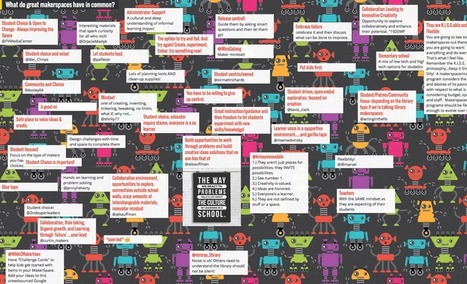
This is the 2nd video in a 3 part series on curriculum design for my PreK-6 makerspace The kids will be in the classroom before I finish producing this podcast- but what will we be doing? This pre-week each grade level team met with me to discuss what we would be learning and how we would …
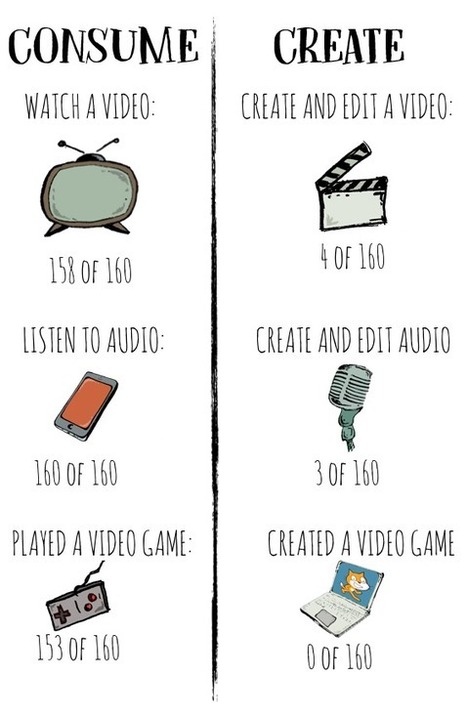
When you hear the word “create” or “make,” you might be tempted to think of a tangible, physical product. However, in design thinking, students might design other types of products. So here are some of the types of things students might create.
#1: A Digital Work
Students might create a podcast, a documentary, or a website that they publish to a global, connected audience. Even when this is the case, it’s important that students can identify an audience that goes beyond merely “online.” In other words, who online do you want to reach and how will you reach them?
#2: A Tangible Work
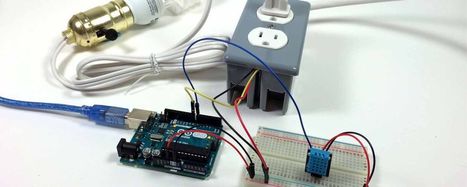
This is what we often think of when we hear about maker spaces. This is what happens when kids do a cardboard challenge or code with Arduino or paint a mural. When we do our Shark Tank style projects, kids typically create a finished tangible work.
#3: An Event
This might be something like a car wash or a dance or a graffiti removal evening. It might be something like a TEDx event or a play.
#4: A Service
Similar to an event, a service is an ongoing activity that students design to help others. Here, what they are designing isn’t a typical finished, tangible product, but rather an action for others. Often, this works in a service learning activity.
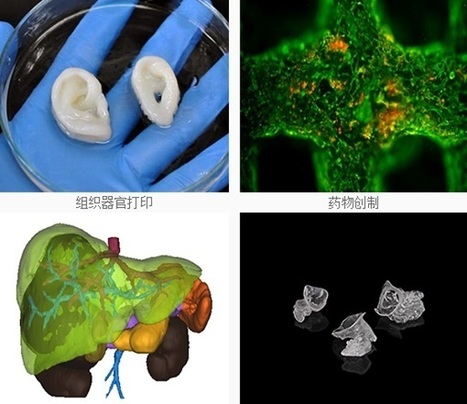
Researchers in AMBER, the Science Foundation Ireland funded materials science centre, hosted in Trinity College Dublin, have created a process to support 3D printing of new bone material. This world first research, led by Professor Daniel Kelly and recently published in the journal Advanced Healthcare Materials, could be used to regenerate large defects caused by tumour resections, trauma and infection, as well as inherited bone deformities. Professor Kelly’s research could also have numerous applications in craniomaxillofacial (the whole area of the mouth, jaw, face and skull) and orthopaedic surgery, especially in cases where tissues with complex geometries need to be regenerated, for example cases in the head, jaw or spine.
By assigning students a one-minute, social-media-friendly video reflecting on their makerspace experience, you encourage them to bring their learning into the world where they live.
The maker movement is built upon a constructivist philosophy that views learning as a highly personal and social process. In this philosophy, teachers facilitate inquiry-based learning, student development of knowledge and thinking processes, and student interaction and sharing of ideas.
Shining 3D, a Chinese 3D printing company, is aiming to become a leader in the field of 3D bioprinting while simultaneously building China’s 3D printing ecosystem. The company owns a 50% stake in Regenovo Biotech, the company behind the Regenovo 3D bioprinter.
This is one article in a series that examines gifted education, classroom creativity and geniuses in society. (See our full genius archive) The 74 is a proud media partner of the 92nd Street Y's "7 Days of Genius," a global series of events orchestrated to explore "the power of genius to make a positive impact on the world" running March 5-12. See events: 92y.org/Genius.
In the last few years, the “maker movement” has become a marvel in American schools through Maker Faires featuring homemade robots to after-school programs that teach kids to code — to entire schools geared around the art of tinkering.
Librarians in the Shawnee Mission School District are making way for “the maker movement,” and some worry where that story is going.
Reading stories, of course, has been a big part of what Jan Bombeck does with children. “Stories, stories and more stories,” she told the school board last month.
The Ray Marsh Elementary School directory lists Bombeck as “librarian” because she is state-certified to be one. But at least four Shawnee Mission grade schools have hired “innovation specialists” to run their libraries when fall classes open.
That’s the language of the maker movement, which seeks to convert once-quiet school spaces — usually in the libraries — into hands-on laboratories of creation and computer-assisted innovation.
The movement, taking place nationwide, is more about robotics than reading.
Making is as old as learning itself. While the maker movement may only be about a decade old, the human desire to create dates back to the earliest forms of human activity, from making stone tools to drawing on cave walls (Halverson & Sheridan, 2014; Martinez & Stager, 2014). Thinkers such as Pestalozzi, Montessori, and Papert helped paved the way for the maker movement by stressing the importance of hands-on, student-centered, meaningful learning. Instead of viewing learning as the transmission of knowledge from teacher to student, these thinkers embraced the idea that children learn best when encouraged to discover, play, and experiment.
More recently, maker education is being used as a way to connect do-it-yourself informal learning to classrooms. Driven by new technologies such as 3D printing, robotics, and kid-friendly coding, making is emerging as an effective way to introduce students to STEM, particularly women and minorities. By incorporating elements of making into the classroom, educators can bridge the gap between what students are passionate about and what they're learning in school.
Welcome to this fifth post in a series that brings STEM, STEAM, and Maker Space together with Project Based Learning and proper technology integration in the classroom. You will discover around one hundred resources in this series along with some great ideas for finding student success.
Part 5: STEM, STEAM, Makers: 35 Resources For A Makerspace
Take a moment to contemplate what it would be like if every school had a Maker Culture and it was part of the school curriculum. You may wish to dream of the possibilities for essential 21st-century skill development and significant content skill alignment. Think about the aura of engagement, flow, grit, perseverance, problem solving, revision, reflection, and satisfaction in that amazing space. Contemplate parents asking the question, “What did you make in school today?” Now sit back and imagine the answer, and further conversations it would bring!
Last spring, I gave my after-school Makers Club a challenge – create a unique, interactive project that guests can interact with at our 2016 Maker Fair. We had held the Cardboard Challenge earlier in the school year, giving my students lots of ideas on how to use cardboard as a medium. So it was no surprise to me when a group of students enthusiastically told me that they would be creating a cardboard Maker Cave for our MakerFair.
Fancy a 3D printed robot for your home? Here’s a list of the best 3D printed robots you can print in one go, assemble or even buy as a kit.
Robots! We just love them: 3D printing and robots are a match made in mechanical heaven. So, we’ve made a short list on the best 3D printed robot projects you can find out there. This list is divided into two parts.
Working programmable 3D printable robots that are programmable, move and actually do things. They usually have to be assembled, which takes some basic knowledge of electronics and 3D printing. Their “brains” usually are powered by an Arduino, Raspberry Pi or other microcomputers. Start right here. Printable 3D printable robots (without a function) for your shelf, desk, etc. They can be 3D printed in several parts or one go. Jump here to see them.
In the 2015 New Media Consortium Horizon Report, makerspaces were recognized as one the six most important educational technology developments.
“Makerspaces are increasingly being looked to as a method for engaging learners in creative, higher-order problem-solving through hands-on design, construction, and iteration,” the report says.
As Laura Fleming, a library media specialist from New Milford (Conn.) High School, said in the Spring 2016 issue of EdTech: Focus on K–12, a good makerspace is one that puts the learner first.
That being said, creating a makerspace that teaches students the skills to aid them in creative and technological futures doesn’t necessarily require renovations and a rollout of new tech.
Fleming’s space, for example, thrives on donations of old computers from her school’s IT department. Here are five other ways to create a makerspace now.
When Connecticut’s New Canaan High School said goodbye to students in the summer of 2015, it said hello to an ambitious new project: boxing up 7,000 books to make room for a brand-new makerspace to encourage students’ creative thinking, problem-solving and self-directed learning.
When the school’s new principal asked what library media specialists were doing with all the library’s books, and inquired about a makerspace, head librarian Michelle Luhtala knew she had a chance to do something unique with the library’s learning environment.
“Kids just come in and make what they want,” Luhtala said. “That’s the thing that is so much fun.”
As the year progressed, so too did the makerspace’s purpose.
The University of Texas Libraries and the College of Fine Arts at The University of Texas at Austin are launching a new productivity space that allows library users to take ideas and turn them into reality.
“The Foundry,” a new maker space set to open in the Fine Arts Library (FAL), will provide tools for pursuing creative impulses and ideas within a space where students can gather to create independently or collaboratively, and where users will have immediate access to traditional library resources and services to augment their work.
My group's research in Human-Computer Interaction focuses on design, prototyping and implementation tools for the era of ubiquitous embedded computing and digital fabrication. We focus especially on supporting the growing ranks of amateur designers and engineers in the Maker Movement. Over the past decade, a resurgence in interest how the artifacts in our world are designed, engineered and fabricated has led to new approaches for teaching art and engineering; new methods for creating artifacts for personal use; and new models for launching hardware products. The Maker Movement is enabled by a confluence of new technologies like digital fabrication and a sharing ethos built around online tutorials and open source design files. A crucial missing building block are appropriate design tools that enable Makers to translate their intent into appropriate machine instructions - whether code or 3D prints. Makers' expertise and work practices differ significantly from those of professional engineers - a reality that design tools have to reflect. I will present research that enables Makers and designers to rapidly prototype, fabricate and program interactive products. Making headway in this area involves working in both hardware and software. Our group creates new physical fabrication hardware such as augmented power tools and custom CNC machines; new design software to make existing digital fabrication tools more useful; software platforms for the type of connected IoT devices many Makers are creating; and debugging tools for working at the intersection of hardware and software. We also create expertise sharing tools that lower the cost and increase the quality of online tutorials and videos through which knowledge is disseminated in this community. Our work on these tools is motivated by our daily experience of teaching and building in the Jacobs Institute for Design Innovation - a 24,000 sq ft space for 21st-century design education that opened in 2015. I will give an overview of institute activities and projects, and how they inform our research agenda.
Like most local schools, we started during a time of educational reform. Unlike most local schools, we’re constructing a new kind of local education—one that’s equitable, diverse and innovative. While most schools follow a model created more than a century ago, Bricolage is designed with the future in mind. We educate children from all backgrounds and teach essential life skills like reasoning, critical thinking, problem solving, planning, and managing ambiguity. Everything connects to our mission of advancing equity and creating innovators.
A unique name
The word bricolage typically means a ‘mash-up’ or a creation from a diverse range of available things. Often used in art to describe a sculpture or other work that brings together random objects that typically don’t go together, it can also be used to describe creative problem solving in the vein of MacGyver. Finding a solution to a challenge from unlikely places is the mark of a bricoleur or one who practices bricolage. In education research, the term bricolage was used by Seymour Papert, the father of contructionism, to mean “a way of learning by trying testing and playing around.”
We are a mash-up of backgrounds, instructional approaches and people, but our overriding educational philosophy strives to develop students into creative problem solvers who will change the world.
When the visual and performing arts, the musical and recording arts, and the theatrical and graphical arts are seen as mere luxuries or add-ons within the walls of a school, powerful forces are thereby prevented from transforming routine schooling into a renaissance of learning.But who has the time
Schools all over the world are seeing higher engagement with PBL, and every day more and more schools decide to give it a shot. There’s just one problem. Many schools that start doing Project-Based Learning do not stick with it. Why? Because it’s not easy to get right.
The 3 Challenges
There are three major challenges schools face when implementing Project-Based Learning:
Since creating my makerspace and more recently, since publishing my book on makerspaces, I have had the honor of having conversations with, as well as working with, people all across the world. One of the most important lessons I have learned is that….
The center draws faculty and students not only from the college of engineering but also the school of computer science and college of science. The multidisciplinary approach is applied to projects in order to develop new ways of thinking about 3D printing for mainstream manufacturing and creating new tools and processes.
The emphasis on collaborative efforts is to pull together all the key players "to share knowledge, ideas and challenges," said Jack Beuth, director of the center and professor of mechanical engineering, in an article about the consortium. "It's an integral part of creating a thriving additive manufacturing ecosystem, and today, we get do that here at Carnegie Mellon."
If you miss the live session, a link to view the recording will be available on this page. Certificates and recordings will be available within 24 hours after the live event. Learn more about edWeb CE certificates.
Design Thinking encourages students to engage in empathy, define problems, prototype, iterate, and solve real-world problems. Makerspaces help students foster critical thinking, open-ended creativity and iterative design.
In this webinar, Beth and Douglas will present the design thinking process. They will show examples of different kinds of makerspaces, from simple to complex, and discuss how teachers can incorporate design thinking into their learning environments. From the very start of the school year, teachers can begin to cultivate a culture of collaboration, exploration and student-driven learning.
Educators, administrators, librarians, and media specialists will find the information shared in this webinar particularly valuable.
People are talking a lot about 3D printing these days, even though it’s far from a new idea since the first 3D printing device was created in 1984. Though the concept isn’t new, the things we can do with 3D printing today are completely revolutionary and unlike anything we’ve ever seen before.
You may have seen one around at your local markets, printing jewellery and knick-knacks, which is pretty cool and interesting to watch, but it doesn’t even scratch the surface of what this technology is capable of.
To get content containing either thought or leadership enter:
To get content containing both thought and leadership enter:
To get content containing the expression thought leadership enter:
You can enter several keywords and you can refine them whenever you want. Our suggestion engine uses more signals but entering a few keywords here will rapidly give you great content to curate.


 Your new post is loading...