One of the most powerful things you can do to set the philosophical tone in your makerspace is to hammer home the idea that taking risks, trying new things, and making mistakes are not only acceptable actions—they’re desirable actions. That’s what you’re hoping for! But telling a group of little kids that it’s okay to make mistakes is not an effective way to deliver your message. The droning voice of the teachers in the Peanuts cartoons springs to mind! To get kids to internalize your message and truly take it to heart, you have to show them in a wide variety of ways what you really mean.
Here are some ideas for getting across the idea that taking risks, trying new things, and making mistakes are desirable outcomes.
“Getting Started” includes a set of curated, introductory resources are for those new to making or interested in learning more about what making is and its potential impact in education. It also provides practical, concrete ways for integrating making into educational settings.
The resources below are listed in alphabetical order, as a default. They are also organized into subcategories, accessible by the tabs at the top of the grid. When hovering over each box, keywords provide a simple description and glimpse into the content of the resource, which is accessible by clicking on the arrow in the upper right-hand corner.
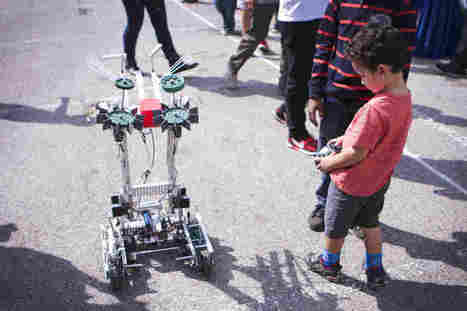
It may seem like a stretch but the building industry is set to see some major disruption.. Brick laying is already challenged to change the skills focus of practitioners. To be a bricklayer in the future will require a range of new capabilities - including the ability to calibrate and program machines like this one.
Marc is passionate about technology, electronics and computer science. He loves teaching people new skills and generating passion within youngsters. A former project manager, head of CMDNet and research engineer at CRP Henri Tudor, Marc is currently in charge of the computer science department at Lycée Technique Ettelbruck. In his spare time, Marc actively participates in youth-oriented tech projects such as the CDays, an interactive fair familiarising students with new technologies and HacKids, a series of workshops introducing hacking to young geeks.
As a teacher, Marc's dream is to bring back natural curiosity and playful behavior into our schools. In Luxembourg's school system, there is little room for improvisation or passion, and little time for cultivating differences, teaching respect and propper team skills. That's where Makerspaces come in. This concept of "learning by doing" makes it possible for students to see what they were taught, learn how to improve existing solutions and grow a passion about what they do best...
In this webinar, expert maker librarians, David Saunders and Susan Polos, tell all about how they built their library makerspaces and turned them into hubs for creativity and invention. Join in the conversation as they look to the future of makerspaces.
Unless you live under a rock or are completely off the grid when it comes to technology, you’re probably aware of the maker movement. However, if you need a refresher, I made an infographic. The maker movement is such an exciting time for students and teachers alike! Yet, while a part of you is excited, the other part of you is flooded with the reasons why you just can’t start a makerspace right now.
“I have no money.” “I’m just not super comfortable with technology.” “We don’t have devices at my school.” “I don’t have the space.” “I don’t have the schedule that allows me to teach the kids how to do the stuff.” I find this to be incredibly unfortunate. Not unfortunate in that I wish you had more money and were more comfortable with technology (although I sympathize), but unfortunate in that you think you need both of those to start a makerspace. With the massive amount of information out there about makerspaces, somewhere along the way, the term “maker” became synonymous with words like “3-D printing” and “robots.”
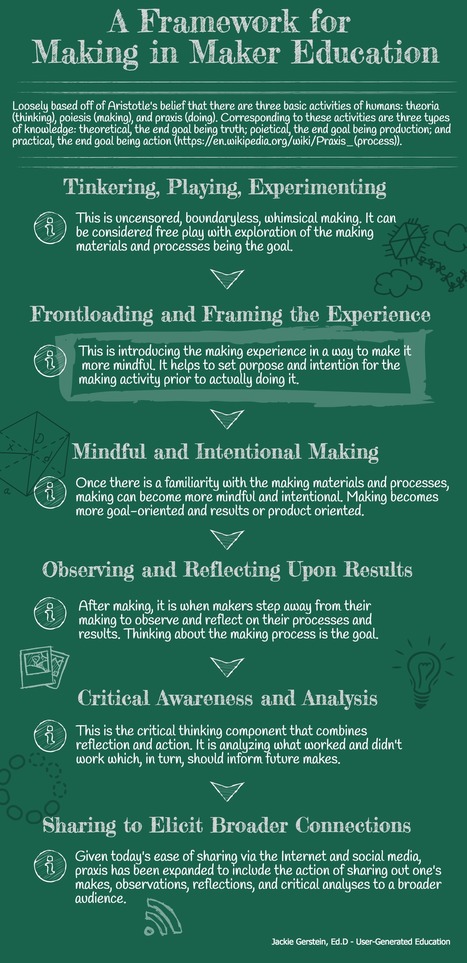
I recently learned, for the first time, about Aristotle’s belief that there were three basic activities of humans: theoria (thinking), poiesis (making), and praxis (doing). Corresponding to these activities were three types of knowledge: theoretical, the end goal being truth; poietical, the end goal being production; and practical, the end goal being action (https://en.wikipedia.org/wiki/Praxis_(process)).
The Greek theoria, from which the English word “theory” is derived, meant “contemplation, speculation, a looking at, things looked at”. The word theoria is derived from a verb meaning to look, or to see: for the Greeks, knowing was a kind of seeing, a sort of intellectual seeing (https://en.wikipedia.org/wiki/Theoria).
Praxis (From ancient Greek: πρᾶξις) is the process by which a theory, lesson, or skill is enacted, embodied, or realized (https://en.wikipedia.org/wiki/Praxis_(process)). “Praxis” may also refer to the act of engaging, applying, exercising, realizing, or practicing ideas. Praxis may be described as a form of critical thinking and comprises the combination of reflection and action. Paulo Freire defines praxis “reflection and action directed at the structures to be transformed.”(https://en.wikipedia.org/wiki/Praxis_(process))
Makerspaces enable opportunities for students to create, imagine, and build…..what better springboard for that than stories? Stories fuel and ignite the imagination.
Many people associate makerspaces with only STEM-related activities, but literacy and making can go hand in hand. An understanding of transliteracies is key to meeting the needs of our 21st century learners and can enhance any makerspace.
My own entry point into the Maker Movement, was through literacy. In this course, inject some STEAM into your makerspace and explore how reading and writing across multiple platforms can help making and creating more engaging and meaningful to learners. Glean insight and practical tips on using literacy and storytelling to derive meaning from various types of making.
A few days ago, I met Manuel Herrera at MORENet. He has an amazing maker space where students engage in creative thinking on a daily basis. It’s a bastion of creativity and wonder and his passion for it is contagious.
However, as we talked about prototyping and design thinking, he mentioned something surprising.
“We have a 3D printer, but only a few students know how to use it for creative purposes. Most students download templates and print things out. There’s not much actual creative thought that goes into it.”
“So, what’s the answer?” I asked.
“I think they need to start by making things by hand,” he said.
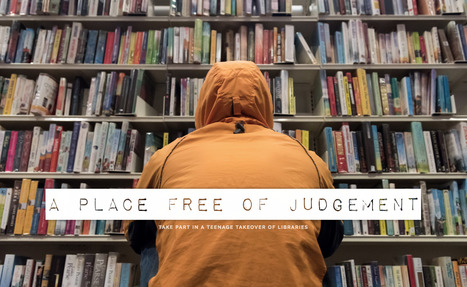
On the Saturday before Halloween, over the course of nine hours, teenagers in Worcester, Telford and Cannock will be taking control of their local libraries and performing live to a worldwide audience online to create A Place Free Of Judgement.
Join us online between 3pm and midnight on the 29th October. Help the teenagers as they roam from library to library, sneaking in and hiding a story in each one. Snoop behind the scenes, listen to confessions and make new stories, as part of a global conversation about the power of libraries.
Acclaimed author Tony White and Blast Theory are collaborating with thirty opinionated, surprising and sensitive teenagers to explore what stories mean to us.
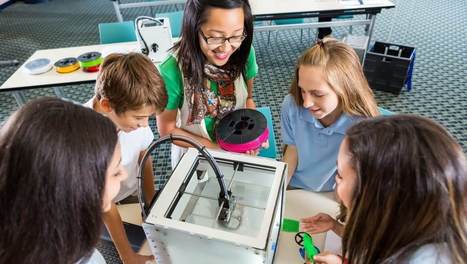
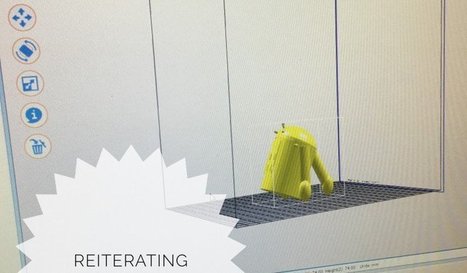
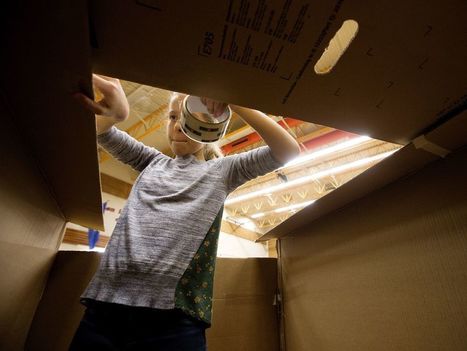
So, what is important in terms of the Maker Mindset? It’s all the things in these images – persistence, resilience, perseverance, the opportunity to fail and then the ability to push through this. This opportunity to fail is really quite significant as she learnt much more from the failures than she did from the first model which worked after only a few quick tweaks. She learnt how the printer works and how the software worked to best suit the capabilities of the printer. She learnt about how models should be designed and how she should hold her ideas lightly so that her designs can get even better.
Connected to this last point above is the importance of having a process which names different styles of thinking and allocates them to a stage in a process which scaffolds inquiry and design. Design thinking is the process which we are using to do this.
A leader of the maker movement talks about how building stuff can help students, teachers, schools and parents be more creative.
We've always been a hands-on, DIY kind of nation. Ben Franklin didn't just invent the lightning rod. His creations include bifocals, swim fins, the catheter, innovative stoves and more.
Franklin, who was largely self-taught, may have been a genius, but he wasn't really an outlier when it comes to American making and tinkering. The personal computing revolution and ethos of disruptive innovation of Silicon Valley grew, in part, out of the tinkerings of the Homebrew Computer Club, which was founded in a garage in Menlo Park, Calif., in the mid-1970s.
Members — including guys named Jobs and Wozniak — started making and inventing things they couldn't buy.
Lissa Davies didn’t hesitate to put 255 elementary school students into a room together with a mountain of cardboard, tape and scissors.
“We want these students to be excited about what they’re doing. And what you see here is students who are totally engaged in what they’re doing,” the Keheewin school teacher-librarian and curriculum co-ordinator said over the din of high-pitched voices Friday.
Armed with plans they revised on the fly, students in the south-side Edmonton public school were engrossed in a school-wide makerspace challenge to build a game out of cardboard.
“People are making (such) cool things,” said six-year-old Wyatt Knorr, who’s in Grade 1. “They’re using their brains, and thinking, and problem solving.”
The feature, announced on Wednesday, lets users walk around an object while it builds a 3-D image to save into photos.
You can rotate that image just as you would with any other 3-D system. This new system allows you to get 3-D pictures without finding yourself at the mercy of a larger device or chained to cords.
No word yet as to price, its availability or platforms for downloading. This element does come in conjunction with Microsoft’s previous announcement that Paint will include 3-D aspects. The new feature could replace Microsoft PhotoSynth, the company’s 3-D panoramic tour app.
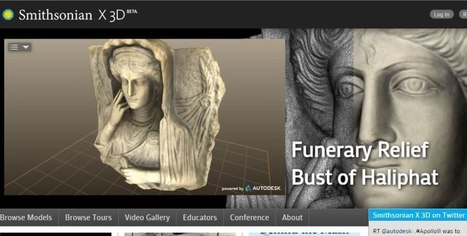
Thingiverse is a great site for finding printable 3D models, but it is not the only website out there. Here are 45 others to choose from. 3D Printing and
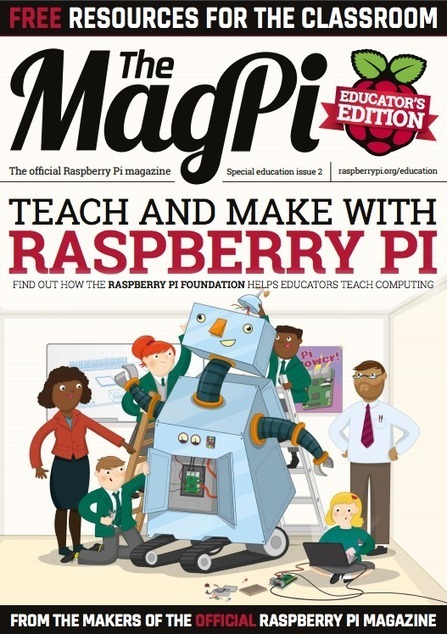
If there’s one thing we’re passionate about here at the Raspberry Pi Foundation, it’s sharing our community’s passion for making with technology. Back in January, the Education team exhibited at the Bett Show with a special Educator’s Edition of our fabulous magazine, The MagPi. The goal was to share our projects and programmes with educators who could join our increasing community of digital makers. Like all our publications, a downloadable PDF was made available on our website; this was good thinking, as the magazine proved to be very popular and we ran out of copies soon after the show.
Hack/slash/cut/bash/scrape/mod/mash – it’s a culture thing
Join the School of Media, Culture and Creative Arts and Curtin Library Makerspace to hack cultural datasets and heritage information.
Use government and institutional research data, gallery, library, archive and museum information as data sources. Experiment with data for a research project or proposal; create something accessible, beautiful and/or useful using craft, games, augmented or virtual reality, apps or something else: it’s up to you.
Date: Thursday 10 November 2016 (afternoon) & Friday 11 November 2016 (9am – 5pm)
To be sure, there have been changes in the Maker movement in the decade-plus since the first Maker Faires wooed a new generation of DIYers. Along the way, we’ve celebrated successes and asked hard questions. How can we help making become more equitable and inclusive? How can maker ed embrace traditional technology, including computer science? What are the benefits of a maker education, and how do we measure them? In this guide, we hope you’ll find answers to—or at least ideas about—these and other questions that explore the meaning of making.
Schools offer tips on setting up hands-on learning in all kinds of spaces.
Two years ago, the White House hosted its first ever Maker Faire, a festival dedicated to invention, creativity and resourcefulness. Today, the spirit and sentiment behind the event — putting education into the hands of students — extends to educational environments and libraries across the country.
Spring Hill School District, a small K–12 district in southwest Arkansas, has joined the makerspace movement in a big way. The district’s massive, new makerspace was built to give teachers new ways to inspire students to hone their abilities and develop their critical thinking skills.
To get content containing either thought or leadership enter:
To get content containing both thought and leadership enter:
To get content containing the expression thought leadership enter:
You can enter several keywords and you can refine them whenever you want. Our suggestion engine uses more signals but entering a few keywords here will rapidly give you great content to curate.


 Your new post is loading...