



Being convinced that 3D printing will eventually lead to an industrial revolution, I've tried to stay up to date with 3D printing and, as a Computer S...

 Your new post is loading...
 Scoop.it! Being convinced that 3D printing will eventually lead to an industrial revolution, I've tried to stay up to date with 3D printing and, as a Computer S... 
No comment yet.
Sign up to comment
Scoop.it!
Mind blowing creations from 3 dimensional printed objects. Subscribe to our channel: http://goo.gl/9CwQhg -----------------------------------------------------------------------------------------...
Scoop.it!

During March and April a "Citizen Science" pilot will be conducted in the London Borough of Lambeth with a cohort of 50 primary school children, their parents, teachers and members of the local community.
Scoop.it!
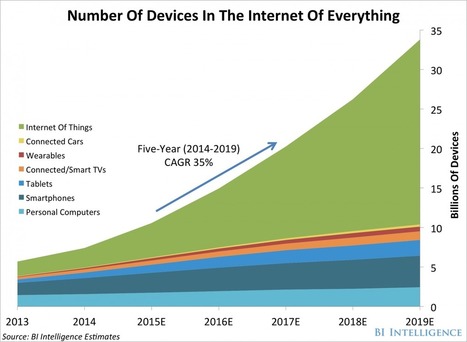
The way we access the internet has changed rapidly over the past few years, transitioning from desktops to mobile devices.
Learn more:
- http://www.scoop.it/t/21st-century-learning-and-teaching/?tag=wearables
- http://www.scoop.it/t/21st-century-learning-and-teaching/?tag=Internet+of+Things
- http://www.scoop.it/t/securite-pc-et-internet/?tag=Internet+of+things
Via Gust MEES

Gust MEES's curator insight,
February 27, 2015 6:33 PM
The way we access the internet has changed rapidly over the past few years, transitioning from desktops to mobile devices. Learn more: - http://www.scoop.it/t/21st-century-learning-and-teaching/?tag=wearables - http://www.scoop.it/t/21st-century-learning-and-teaching/?tag=Internet+of+Things - http://www.scoop.it/t/securite-pc-et-internet/?tag=Internet+of+things 
Tony Guzman's curator insight,
March 2, 2015 3:33 PM
This article shares on how the Internet, and the way we connect to it, is changing in 2015. Any surprises?
Scoop.it!

A young woman walks up to a vending machine, slides her student ID card, plugs in a USB drive, specifies the right file, chooses a color and starts the production process. When her object is printed, the machine shoves it into a tray and sends her a text message that it's ready for pickup — practically like buying a Snickers bar. So goes another print job for DreamVendor 2, Virginia Tech's latest experiment in open-access 3D printing.
Scoop.it!

Dubbed the CytonE family, the humanoid robots are about the size of a human arm, weigh less than five pounds and feature seven axes of motion and a gripper. CytonE robots use Actin, software originally created by Energid Technologies for NASA and currently used in industrial robotics in fields such as oil exploration and nuclear inspection. Actin is designed to make programming the robots easy and to provide fluidity, efficiency and power similar to human movements.
Scoop.it!

Australian researchers create the world's first 3D-printed jet engine in a manufacturing breakthrough.
Scoop.it!

When Tarrawanna's Kim Warner learnt about 3D printing at a demonstration at Towradgi Public School, she half-jokingly asked demonstrator Ben Roberts to make an artificial hand for her daughter. She didn't expect him to do it.
Scoop.it!

A man who suffered horrific facial injuries in a motorbike accident has his face rebuilt using 3D printed parts.
Scoop.it!

Too many educators make the mistake of assuming a false equivalence between “technology” and its use. Technology is not neutral. It is always designed to influence behavior. Sure, you might point to an anecdote in which a clever teacher figures out a way to use a white board in a learner-centered fashion or a teacher finds the diagnostic data collected by the management system useful. These are the exception to the rule.
Scoop.it!

Probably one of the coolest projects we have seen in the last several months is that of the Pi-Top, a Raspberry Pi-enabled 3D printed laptop. When the Pi-Top was first unveiled back in September we were already impressed, but since then they have been working to reduce the size of the laptop, shrinking components and redesigning the 3D printable case. In October a brand new, sleeker version of of the 3D printed laptop was unveiled
Kim Flintoff's insight:
Has the added feature of gamified tutorials to build and understand your pi-top. http://pi-top.com/
Scoop.it!

Design with 3D patterns
Project Shapeshifter is a browser-based tool for generating interesting geometric shapes, and then exporting them for 3D printing. We think it is a fun and interesting way to produce gifts and ornaments that show off what you can do with 3D printing. It’s a product of Autodesk’s Research labs, and highlights a possible direction for making 3D design and printing accessible to everyone!
Scoop.it!

We’d love to share these timeless Design Challenge lessons that have been developed throughout the history of The Tech Museum. They are great for leading your students through science and engineering challenges in your classroom, and also make very fun and effective team-building activities for groups of teachers.
|
Scoop.it!

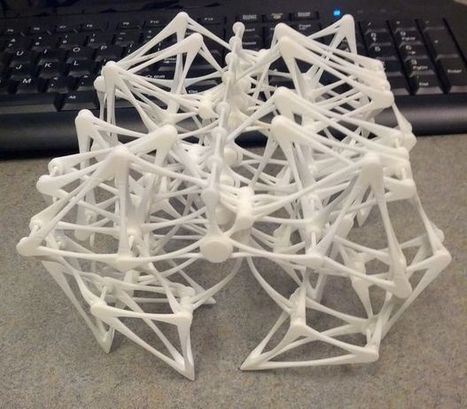
Based upon the famous walking Strandbeest from Theo Jansen ( http://www.strandbeest.com ). This is a modular clip together system that is FDM printer friendly. No support required.
Scoop.it!

MakerBot has launched Starter Labs, kits designed to help educational institutions get 3D printing systems set up quickly.
Scoop.it!

We hear a lot these days about STEM, STEAM and the importance of engaging young people in learning science. We also hear a lot about computer science and learning coding. We hear a lot about making. We hear a lot about parental engagement in their child’s learning. We hear a lot about flipped classrooms. You get the picture.
So in Lambeth this month and next I will be working with Nicky and colleagues to provide a cohort of children, parents and community members with a collection of internet connected sensors and activity trackers. The idea is that we will use these devices as part of the Internet of Things to conduct experiments that encourage conversations and deeper learning as a result of experiences and multi-generational participation. We also hope that it may embed some knowledge and thinking about some vital urban issues and we want to do this by co-discovery engaging all of the participants.
Scoop.it!

Spark has grown from a gleam in the eye of CEO Zach Supalla to a fully baked prototyping platform. These tiny boards allow you to make programmable..
Scoop.it!

Tinkercad is an easy-to-use 3D CAD design tool. Quickly turn your idea into a CAD model for a 3D printer with Tinkercad.
Scoop.it!

Australian high school students will soon be reaping the benefits of 3D printing technology.
Scoop.it!

3-D printing is not just being used to make souvenirs and car parts, but also being used more and more in hospitals and medical schools to help save lives.
Scoop.it!

3D-printing set to revolutionise medical training with body parts that don't cost an arm and a leg.
Scoop.it!

3D printing can offer great benefits in medicine, but it also raises a number of ethical questions as the technology develops, says Susan Dodds.
Scoop.it!

The Space Tank Studio provides artists & designers with the machinery, technology & studio space to work in to create their masterpieces.
Check out K-12 educator project - Pretty Cool - Autonomous Car project by Roland Gesthuizen Initiative of VicRoads and Dynamic Connection http://t.co/olmD4gDJIu
Scoop.it!

Make one-of-a-kind 3D printing pendants and charms personalized with your own photo.
Charmr is a quick way to make one-of-a-kind 3D jewelry with a photo of your choice.
Charmr enables you to put together a 3D printable design in just minutes!
For added fun, tag your charm as LOV3D to have it appear in our special gallery dedicated to all things love!
Scoop.it!

Design Challenges is a new Museum program designed to introduce students and visitors to the engineering design cycle. By participating in a hands-on activity to design, build, and test a prototype solution to a given problem, visitors have a fun and engaging experience with engineering and innovation processes.
|





