


The University of Massachusetts Amherst has teamed up with MakerBot to install the first MakerBot Innovation Center at a university library.

 Your new post is loading...
 Scoop.it! The University of Massachusetts Amherst has teamed up with MakerBot to install the first MakerBot Innovation Center at a university library. 
No comment yet.
Sign up to comment
Scoop.it!
About a year and a half ago, Colorado resident and inventor David Hartkop unveiled the Mini Metal Maker, the world’s first desktop 3D printer for metal. Not only did the prototype appear to have potential, but Hartkop also gave the world a first-hand glimpse at the fast-growing maker culture, or do-it-yourself 3D printing aficionados — an eye-opener for those who have never touched a 3D printer. Since then, this interesting contraption has gone from prototype to production version, and Hartkop is now looking to bring the printer to market.
In another exclusive interview with Hartkop, The Motley Fool again gets the first close look at this interesting desktop printer.
Scoop.it!

New technique works 100 times faster than conventional 3D printing and makes objects within minutes by simply lifting them out of a pool of resin
The new technique, called continuous liquid interface production (Clip)
Scoop.it!

Take part in some creative fun in the pop-up Makerspace in the Library Lounge. Help build a LEGO tower city and an origami crane sculpture, yarnbomb the Makerspace, see 3D printers at work, try a 3D scanner, tinker with Arduinos, experiment with augmented reality and more! Interested? View the Library’s Festival of Learning Makerspace program or register below.
Scoop.it!

What we think of as 3D printing, says Joseph DeSimone, is really just 2D printing over and over ... slowly. Onstage at TED2015, he unveils a bold new technique -- inspired, yes, by Terminator 2 -- that's 25 to 100 times faster, and creates smooth, strong parts. Could it finally help to fulfill the tremendous promise of 3D printing?
Scoop.it!

Eager to try out a 3D printer in your classroom? Here are 10 ideas to help you use them to promote real learning.
Scoop.it!

Oliver Kreylos' research and development homepage. Augmented Reality Sandbox - A mixed real / virtual system where users can create a topographic surface by shaping sand, which is then color-mapped and augmented with topographic contour lines and simulated water using a Kinect 3D camera and a data projector.
Scoop.it!

The time has come to move your student experiments from the classroom into outer space. With the advent of inexpensive electronics that can monitor everything from ambient temperature to magnetic fields, it is possible to conduct real science outside the confines of earth’s atmosphere. The most practical method to reach the ‘outer limits’ is to use a weather balloon that lofts the experimental payload into the stratospshere. Doing this in an advanced level course is an excellent STEM project that can take the entire year to complete. It involves students in everything from obtaining permits from the FAA to release the balloon to calculating trajectories, forecasting weather and using telemetry. This is a project in and of itself, and creating the on board science experiments is another layer of challenges to complete.
Scoop.it!

Educational initiatives that emphasize making, design, engineering, and tinkering are gaining traction in schools and organizations across the country. While making-centered learning is not a new concept, recent and emerging trends suggest a new kind of hands-on pedagogy— a pedagogy that encourages community and collaboration (a do-it-together mentality), distributed teaching, boundary crossing, and a responsive and flexible pedagogy.
Scoop.it!
Scoop.it!
Karen Miller's insight:
Not just good for kids!
Scoop.it!

The MAKE Lab is a collaborative space facilitated by Dr. Shaunna Smith in the Educational Technology program area of the Department in Curriculum & Instruction at Texas State University. Designed as an educational makerspace, The MAKE Lab focuses on exploring the instructional issues of integrating inexpensive technologies to facilitate brainstorming, tinkering, playing, learning, and art creation that supports multidisciplinary learning. Honoring the notion of both the strategic and serendipitous design that takes place as people engage in hands-on making that is personally meaningful and expressive, The MAKE Lab asks makers of all ages “what do you want to MAKE today?”
|
Scoop.it!

Fab Lab Connect brings resources to the Fab Lab network.
Fab Lab Connect offers a project funding platform that showcases Fab Lab social & business innovation projects.
Fab Lab Connect runs challenges to get projects funded and mentored by sponsors to benefit the individual, the team and the community.
Participants access a dedicated Fab Lab crowdfunding platform as a second source to support their projects.
Our goal is to connect innovation, prototyping and fabrication with resources to take them to the next level of evolution.
Scoop.it!

Although three-dimensional (3D) printing is now possible using relatively small and low-cost machines, it is still a fairly slow process. This is because 3D printers require a series of steps to cure, replenish, and reposition themselves for each additive cycle. Tumbleston et al. devised a process to effectively grow solid structures out of a liquid bath. The key to the process is the creation of an oxygen-containing “dead zone” between the solid part and the liquid precursor where solidification cannot occur. The precursor liquid is then renewed by the upward movement of the growing solid part. This approach made structures tens of centimeters in size that could contain features with a resolution below 100 µm.
Scoop.it!

Some scientists turn to nature for inspiration, whereas others use movies as their muse. We’ve already had a hoverboard invented thanks to "Back To The Future," and now we have a Terminator 2-style 3D printer that materializes impressive objects seemingly impossibly out of a pool of liquid.
Scoop.it!

That's why I was surprised to be, well, surprised by the Tiko, a Canadian 3D printer that will hit Kickstarter next week. The Tiko is a delta printer, which means its body is shaped like a triangle instead of a rectangle. It has a sleek, unibody design.
Scoop.it!

Hello everyone! In this instructable I will show you how to make a low cost 3d printer that I designed! It should cost around $150 US dollars or $175 ...
Scoop.it!
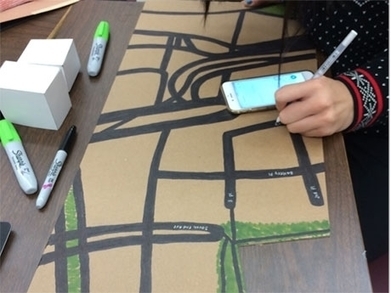
To assess maker projects in your class, begin with a three-part rubric to guide students through process, understanding, and product.
Scoop.it!

The Maker Workshop will explore how students and teachers can create innovative and unique products in their K12 classroom using a mix of readily available technology tools combined with other materials such as cardboard, fabric etc.
The Educational Maker Movement is about utilising these inventions to create an innovative, interdisciplinary, collaborative classroom environment – a classroom in which “making” is happening is one where students are learning through building things.
Scoop.it!
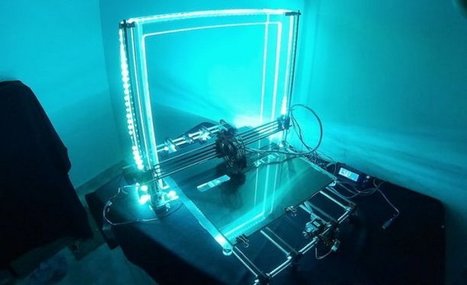
Aldric Negrier, a maker and builder in Portugal, has just built – and provided you the information you'll need to build yourself – a Prusa-based 3D prin Via Brittney

Brittney's curator insight,
March 13, 2015 1:29 PM
Want an Enormous 3D Printer? Aldric Negrier is There for You with the Mega Prusa i3 http://3dprint.com/50680/enormous-prusa-3d-printer/
Scoop.it!

From
mkshft

Makeshift is a field guide to hidden creativity. From homemade aircraft in Nigeria to drug smugglers in Mexico, Chinese hackers pushed up against the Great Firewall to Haitian communities pushing back against marginalization, we believe ingenuity can be found everywhere if you know where to look. Let us tag along on your creative pursuit.
Scoop.it!

About the NIH 3D Print Exchange
Few scientific 3D-printable models are available online, and the expertise required to generate and validate such models remains a barrier. The NIH 3D Print Exchange eliminates this gap with an open, comprehensive, and interactive website for searching, browsing, downloading, and sharing biomedical 3D print files, modeling tutorials, and educational material. The NIH 3D Print Exchange is a collaborative effort led by the National Institute of Allergy and Infectious Diseases in collaboration with the Eunice Kennedy Shriver National Institute for Child Health and Human Development and the National Library of Medicine.
Scoop.it!

Schooling vs Making by @garystager #makered pic.twitter.com/oGqJWtJvnQ
Scoop.it!

Welcome to the Open Academic Robot Kit! Have you ever built a robot from a kit of plastic parts and wished that you could change just a few things to make it perfect for your purposes?Have you ever built a robot from a construction kit (Lego, Meccano, Fischertechnik, etc.) and wished that it could be stronger, that you could easily incorporate non-standard parts, that you could make parts just a bit larger or a bit smaller, or that you didn't have to keep buying expensive proprietary parts?Have you ever looked at robots at a fair, in a competition or the like and wished that you could have one “exactly like that” but don't have the technical skills to build it from scratch?If you've ever thought any of these things (or even if you haven't!) the Open Academic Robot Kit may well be what you're looking for!
|






