Your new post is loading...

|
Scooped by
LIGHTING
December 21, 2013 11:31 AM
|
LIGHTING-INNOVATION-DESIGN

|
Suggested by
Gilbert C FAURE
September 27, 11:34 AM
|
Europe will not restore its nights through isolated projects—cooperation is part of the solution.
The European Light Pollution Coalition connects groups working to reduce light pollution across Europe, enabling them to share knowledge, coordinate projects and build joint initiatives for natural nights and healthier nocturnal environments.
🔗 website: lightpollutioncoalition.eu
#lightpollution #darksky #Europe #biodiversity #nocturnalenvironment #sustainablelighting #collaboration
|
|
Suggested by
Gilbert C FAURE
September 27, 11:33 AM
|
Artificial light does not stop at the shoreline—it can reshape life beneath the water’s surface.
A new systematic review finds that artificial light at night affects fish behaviour, physiology and life history, while its consequences for populations, communities and ecosystem functioning remain largely unknown. Freshwaters, coasts and even offshore waters are exposed through nearby infrastructure, vessels and skyglow.
🔗 research article: https://lnkd.in/ez6PXfZQ
#lightpollution #artificiallightatnight #fish #aquaticecology #biodiversity #darksky #freshwater
|
|
Suggested by
Gilbert C FAURE
September 21, 4:51 AM
|
👏 Congratulations to @mube!
The picture speaks for itself and clearly demonstrates the benefits of the GRANUM greening solution by GHM x Mube.
#UrbanGreening #SustainableCities #LandscapeArchitecture #GHMxMube
|
|
Suggested by
Gilbert C FAURE
September 21, 4:51 AM
|
🌃 How far does city light actually travel at night?
Further than you might think — and further than most conservation zones currently assume.
Our new paper, just published in Urban Climate, looks at how artificial light from cities propagates through the atmosphere across different wavelengths and city sizes. The short answer? Light from a major city can reach natural darkness levels hundreds of kilometres away — well beyond standard dark sky protection buffers.
🔦 Different colours of light behave very differently out there in the night sky — and the findings have real implications for how we design lighting, protect biodiversity, and plan our cities.
🌍 This work provides a physically grounded, quantitative basis for setting protection zones around dark sky areas and biodiversity hotspots — and it highlights just how fragile nocturnal habitats can be. Natural protected areas not only in the vicinity of cities, but potentially hundreds of kilometres away, may still be affected by urban light.
📖 Open access — Link: https://lnkd.in/dZAGTFZm, free to read!
Big thanks to my co-author Miroslav Kocifaj for making the computational heavy lifting possible! 🙏
If you work in conservation, urban planning, lighting design, or simply care about the night sky — I'd love to hear your thoughts. Does this change how you think about the areas we consider "protected"? 🌌
#LightPollution #DarkSky #Biodiversity #UrbanClimate #Sustainability #NocturnalWildlife #Conservation #OpenAccess
|
|
Suggested by
Gilbert C FAURE
September 21, 4:50 AM
|
After midnight, Germany still leaves more than one artificial light on for every resident — and streetlights are not the main source.
A 2025 Nature Cities study used citizen-science mapping of 234,044 lights across 33 German municipalities. Private windows were the most common source; illuminated signs and shop windows roughly matched streetlights in dense areas, showing why lighting policy must look beyond roads.
🔗https://lnkd.in/eJFt9YNA
🔬 https://lnkd.in/e9972RfC
#lightpollution #darksky #citizenscience #urbanlighting #biodiversity #energy #nightscape
|
|
Suggested by
Gilbert C FAURE
September 21, 4:50 AM
|
Join us for an interactive panel on turning your passion for dark skies into stories that capture public and media attention.
Hear from a communications strategist and seasoned DarkSky Advocates who have successfully brought their work to the public eye. From literary publishing to active media campaigns, our panelists will share practical strategies to help you:
✔️ Find and connect with the right journalists
✔️ Pitch compelling local stories
✔️ Stay on-message during interviews
✔️ Create social content that can take your local impact to a global audience
🗓 Date: September 17th, 2026
🕕 Time: 8:30 a.m. PDT
⚠️ You must be registered as a DarkSky Advocate to attend this event. Not an Advocate yet? Register to become one and join us: https://bit.ly/3WhIpam
📷 Photo by Julio Castro Pardo
|
|
Suggested by
Gilbert C FAURE
September 21, 4:50 AM
|
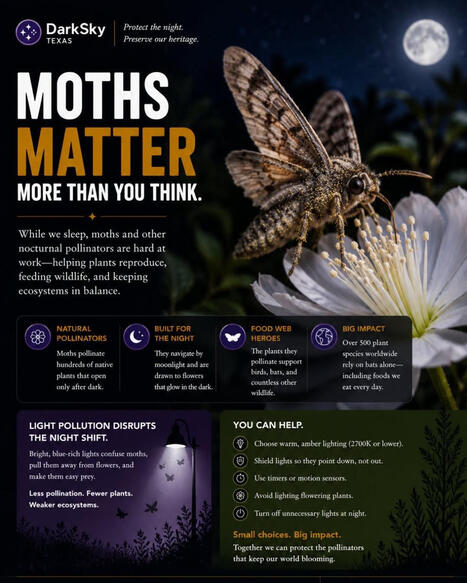
Moths are quiet nighttime pollinators, helping native plants reproduce after dark.
Artificial light can disrupt their routines and impact the ecosystems that depend on them.
Protecting dark skies helps protect nighttime pollinators.
#DarkSkyTexas #ProtectTheNight #Moths #LightPollution
|
|
Suggested by
Gilbert C FAURE
September 21, 4:50 AM
|
Vernon, BC Passes Light Pollution Policy
https://lnkd.in/g6J4r4_t
New rules will limit brightness and spill from municipally owned and managed sources, without any new penalties or approval procedures for private lighting.
|
|
Scooped by
LIGHTING
August 25, 1:33 PM
|
Connected homes and smart cities are converging around a deceptively simple technology category that's proving anything but simple in its growth trajectory.
|
|
Suggested by
Gilbert C FAURE
August 25, 1:28 PM
|
Canada is home to some of the best dark-sky locations, where low levels of artificial light allow the night sky to be observed with clarity. These protected areas provide ideal conditions for viewing stars, planets, the Milky Way, and other celestial phenomena that are often difficult to see from urban environments. 🌌🔭
|
|
Suggested by
Gilbert C FAURE
August 25, 1:28 PM
|
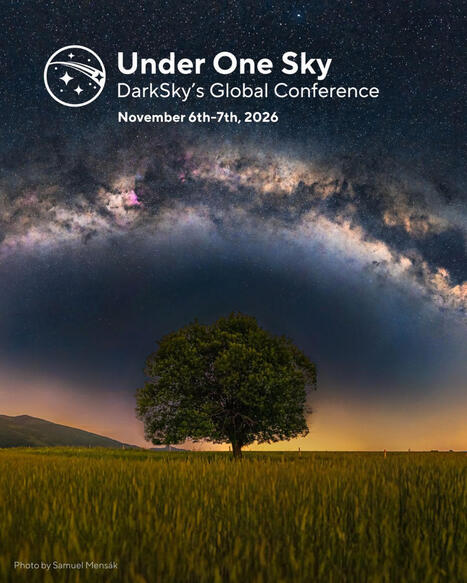
The global dark sky community is coming together once again. 🌎✨
Join DarkSky for 24 hours of connection, learning, and inspiration with people around the world working to protect the night.
As light pollution grows and challenges like satellite proliferation continue to reshape our nighttime environment, coming together to share knowledge, strengthen our advocacy, and imagine what’s possible is more important than ever.
✔️ Practical workshops to build your advocacy skills
✔️ Stories and perspectives from across the globe
✔️ Opportunities to connect with fellow DarkSky Chapters and Advocates
✔️ Ideas and inspiration to help create a future where the night can thrive
Early bird tickets are available now for $25 USD.
Get your ticket and join us Under One Sky: https://bit.ly/4qmiBHw
📷 Photo by Samuel Mensák
|
|
Suggested by
Gilbert C FAURE
August 25, 1:27 PM
|
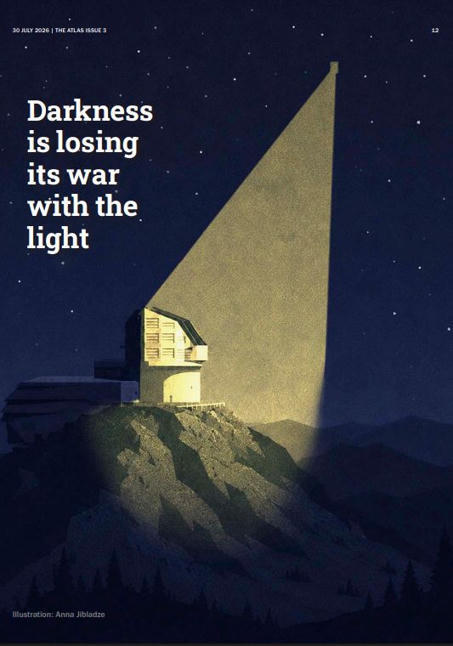
I spoke to a lot of interesting people while reporting this story (shout out especially to Stuart Buchanan and Sthabile Kolwa, PhD), about the American military-backed company that wants to put 50,000 giant mirrors into space, so they can light up the night sky at will with reflected sunlight.
But it was something that Ruskin Hartley said that really put the story in perspective. “It’s almost like we are on a mission to obliterate natural darkness from earth," he said, explaining how human settlements have been getting brighter and brighter for the past 150 years - ever since Thomas Edison figured out how to make the incandescent light bulb commercially viable (that itself is an interesting story: after testing dozens of options, the key to his innovation was using a specific type of Japanese bamboo for the filament).
And these space mirrors, if they go ahead - and given the Silicon Valley-Tech Bro-US military nexus that is backing them, there's every reason to think this is actually going to happen - will make the night sky, on average, 300% brighter. The stars, the constellations, Milky Way, the planets in our solar system - "Chances are those views are not here to stay forever," wrote Tereza Pultarova for Space.com. The million - yes, million - data centre satellites that SpaceX wants to put into low-earth orbit won't help either.
This is an existential threat to astronomy, and the profession is panicking. It could mean the end of Earth-based astronomical observation - the night sky will simply be too bright to see anything - which means we'll only be able to observe the universe from space, from telescopes like the James Webb and the Hubble. And that introduces a major political dimension, because only major space powers have that capacity - the rest of us will be blind to the universe.
This may not be the most important story in the world right now. But it is almost certainly the most important story in our galaxy. Which is why we put it on the front page of the Atlas Newspaper.
Get the newspaper here: www.theatlasnewspaper.org.
(The Atlas is a pilot by Coda Media, Inc and The Continent News: a newspaper for the planet. We're three issues in.)
|
|
|
Scooped by
LIGHTING
September 28, 10:34 AM
|
🌃🇺🇸 CHICAGO, 1989 — LOOK AT THE CITY FROM ABOVE.
At street level, Chicago feels enormous.
But from the air at night, something almost mathematical appears.
Thousands of individual lights line streets and avenues, revealing the structure of the city as a glowing pattern across the landscape. 👀✨
🗺️ THE GRID HAS A MUCH OLDER STORY
Chicago’s famous street grid wasn’t created after the Great Chicago Fire.
The basic layout dates back to 1830, when James Thompson surveyed and mapped the original town plat. As Chicago expanded, that grid became the foundation for streets, blocks, and future development across the growing city.
Then came the Great Chicago Fire of 1871.
Much of the city was destroyed, but Chicago rebuilt and continued expanding on an already established street framework.
🌃 WHY DOES THE CITY GLOW SO WARM?
Historical nighttime city imagery can show a distinctly warm orange or golden appearance, partly associated with older forms of street lighting such as high-pressure sodium lamps.
From above, those individual lights stop looking like separate lamps.
They become lines.
Those lines become blocks.
And suddenly, the entire structure of Chicago becomes visible.
✨ THAT’S WHAT MAKES THIS VIEW SO FASCINATING.
You’re not simply seeing Chicago at night.
You’re seeing the hidden geometry of a city that is difficult to appreciate from ground level.
A street grid that stretches across the landscape becomes almost like a map made entirely of light.
And this historical view gives us a glimpse of Chicago before today’s nighttime cityscape looked the way it does now.
👀 Could you recognize Chicago from this view if you weren’t told what city it was?
DISCLAIMER: The historical date and lighting characteristics of the specific image should be treated according to the original archive/source for that photograph. The explanation above describes Chicago’s documented street-grid history and the general appearance of historical nighttime urban lighting; it does not claim that every visible light in this particular image came from one specific type of lamp.
#Shorts #Chicago #ChicagoHistory #ChicagoAtNight #UrbanPlanning #CityLights #AerialPhotography #UrbanDesign #Architecture #Geography
|
|
Suggested by
Gilbert C FAURE
September 27, 11:33 AM
|
It was a privilege to take part in this conference with Dark Sky Ireland colleagues Kerem Ali Asfuroglu and Brian Espey. A growing number of County Councils across Ireland are taking light pollution seriously and it is so encouraging to have these events where practice and solutions are explored together. We have a long way to go to get lighting right but the wheels are turning.
Congratulations to all involved at Kildare County Council and the Biodiversity Officers of Leinster for putting this together. Heritage Council
#darkskyireland
#endlightpollution
|
|
Suggested by
Gilbert C FAURE
September 21, 4:51 AM
|
The book of abstracts for the 7th Annual International Conference on Night Studies (7–9 October 2026, online) is now available, with this year’s special theme entitled: “Horizons, Dimensions and Atmospheres of the Night”. This is the world’s leading academic event in the field of night studies, organised annually by the International Night Studies Network. As always, the final programme is abdolitely amazing (you can view it on the conference website). And, as always, a big thank you to you, Manuel García Ruiz, for your boundless energy, your extraordinary ability to lead the network and organise the conference, and for your outstanding professionalism in this increasingly confusing global academic world.
Enjoy the 7th ICNS Book of Abstracts!😊😊
Link: https://lnkd.in/eWxD6Nhm
|
|
Suggested by
Gilbert C FAURE
September 21, 4:51 AM
|
|
|
Suggested by
Gilbert C FAURE
September 21, 4:51 AM
|
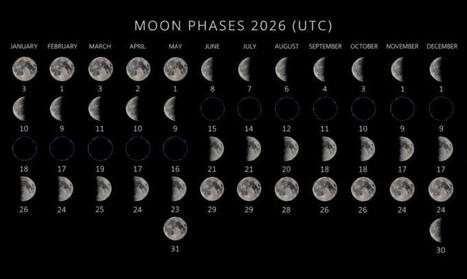
Did Artificial Light Make Us Forget the Moon? #8/32
For millions of years, the Moon was one of the most predictable biological signals on Earth. Before electric lighting, the difference between new moon and full moon represented an enormous change in the nighttime environment. Around new moon, illumination can fall to thousandths of a lux or less, while full moonlight can reach tenths of a lux. Daylight reaches tens of thousands of lux. Today these nighttime numbers may seem irrelevant because our homes, streets and cities routinely produce much higher illuminances. But evolution had millions of years to respond to these subtle changes. And the bright full moon itself is only a brief part of each lunar cycle.
Many organisms use lunar cycles to coordinate behavior and reproduction. Perhaps the most spectacular example is coral spawning, where huge numbers of organisms synchronize reproduction with the lunar cycle. Artificial light at night has been shown to alter its timing. And humans may not be completely different. The female menstrual cycle occupies a similar timescale to the 29,5 day lunar cycle. This alone proves nothing. However, long-term menstrual records show that human cycles can temporarily synchronize with lunar cycles, and large datasets have detected a small but significant lunar rhythmicity. The lunar cycle is not only a light cycle; gravitational cues have also been proposed as a possible contributor.
This raises a fascinating question: what did female reproductive rhythms look like before electric light? We cannot examine menstrual calendars from 1500, 200 BC or 100000 years ago. Almost all modern data come from people already living in an environment fundamentally different from that in which our biological timing systems evolved. For most of human history, nighttime illumination varied between almost complete darkness and moonlight measured in fractions of a lux. Within only about 150 years, electric lighting has largely erased that contrast.
This does not prove that artificial light causes infertility, nor that human ovulation was universally synchronized with the full moon. But research connecting circadian disruption, light at night, reproductive hormones and menstrual physiology makes an ancient lunar influence worth investigating.
The question extends far beyond humans. Insects, birds, turtles, fish, corals and countless other organisms evolved under the same alternation of sunlight, darkness and moonlight. Unlike humans, they cannot close the curtains. We defend nighttime lighting for a sense of safety, mobility, architecture and comfort. These needs matter. But the biological environment matters too.
Before illuminating every remaining darkness, perhaps we should ask: How deeply are we interfering with biological rhythms that evolved for millions of years under nights illuminated only by the Moon and stars?
#ArtificialLightAtNight #LightPollution #CircadianRhythm #Moonlight #MenstrualCycle #CoralReefs
|
|
Suggested by
Gilbert C FAURE
September 21, 4:50 AM
|
When cities dim and warm their lights, urban plants may begin to recover their natural seasonal clock.
A new PNAS Nexus study compared New York and Washington, DC with nearby cities lacking equivalent lighting policies. Satellite data found lower nighttime emissions—especially blue light—and vegetation shifts consistent with less artificial disruption, while the authors stress the evidence is exploratory rather than causal.
🔗 News article: https://lnkd.in/exc7-8S3
🔬 Research paper: https://lnkd.in/ex55nF9Q
#lightpollution #darksky #urbanecology #biodiversity #sustainablelighting #plantscience #nightscape
|
|
Suggested by
Gilbert C FAURE
September 21, 4:50 AM
|
🌙 Earth Night 2026 - NATURAL NIGHT: RETHINKING LIGHT
Friday, 11 September 2026, worldwide.
Every year on the Friday around the September new moon, when no moonlight brightens the sky. Initiated in 2020 by the German non-profit Paten der Nacht. Unlike Earth Hour, this is not one hour in March. It is a whole night: lights off from dusk, 10 pm local time at the latest.
When did you last experience a truly dark night?
A night where the stars come back. Where darkness is not felt as a lack but as something entirely natural.
🌙 Night is part of life.
Once a year, Earth Night invites us to experience the night deliberately: reduce or switch off outdoor lighting and discover what happens when we give darkness room.
Maybe change begins with wonder, and wonder begins with the starry sky.
Because anyone who marvels again at the stars, the quiet of the night and the life that unfolds in the dark may also start asking:
- Do we really need light everywhere?
- Do we really need it all night?
- And does it really have to be this bright?
For Wilfried L. Bott, a dear LinkedIn connection who wrote the original German post and gets all the credit, that is the way into RETHINKING LIGHT.
Not against light.
Not for total darkness. Under a natural night sky there is no such thing anyway. Total darkness lives in a well-stuffed wardrobe.
This is where the economy of effect comes in:
Not producing as much light as possible, but achieving the desired effect with the least effort and the fewest unwanted side effects.
Good light is not maximum light.
Good light is light that works.
🌎 Earth Night 2026
🌙 NATURAL NIGHT
💡 RETHINKING LIGHT
Who's in?
👉 https://lnkd.in/eP7QCiqB
If we want to reclaim a piece of the night, one thing comes first: reduce #LightPollution.
#transformation #regeneration
Photo: NASA - National Aeronautics and Space Administration - "Black Marble"
|
|
Suggested by
Gilbert C FAURE
September 21, 4:50 AM
|
|
|
Suggested by
Gilbert C FAURE
September 21, 4:49 AM
|
#nuit #éclairage #environnement
Comment gérer l'éclairage public ?
La #pollution lumineuse, devenue un enjeu majeur de santé publique, environnemental et économique, cristallise les tensions entre extinctions nocturnes contestées et innovations techniques.
Par ses études scientifiques, le Cerema éclaire les décideurs d’éléments factuels et opérationnels.
« Éclairage public : un équilibre fragile », un article de Marie Laure Papaix-Couderc, Paul VERNY, Stéphanie Bordel et Florian Greffier à lire ici :
👉 https://lnkd.in/egAgCWWn
|
|
Suggested by
Gilbert C FAURE
August 25, 1:28 PM
|
Continuing my discussion on light pollution...
I asked students in my class if they have seen milkyway 🌌. No one had. I feel sad that kids do not get to see such wonders. I remember tracking satellites in the night sky as a kid.
But...
Did you know 💡that India has Two
Official Dark Sky Designations?
Hanle Dark Sky Reserve: Located in Ladakh inside the Changthang Wildlife Sanctuary, this is India's first official dark sky reserve (established in 2022) covering a cluster of villages around the Indian Astronomical Observatory with strict local shielding and lighting restrictions.
Pench Tiger Reserve: Spanning Maharashtra and Madhya Pradesh, it was designated India's first Dark Sky Park in 2024 to safeguard nocturnal animal habitats from artificial light interference.
#lightpollution #environment #OneHealth #DarkZones #Biodiversity
|
|
Suggested by
Gilbert C FAURE
August 25, 1:28 PM
|
What If Night Time LED Lighting Started With the Human Retina? #6
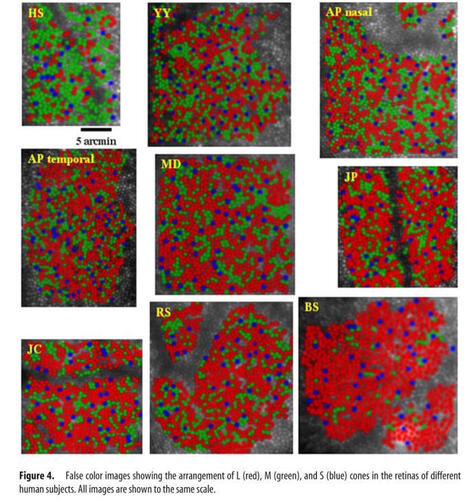
Look at these images. They show real cone mosaics from people with normal colour vision. Hofer and colleagues found enormous differences in the ratio of L to M cones from 1.1:1 to 16.5:1 while S cones remained a small and remarkably stable minority, around 6%. Despite these dramatically different retinas, the colour normal subjects had normal colour vision.
How is that possible? Because the retina is not a camera sensor producing a finished image. Cones provide signals, retinal circuits begin processing them, and the visual system continues interpreting and comparing this information in the brain. The percept we call colour emerges from this neural processing. We can agree that a surface is “red” because we learned to use the same word for that percept. But whether the subjective red created in my brain is identical to the red created in yours is a much harder question. A spectrometer cannot tell us.
Now consider the light humans experienced after sunset before the LED era. Fire, incandescent and halogen lamps are physically very different sources, but compared with today’s blue pump white LEDs their spectra contain proportionally much less short wavelength energy and are weighted more strongly towards longer wavelengths. Within only a few decades, we introduced a pronounced blue peak into our homes, streets and vehicle headlights at night.
The small number of S cones does not mean blue light is unnecessary. Receptor count alone cannot define an optimal spectrum. But short wavelengths also strongly influence the pupillary light reflex through melanopsin containing ipRGCs. CIE TN 003:2015 shows that the spectral sensitivity of the pupillary light reflex shifts towards shorter wavelengths with increasing stimulus duration, with sustained responses strongly involving melanopsin containing ipRGCs. Spectrum therefore affects not only what we see, but also pupil diameter and consequently how much light reaches the retina.
So perhaps we should ask a simple question: when white LEDs replaced incandescent and halogen sources, what night-time visual benefit justified the large increase in short wavelength energy? Did we determine the spectrum that gives people the visual information they need with minimum glare and unnecessary biological stimulation or did available LED technology and photopic efficiency determine the spectrum first?
LED technology gives us something previous technologies never offered: extraordinary freedom to engineer light and spectrum. Perhaps we should finally use it. The next generation of night time lighting at home, on our streets and in vehicle headlights should begin not with what an LED can produce, but with the human retina, the pupil and the biological night.
#Lighting #VisionScience #LED #HumanVision #Retina #StreetLighting #AutomotiveLighting #LightingScience
Figure: Hofer H. et al., Organization of the Human Trichromatic Cone Mosaic, J Neurosci 2005
|
|
Suggested by
Gilbert C FAURE
August 25, 1:28 PM
|
🌑Retiens la nuit
Depuis 1990, les émissions lumineuses en Suisse ont augmenté de plus de 70%. Conséquence: les animaux et les insectes nocturnes peinent à s’orienter, ils sont attirés ou repoussés de leurs zones d’alimentation, ce qui entraîne à terme une perte de biodiversité.
Pour comprendre le phénomène, Claude Fischer, professeur HES ordinaire à la Haute école du paysage, d'ingénierie et d'architecture de Genève - HEPIA et Laurent HUBER, adjoint scientifique HES, ont développé une méthode permettant de cartographier les territoires d’obscurité encore préservés.
«De nombreux éclairages publics engendrent une pollution lumineuse, particulièrement problématique dans les corridors de déplacement des animaux, notamment ceux des espèces nocturnes comme les chauves-souris, ou des grands mammifères comme les cerfs», explique le professeur.
👉 Article complet: https://lnkd.in/edWt8g4s
Photo: Carte de la pollution lumineuse du Grand Genève. © Système d'information du territoire à Genève (SITG)
|
|
Suggested by
Gilbert C FAURE
August 25, 1:26 PM
|
Sun Valley Resort recognized by DarkSky
https://lnkd.in/gwX3Ammg
Idaho resort the first US recognized by DarkSky International's Lodging program.
|