Your new post is loading...

|
Scooped by
LIGHTING
December 21, 2013 11:31 AM
|
LIGHTING-INNOVATION-DESIGN

|
Suggested by
Gilbert C FAURE
August 25, 1:28 PM
|
Continuing my discussion on light pollution...
I asked students in my class if they have seen milkyway 🌌. No one had. I feel sad that kids do not get to see such wonders. I remember tracking satellites in the night sky as a kid.
But...
Did you know 💡that India has Two
Official Dark Sky Designations?
Hanle Dark Sky Reserve: Located in Ladakh inside the Changthang Wildlife Sanctuary, this is India's first official dark sky reserve (established in 2022) covering a cluster of villages around the Indian Astronomical Observatory with strict local shielding and lighting restrictions.
Pench Tiger Reserve: Spanning Maharashtra and Madhya Pradesh, it was designated India's first Dark Sky Park in 2024 to safeguard nocturnal animal habitats from artificial light interference.
#lightpollution #environment #OneHealth #DarkZones #Biodiversity
|
|
Suggested by
Gilbert C FAURE
August 25, 1:28 PM
|
What If Night Time LED Lighting Started With the Human Retina? #6
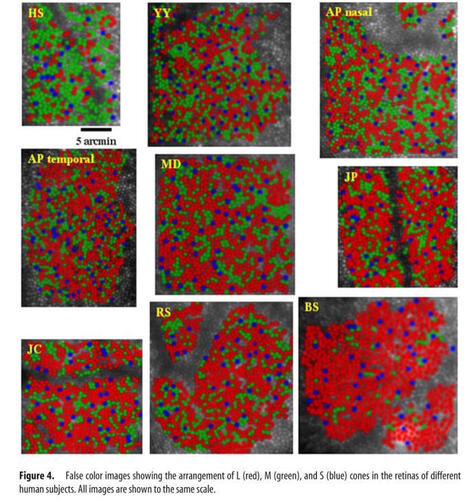
Look at these images. They show real cone mosaics from people with normal colour vision. Hofer and colleagues found enormous differences in the ratio of L to M cones from 1.1:1 to 16.5:1 while S cones remained a small and remarkably stable minority, around 6%. Despite these dramatically different retinas, the colour normal subjects had normal colour vision.
How is that possible? Because the retina is not a camera sensor producing a finished image. Cones provide signals, retinal circuits begin processing them, and the visual system continues interpreting and comparing this information in the brain. The percept we call colour emerges from this neural processing. We can agree that a surface is “red” because we learned to use the same word for that percept. But whether the subjective red created in my brain is identical to the red created in yours is a much harder question. A spectrometer cannot tell us.
Now consider the light humans experienced after sunset before the LED era. Fire, incandescent and halogen lamps are physically very different sources, but compared with today’s blue pump white LEDs their spectra contain proportionally much less short wavelength energy and are weighted more strongly towards longer wavelengths. Within only a few decades, we introduced a pronounced blue peak into our homes, streets and vehicle headlights at night.
The small number of S cones does not mean blue light is unnecessary. Receptor count alone cannot define an optimal spectrum. But short wavelengths also strongly influence the pupillary light reflex through melanopsin containing ipRGCs. CIE TN 003:2015 shows that the spectral sensitivity of the pupillary light reflex shifts towards shorter wavelengths with increasing stimulus duration, with sustained responses strongly involving melanopsin containing ipRGCs. Spectrum therefore affects not only what we see, but also pupil diameter and consequently how much light reaches the retina.
So perhaps we should ask a simple question: when white LEDs replaced incandescent and halogen sources, what night-time visual benefit justified the large increase in short wavelength energy? Did we determine the spectrum that gives people the visual information they need with minimum glare and unnecessary biological stimulation or did available LED technology and photopic efficiency determine the spectrum first?
LED technology gives us something previous technologies never offered: extraordinary freedom to engineer light and spectrum. Perhaps we should finally use it. The next generation of night time lighting at home, on our streets and in vehicle headlights should begin not with what an LED can produce, but with the human retina, the pupil and the biological night.
#Lighting #VisionScience #LED #HumanVision #Retina #StreetLighting #AutomotiveLighting #LightingScience
Figure: Hofer H. et al., Organization of the Human Trichromatic Cone Mosaic, J Neurosci 2005
|
|
Suggested by
Gilbert C FAURE
August 25, 1:28 PM
|
🌑Retiens la nuit
Depuis 1990, les émissions lumineuses en Suisse ont augmenté de plus de 70%. Conséquence: les animaux et les insectes nocturnes peinent à s’orienter, ils sont attirés ou repoussés de leurs zones d’alimentation, ce qui entraîne à terme une perte de biodiversité.
Pour comprendre le phénomène, Claude Fischer, professeur HES ordinaire à la Haute école du paysage, d'ingénierie et d'architecture de Genève - HEPIA et Laurent HUBER, adjoint scientifique HES, ont développé une méthode permettant de cartographier les territoires d’obscurité encore préservés.
«De nombreux éclairages publics engendrent une pollution lumineuse, particulièrement problématique dans les corridors de déplacement des animaux, notamment ceux des espèces nocturnes comme les chauves-souris, ou des grands mammifères comme les cerfs», explique le professeur.
👉 Article complet: https://lnkd.in/edWt8g4s
Photo: Carte de la pollution lumineuse du Grand Genève. © Système d'information du territoire à Genève (SITG)
|
|
Suggested by
Gilbert C FAURE
August 25, 1:26 PM
|
Sun Valley Resort recognized by DarkSky
https://lnkd.in/gwX3Ammg
Idaho resort the first US recognized by DarkSky International's Lodging program.
|
|
Suggested by
Gilbert C FAURE
August 25, 1:26 PM
|
💡 Éteindre l'éclairage public la nuit augmente-t-il vraiment la délinquance ?
C'est une question que beaucoup de collectivités se posent, sans toujours trouver de réponse claire.
Entre transition énergétique, lutte contre la pollution lumineuse et sentiment de sécurité des habitants, les collectivités font face à un débat polarisé qui complique les prises de décisions.
Mais qu’en est-il vraiment ? L’extinction de l’éclairage public est-il un facteur augmentant la délinquance dans l’espace public ?
Pour répondre à leurs interrogations, nous avons mené une étude en partenariat avec l'INRAE afin de mesurer objectivement le lien entre extinction de l'éclairage public et délinquance dans l'espace public.
👉 Les résultats sont à retrouver dans notre synthèse d'étude, à télécharger dès maintenant : https://lnkd.in/dkgB25Ma
De quoi éclairer vos décisions et vos échanges avec les habitants !
#EclairagePublic #Collectivites #TransitionEnergetique
|
|
Suggested by
Gilbert C FAURE
August 25, 1:26 PM
|
Automotive lights are better than they've ever been, but there's a trade-off.
|
|
Suggested by
Gilbert C FAURE
August 25, 1:24 PM
|
🏖️ L'été est là… mais une entreprise industrielle ne s'arrête jamais vraiment.
Chez Eclatec et Ghm, nos usines entrent pour quelques semaines en mode veille.
Les ateliers ralentissent, nos équipes profitent d'un repos bien mérité… mais, en coulisses, l'activité continue.
👨🔧👩🔧 Maintenance, informatique, finances, logistique, sécurité… des femmes et des hommes assurent les permanences indispensables pour entretenir nos outils de production et préparer la reprise... Parce qu'une rentrée réussie se prépare bien avant le premier jour de production.
Un grand merci à celles et ceux qui veillent pendant l'été afin que tout soit prêt pour retrouver nos clients et partenaires dès la fin août ☀️.
🔗 Et si nos usines passent en mode veille, notre formulaire de contact en ligne, lui, reste bien éveillé et prêt à enregistrer toutes vos demandes
https://lnkd.in/eb8viJXv
|
|
Suggested by
Gilbert C FAURE
August 7, 1:59 AM
|
Sérieux! qu'est-ce qui pourrait mal tourner? Est-ce fortement accroître la pollution lumineuse, congestionner l'espace, perturber les écosystèmes qui dépendent de l'obscurité, bousculer le biorythme des animaux, entraver les liaisons aériennes, brûler des terres agricoles, mettre le feu aux forêts en manque d'eau... et là on pas encore commencé à parler de la souveraineté, de sécurité nationale, de la possible militarisation, etc. C'est vrai, à bien y penser, what could go wrong? 🤷♀️
https://lnkd.in/gMwMRvnS
|
|
Suggested by
Gilbert C FAURE
August 3, 3:01 AM
|
|
|
Suggested by
Gilbert C FAURE
August 3, 3:01 AM
|
🌌 The stars don't recognise borders — and neither do we. 🌌
Since 2018, Dark Sky Ireland has been a proud cross-border partnership, uniting communities from Kerry to Tyrone in the fight against light pollution. One island, one sky, one mission. ✨
Here's what "all-island" actually looks like in practice:
🟢Kerry International Dark Sky Reserve — Europe's only Gold Tier reserve, lighting up the Iveragh Peninsula
🟠 Mayo Dark Sky Park — Gold Tier status since 2016 and International Dark Sky Place of the Year 2024
🔵 OM Dark Sky Park, Davagh Forest, Co. Tyrone — Northern Ireland's only official Dark Sky Park, pairing Bronze Age stone circles with cutting-edge telescopes
⚪ Armagh Observatory & Planetarium — over 200 years of Irish astronomy, still going strong
🟣 Carrick-a-Rede, Co. Antrim — free 24-hour stargazing access, no rope-bridge nerves required 😄
🔴 Blackrock Castle Observatory, Cork — a 16th-century castle turned working observatory and science centre, right on the banks of the Lee
🟡 Dunsink Observatory, Dublin — Ireland's oldest observatory, quietly watching the skies since 1785
🟤 Birr Castle Observatory & Great Telescope, Offaly — home to the "Leviathan of Parsonstown," the largest telescope in the world for over 70 years
From a starry night over Ballycroy to one over Beaghmore, from Blackrock's castle walls to Birr's historic dome — it's the same Milky Way arching over every county on this island, north and south. Light pollution doesn't stop at a border, so neither does our work to stop it.
🌟 And behind every one of these reserves, parks and observatories are the dark sky community groups doing the real, unglamorous, brilliant work on the ground — north and south. From FRIENDS OF MAYO DARK SKIES to the CORK SKY FRIENDLY CAMPAIGN, from DONEGAL DARK SKIES to CLOUGHJORDAN ECO VILLAGE and all the NATIONAL TIDY TOWN VOLUNTEERS monitoring skyglow in their own back gardens — this movement is powered by ordinary people giving up their evenings to protect something extraordinary. Whether you're in a village hall in KERRY or a community centre on RATHLIN ISLAND, if you're out there talking to your local council about street lighting, running a stargazing night for kids, or just nagging your neighbour about that floodlight — we see you, and we appreciate you. 🙌
💚 Why this matters: Ireland's night skies are one of our last truly shared natural resources — no passport required to look up. Protecting them means working together: sharing data, sharing lighting guidelines, sharing festivals, and sharing the wonder.
#DarkSkyIreland #ProtectTheNight #EndLightPollution #SharedIsland #IrishAstronomy #SDGsIRL
Kerry Dark Sky Tourism Mayo Dark Sky Park Friends of Mayo Dark Skies Cork Environmental Blackrock Castle Observatory Armagh Observatory & Planetarium Dunsink Observatory Birr Castle Demesne Cloughjordan Ecovillage
|
|
Suggested by
Gilbert C FAURE
July 27, 9:56 AM
|
Do you know what we are losing? Light pollution is doubling every 8 years.
Ponder that for a moment.... pretty soon in a lot of places NO stars will be visible. How does that make you feel?
|
|
Suggested by
Gilbert C FAURE
July 27, 9:55 AM
|
Incredibly proud of Bray & Co's client DarkSky International who have partnered with Star Trek! This is the first activation with more to come. Watch this space (yes, bad pun intended).
|
|
|
Scooped by
LIGHTING
August 25, 1:33 PM
|
Connected homes and smart cities are converging around a deceptively simple technology category that's proving anything but simple in its growth trajectory.
|
|
Suggested by
Gilbert C FAURE
August 25, 1:28 PM
|
Canada is home to some of the best dark-sky locations, where low levels of artificial light allow the night sky to be observed with clarity. These protected areas provide ideal conditions for viewing stars, planets, the Milky Way, and other celestial phenomena that are often difficult to see from urban environments. 🌌🔭
|
|
Suggested by
Gilbert C FAURE
August 25, 1:28 PM
|
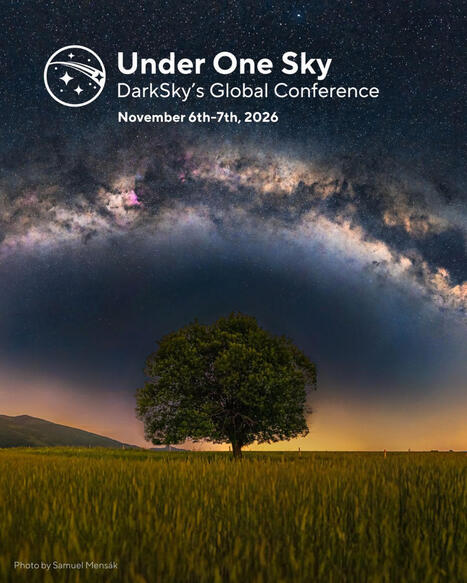
The global dark sky community is coming together once again. 🌎✨
Join DarkSky for 24 hours of connection, learning, and inspiration with people around the world working to protect the night.
As light pollution grows and challenges like satellite proliferation continue to reshape our nighttime environment, coming together to share knowledge, strengthen our advocacy, and imagine what’s possible is more important than ever.
✔️ Practical workshops to build your advocacy skills
✔️ Stories and perspectives from across the globe
✔️ Opportunities to connect with fellow DarkSky Chapters and Advocates
✔️ Ideas and inspiration to help create a future where the night can thrive
Early bird tickets are available now for $25 USD.
Get your ticket and join us Under One Sky: https://bit.ly/4qmiBHw
📷 Photo by Samuel Mensák
|
|
Suggested by
Gilbert C FAURE
August 25, 1:27 PM
|
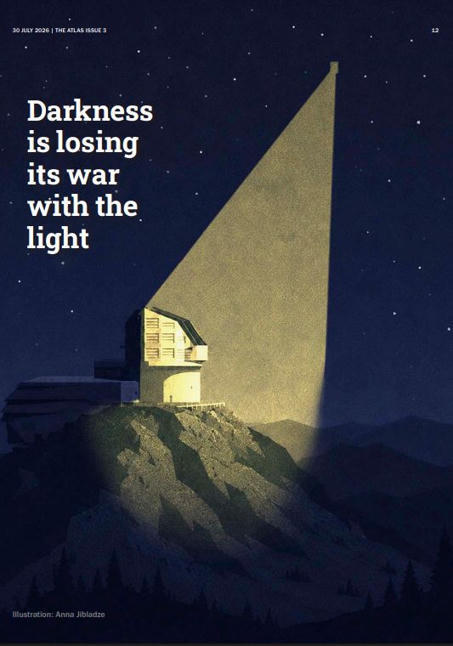
I spoke to a lot of interesting people while reporting this story (shout out especially to Stuart Buchanan and Sthabile Kolwa, PhD), about the American military-backed company that wants to put 50,000 giant mirrors into space, so they can light up the night sky at will with reflected sunlight.
But it was something that Ruskin Hartley said that really put the story in perspective. “It’s almost like we are on a mission to obliterate natural darkness from earth," he said, explaining how human settlements have been getting brighter and brighter for the past 150 years - ever since Thomas Edison figured out how to make the incandescent light bulb commercially viable (that itself is an interesting story: after testing dozens of options, the key to his innovation was using a specific type of Japanese bamboo for the filament).
And these space mirrors, if they go ahead - and given the Silicon Valley-Tech Bro-US military nexus that is backing them, there's every reason to think this is actually going to happen - will make the night sky, on average, 300% brighter. The stars, the constellations, Milky Way, the planets in our solar system - "Chances are those views are not here to stay forever," wrote Tereza Pultarova for Space.com. The million - yes, million - data centre satellites that SpaceX wants to put into low-earth orbit won't help either.
This is an existential threat to astronomy, and the profession is panicking. It could mean the end of Earth-based astronomical observation - the night sky will simply be too bright to see anything - which means we'll only be able to observe the universe from space, from telescopes like the James Webb and the Hubble. And that introduces a major political dimension, because only major space powers have that capacity - the rest of us will be blind to the universe.
This may not be the most important story in the world right now. But it is almost certainly the most important story in our galaxy. Which is why we put it on the front page of the Atlas Newspaper.
Get the newspaper here: www.theatlasnewspaper.org.
(The Atlas is a pilot by Coda Media, Inc and The Continent News: a newspaper for the planet. We're three issues in.)
|
|
Suggested by
Gilbert C FAURE
August 25, 1:26 PM
|
🌙 Et si nous prenions le temps d’observer la nature… une fois la nuit tombée ?
Le mardi 11 août, rendez-vous à Jeumont pour une sortie nature consacrée à un phénomène souvent invisible mais pourtant essentiel : l’impact de la lumière artificielle sur la biodiversité nocturne. 💡🌿
De nombreuses espèces ont développé, au fil de l’évolution, des modes de vie adaptés à l’obscurité. Mais lorsque la nuit est éclairée par nos activités humaines, leurs habitudes peuvent être profondément perturbées.
🦇 À l’occasion des Nuits Européennes des Chauves-souris, cette sortie nocturne sera l’occasion de mieux comprendre les effets de la pollution lumineuse et de découvrir autrement la vie qui s’anime après le coucher du soleil.
📅 Mardi 11 août
🕗 20h – 22h30
📍 Jeumont (59)
🥾 Prévoir de bonnes chaussures de marche
🔦 Une lampe torche peut également être utile
⚠️ Inscription obligatoire auprès du Conservatoire d'espaces naturels des Hauts-de-France
👉 Retrouvez toutes les informations et inscrivez-vous ici : https://lnkd.in/ei_-yB25
Une animation proposée par le Conservatoire d'espaces naturels des Hauts-de-France, avec la commune de Jeumont et la Communauté d'Agglomération Maubeuge Val de Sambre (projet LUNÉfil).
Interreg France-Wallonie-Vlaanderen Conservatoire d'espaces naturels des Hauts-de-France Communauté d'Agglomération Maubeuge-Val de Sambre CREAT - UCLouvain Agence de Développement et d'Urbanisme Sambre Avesnois Hainaut Thiérache IGRETEC Espace Environnement Parc naturel régional de l'Avesnois
#Biodiversité #PollutionLumineuse #HautsDeFrance #CENHautsdeFrance #LUNEfil
|
|
Suggested by
Gilbert C FAURE
August 25, 1:26 PM
|
Atmospheric Light Pollution by Proposed Reflect Orbital Space Mirrors Miroslav Kocifaj ICA, Slovak Academy of Sciences, Slovakia Faculty of Mathematics, Physics and Informatics, Comenius University in Bratislava, Slovakia miroslav.kocifaj@savba.sk Gáspár Á.
|
|
Suggested by
Gilbert C FAURE
August 25, 1:25 PM
|
A l'occasion de la nuit des étoiles la semaine prochaine, petit retour sur deux ateliers organisés dans le cadre du congrès des réserves internationales de ciel étoilé (RICE) françaises, en juin, par la RICE Alpes Azur Mercantour, et auxquels nous avons eu le plaisir de contribuer avec Paul VERNY :
https://lnkd.in/d_Y2aVbF
Ces ateliers se sont intéressés aux solutions existantes ou encore à développer pour réduire les nuisances lumineuses liées à l'éclairage sportif et des particuliers sur les riverains, la biodiversité et la qualité du ciel nocturne.
Sterenn POUPARD Héloïse Granier Dark Sky France Richard Scherrer Philippe Moutet Bruno Rouch
|
|
Scooped by
LIGHTING
August 7, 2:01 AM
|
Emitel, which says it delivers digital services and solutions powered by infrastructure, technology and data, has won a contract to build an intelligent street lighting control system for Warsaw.
|
|
Suggested by
Gilbert C FAURE
August 7, 1:59 AM
|
💡L’éclairage public est-il vraiment conçu pour tous les usagers ❓
🔬Une étude récente sur le comportement visuel dans l’espace public montre que tous les usagers ne regardent pas leur environnement de la même manière.
Alors que certains concentrent naturellement leur regard sur leur trajectoire, d’autres balayent en permanence les abords : buissons, zones d’ombre, recoins, accès latéraux… autant d’endroits où pourrait apparaître un danger.
Cela soulève une question qui dépasse la simple conformité aux normes.
📆 Aujourd’hui, les normes d’éclairage routier définissent notamment des exigences de :
✔️ luminance ou éclairement sur la chaussée,
✔️ uniformité,
✔️ limitation de l’éblouissement,
✔️ et, dans certains cas, d’éclairement vertical dans la direction de déplacement.
Ces critères sont essentiels et ont considérablement amélioré la sécurité.
Mais ils évaluent principalement ce qui se passe sur le chemin de déplacement.
Ils prennent beaucoup moins en compte la perception des espaces périphériques, pourtant déterminante pour le sentiment de #sécurité de nombreux usagers.
Et surtout…
🧑🧑🧒🧒Pour qui concevons-nous réellement nos installations ?
Un jeune adulte, une personne âgée, un homme, une femme ou une personne photosensible ne perçoivent pas l’espace public de la même manière. Leurs besoins en matière d’éclairage sont différents.
Un espace public “conforme” est-il nécessairement un espace public perçu comme sûr par tous ?
À l’heure où les villes parlent d’inclusion, il est peut-être temps d’élargir notre réflexion.
Ne plus seulement se demander :
“Combien de lux avons-nous sur la chaussée ?”
Mais aussi :
“Qui utilisera cet espace… et que verra réellement cette personne ?”
🎯La lumière ne sert pas uniquement à rendre un obstacle visible.
Elle doit aussi permettre de comprendre son environnement, d’anticiper et de se sentir en sécurité.
Peut-être que la prochaine évolution de l’éclairage public ne viendra pas uniquement de luminaires plus performants…
... mais d'une meilleure compréhension des usagers et d'une définition plus fine des besoins multiples et complexes de la vie urbaine.
(Lien vers l'étude : https://lnkd.in/e4wKKA4b)
#EclairagePublic #UrbanLighting #LightingDesign #Urbanisme #Sécurité #Accessibilité #PlanLumière #SmartCities #ConceptionUrbaine #Éclairage #VilleInclusive #Easylight #AECIlluminazione
|
|
Suggested by
Gilbert C FAURE
August 3, 3:01 AM
|
For decades, we have treated darkness as a design defect. New road? Add lights. New pathway? Add lights. Existing luminaire? Replace it—often with something brighter.
But lighting is one of the few areas of engineering where over-engineering can itself produce a non-compliant outcome.
Too little light can fail the required criteria. Too much can create excessive illuminance, glare, spill and poor uniformity. Good lighting design exists in a “Goldilocks zone”: enough light to achieve the safety and operational outcome, but no more than the environment actually needs.
Belgium’s Hoge Kempen National Park is removing 75 unnecessary streetlights, while Massachusetts has advanced measures encouraging shielded, warmer and lower-output public lighting.
This is not an argument for switching everything off. It is an argument for classification, targeted optics, shielding, dimming and—where justified—the deliberate preservation of darkness.
Good lighting design is not about installing the most light.
It is about providing the right light, in the right place, at the right time—and having the restraint to stop there.
Belgian national park lighting removal | Massachusetts lighting legislation
|
|
Suggested by
Gilbert C FAURE
August 3, 3:00 AM
|
I talk a lot about light pollution caused by artificial light at night. Now for something totally bonkers, light pollution caused by reflecting the sun back to earth at night 🤯
This idea if it comes to fruition will literally turn night to day and no consideration is being offered to the environmental (or other) impacts that might have.
#DontNeglectTheNight
|
|
Suggested by
Gilbert C FAURE
July 27, 9:56 AM
|
The sustainable city of the future will not be built through new infrastructure alone. It will also depend on how intelligently we use, upgrade and extend the life of what is already in place.
Lighting is a powerful example. By refurbishing and connecting existing systems, cities can reduce energy use, preserve materials and create public spaces that respond more effectively to people’s needs.
Read Signify’s latest article exploring how cities in Denmark and Switzerland are putting this thinking into practice: https://lnkd.in/eUDBZ4s4
#BrighterLivesBetterWorld #Sustainability #CircularLighting
|
|
Suggested by
Gilbert C FAURE
July 27, 9:55 AM
|
From my latest presentation, Humanizing the Night: Are you afraid of the dark? Since ancient times night and darkness have been symbols of evil. Yet, for night owls and artists, the afterhours represent freedom and creativity.
From Fast Company
“Our study found that adults who are naturally more active in the evening, what we called ‘eveningness,’ tended to perform better on cognitive tests than those who are ‘morning people.’ Rather than just being personal preferences, these chronotypes could impact our cognitive function,” "Off-the-clock creatives may also be some of the greatest visionaries. The music and art world, for example, provides plenty of examples of late-night genius: Bob Dylan famously did his best songwriting at night. Carl Jung, Franz Kafka, Prince, and Picasso were also often hard at work after dark. Likewise, Fiona Apple has described herself as being nocturnal, while Taylor Swift wrote her record-breaking album Midnights after dark."
For more on Humanizing the Night, 7 steps to safer and more vibrant cities https://lnkd.in/gkxU37nN
#nighttimedesign #urbanlighting #nightowls #lifeatnight #nightshift #nightlife
|