Your new post is loading...



Impairment of physiological functions of the endoplasmic reticulum (ER) induces the so-called ER stress. ER stress has been implicated in many cardiovascular diseases including ischemic heart, hypertrophy and heart failure. To overcome the deleterious effect of ER stress, an evolutionarily conserved adaptive response, known as Unfolded Protein Response (UPR), is activated in order to restore ER homeostasis and promote cell survival. However, in the case of prolonged or severe ER stress, apoptotic cell death is ultimately activated to eliminate stressed cells, thus contributing to the development of the pathology. The modulation of ER stress response, in order to reduce cardiomyocyte apoptosis, thus appears as a promising therapeutic strategy for such pathologies.
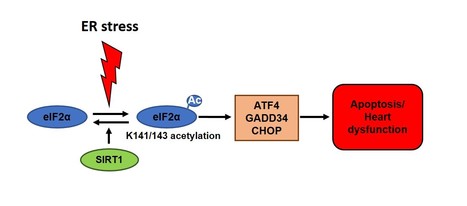
In an article that just appeared in Cell Death & Differentiation, Christophe Lemaire and his colleagues in the Faculty of Pharmacy of Châtenay-Malabry (Inserm-UPSud UMR-S 1180) studied the modification that occurs during ER stress response in the heart and the role of the sirtuin-1 (SIRT1) in the modulation of this response. SIRT1 is a deacetylase activated in response to many cardiac stresses to promote cell survival. Using isolated cardiomyocytes and SIRT1-KO mice, they demonstrated in vitro and in vivo (i) that SIRT1 is activated and plays a cardioprotective role in ER stress response, (ii) that SIRT1 attenuates the UPR by specifically regulating the PERK pathway, and (iii) that SIRT1 reduces PERK axis activation and apoptosis by deacetylating eIF2a on lysine residues K141 and K143.
Their results provide the first evidence that SIRT1 modulates ER stress-induced apoptosis in the heart and suggest that this deacetylase may represent a therapeutic target to prevent apoptosis in cardiac pathologies associated to ER stress.
Contact : christophe.lemaire@u-psud.fr
In an article that just appeared in Cell Death & Differentiation, Christophe Lemaire and his colleagues in the Faculty of Pharmacy of Châtenay-Malabry (Inserm-UPSud UMR-S 1180) studied the modification that occurs during ER stress response in the heart and the role of the sirtuin-1 (SIRT1) in the modulation of this response. SIRT1 is a deacetylase activated in response to many cardiac stresses to promote cell survival. Using isolated cardiomyocytes and SIRT1-KO mice, they demonstrated in vitro and in vivo (i) that SIRT1 is activated and plays a cardioprotective role in ER stress response, (ii) that SIRT1 attenuates the UPR by specifically regulating the PERK pathway, and (iii) that SIRT1 reduces PERK axis activation and apoptosis by deacetylating eIF2a on lysine residues K141 and K143.
Their results provide the first evidence that SIRT1 modulates ER stress-induced apoptosis in the heart and suggest that this deacetylase may represent a therapeutic target to prevent apoptosis in cardiac pathologies associated to ER stress.
Contact : christophe.lemaire@u-psud.fr