Your new post is loading...

|
Scooped by
Kim Flintoff
September 21, 2018 2:09 AM
|
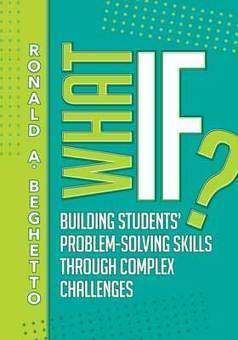
Building Students' Problem-Solving Skills Through Complex Challenges What If? Building Students' Problem-Solving Skills Through Complex Challenges - ASCDIf a fundamental goal of schooling is to help prepare young people for the unknowable future, then how might we provide our students with learning experiences that prepare them to creatively respond to uncertainty? Presented by Ronald Beghetto, author of What If? Building Students' Problem-Solving Skills Through Complex Challenges, this webinar will provide K–12 educators with practical strategies for addressing this question. More specifically, participants will learn How to foster "possibility thinking" to help students open up their thinking and learning in creative ways. The process of lesson unplanning, a way of transforming existing lessons, activities, and assignments into more complex classroom challenges. Four basic action principles that teachers and students can use to design and solve complex challenges both inside and outside the classroom. The steps for creating legacy challenges, which require students to identify a problem, develop a solution, and ensure that their work makes a positive and lasting contribution beyond the walls of the classroom.
|
|
Rescooped by
Kim Flintoff
from Edumorfosis.it
September 9, 2018 7:13 PM
|
Automation is changing the nature of education and the ways people learn. More schools are using online learning to supplement in-class activities. In fact, some schools are completely online. Distributed computing on the internet and the automation that drives it makes this possible.
Everything changes when the formal education process becomes embedded in the internet. Courseware delivery becomes asynchronous; people learn what they want, when they want to. Test administration becomes more about the efficient acquisition of data and evaluation thereof. Human-to-human interaction as a basis for a meaningful educational experience becomes optional. Today, it’s entirely possible to learn all you need to know to make a good living in the modern world without ever needing to sit in a classroom or interact with a human directly. Let’s face it: You can do a lot of learning from YouTube.
Via Edumorfosis
|
|
Scooped by
Kim Flintoff
September 8, 2018 4:25 AM
|
Despite the shortcomings above, going to college has been a smart choice for every generation prior to millennials. But over the past 15 years, two trends have made this decision a lot more questionable:
the price increased, the value decreased.
Let’s start with the first.
|
|
Scooped by
Kim Flintoff
August 22, 2018 7:37 PM
|
What will happen with NMC? What is the future of the Horizon Report, that future-focused look at educational technology? What is EDUCAUSE planning? Will EDUCAUSE change the Horizon Report? And will the NMC acquisition change EDUCAUSE?
Good questions all. We've been asking those and other questions and seeking answers in many places, particularly with members of the NMC community itself. We've learned a lot and yet still have so much to learn.
Here is our plan for the NMC Community and the Horizon Report, in a format that might look familiar.
|
|
Scooped by
Kim Flintoff
August 22, 2018 12:34 AM
|
David Chandross explores how universities are immersing students in virtual reality games to enhance their learning.
|
|
Scooped by
Kim Flintoff
August 14, 2018 1:58 AM
|
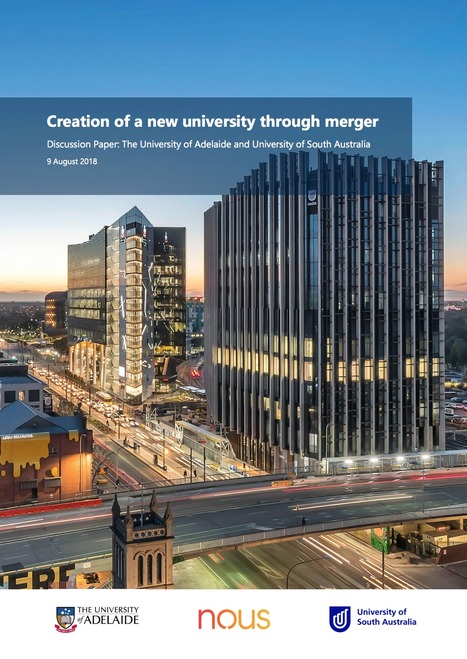
The councils of The University of Adelaide (UofA) and University of South Australia (UniSA) (the universities) have agreed to formally consider the merits of creating a new university through a merger of the two institutions. Nous Group has been commissioned by the two universities to undertake an assessment of the value of the merger.
|
|
Scooped by
Kim Flintoff
August 13, 2018 8:22 PM
|
A new survey published on the 5th of July by Education and Employers in partnership with TES and NAHT reveals the importance teachers place on introducing children to the world of work. The survey asks 250 primary school principals and teachers across England about their opinions on career learning in primary and its impact.
Headline findings:
The majority of teachers answering our survey believe children should be learning about the world of work and different jobs in their first years of primary school.
Nearly half (47%) believe this should start from Age 5 and under
A further 21% believe this should start from Age 5 – 7 in year 1 and 2
Overwhelming majority of primary schools were already carrying out activities with the aim of increasing children’s understanding of the world of work.
Most primary schools have not heard about the Government’s new Careers Strategy, which specifically mentions primary for the first time.
In line with our previous work in secondary, nearly all teachers in our survey agreed that introducing children to the world of work was important in:
Linking learning to the real world and in doing so increasing motivation to work hard
Challenging gender stereotyping about jobs and school subjects
Broadening aspirations
While teachers appreciate the importance of these activities, there are challenges which prevent them being organised on a regular basis:
The majority of our respondents believed time constraints are the major barrier in organising more activities with employers (60%).
The second biggest challenge is availability of employers/volunteers and teachers and difficulty in communication and/or scheduling a suitable time for both groups.
The findings were formally launched at the 5th International Conference on Employer Engagement in Education and Training.
|
|
Scooped by
Kim Flintoff
August 2, 2018 3:33 AM
|
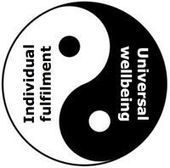
The EVMF defines the purpose of education as being to prepare people for life now and in the future. This is deliberately broad. It also fails to recognise that there are other purposes for (parts of) the education system, such as schools providing custodial care for young people so that their parents/carers can engage in paid employment.
|
|
Scooped by
Kim Flintoff
August 2, 2018 2:42 AM
|
At Indiana University, faculty input is a key part of the classroom design process. Here's how a recent symposium fostered cross-campus collaboration and future-thinking conversation about new learning spaces.
|
|
Scooped by
Kim Flintoff
August 1, 2018 12:10 AM
|
Four young Roebourne residents have created a 12-minute virtual reality film, Future Dreaming, starring future versions of themselves as they guide viewers around their lives on the fictional planet Daya.
|
|
Scooped by
Kim Flintoff
July 30, 2018 10:08 PM
|
An increasing policy focus in Australia, and internationally, is on getting young people interested in and studying science, technology, engineering and maths (STEM) subjects.
One approach being explored is to bring the school STEM curriculum closer to current research and practices – for instance, by engaging students in authentic inquiry and reasoning.
|
|
Scooped by
Kim Flintoff
July 29, 2018 9:52 PM
|
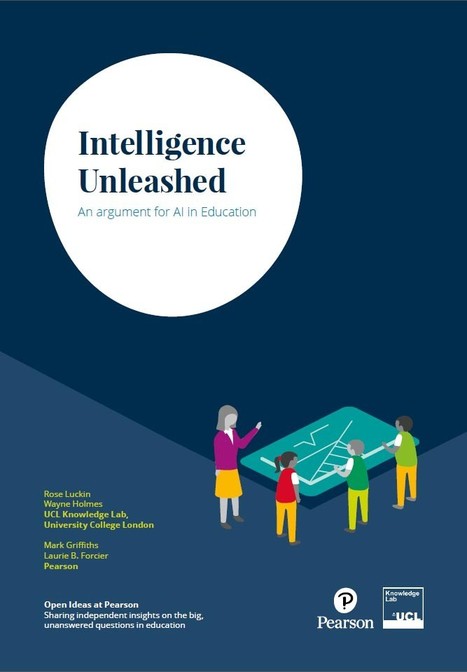
In this important new report, a positive and plausible vision is set out of how learning could be transformed by artificial intelligence in education (AIEd). For example, technology available today could be applied to support student learning at a scale previously unimaginable by providing one-on-one tutoring to every student, in every subject. Existing technologies also have the capacity to provide intelligent support to learners working in a group, and to create authentic virtual learning environments where students have the right support, at the right time, to tackle real-life problems and puzzles.
|
|
Scooped by
Kim Flintoff
July 24, 2018 9:51 PM
|
Human beings have an astonishing ability to learn, but our motivation to do so tends to decrease with age, particularly in adulthood. As children, we are naturally curious and free to explore the world around us. As adults, we are much more interested in preserving what we learned, to the point of resisting any information — and data — that challenges our views and opinions. Unsurprisingly, there is now big demand for employees who can demonstrate high levels of “learnability,” the desire and ability to quickly grow and adapt one’s skill set to remain employable throughout their working life. This demand has been turbocharged by the recent technological revolution.
|
|
|
Scooped by
Kim Flintoff
September 17, 2018 5:06 AM
|
Education is a human system. Sir Ken Robinson describes it as being ‘not an impersonal, inert engineering system, it’s constantly in flux and changing. It exists in the actions and activities of people every day.’ This means that, as with all human systems, it is unpredictable and subject to influence by any amount of circumstances – making it impossible to guess what the future of education will look like.
How the next 100 years of education should look however, depends on a number of factors, including what the purpose of education is believed to be, and whom education is believed to be for. With that in mind, we turned to 100 education thought leaders, influencers and change makers from across the world to discover their views.
|
|
Scooped by
Kim Flintoff
September 8, 2018 5:14 AM
|
Howard Rheingold, author, virtual community pioneer and self-described “online instigator and expert learner,” has interviewed more than 100 innovative and inspiring educators who exemplify connected learning: a fundamentally different mode of learning from education that is centered on fixed subjects, one-to-many instruction and standardized testing. The following are some of his most relevant picks for learner agency, co-learning, making, 21st-century learners, networked publics, media literacy, civic engagement and pedagogy.
|
|
Scooped by
Kim Flintoff
August 27, 2018 7:50 PM
|
Ken Robinson once famously said, “Students are educated in batches, according to age, as if the most important thing they have in common is their date of manufacture.” (Ken Robinson, The Element: How Finding Your Passion Changes Everything).
I have the privilege of working with 2nd through 6th graders in my gifted education classes and Kindergarten through 6th grade in my summer STEM and robotics camps. With my summer camps, they get to choose their camp by interest not age. In my gifted program, they select from a menu of content areas so it is also interest- rather than age-driven. I wouldn’t have it any way.
|
|
Scooped by
Kim Flintoff
August 22, 2018 6:59 AM
|
Higher education is changing, and digital is at the heart of it. We are now at a tipping point where failing to adapt will soon see institutions fall behind the curve in terms of offering a modern, relevant product to students. However, why is it that digital transformations in higher education typically end up failing, often after very high levels of spending? We are all familiar with the problem of departments acting in siloes. What is less well understood is how digital itself is seen as a silo. Nowhere is this better shown than by the fact that there is a job title of Head of Digital or similar – digital is positioned as a silo in and of itself. The reality is that digital underpins everything in the product experience and cannot be relegated in this way. Achieving anything in terms of the student experience relies on a much deeper, more profound adoption of digital techniques and thinking.
|
|
Scooped by
Kim Flintoff
August 21, 2018 11:30 PM
|
Research for this project began in March 2018 over a twelve‑week period, with over 100 hours of surveying, compiling and annotating nearly 300 academic articles and government white papers, specialist and general media reports and educational literature covering both theoretical and current issues in education. Nearly 20 hours of interviews were conducted with participants featured and quoted in the white paper, as well as follow-up interviews and correspondence. Participants were selected for their experience in all educational sectors – primary, secondary and tertiary – as well as both private, independent and public schools.
|
|
Scooped by
Kim Flintoff
August 13, 2018 8:26 PM
|
Primary Futures Australia aims to widen the horizons and aspirations of primary school children by helping them make the connections between their learning and their futures.
It is completely free to all primary schools as part of the successful Inspiring the Future Australia program.
Through Primary Futures, teachers can access a vast network of volunteers from different backgrounds and professions – from Apprentices to Chief Executives, Archaeologists to Zoologists or employees from small, medium sized or multi-national companies all of whom have signed up to inspire school children in their indicated geographical region.
|
|
Scooped by
Kim Flintoff
August 2, 2018 3:33 AM
|
The underlying premise of this paper is that lifelong learning, people-skills and problem-solving need to be developed for our societies and economies to be successful. If we want to rise to this challenge, we need to recognise that learning is a socialised process; learning means we know how to do things with information and skills in social contexts. As a result, we can only support, encourage and evaluate professional learning(1) if we have evidence about changes in practice. This cannot happen in a one-off or series of top-down, pre-ordained assessments or within competence frameworks. It needs to be situated in people’s working contexts. It needs to allow for multiple moments of assessment that include a full range of perspectives relevant to those contexts and support reflection on practice.
|
|
Scooped by
Kim Flintoff
August 2, 2018 2:53 AM
|
Provided for each are future-focused learning activities called “micro-shifts,” which are possible activities to trial and to reflect upon in order to build capacity. I call them micro-shifts because they are a single activity that can help you to nudge your practice towards a permanent transformation in relation to the corresponding Shift of Practice. But the broader question is, why would we do all this?
|
|
Scooped by
Kim Flintoff
August 2, 2018 1:57 AM
|
Every field and every industry is grappling with a version of this problem, trying to stay ahead of the technology to yield its greatest good while offering protection from its potential for harm. In that sense, the signal that must receive most of our attention is not one from the future after all. Rather, it is a signal from the past: that is, every life has value and dignity and a right to self-determination. What that means in an increasingly technological world may be the most important question of the next twenty years. EDUCAUSE can help us find the answer.
|
|
Scooped by
Kim Flintoff
July 31, 2018 8:27 PM
|
More companies, desperate for candidates for jobs ranging from auto mechanic to e-commerce analyst, are abandoning requirements about college degrees and prior job experience.
|
|
Scooped by
Kim Flintoff
July 30, 2018 6:45 AM
|
The next step: strengthening capabilities
While there are a number of policy, structural and practice changes needed to transform the education system, Mitchell Institute believes that a renewed focus on capabilities must underpin reform. Capabilities can bridge the academic and vocational divide, providing young people with the resources to navigate the future. The final section is a reflection on the importance of capabilities.
|
|
Scooped by
Kim Flintoff
July 29, 2018 9:49 PM
|
Wondering whether Millennials Are The Future Of eLearning? Check why Millennials Are The Future Of eLearning and how this is proven today.
|