Your new post is loading...

|
Scooped by
Kim Flintoff
November 22, 2018 6:37 PM
|
Excerpted from "Just Ask Us: Kids Speak Out on Student Engagement" by Heather Wolpert-Gawron.
Read the companion piece, "Why Choice Matters to Student Learning," for more about the research on student engagement and choice.
By Heather Wolpert-Gawron
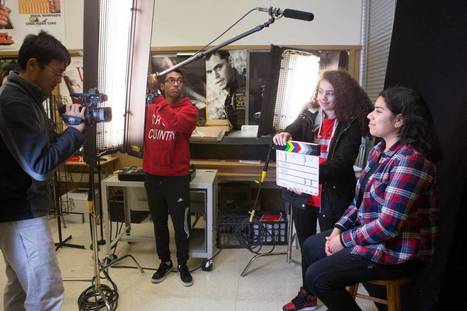
Keeping in mind the prior research that proves there is such a thing as too much choice, it’s important to just look at all the possible options that teachers have who are looking to incorporate more choice in their classrooms.
|
|
Scooped by
Kim Flintoff
October 22, 2018 10:51 PM
|
What jobs will be on offer to students graduating high school this year?
That’s the question IBISWorld hoped to help answer through a new release on the industries set to add the most new jobs to the Australian economy.
The market research company looked at a combination of total employment number increases and annualised growth rates over the next five years.
So, under that metric, which areas will need plenty of new blood?
|
|
Scooped by
Kim Flintoff
October 20, 2018 11:59 AM
|
Over the last few years, the Christensen Institute has written extensively on how innovation in K–12 education will impact teachers. We’ve tackled important questions such as “Will computers replace teachers?”, “How will technology change teaching?”, and “How do you develop teachers for next-gen classrooms?” Below are highlights of our key findings and insights.
|
|
Scooped by
Kim Flintoff
October 14, 2018 1:10 AM
|
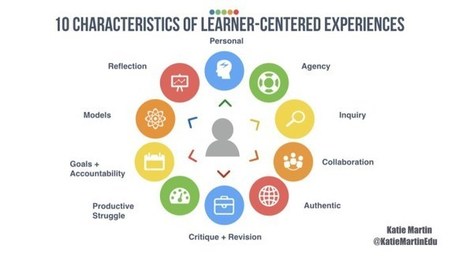
The school’s aim is to foster an environment in which student and teacher together are jointly responsible for learning. That heightened sense of ownership, which some research suggests could strengthen students’ desire to learn, is one of the many facets of an educational approach called “personalized learning.” Although definitions vary broadly, personalized learning endeavors to design educational experiences that suit an individual student’s abilities and interests. It’s an idea that’s gaining traction as technology offers new tools for both tracking student learning and customizing classwork based on past performance.
|
|
Scooped by
Kim Flintoff
October 13, 2018 8:31 PM
|
“Knowing” doesn’t make you good at something on its own, which is why doing well in school doesn’t always translate to succeeding in life. In school, there are often clear rules and a narrow path that defines success. Life does not work this way. In fact, high achievers in school often struggle to make their own way in an uncertain world. Yet, as many of us expected to go to school, follow the rules, get a job out of school, that path is becoming more of a distant dream as kids today will have to create their jobs and a new path. When we become so focused on compliance, improving test scores, and covering it all, it can prevent us from the larger goals of developing learners to think, communicate, and generate novel ideas based on their passions and skills.
|
|
Scooped by
Kim Flintoff
October 10, 2018 4:29 AM
|
In December 2017, a report from management consulting firm McKinsey & Company, "Jobs Lost, Jobs Gained: Workforce Transitions in a Time of Automation," predicted that between "almost zero" and a third of work activities could be displaced by 2030, with wide variation among countries. (The more advanced the economy, the more likely the impact of automation.) While workforce transitions could hit between 75 million and 375 million people, overall, McKinsey found, more occupations will change than will be lost in a machine-driven world.
|
|
Scooped by
Kim Flintoff
October 5, 2018 9:32 PM
|
Disruptive models can make college radically affordable
Across industries, sustaining innovations help organizations stay competitive—until another type of innovation comes along. Disruptive Innovations are cheaper, simpler products and services that take root at the low-end of the market, often serving customers disregarded by more established industry competitors.
In higher education, business models are emerging that fit the disruption mold. One example is Western Governors University (WGU), which is growing at 20% annually, has raised tuition once in the past ten years (currently $6,500 per year), and as of this summer serves over 100,000 students. WGU primarily serves adult learners—not the prime market of 18- to 24-year-olds that more traditional colleges typically compete for—and provides those students with a radically different college experience.
|
|
Scooped by
Kim Flintoff
September 28, 2018 11:57 PM
|
So-called education reformers—myself included—constantly propose new plans, programs, and policies to fix whatever supposedly ails public education.
These ideas often fall flat because teachers aren’t buying what the reformers are selling.
For any change in a school to be successful, the teachers in that school have to buy-in and execute it well.
Too often reformers forget to understand the progress that teachers are trying to make. They ignore what would motivate teachers to make changes in their classrooms and schools.
|
|
Scooped by
Kim Flintoff
September 27, 2018 1:07 PM
|
Overview
The HP/EDUCAUSE Campus of the Future project explored the efforts of eleven colleges and universities to investigate the ways that augmented reality (AR), virtual reality (VR), and 3D scanning and printing technologies can benefit teaching, learning, and research.
This is the one of the broadest, most diverse studies to date of the integration of 3D technologies into higher education, in terms of sample size, learning environments, academic disciplines, and number of users. In this study, researchers explored the ability of extended reality technologies to enhance the educational experience, including participation in collaborative simulations of real world challenges; exploration of historical sites; audio simulations to improve the ease of hearing aid adjustments; and using AR overlays to increase understanding and capacity in participatory activities.
In collaboration with HP, select institutions were given AR, VR, and 3D printing and scanning technologies, which were utilized in myriad ways to create immersive and innovative learning experiences for students during the 2017-18 academic year. Through this research, EDUCAUSE researchers determined that 3D technologies are best used for experiential learning approaches that augment real-world examples, increasing access to subject matter, concepts, or locations that would otherwise be cost or logistically-prohibitive.
|
|
Scooped by
Kim Flintoff
September 27, 2018 3:29 AM
|
We saw that even within the first five weeks of the school year, if you were in a classroom of a teacher who was a more controlling in his or her strategies for motivating, that not only did children feel less able to do schoolwork and less interested in doing their schoolwork, they wanted lower levels of challenge, they wanted things to be easier in the classroom because they didn’t want to make mistakes… If you had a teacher, on the other hand, who was autonomy supportive, children increased in their engagement in classroom and their interest and their desire for challenge and they felt better about themselves… And those results were pretty dramatic. It showed us just how powerful a classroom environment can be on a child’s motivation and wellness.”
|
|
Scooped by
Kim Flintoff
September 26, 2018 8:30 PM
|
Most of these learners, 33 %, were in the Foundation Phase, meaning they are between ages of six and nine. These young people will make up the workforce of the future and with the rapid advance of new technologies, they are likely to face a complicated global market.
Recent research estimates that by 2030 half of the work being done by people around the world today will be automated by existing technology, and up to 375-million people may need to switch occupational categories between now and then.
Policy makers will need to take this into account and embrace advances like artificial intelligence, cloud computing and the intelligent edge to empower young learners and equip teachers with the tools, knowledge and skills to effectively shape their students’ young minds.
The future of education
|
|
Scooped by
Kim Flintoff
September 25, 2018 6:46 PM
|
About this course Skip Course Description
This education course will show you, through current research, how we learn — the way our brain makes, stores, and retrieves memories.
You will examine common misconceptions and misunderstandings about learning that can prevent students from learning at their fullest capacity. Along the way you will explore the practical implications of cognitive science for classroom teaching in terms of choosing effective instructional strategies, developing useful assessments, motivating student effort, and designing learner-centered curricular units.
This course is aimed to enhance the practice of K-12 teachers.
|
|
Scooped by
Kim Flintoff
September 24, 2018 6:35 AM
|
Online learning taught by robots could be widespread by 2030.
Thirty years ago, it was a big deal when schools got their first computers. Today, it’s a big deal when students get their own laptops.
According to Futurist Thomas Frey, in 12 years it’ll be a big deal when students learn from robot teachers over the internet.
It’s not just because the technology will be that sophisticated, Frey says, but because the company responsible for it will be the largest of its kind.
“I’ve been predicting that by 2030 the largest company on the internet is going to be an education-based company that we haven’t heard of yet,” Frey, the senior futurist at the DaVinci Institute think tank, tells Business Insider.
|
|
|
Scooped by
Kim Flintoff
October 24, 2018 6:52 PM
|
Idaho just became the second state in the country to adopt a robust policy plan to expand computer science in schools across the state. This is an impressive milestone and shows what can be achieved when teachers, students, legislators and community members work collaboratively toward the expansion of computer science education!
|
|
Scooped by
Kim Flintoff
October 22, 2018 6:41 AM
|
In the decade since the release of smartphones, I've never caught a student on his or her device talking with experts in Botswana about water conservation, or anything like it. Students play games, take selfies, and message their parents and friends. When I shared this video with my students, they erupted into laughter. One student volunteered, "If you see me on my phone, there's a 0 percent chance I'm doing something productive. If you see me on my laptop, there's a 50 percent chance." Most students disagreed. They thought 50 percent was too high.
....
When teachers put devices in the hands of kids and expect them to be productive, they're expecting too much. Teaching kids with technology is analogous to having an AA meeting in a bar.
|
|
Scooped by
Kim Flintoff
October 17, 2018 12:01 AM
|
According to Ron Ritchhart, seeing ourselves through our students' eyes is the key to being a great model for thinking. He describes two types of modelling in
|
|
Scooped by
Kim Flintoff
October 13, 2018 8:33 PM
|
“I think it is likely in the next 200 years or so Homo sapiens will upgrade themselves into some idea of a divine being, either through biological manipulation or genetic engineering of by the creation of cyborgs, part organic part non-organic. It will be the greatest evolution in biology since the appearance of life. Nothing really has changed in four billion years biologically speaking. But we will be as different from today’s humans as chimps are now from us.”
|
|
Scooped by
Kim Flintoff
October 10, 2018 6:15 PM
|
We often think of “virtual work” as working with someone located outside an office, or in another city or country. This type of work is on the rise: a 2017 Gallup report found 43% of American employees work remotely; in another survey, 48% of respondents reported that a majority of their virtual teamwork involved members from other cultures.
However, virtual work also encompasses how we are turning to technology to conduct business with nearby colleagues, sometimes within the same building or campus. At a large consumer-products firm where we’ve been conducting research, an HR director recounted the changes she witnessed in employees located in two buildings a few miles apart. “Ten years ago, we would regularly drive between buildings to meet each other, but today, we almost never do; meetings are conducted by videoconference and everything else is handled on e-mail and IM.”
|
|
Scooped by
Kim Flintoff
October 7, 2018 11:44 PM
|
In Perth to deliver the 2018 Vice-Chancellor’s Distinguished Oration at Edith Cowan University on Friday, like the UK PM, the Vice-Chancellor of Portsmouth University initially uttered the much-maligned ‘B’ word.
“You will be delighted that I don’t intend to focus on Brexit itself,” he assured the audience. Instead, he explored its causes, in the context of his lengthy speech, ‘Universities are central to societies’ future success – but only if we learn some lessons’.
|
|
Rescooped by
Kim Flintoff
from Edumorfosis.it
September 30, 2018 7:19 PM
|
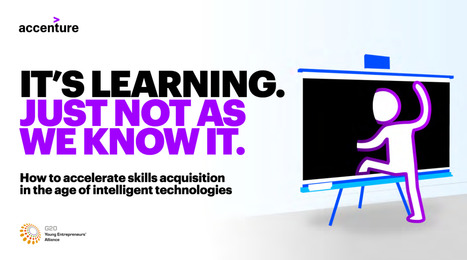
The future of Work is a race between education and technologies. Blockchain, AI and advanced biosciences promise new efficiencies and growth opportunities at a time when leading economies are struggling with weak productivity gains and, in some cases, slow GDP growth. But it’s easier said than done. Industrial age education and training systems put these economic opportunities at risk. If skill-building doesn’t catch up with the rate of technological progress, the G20 economies could lose up to US$11.5 trillion in cumulative GDP growth in the next ten years. That’s equivalent to losing more than an entire percentage point from the average annual growth rate every year over that period. For this report, we look through the lens of the future worker – from the shop floor to the boardroom, from the shop front to the back office – and we identify their evolving skills demand. We analyze the changing importance of skills to different roles and the impact of intelligent technologies. Contrary to conventional wisdom, this is not about technological skills. It is about cultivating the full range of skills, from the creative to the complex cognitive capabilities that the future workforce will need. Our diagnosis: Current education and corporate learning systems are not equipped to address the coming revolution in skills demand. The challenge is especially urgent for roles that are more vulnerable to dislocation through intelligent automation. The impact is uneven across economies and industries, demanding targeted interventions. Our proposed solutions: Learning with experiential techniques, shifting the focus from institutions to individuals and empowering the most vulnerable people to learn. Advances in the science of learning, paired with new technologies, allow pioneering businesses to offer new approaches to learning. The challenge? Accelerating their adoption across all organizations, large and small, and throughout education systems in the G20 economies.
Via Edumorfosis
|
|
Scooped by
Kim Flintoff
September 27, 2018 1:55 PM
|
High Schools That Work is the nation’s largest school improvement initiative for high school leaders and teachers.
More than 1,200 HSTW sites in 30 states and the District of Columbia currently use the HSTW Goals and Key Practices to raise student achievement and graduation rates.
HSTW’s annual Staff Development Conference attracts thousands of educators each year for professional development. HSTW publications, case studies, site development guides and other materials help improve high school curriculum and instruction across the nation.
|
|
Scooped by
Kim Flintoff
September 27, 2018 3:31 AM
|
When principal of Templestowe College, Peter Hutton, was at school, like many of us, he was told that one day the esoteric-seeming knowledge he gained would be useful.
“That hasn’t happened yet,” Hutton quipped at a recent event.
|
|
Scooped by
Kim Flintoff
September 27, 2018 3:14 AM
|
For years the male dominance of STEM-related careers has been explained away as women having less aptitude for the relevant subjects. But a new study challenges this view, finding a high similarity between male and female performance in science, technology, engineering and mathematics). It even goes so far as to suggest that the top 10% of a class was, on average, equal parts male and female. The study, conducted by Rose O’Dea and published today in the journal Nature Communications, a PhD student at Australia’s University of News South Wales, collected data from more than 1.6 million students, from age six to university across 268 different schools. , It focused on the gender differences in variability regarding academic grades.
|
|
Scooped by
Kim Flintoff
September 25, 2018 7:28 PM
|
Technology is everywhere, and one of the most promising new technologies of the age is artificial intelligence and its sister technology machine learning. AI and machine learning work together to make it easier than ever before to process large amounts of data. It's the same thing that Netflix uses to provide personalized recommendations based on the viewing data of every single user on the site.
Now, this might not sound like it has much to do with the field of education, but if you'll bear with us then we think you might just be surprised. In fact, AI and education go together like chalk and a chalkboard, and the rising new technology might just be what we need to overhaul the education system and to make sure that every pupil is given the best possible shot at academic success.
Here are just three of the main ways that artificial intelligence is set to come along and change the way we look at education.
|
|
Scooped by
Kim Flintoff
September 25, 2018 6:45 PM
|
About this course Skip Course Description
We live in a time of disruptive change. How to activate our capacity to lean into the emerging future may well be the most important leadership challenge of our time. How do you cultivate curiosity, compassion and courage in the face of prejudice, anger and fear?
|