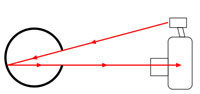
You have checked your camera, have extra memory cards and back up batteries, and are ready to shoot. You start blasting away capturing awesome moments with family and friends, only to be shocked by your photos days later. You slowly begin to think that everyone you know are evil aliens! Okay, so that joke is getting old, but I’m referring to red-eye.
Red-eye, in photography terms, is when the pupils of the eyes in people and some animals, appear red in photos. Since ’tis almost the season for many great holidays, and amazing photo opportunities, I thought I’d give you a gift of my own, so here it is, how to avoid this tragedy.
Photography has become an important part of our life. Photography gives us an opportunity to capture the best moment of our lives and relive them by watching them whenever we want to. In order to become a photographer one must have the cunning skill to capture the winning shots which is not an easy task. Not everyone can become a photographer because in order to be one you need to have a sharp eye for capturing the moments are worth reliving. If you really want to become a photographer, you should take a part in photography competition in order to know more about yourself as a photographer. Plus, if you get recognition, nothing can be better to boost your morale. Perfect photographs can be used in websites, booklet printing, rack card printing and so much more.
It is not easy to capture someone’s attention merely by a photographer. A best photographer is someone who can not only capture a beautiful moment but his picture should depict the entire story behind that moment. So capturing that one winning shot is never easy unless you learn how to do it. Some people are naturally talented with photography but some will learn with the passage of time. If you are actually planning to participate in a competition, you must be aware of the theme, rules and regulations of the competition. It is important to keep the theme in mind because if you fail to understand the actual theme, you might lose the entire essence of the competition regardless of the fact if you have taken the best pictures.
There’s something to be said about having a nice collection of travel photos. They document not only your personal journey in other cities and countries, but also showcase the artistic side of your photographic abilities. Throughout my recent travels through Southeast Asia (and many smaller trips in years past), I’ve been able to capture some images that I’m quite proud of.
The following tips have helped me take better and more unique photos when I am traveling or when I’m home :
1. Always Be Ready 2. Don’t Do What Others are Doing 3. Do Some Research & Make Connections 4. Take Risks 5. Get Off the Beaten Path 6. Take a Timeout
L’indice de lumination (IL), aussi appelé Exposure Value (EV) en anglais, ou plus simplement « stop« , est la manière qu’utilise votre appareil pour mesurer la luminosité. Voyons comment comprendre ce concept va vous permettre de maîtriser la fonction de correction d’exposition de votre appareil. Qu’est-ce qu’un « stop » ?
Si vous avez pas mal lu sur la photo, notamment en anglais, vous avez peut-être déjà rencontré ce terme employé à toutes les sauces, avec des formulations compliquées. Dédramatisons le concept : les stops/EV/IL sont juste une manière de mesurer la lumière.
Pour faire simple, à chaque fois que vous doublez la quantité de lumière, vous augmentez d’1 EV, et à chaque fois que vous divisez la quantité de lumière par deux, vous diminuez d’1 EV. Exemple simple : admettons que 2 ampoules soient équivalentes à 0 EV. Si vous éclairez avec 1 ampoule, vous serez à -1 EV (vous diminuerez la luminosité d’1 stop), et si vous éclairez avec 4 ampoules, vous serez à + 1 EV (vous augmenterez la luminosité d’1 stop). Un stop n’est donc pas une quantité de lumière absolue, mais une différence entre deux quantités de lumière.
The night sky is an incredible phenomenon. Whenever I take a minute to gaze up at a clear star-filled sky, I am filled with awe and wonder at the magnitude of space and the depth and quantity of stars on display. Capturing this in photographic form can be a tricky business, but hopefully the following tips will get you started.
La "composition" d'une image photographique consiste à mettre les éléments suivants en harmonie :
- les éléments de la scène (leur placement relatif) - leur rapport de dimensions (masses, positions relatives dans le même plan et dans la profondeur, etc), prenant donc en compte la perspective. - leurs couleurs mais aussi les tons clairs et foncés et donc l'éclairage - la profondeur de champ (les zones nettes ou floues dans la profondeur de l'image) - le cadre dans lequel tous les éléments précédents prendront place.
La rotule est l'élément sur lequel repose votre appareil photo lorsque vous le mettez sur un trépied ou un monopode. Intégré directement sur certains pieds, il faut cependant le choisir lorsque vous achetez un trépied haut de gamme. Avec poignées, sans poignée, à crémaillère ou encore avec un joystick, les constructeurs regorgent d'idées pour faciliter la vie des photographes.
You might already know all about histograms, if you don’t it’s well worth getting your head around them because, well, they are pretty awesome. Unfortunately they are often overlooked, dismissed or misunderstood but they are very helpful especially when it comes to strobist photography.
A lot of people will tell you that a good photograph must have a nice even histogram, this is a blatant lie & you must immediately set fire to who ever told you that. What you should do is think of a histogram as a light meter for after you’ve taken the shot — a light meter on a cocaine fuelled acid trip with a dab of heroine and a touch of speed.
A panoramic photo is simply an image consisting of multiple photos. And since the rise of digital photography, the panoramic shot has become easy to do and an art in itself. In this tutorial, you’ll get a quick look at how these images are created.
Kids are absolutely the funniest little creatures on the planet. One minute, they’re laughing, the next minute…well…total meltdown. And when you are a momarazza like myself, camera in hand, you will never miss an opportunity to capture your children in action. As simple as it may seem (or perhaps you don’t think it sounds simple at all!) this can be a difficult task which requires cunning skill and patience. Try these tips to get your creative juices flowing.
Shutter Priority is an auto exposure system in which the camera achieves correct exposure by selecting the aperture after the user has selected the shutter speed.
Conversely, Aperture Priority is an auto exposure system in which the camera achieves correct exposure by selecting the shutter speed after the user has selected the aperture.
Each system has its own set of distinct advantages and disadvantages. But to fully understand Aperture Priority and Shutter Priority you must understand the fundamentals of exposure. Please refer to the preceding segment (Program AE) if you need a quick review.
Photographs, by definition, capture and immortalize a small slice of life. There is little for the viewer to infer what happens before or after that moment. However, there are images that need to communicate motion. For example, you may want to capture a dog running, a train barreling down the tracks, or trees that are blowing in the wind. Each of these scenes can come alive within your photographs if you learn how to convey motion properly.
Oui, un portrait n’est techniquement pas complexe à réaliser la plupart du temps. Il faut mettre en valeur votre sujet, qu’il soit fort et qu’il occupe toute l’attention dans l’image, à moins que vous vouliez le mettre en relation avec un autre élément. Mais restons simples.
1. Faites la mise au point sur les yeux. « Le miroir de l’âme », tout ça, on connaît la chanson, mais c’est vrai. Le regard de quelqu’un peut réellement décupler l’effet d’un portrait, et j’ai tendance à penser qu’il faut qu’il soit net pour en maximiser l’effet. Enfin au moins un œil sur les 2, si vous aimez comme moi jouer avec de très faibles profondeurs de champ ;)
2. Cadrez serré. En ce qui me concerne j’aime beaucoup les portraits très serrés, mais dans tous les cas (même pour une photo en pied), remplissez autant que possible le cadre avec votre sujet, il n’en sera que renforcé.
3. La profondeur de champ, parlons-en. Il vous faut la réduire pour isoler votre sujet de l’arrière-plan. Je ne vais pas vous refaire tout le speech car j’ai déjà fait un cours sur la profondeur de champ ;)
4. Une jolie lumière : j’aime beaucoup jouer avec la lumière ambiante pour mettre en valeur mon sujet. Mais une jolie lumière n’est pas toujours ce que vous pensez : un grand soleil provoque des ombres un peu dures qui peuvent jurer avec le visage. Ce n’est pas forcément rédhibitoire, mais il faut y prendre garde. Au contraire, un soleil légèrement voilé permet de diffuser la lumière et d’adoucir les ombres. Préférez donc ce temps-là pour vos portraits en lumière naturelle.
Et c’est tout. Et encore, ce ne sont que des règles générales, et vous pouvez tout à fait les prendre à contrepied si vous avez une idée originale derrière.
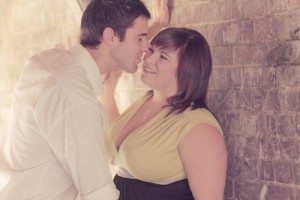
The first thing to acknowledge here is that large people know that they’re large. As with any body type (skinny included) their body image may cause them to believe that they’re either larger or smaller than they are. You can tastefully discuss body image with them clients which is something I may be inclined to do with any type of person. Understanding how a client feels about their body is always a great thing to know. And if they’ve scheduled a photo session, they’re probably already pretty confident people.
As a society, we try to find ways to make people look smaller and we think that smaller = more attractive, but this doesn’t need to be our primary focus when shooting large people. Making them appear comfortable? Now that’s important. And I agree, laying on the ground is usually a no-go. Here are a few tips I’ve found helpful:
1, Use a telephoto lens or the longest zoom that you have. This will compress the shot and keep it from suffering from widening distortion. Experiment with the distortion correction in Photoshop to see if there’s any barreling that you don’t notice on first inspection.
2. Don’t shoot from a low angle.
3. You can shoot from higher up looking down, but beware that this is a way overused tactic for photographing larger people so throw in lots of other types of framing, not just this one.
4. You can use one subject’s body to shield another (if one is lighter than the other)
5. Obviously, you have the option of not photographing their whole body. Try different varieties of head-and-shoulders shots, but beware that they may feel that you’re saying that they’re unattractive if you don’t also provide them with body shots. Your job is to photograph them like you would anyone else so don’t think you’re doing them a favour by completely ignoring their entire body.
6. In a post of mine this week on posing families, try the ‘huddle’ and ’squeeze in’ poses which eliminates full body shots.
Vous pensez que la perspective est contrôlée par la longueur focale ? Et bien je pensais comme vous jusqu’à il y a peu, et je me trompais. Démontons ensemble cette idée reçue très courante.
Là, logiquement, vous devez vous étrangler. Depuis qu’on vous a expliqué la différence entre un grand-angle et un téléobjectif, vous pensez que le premier accentue les perspectives et que le second les tasse. Sauf qu’on oublie trop facilement un autre élément : le grand-angle a tendance à vous faire vous rapprocher de votre sujet, et le téléobjectif à vous en éloigner. Il n’y a donc pas que la longueur focale qui change, mais aussi la distance par rapport à votre sujet. Décryptons ensemble les effets de ces deux variables sur vos images. Pourquoi devriez-vous lire cet article ?
La perspective, c’est-à-dire la relation entre les tailles de différents éléments de l’image situés à des distances différentes, peut considérablement modifier un cliché. Et il est important de comprendre comment agir sur cet élément pour mieux contrôler le rendu de vos images. Faire paraître vos amis très grands ou au contraire tout petits à côté d’une montagne, ça vous intéresse ? Et bien si vous pensiez que ce n’était qu’une histoire de longueur focale, vous devriez continuer à lire
In this video tutorial, we’ll take an modern digital image and with Photoshop make it look like it was captured on film during the very early days of photography. This technique can be applied to any image to convey a nostalgic mood or just to have some fun!
Lots of websites that offers applications to edit pictures in web browsers have come a long way. Instead of buying expensive picture editing software programs and installing them on your computer, you may basically edit your pictures online with no much difficulty. With this online picture editing tools, you may simply generate all the particular effects you want in your picture. Even some websites gives templates for newbie creative designers to make unique effects in their pictures.
The alarm clock buzzes. You crack an eye open and see the light blinking at you. 4:45am. After a few moments, your groggy mind remembers why you set your alarm in the first place. You groan, and after another minute, roll out of bed.
You take a quick peek out the window. Still dark out. But it won’t be for long. You quickly dress in multiple layers, pulling out a pair of fingerless gloves and beanie cap. You pack a breakfast bar and thermos full of coffee. Then you double-check your equipment list:
Camera [no brainer]. Check. 24-70 lens [favorite for this activity]. Check. Tripod and quick release [a necessity]. Check. Shutter release [makes for clear pictures]. Check. Cleared cards [to take as many as you can]. Check.
By 5:00am, you are on your way out the door and headed out your driveway.
You know exactly where you are headed; peak about 20 minutes from your home. After unpacking your equipment, you face the Eastern horizon. Already the golden glow of the sun is beginning to appear. The fog is swirling around the base of the rolling green hills. You smile. It’s going to be a beautiful sunrise.
Twitter, Facebook, Flickr, Linkedin, Myspace, etc … A l’heure où internet et les réseaux sociaux font complètement partie de nos vies, le photographe doit être alerte et doit savoir profiter des outils de communication qui sont mis à sa disposition. Pourquoi les utiliser ? Comment exploiter leurs potentiels ? Voici quelques pistes pour faire de vous un photographe 2.0.
Les appareils photographiques modernes sont pourvus d'automatismes qui prennent en compte les conditions de prise de vue, et souvent même les préférences de l'utilisateur, permettant de réaliser des images techniquement correctes avec le minimum d'intervention du photographe : « Visez et appuyez, nous ferons le reste ! ».
Toutefois, les professionnels et les amateurs exigeants peuvent souhaiter obtenir certains résultats que l'automatisme intégral ne permet pas. D'autre part, de nombreux appareils anciens sont encore utilisés, qui ne sont pas pourvus des derniers perfectionnements techniques. C'est pourquoi il est important de connaître les différents réglages nécessaires pour réussir une photo.
Dans le texte qui suit, l'on s'efforcera de citer pour chaque type de réglage les automatismes existants sur les appareils actuels, et les réglages manuels possibles sur les différents types de boîtiers.
Le filtre photo est un dispositif transparent que l'on met à l'avant ou à l'arrière d'un objectif afin d'ajouter un effet colorimétrique sur une photographie. Colorisé, le filtre permet alors d'ajouter une teinte à son image.
Les filtres étaient fréquemment utilisés en argentique afin de compenser une couleur dominante en fonction de l'éclairage ambiant et de la pellicule utilisée. Avec les appareils photos numériques, la possibilité de gérer la balance des blancs électroniquement a restreint son utilisation.
The digital single-lens reflex (dSLR) camera is the great step upward for photographers who want to expand their creative horizons. Whether you want to become a serious photo hobbyist or simply want to take advantage of the improved control that digital SLR cameras give you, becoming familiar with the dSLR’s controls is one of your top priorities.
Ever wonder what it is that actually makes a camera work? This tutorial will cover the inner workings of a camera, and introduce you into the world of photography.
To get content containing either thought or leadership enter:
To get content containing both thought and leadership enter:
To get content containing the expression thought leadership enter:
You can enter several keywords and you can refine them whenever you want. Our suggestion engine uses more signals but entering a few keywords here will rapidly give you great content to curate.


 Your new post is loading...