JavaScript for Line of Business Applications
606.6K views | +7 today
JavaScript for Line of Business Applications
Keeping track of current JavaScript Frameworks that help design your clientside Business Logic Layers.
Curated by Jan Hesse
Beam to my Inbox:
Your new post is loading...

Popular Tags - Filter using the Funnel

Scoop.it!

Learnings from Client-side and Server-side rendering in Backbone.js

Learnings from Client-side and Server-side rendering in Backbone.js | JavaScript for Line of Business Applications | Scoop.it

In this article, I’ll talk about the high-level technologies and pros and cons to go from a fully client-side to server-side rendered application with a supplementary Backbone.js app on top. This article draws on about a year of experience using both techniques on production apps at YouNow.

If you’ve ever built a fully client-side rendered app (I only have experience with Backbone.js), you are probably aware of its downfalls: slow loading/render times, and no useful search engine indexing of your pages.

Despite the downfalls, these apps are pretty straightforward to build...


No comment yet.
Scoop.it!

Phonegap app with AngularJS fetching data from Drupal

Phonegap app with AngularJS fetching data from Drupal | JavaScript for Line of Business Applications | Scoop.it
The power to make single page application so easily with AngularJS always pushed me to make a mobile app using Phonegap and AngularJS which will talk to a Drupal website. In this tutorial, I will show you how I made this basic app in AngularJS which allows a user to login using the Drupal credentials and then fetch the latest nodes.

After trying a lot to use the Drupal Services module and failing at the authentication, I finally decided to write a custom module which will handle the authentication and the REST requests. The Drupal module is not in the scope of this tutorial; I would share the link for ease.

No comment yet.
Scoop.it!

Databinding Using Knockoutjs in Web API

Databinding Using Knockoutjs in Web API | JavaScript for Line of Business Applications | Scoop.it

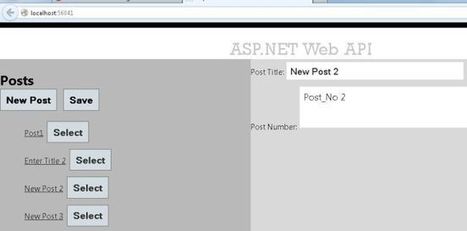
This article shows Databinding and Templating using Knockout in the ASP.NET Web API. In this article we use the Knockout.js file. Knockout contains a JavaScript library and this library helps for creating a responsive display and editor user interface under laying of the data model.

Use the following procedure to create a sample.

Scoop.it!

Introduction to ElasticSearch

Introduction to ElasticSearch | JavaScript for Line of Business Applications | Scoop.it

This blog post is an introduction to some of the basic concepts of using ElasticSearch in a web application. It uses examples and lessons learned from working on the social media tool Engagor over the course of the last two years. 
ElasticSearch is marketed as a flexible and powerful open source, distributed real-time search and analytics engine for the cloud.
The application we’ve developed is mainly built in php, but since this post will detail the HTTP REST interface of ElasticSearch, implementation language is irrelevant. We’ll also touch briefly on a few other, related technologies.
I’m presenting a real use case that showcases most of the main features of ElasticSearch, so please bear with me while I explain a few things about our product and our company.

Jan Hesse's insight:

http://www.slideshare.net/oemebamo/introduction-to-elasticsearch-damndata

http://www.youtube.com/watch?v=jk9QFvT1Gok

No comment yet.
Scoop.it!

Taming asynchronous programming with Harmony

Taming asynchronous programming with Harmony | JavaScript for Line of Business Applications | Scoop.it

Chained is an experiment and a prototype library for Javascript I developed in the past weeks. It is meant to show a concept and to provide some limited but useful functionality. All the examples below are written in Coffeescript (and I guess that this makes me a hippie, right?).

Chained allows to chain functions explicitly — both those that return promises and those who don’t — without using then-based constructs.

No comment yet.
Scoop.it!

Mojo.js - Modular Isomorphic MV+ JavaScript Framework

Mojo.js - Modular Isomorphic MV+ JavaScript Framework | JavaScript for Line of Business Applications | Scoop.it

Mojo.js (alpha) is a JavaScript framework for building Single Page Applications, or static websites in Node.js. It's inspired by Angular.js, Derby.js, Knockout.js, Meteor.js, Ember.js, jQuery, Backbone.js, and many other JavaScript, and non-JavaScript frameworks. Much of the design was inspired by Backbone.js, and Node.js. The core is small, while third-party modules allow you to customize Mojo depending on your requirements. Mojo was built initially to phase out old code, and itself - hence the modularity. The philosophy behind Mojo is to allow you to build on top of your old code base, and slowly strangle out your old application until you have a new, highly maintainable application.

No comment yet.
Scoop.it!

Authentication with Rails, Devise and AngularJS

Authentication with Rails, Devise and AngularJS | JavaScript for Line of Business Applications | Scoop.it

I recently started building a Rails driven web app and decided to use Devise for authentication. This would be pretty straight forward to implement but I planned to use AngularJS to power the front-end and decided to only use Rails as a JSON API.

Getting down to development on that path, I quickly ran into some problems structuring AngularJS to recognize Devise sessions. Thanks to some useful examples on GitHub I was able to get around those issues and get them to play nice. Here’s how...

No comment yet.
Scoop.it!

Functional data structures in JavaScript with Mori

I have a long-standing desire for a JavaScript library that provides good implementations of functional data structures. Recently I found Mori, and I think that it may be just the library that I have been looking for. Mori packages data structures from the Clojure standard library for use in JavaScript code.

A functional data structure (also called a persistent data structure) has two important qualities: it is immutable and it can be updated by creating a copy with modifications (copy-on-write). Creating copies should be nearly as cheap as modifying a comparable mutable data structure in place. This is achieved with structural sharing: pointers to unchanged portions of a structure are shared between copies so that memory need only be allocated for changed portions of the data structure.

No comment yet.
Scoop.it!

jbone - Replacement jQuery for Backbone in browsers

jbone - Replacement jQuery for Backbone in browsers | JavaScript for Line of Business Applications | Scoop.it

JavaScript Library for DOM manipulation in modern browsers with jQuery-compatible API.

Replacement jQuery for Backbone in browsers (2kb gzipped)

No comment yet.
Scoop.it!

Ember Data: Faking a Composite Key

While Ember Data has had its growing pains as a persistance library it’s shaping up quite nicely. I like how the new Beta’s adapter and serializer allow you to customize data coming into and going out of your app on a per-model basis. Particularly when building for a 3rd party API, you really need proper hooks to fine-tune the data exchange with your RESTful backend.

In earlier versions of Ember Data I found myself having to copy/paste/edit sizable chunks of library code into my own custom adapter or serializer. The necessary hooks were not present. This time around, I’m finding hooks in all the right places.

Straight from my project, here’s an example customization I did for the MapFloor model...

No comment yet.
Scoop.it!

An Introduction to Meteor

An Introduction to Meteor | JavaScript for Line of Business Applications | Scoop.it

The goal of this blog post is to give you a brief introduction to Meteor which is a framework for building Single Page Apps. In this blog entry, I provide a walkthrough of building a simple Movie database app.

What is special about Meteor? Meteor has two jaw-dropping features:

* Live HTML

* Latency Compensation


The goal of this blog post was to provide you with a brief walk through of a simple Meteor app. I showed you how you can create a simple Movie Database app which enables you to display a list of movies and create new movies.

I also explained why it is important to remove the Meteor insecure package from a production app. I showed you how to use Meteor Methods to insert data into the database instead of doing it directly from the client.

I’m very impressed with the Meteor framework. The support for Live HTML and Latency Compensation are required features for many real world Single Page Apps but implementing these features by hand is not easy. Meteor makes it easy.


No comment yet.
Scoop.it!

AngularJS for jQuery Developers

AngularJS for jQuery Developers | JavaScript for Line of Business Applications | Scoop.it

AngularJS is a sweet web app framework. It comes with decent official documentation and samples, it looks superior among a large number of frameworks in an almost-real-world application test (the famousTodoMVC project), and there are cool presentations and screencasts about it all over the web.

But for a developer who has not used frameworks similar to Angular before, and has mostly worked withJavaScript libraries like jQuery, there may be some difficulty in shifting from the jQuery mindset to the Angular mindset. At least there was for me, and I’d like to share some notes–maybe this will be useful to someone.

* Not a Library
* Declarative, rather than Imperative
* Two-way Data Binding
* Dependency Injection
* Data Access

No comment yet.
Scoop.it!

Building Confidence in Your Code

Building Confidence in Your Code | JavaScript for Line of Business Applications | Scoop.it

I'm attending HTML5DevConf this week. During this conference, I attended a talk titled " JavaScript Insights " provided by Ariya Hidayat  of Sencha (a front-end component library provider) and Ann Robson of Yammer (an enterprise social network).

Their discussion was centered around how their two very different approaches to developing front-end software in JavaScript really had a centrifugal component of quality and confidence for their code being released into production.

They defined three (3) main topics which I had to share with our internal teams and I thought I'd share them with our Code@ community.

* Code Structure Validations

* Test Coverage of the Code

* Code Complexity Valuations

No comment yet.
Scoop.it!

inputEx - a field framework for web applications based on YUI3

inputEx - a field framework for web applications based on YUI3 | JavaScript for Line of Business Applications | Scoop.it

inputEx is an open-source javascript framework to build fields and forms for web applications using the YUI3 library.

All the fields and forms are configured using JSON or created in Javascript. It provides a very efficient abstraction for building interactive web applications.
No comment yet.
Scoop.it!

ECMAScript 6 modules in future browsers

ECMAScript 6 modules in future browsers | JavaScript for Line of Business Applications | Scoop.it

This an introduction to ECMAScript 6 modules and how they can be used in current browsers. In contrast, this blog post explains how future browsers will support them natively. As part of that support, we will get the <module> tag, a much better version of the <script> tag.

The main advantages of ECMAScript 6 modules compared to current module systems are: Their syntax is more elegant (than even Node.js modules), they work both synchronously and asynchronously (without an extra compilation step), and they unify the JavaScript module landscape.

No comment yet.
Scoop.it!

Treema - jQuery plugin that generates HTML interfaces to edit JSON data

Treema - jQuery plugin that generates HTML interfaces to edit JSON data | JavaScript for Line of Business Applications | Scoop.it

Treema is a jQuery plugin that builds interfaces for editing large, complex, well-defined JSON data. It runs on tv4, which implementsJSON-Schema validation.

No comment yet.
Scoop.it!

Marking your Ember.js links as active

Marking your Ember.js links as active | JavaScript for Line of Business Applications | Scoop.it

Ember.js is a client-side application framework. One of its core principles is that the URL should drive the design of the application. Consequently, the router and helpers related to routing have a very rich API.

In this article, I’m going to show how Ember creates markup for links that can be used to indicate whether they are active.

No comment yet.
Scoop.it!

Programming in the Reactive Style with Meteor JS

Meteor allows you to quickly create new web applications. Using a single code base for the client and the server, no-sql mongo, template-oriented UX organization and painless deployment, designing and developing with Meteor is fun. But the real game changer is Reactivity. 

Reactivity is made up of two parts – data sources and computations. When you build a page, Meteor remembers the computations that use reactive data sources. Then, when a data in a reactive source changes, the computations that depend on the data are invalidated and re-run – which can re-render the affected parts of your application. The true beauty of it is that it’s all automatic. You don’t need to write any code to watch for changes – Meteor does all that for you. 

Learning to build web applications in the Reactive Style gives you more time to concentrate on UX than traditional web development. Being able to side-step much of the application setup and data management frees you to focus on providing a pleasurable experience as well as useful functionality.

No comment yet.
Scoop.it!

The Meteoric experience- My experience with Meteor.js

Meteor.js is the new kid in the town, but don't consider it as some less powerful. Here are some reasons why

* Meteor.js is the only open source project that has been funded by a whooping $11 million ,so their developers have some more time to focus on their real work

* Meteor.js uses one language, only javascript both on the client and server and after ruby on rails and django javascript on node.js is considered to be the next big developer's help in making web application easely.

* And there is a difference between website and a web application as in ancient years(In the world of web anything is ancient if above 5 years as its one of the fastest changing things) there was a thick server(all business logic was on the server side) an a thin client while now in webapps there is a thick client( as most of us are using some great web browsers -like chrome,safari,firefox so more application logic is put on the client side than the server . Some great examples of website like these are -Trello and Medium.The ease of use on adapting to this methology canbe easily seen .The user experience is just astounding.

* Meteor.js is great for front-end developers as it uses mongo.db on the server and minimongo on the client(yes a database on the client) and their is a complete synchronization between the client and the server, so any change in the database on the server or the client is immediately reflected on the server and beleive me its my personal experience that it makes developing reactive web application just a breeze.

No comment yet.
Scoop.it!

Functional Reactive Programming in JavaScript

Streams can be assigned to variables, shared, and used as inputs to create more specific streams. In the example above inputs is used to create two more streams: one that limits the stream so that events are emitted at most every 500 ms and another that takes the throttled stream and drops duplicate values that appear consecutively. So when the final stream, distinct, is consumed later it is guaranteed that events 1) will be non-empty strings with length greater than two, 2) will not occur too frequently, and 3) will not include duplicates.

That stream can be fed through a service via ajax calls to show a live list of results...

No comment yet.
Scoop.it!

Mobile Ember - Performance

Using Ember.js for creating native-like mobile apps

VIEW LAYER PERFORMANCE
* Screaming Crowd
* Views all the way down
* Stay in the Run Loop
* Forcing Reflows

No comment yet.
Scoop.it!

Understanding the "this" keyword in JavaScript

Understanding the "this" keyword in JavaScript | JavaScript for Line of Business Applications | Scoop.it

Many people get tripped up by the this keyword in JavaScript. I think the confusion comes from people reasonably expecting this to work like “this” does in Java or the way people use “self” in Python. Although this is sometimes used to similar effect, it’s nothing like “this” in Java or other languages. And while it’s a little harder to understand, its behavior isn’t magic. In fact, this follows a relatively small set of simple rules. This post is an explanation of those rules.

But first, I want to give some terminology and information about JavaScript runtime environments which will hopefully help you develop a mental model to better understand this.[1]

No comment yet.
Scoop.it!

Validations with Ember.js

Validations with Ember.js | JavaScript for Line of Business Applications | Scoop.it

These days, with the rise of the single page applications, there has been a steady rise in the number of complete websites that are built on a client side JavaScript framework.
At any given point of time, these sites have always had the need for validations that they need to run client side.

Recently, while working on a pet-project using Ember.js as the client side framework and jQuery for running my client side validations, I came across a rather interesting question.
How would you handle client side validations with a framework such as Ember.js? 

The confusion…

The validations are run on the actual fields, which are the part of the view, but they are triggered and handled in an event handled by the controller. So where do the validations go?

No comment yet.
Scoop.it!

Web Design and Development

Web Design and Development | JavaScript for Line of Business Applications | Scoop.it
Topics for web, mobile design and development.

Really well fed Blog with a Collection on free Tutorials and News Panels for the Front-End Developer.

Jan Hesse's insight:

discovered it and found a lot of value in it

No comment yet.
Scoop.it!

Intro to the React Framework

Intro to the React Framework | JavaScript for Line of Business Applications | Scoop.it

In today’s world of Javascript Application frameworks, design philosophy is the key differentiating factor. If you compare the popular JS frameworks, such as EmberJS, AngularJS, Backbone, Knockout, etc. you are sure to find differences in their abstractions, thinking models, and of course the terminology. This is a direct consequence of the underlying design philosophy. But, in principle, they all do one thing, which is to abstract out the DOM in such a way that you don’t deal directly with HTML Elements.

I personally think that a framework becomes interesting when it provides a set of abstractions that enable a different mode of thinking. In this aspect, react, the new JS framework from the folks at Facebook, will force you to rethink (to some extent) how you decompose the UI and interactions of your application. Having reached version 0.4.1 (as of this writing), React provides a surprisingly simple, yet effective model for building JS apps that mixes a delightful cocktail of a different kind.

In this article, we’ll explore the building blocks of React and embrace a style of thinking that may seem counter-intuitive on the first go. But, as the React docs say: “Give it Five Minutes” and then you will see how this approach will become more natural.

No comment yet.