JavaScript for Line of Business Applications
606.6K views | +4 today
JavaScript for Line of Business Applications
Keeping track of current JavaScript Frameworks that help design your clientside Business Logic Layers.
Curated by Jan Hesse
Beam to my Inbox:
Your new post is loading...

Popular Tags - Filter using the Funnel

Scoop.it!

Make your own computed property macro in Ember.js

The most common way to define computed properties (CPs) in Ember.js apps is to call the property function extension, passing in the “dependent keys”, the path patterns that should trigger the recomputation of the property’s value.

We need a repeatable way to create such computed properties that also eliminates the risk of misspelling the property name.

No comment yet.
Scoop.it!

Json Web Tokens: Examples

Imagine a web app. You browse it and you decide you want to register yourself. Then you put your credentials on a login form. The web page will send you a token via JSON. What can you do with that token? In that concrete app, you can access your user profile, your messages or even add new friends.

The same fact applies: You can access your profile but not others profiles (Imagining they are private) and you can’t certainly remove friends from your partner account :P

Now that we have an idea of how JWT works, let’s see it from a more technique perspective.

A JWToken is self-contained, so when we create one, it will have all the necessary pieces needed inside of it. What are those pieces? A token is divided in 3 parts:

  • A header
  • A payload
  • A signature
No comment yet.
Scoop.it!

Building User Interfaces with React

Building User Interfaces with React | JavaScript for Line of Business Applications | Scoop.it

React is delightfully simple (contrasted with Angular, which is a nightmare for beginners, and Backbone, which is relatively simple but still has several core concepts). It's built around one idea: the Component, which is merely a reusable unit of UI. React was designed from the ground-up to be composable—Components are composed of other Components.Everything in the DOM is a Component, so your UI consists of a hierarchy of them.

No comment yet.
Scoop.it!

remoteStorage - An open protocol for per-user storage

remoteStorage - An open protocol for per-user storage | JavaScript for Line of Business Applications | Scoop.it

An open protocol for per-user storage.

Use the same data across different apps. Create a to-do list in one app, and track the time on your tasks in another one. Say goodbye to data silos.

Offline support is built into remoteStorage.js by default. Use your apps offline on the go, and automatically sync when you're back online.


remoteStorage.js is a JavaScript library that does all the heavy-lifting of connecting to any remoteStorage backend, caching, synchronizing and storing user data.

Jan Hesse's insight:

http://remotestorage.io/

https://unhosted.org/adventures/7/Adding-remote-storage-to-unhosted-web-apps.html

No comment yet.
Scoop.it!

Reusing require.js modules in Node.js

Reusing require.js modules in Node.js | JavaScript for Line of Business Applications | Scoop.it
A tutorial on how to reuse require.js AMD modules directly in Node.js at the same time as using the standard Node's modules using AMDrequire library.
No comment yet.
Scoop.it!

LoopBack - Open-source API Server Powered by Node.js

LoopBack - Open-source API Server Powered by Node.js | JavaScript for Line of Business Applications | Scoop.it

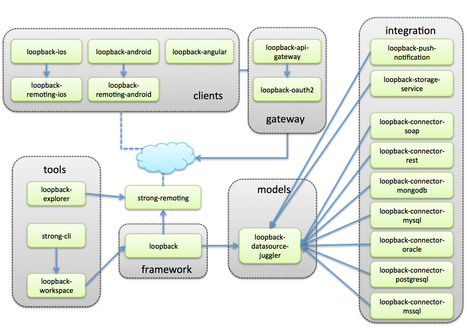
LoopBack is an open source Node.js framework built on top of Express optimized for mobile, web, and other devices. Connect to multiple data sources, write business logic in Node.js, glue on top of your existing services and data, connect using JS, iOS & Android SDKs.

Jan Hesse's insight:

https://github.com/strongloop/loopback

No comment yet.
Scoop.it!

Single-Page-Application & REST security

Authentication

* How protect REST services

* API-Key

* Secret-key

* Signature

* Nonce, non-repuduation

* OAuth1 vs OAuth2


Authorization

* Profiles

* Stateless vs stateful

* HATEOAS

* Atom/RSS

No comment yet.
Scoop.it!

React Router

React Router | JavaScript for Line of Business Applications | Scoop.it

Ember.js nailed the router. This library is generally a translation of the ember routing API for React. All praise be to Yehuda Katz, Tom Dale, and the Ember community for nailing down such a beautiful interface. May the web be unbroken regardless of your tools.

* Incredible screen-creation productivity

* Immediate understanding of application structure

* Code tractability

* URLs are your first thought, not an after-thought

Jan Hesse's insight:

This is a huge work in progress. Don't use it yet.

No comment yet.
Scoop.it!

Why I stopped using ng-grid and rolled my own with ReactJS

Why I stopped using ng-grid and rolled my own with ReactJS | JavaScript for Line of Business Applications | Scoop.it

I get that ng-grid is based off SlickGrid and uses virtualization to not render the full data set, but I am not sure this works well with Angular and the performance issues you run into when you have 2000+ bindings on the page.

I knew I could not be happy with this project until I fixed this problem. I tried a lot things with ng-grid, using bindonce, and other suggestions but the performance gain would usually create a bug in one of the grids where I was expecting the bindings to work as usual.

At the time, I thought to myself that I should switch to ng-table. But I had written so much code already that the ng-table seemed too expensive.

That's when I decided to create a proof of concept with one of the bigger grids and render it with ReactJS.

I created an AngularJS directive called reactGrid, and tried to support ng-grid's api as much as possible (with some minor changes).

Jan Hesse's insight:

http://josebalius.github.io/ngReactGrid/

No comment yet.
Scoop.it!

Building Your Own Ember App Kit Lite

Building Your Own Ember App Kit Lite | JavaScript for Line of Business Applications | Scoop.it

Last year Stefan Penner launched Ember App Kit as an experimental project to help the community build a common foundation for ambitious projects built with ember.js. I loved the concept and personally couldn't thank Stef and the community enough for paving the way forward with this amazing project.

With that said, I didn't adopt it for any personal projects because I never fully understood how it all worked. In particular, the Gruntfile itself seemed like the most complex configuration file I'd ever seen. But to be clear, I can still appreciate the work and experience that went into building that file.

And because I found this project extremely helpful, I decided the community would benefit from a fresh step-by-step blog series showing how to build up a Gruntfile like this from scratch. I hope to give others some insight into each decision that is made along the way.


Content:

Part 1 - Introduction
Part 2 - Concatenation (introducing Grunt)
Part 3 - Handlebars template precompilation
Part 4 - ES6 modules
Part 5 - JSHint
Part 6 - Watch + Live Reload
Part 7 - Testem
Part 8 - Deployment

Jan Hesse's insight:

http://toranbillups.com/blog/archive/2014/04/06/Building-your-own-ember-app-kit-lite/

No comment yet.
Scoop.it!

Adding Even More Fun to Functional Programming With RXJS

Adding Even More Fun to Functional Programming With RXJS | JavaScript for Line of Business Applications | Scoop.it

With the rise in popularity of functional programming lately new ways of writing concise and expressive code have emerged. Reactive JavaScript (RXJS) is one of these and takes functional programming a step further by turning events and asynchronous calls into compostable data streams. Focusing on how we use RXJS at Netflix, this session will show attendees how to use the 5 pillars of Functional programming: map, mergeAll, filter, reduce, and zip and how they are superior to their imperative counterparts. Attendees will then learn how to use Observable objects to put the “reactive” into their functional code to write code that will react to asynchronous calls and events using the RXJS library.

No comment yet.
Scoop.it!

Transforming WebSockets

An introduction to WebSockets and why Primus might be a better fit for your project.

Jan Hesse's insight:

http://primus.io

No comment yet.
Scoop.it!

Ionic Restify MongoDB - An End to End Hybrid App

Ionic Restify MongoDB - An End to End Hybrid App | JavaScript for Line of Business Applications | Scoop.it

In this post, we are going to build an End to End Hybrid App, that has a server component and a client component. Our server will be built on top of Node js, with Restify as the server side framework and MongoDB as the data persistence layer. Our Client is a Hybrid App, built with Ionic framework. We then are going to deploy the Ionic app using PhoneGap Build service to generate a Native installer.

The App we are going to build is a Bucket List app. Here a user can register and login. Then s/he can create a few bucket list items. Which would eventually result in

No comment yet.
Scoop.it!

Fixture Adapters - Ember.js With No Server

Fixture Adapters - Ember.js With No Server | JavaScript for Line of Business Applications | Scoop.it

Fixture adapters allow you to mock any possible calls to a server with locally stored dummy data. Once development is complete, you can swap out the fixtures, enabling your application to make calls to a server for real data. In this tutorial, we will be building a sample blog application that shows off Ember’s fixture adapters.

No comment yet.
Scoop.it!

The Frustratingly Lovable Crazy-making Huggable Ball of Whack That Is Ember.js

The Frustratingly Lovable Crazy-making Huggable Ball of Whack That Is Ember.js | JavaScript for Line of Business Applications | Scoop.it

I like Ember, but with some reservations - my own personal weirdness reservations that I'll go into in a bit. I finally "got it" and it took some doing. Maybe my brain's slowing down or I've been doing this stuff for too long but my brain just doesn't work the way Ember wanted it to.

After a few key insights, however, the light went on and it was all downhill after that. Once that happened I was completely stunned by what I could do with Ember, and how fast I could do it.

Here are those insights, if you need them.

No comment yet.
Scoop.it!

Using Make with React and RequireJS

However, if you're using RequireJS and opt to defer JSX compilation to the browser, you'll have problems loading your JSX modules since they aren't valid JavaScript. Fortunately, there are RequireJS plugins to work around this, such as require-jsx.

The other option, as I hinted at, is to precompile your JSX. This offloads the JSX transformation and allows Require's optimizer to minify your entire client. React has a set of complementary tools, aptly named react-tools, which includes a command-line utility for performing this compilation.

No comment yet.
Scoop.it!

Stop Making Excuses and Start Testing Your JavaScript

Talk from HTML5DevConf about JavaScript unit testing.
No comment yet.
Scoop.it!

How do I "think in AngularJS" if I have a jQuery background?

How do I "think in AngularJS" if I have a jQuery background? | JavaScript for Line of Business Applications | Scoop.it

Suppose I'm familiar with developing client-side applications in jQuery, but now I'd like to start using AngularJS. Can you describe the paradigm shift that is necessary ? Here are a few questions that might help you frame an answer:

* How do I architect and design client-side web applications differently? * What is the biggest difference?
* What should I stop doing/using; what should I start doing/using instead?
* Are there any server-side considerations/restrictions?

No comment yet.
Scoop.it!

Meteor vs Angular

Meteor vs Angular | JavaScript for Line of Business Applications | Scoop.it

Comparing Meteor and Angular is a bit difficult since the two are actually very different at the moment, other than they are both written in javascript. Meteor is a full stack framework/platform that runs on top of Node.js on the server. Angular is a client only framework, running only in the browser. Both are awesome, so I will try to provide a very high-level look at each, when I’ve used each, and what really stands out about each.

No comment yet.
Scoop.it!

Introducing Ramda

Introducing Ramda | JavaScript for Line of Business Applications | Scoop.it

Ramda: “a practical functional library for Javascript programmers.” 

There are already some excellent libraries with a functional flavor, such as Underscore and Lodash. Ramda includes all of the favorite list-manipulation functions you expect, e.g. map, filter, reduce, find, etc. But Ramda is significantly different from libraries like Underscore and Lodash. The primary distinguishing features of Ramda are:

* Ramda takes the function first, and the data last.

* Ramda methods are automatically curried.

Jan Hesse's insight:

https://rawgit.com/CrossEye/ramda/master/docs/ramda.html

No comment yet.
Scoop.it!

Defining AngularJS Routing in an ASP.NET MVC application

Defining AngularJS Routing in an ASP.NET MVC application | JavaScript for Line of Business Applications | Scoop.it

In this article, we will explore Routing in AngularJS as well as how to make Angular Directives self-contained.

If you are familiar with MVC routing, you are wondering, err… routing is a server side thing, how does it matter to a client side framework. Well you are not alone, even I had the same thoughts when I heard of Routing in JS frameworks. But as you will see, routing is real and it works rather nicely on Angular JS.

So far the application consists of one view with a single ng-controller. As a next step, we would like to implement a details view of the Tweet that will show us more information and if there are any embedded images, show the image as well.


We built a Twitter reader over the course of the article, highlighting how well AngularJS was suited to interact with HTTP APIs. Combined with its routing capabilities, AngularJS provides a nice platform for the category of web applications that is now termed as SPAs or Single Page Applications.

No comment yet.
Scoop.it!

RFID-based Asset Tracking with Node.js and MongoDB

RFID-based Asset Tracking with Node.js and MongoDB | JavaScript for Line of Business Applications | Scoop.it

As the title states, we are going to discuss how to build an RFID-based asset tracking system using popular open source tools like Node.js and MongoDB. For the sake of simplicity, let’s start with a very basic model of a system addressing only a general concern of getting some information from RFID hardware and putting it in the database. Of course, in real life we would have to think about many details and additional components to take into account security, bandwidth consumption, monitoring, etc., but let us forget about it all for now and get back to these aspects in our future posts.

No comment yet.
Scoop.it!

react-gulp-example

react-gulp-example | JavaScript for Line of Business Applications | Scoop.it

a simple react web app using gulp along side karma/mocha/chai

No comment yet.
Scoop.it!

Flux in practice - A guide to building UIs with React

Flux in practice - A guide to building UIs with React | JavaScript for Line of Business Applications | Scoop.it

In my previous post, I extolled the virtues of Flux, echoing many of the points given by the Facebook engineers in their excellent F8 talk on the topic. It amounted to a high-level overview of what you might expect to find in Flux-style application, but not much more than that.

So, what does it actually mean to write an application in the Flux way? At that moment of inspiration, when faced with an empty text editor, how should you begin?

No comment yet.
Scoop.it!

Protractor for AngularJS: writing end-to-end tests has never been so fun

Protractor for AngularJS: writing end-to-end tests has never been so fun | JavaScript for Line of Business Applications | Scoop.it
A step-by-step presentaion on Protractor End-to-End Testing for AngularJS

* Write your tests using Jasmine and WebdriverJS

* Searching for elements on the page

* Executing events

* Maintanable Tests - Best practices to organize your tests

* Bonus

No comment yet.