JavaScript for Line of Business Applications
606.5K views | +15 today
JavaScript for Line of Business Applications
Keeping track of current JavaScript Frameworks that help design your clientside Business Logic Layers.
Curated by Jan Hesse
Beam to my Inbox:
Your new post is loading...

Popular Tags - Filter using the Funnel

Scoop.it!

Intravenous - lightweight inversion of control container for Javascript

With Intravenous you create a container and tell this container which services are available in your system. Then, when you have a class that wants to use these services you simply list them as dependencies. You tell the container to create an instance of your class and all dependencies will be automatically resolved (even if your depedencies have dependencies of their own).

No comment yet.
Scoop.it!

Angular and Polymer Data Binding, Together!

Angular and Polymer Data Binding, Together! | JavaScript for Line of Business Applications | Scoop.it

This post shows you how to connect Angular-controlled components to Polymer-controlled elements via data binding. And we do it all in Dart.

Polymer excels at creating encapsulated custom elements. You can use those custom elements in any web app or web page, regardless if that app is built with Angular, Ember, etc. Angular excels at application engineering, with dependency injection, end-to-end testability, routing, and services.

No comment yet.
Scoop.it!

AngularJS with Browserify

AngularJS with Browserify | JavaScript for Line of Business Applications | Scoop.it

WHAT
Browserify is and does
WHY
Using it is a good thing
HOW
Your AngularJS code will benefit

No comment yet.
Scoop.it!

Responsive Web Design Tutorial - CSS3 rem unit

Using CSS3 "rem" Units for "Elastic Pixels"

No comment yet.
Scoop.it!

AngularJS End to End testing with Protractor

This is the first episode in a revised series of videos about using Protractor to perform end to end test for AngularJS applications.

This episode covers what Protractor is and how to install it into your application. It also provides a simple hello world style demo showing how to configure a project to use protractor and phantomjs to write end to end tests.

No comment yet.
Scoop.it!

ASP.NET Boilerplate

ASP.NET Boilerplate | JavaScript for Line of Business Applications | Scoop.it

ASP.NET Boilerplate is a starting point for new modern web applications using best practices and most popular tools. It's aimed to be a solid model, a general-purpose application framework and a project template.

*  includes most used framework and libraries by default. Also allows you to choice Single-Page (Angularjs or Durandaljs) or Multi-Page architecture, EntityFramework or NHibernate as ORM.

* implements NLayer architecture(Domain, Application, Infrastructure and Presentation Layers) and Domain Driven Design (Entities, Repositories, Domain/Application Services, DTO's...). Also implements and provides a good infrastructure to implement best practices such as Dependency Injection.

Jan Hesse's insight:

http://www.codeproject.com/Articles/768664/Introduction-to-ASP-NET-Boilerplate

No comment yet.
Scoop.it!

Mocking a REST backend for your AngularJS / Grunt web application

Mocking a REST backend for your AngularJS / Grunt web application | JavaScript for Line of Business Applications | Scoop.it

or a single-page application, build with a framework such as AngularJS, that gets all it's data from a REST backend this means you should verify your front-end against different responses from your backend. For a small application with primarily GET requests to display data, you might get away with testing against your real (development) backend. But for large and complex applications, you need to mock your backend.

In this post I'll go in to detail how you can solve this by mocking GET requests for an AngularJS web application that's built using Grunt.

No comment yet.
Scoop.it!

Bringing together Docker, Grunt, Maven, EmberJS & MongoDB

Bringing together Docker, Grunt, Maven, EmberJS & MongoDB | JavaScript for Line of Business Applications | Scoop.it

Abstract : Will it work? ... How can I be sure? ... Am I forgetting something? ... questions that pile up slowly and ruin our confidence once we cannot clearly answer them. For reasons like these we write tests - to be confident, to be certain, to sleep better. Yet, writing tests is one part of the problem. Getting them executed in an environment close to the production one is another . ... and so, more questions pile up : How do we keep a snapshot of our production environment for testing purposes? What if our app needs to run in different environments? Can we keep multiple virtual environment snapshots? How many? Can we have test parallelization? Is the sandboxing guaranteed? and so on, and so on ...

In this post, we are going to take a look at orchestrating Maven, Grunt & Docker to provide the basis for setting up integration tests.

No comment yet.
Scoop.it!

free eBook: Human JavaScript - Build powerfully simple browser apps

free eBook: Human JavaScript -  Build powerfully simple browser apps | JavaScript for Line of Business Applications | Scoop.it

When most people say they're building a "web app" they're talking about writing source code that describes an application that will run on the server and send rendered HTML to the browser. This definition seems a bit narrow and limiting. Plus, when I think of my favorite web apps they don't fit neatly into that box. The best web apps often have multiple interfaces and clients, some native, some web. Most play nicely with or completely integrate with other services. Generally web apps are good at solving some specific problem or provide some specific benefit and use the web to tie it all together.

No comment yet.
Scoop.it!

Structured Page Fragments: navigation and page updates from YouTube

Structured Page Fragments: navigation and page updates from YouTube | JavaScript for Line of Business Applications | Scoop.it

Structured Page Fragments — or SPF for short — is a lightweight framework that handles navigation and updates of page sections. Using progressive enhancement and HTML5, SPF seamlessly updates pages with server-side rendering. Only document fragments are sent, and corresponding page sections are asynchronously updated when received.

No comment yet.
Scoop.it!

ExtJS: a dream or a nightmare?

ExtJS: a dream or a nightmare? | JavaScript for Line of Business Applications | Scoop.it

In a nutshell, ExtJS is an insanely powerful framework that makes fancy stuff easy to achieve. It takes time to learn (and I bet a more senior developer would pick it up much faster than I did), but once you bridged the learning curve you have a lot of power at your fingertips.

Despite being a big proponent of ExtJS for the reasons mentioned earlier, over time I have become more frustrated with the cons of the framework that I believe are doing serious harm to community involvement in Revolution. Learning ExtJS has been a great business decision (it made up probably a good 85% of my freelance work), but as I'm a big community fan I'd rather see something a bit more.. approachable.

No comment yet.
Scoop.it!

Sharing Polymer Components: Part 2

Sharing Polymer Components: Part 2 | JavaScript for Line of Business Applications | Scoop.it

Learn how to auto-generate documentation and setup GitHub distribution using Bower, in this second part on sharing Polymer components.

In the following tutorial, I'll dig deeper into what untitled-element includes, like its auto-generating documentation feature and how to setup your component to be distributed via Bower. We'll continue using the Reddit component code that I created in my first Polymer tutorial as well.

No comment yet.
Scoop.it!

Desktop apps with node webkit

This is a talk I gave at LNUG June 2014 about building desktop applications with Node Webkit
No comment yet.
Scoop.it!

Trimming Down jQuery With Grunt

Trimming Down jQuery With Grunt | JavaScript for Line of Business Applications | Scoop.it

In the past several releases, the jQuery team has reorganized their file structure to make the blacklisting process more effective, by placing less common pieces of functionality in their own files. In this article we’ll look at how to blacklist jQuery modules, which modules you should remove, and how to automate the whole thing.

No comment yet.
Scoop.it!

Journey into Meteor's Reactivity

Journey into Meteor's Reactivity | JavaScript for Line of Business Applications | Scoop.it

Meteor is a full-stack JavaScript framework. It runs on both the client and the server. The client communicates with the server using a protocol called DDP.

As I said before, some people think Meteor generates codes on the fly or does some magic behind the scenes. But it does not. It’s a combination of carefully crafted technologies built into a single framework. It’s extensible and very easy to use.

No comment yet.
Scoop.it!

Scaffolding AngularJS SPA(s)

Scaffolding AngularJS SPA(s) | JavaScript for Line of Business Applications | Scoop.it

While working on many Web SPA projects, I frequently need to present concepts and rationalizations on SPA scaffolding considerations.


Typical Questions:

  • What client tools should I use ?
  • What is NPM and Bower ? And why should I use both ?
  • How should I structure my code to scale ?
  • Why would I need/want a NodeJS server ?


Slide topics:

  • Full-Stack and development tools such as NPM, Bower, Grunt
  • SPA source code packaging
  • Present a middle-tier, NodeJS app-server solution with custom routing.
No comment yet.
Scoop.it!

Starting a new Ember.js application

This video is part of a Screencast series made to help you get started with Ember.js. This screencast starts from a new empty directory and ends up with a simple Hello-world type application with text into both the application and index templates. 

No comment yet.
Scoop.it!

AngularJS & SEO - finally a piece of cake

The TL:DR quintessence is, be a hero and build the html-snapshot-and-rerouting stuff yourself, for example with angular and PhantomJS, like it's lined out in the nice yearofmoo article. Or, go somewhere and pay for it. To be fair, there are some well lay out service providers for this and the whole technique still has its right to exist.

No comment yet.
Scoop.it!

AngularJS's Controller As and the vm Variable

AngularJS's Controller As and the vm Variable | JavaScript for Line of Business Applications | Scoop.it

The great thing about coding is that we are able to mix coding style and personal/team preference together. This post is all about a preference of mine that has helped me stick to be principles of readable, efficient, and maintainable code with AngularJS.

No comment yet.
Scoop.it!

Generic HTTP Error Handling in AngularJS

Generic HTTP Error Handling in AngularJS | JavaScript for Line of Business Applications | Scoop.it

Lately during development at one of our clients, Ravello Systems, we decided we wanted better HTTP error handling.

Basically, our perfect solution would have generic handlers for errors, and most calls in the code will not have to do any special work for handling errors. This means that things like authentication problems, server unavailability issues, etc. will be handled in one place — like adding a generic “something went wrong” modal.

But, we also wanted to be able to easily override these default handlers so that specific places can do things like silently ignore errors of unimportant calls (e.g. background requests that aren’t user-facing), or display a special “try again later” context—aware message.

This is a case study of how we currently implemented this. I’m sharing this for others that might need it and in hopes to hear of alternative ways to accomplish it.

No comment yet.
Scoop.it!

Flatiron, A framework for Node.js

Flatiron, A framework for Node.js | JavaScript for Line of Business Applications | Scoop.it

flatiron is an adaptable framework for building modern web applications. It was built from the ground up for use with Javascript and Node.js.

ild a collection of decoupled, unobtrusive tools that can operate as well in unison as they do independently. Promote code organization and sustainability by clearly separating development concerns.

No comment yet.
Scoop.it!

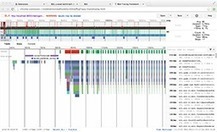
tracing-framework by Google

tracing-framework by Google | JavaScript for Line of Business Applications | Scoop.it

Rich tools for instrumenting, analyzing, and visualizing web apps.
Make your app jank-free at 60fps!

Squeeze every drop of performance out of your code.

No comment yet.
Scoop.it!

Using Polymer to Create Web Components

Using Polymer to Create Web Components | JavaScript for Line of Business Applications | Scoop.it

Web Components aim to solve some of these complexities by providing a unified way to create new elements that encompass rich functionality without the need for all the extra libraries. Web components are comprised of four different specifications (Custom Elements, Templates, Shadow DOM and HTML imports) which are being fleshed out in the W3C.

To bridge the gap and give developers access to this rich functionality now, Google has created the Polymer library which serves as a set of polyfills to bring the promise of Web Components to you today. Let's dive a little deeper into.

What this library can do, is allow us to create reusable components that work as true DOM elements while helping to minimize our reliance on JavaScript to do complex DOM manipulation to render rich UI results.

No comment yet.
Scoop.it!

Single Page ToDo Application With Backbone.js

Single Page ToDo Application With Backbone.js | JavaScript for Line of Business Applications | Scoop.it

Backbone.js is a JavaScript framework for building flexible web applications. It comes with Models, Collections, Views, Events, Router and a few other great features. In this article we will develop a simple ToDo application which supports adding, editing, and removing tasks. We should also be able to mark a task as done and archive it. In order to keep this post's length reasonable, we will not include any communication with a database. All the data will be kept on the client-side.

No comment yet.
Scoop.it!

Composing Discrete Events with RxJS

Composing Discrete Events with RxJS | JavaScript for Line of Business Applications | Scoop.it

DOM events are very rich but badly composable. If we need a discrete conceptual move event, it would demand subscription to 3 DOM events: mousedown, mousemove, and mouseup.

RxJS implements the concepts of reactive programming. The main idea (in a nutshell) is working with streams using LINQ operators and schedulers. It has insane amount of methods that can be applied. 

No comment yet.