JavaScript for Line of Business Applications
606.5K views | +11 today
JavaScript for Line of Business Applications
Keeping track of current JavaScript Frameworks that help design your clientside Business Logic Layers.
Curated by Jan Hesse
Beam to my Inbox:
Your new post is loading...

Popular Tags - Filter using the Funnel

Scoop.it!

Routie | Javascript hash router

Routie | Javascript hash router | JavaScript for Line of Business Applications | Scoop.it

Routie is a javascript hash routing library. It is designed for scenarios when push state is not an option (IE8 support, static/Github pages, Phonegap, simple sites, etc). It is very tiny (800 bytes gzipped), and should be able to handle all your routing needs.

No comment yet.
Scoop.it!

What you should know about JavaScript regular expressions

What you should know about JavaScript regular expressions | JavaScript for Line of Business Applications | Scoop.it

Regular expressions in JavaScript may not always be intuitive. I aim to provide some clarity by providing examples about things I have found myself getting stuck on. This post covers a few topics including state in regular expressions, regular expression performance and various things that have tripped me up.

No comment yet.
Scoop.it!

99 Reasons for Using Ember.js

99 Reasons for Using Ember.js | JavaScript for Line of Business Applications | Scoop.it

A presentation on the Ember.js Framework

Part 1: The Library

Part 2: The Ecosystem

Part 3: The Philosophy Behind

Part 4: The Community

No comment yet.
Scoop.it!

Lazy loading AngularJS components using Providers

Lazy loading AngularJS components using Providers | JavaScript for Line of Business Applications | Scoop.it

In most of the example applications that I've seen, all application script files are loaded upfront i.e. all JavaScript files are loaded when the user accesses application. I get annoyed by this approach; why should all the components be loaded upfront when the probability of user accessing the entire application is very less. How does one architect a multi-page application using Angular? What would be the size of the application after minifying all the JavaScript files. Most importantly how does one load the components lazily. I've used RequireJS in my previous projects and it allows you to load components on demand; the idea is to load components based on the selected route. I've tried a similar approach with Angular using 'resolve' property in the $routeProvider.

No comment yet.
Scoop.it!

Is Protractor Easier Than Selenium?

Is Protractor Easier Than Selenium? | JavaScript for Line of Business Applications | Scoop.it

In this blog post I plan to give you a taste of why you’d benefit from using Protractor for your JavaScript tests instead of using Selenium webdriver directly, even if your app has nothing to do with AngularJS.

If you peek inside Protractor you’ll see the good old Selenium Web Driver (aka WebDriverJS aka selenium-webdriver).

Protractor is essentially a wrapper for the JavaScript Selenium webdriver. Therefore – you get all the capabilities of the webdriver – along with a number of very useful additions.

No comment yet.
Scoop.it!

Node-Webkit #1: Complete CheatSheet

Node-Webkit #1: Complete CheatSheet | JavaScript for Line of Business Applications | Scoop.it

node-webkit is an app runtime based on Chromium and node.js. You can write native apps in HTML and JavaScript with node-webkit. It also lets you call Node.js modules directly from the DOM and enables a new way of writing native applications with all Web technologies.

No comment yet.
Scoop.it!

node-webkit and Firebase - Simple and Social Authentication

node-webkit and Firebase - Simple and Social Authentication | JavaScript for Line of Business Applications | Scoop.it

In this post, we will take a look at the Integration between Firebase Simple Authentication and node-webkit. We are going to use slush generators to scaffold basic apps for us. Then we will create and configure a Firebase account to manage Simple Authentication i.e. Email and Password and Social Authentication using Twitter, Google and Facebook services.

No comment yet.
Scoop.it!

A smart way to fit SignalR with AngularJS

A smart way to fit SignalR with AngularJS | JavaScript for Line of Business Applications | Scoop.it
Fine, I hope you all you have more or less knowledge of both and you want to see how they fit together side by side?  
Ok, then you are in right place. We will implement SinglaR hub and then we will implement client hub factory using AngularJS and then we will consume server hub from controller. So, in nutshell, we will take help of AngularJS to create SignalR proxy and to call hub method using the proxy.
No comment yet.
Scoop.it!

Creating and testing Meteor applications with BDD using Velocity and Jasmine

Creating and testing Meteor applications with BDD using Velocity and Jasmine | JavaScript for Line of Business Applications | Scoop.it
In this tutorial, I would like to present how to safely develop Meteor application using Behaviour Driven Development (BDD), using the new Velocity framework and Jasmine test suite. This tutorial a...
No comment yet.
Scoop.it!

Meteor Beginner Tutorial

Meteor Beginner Tutorial | JavaScript for Line of Business Applications | Scoop.it

I’ve been talking a lot about how Meteor is awesome. I wrote some posts and you could read about it here: Why Beginners Should Start With Meteor and Reasons 4 Meteor. Now that I’ve been advocating you to try Meteor, let us build a Grocery List app.

No comment yet.
Scoop.it!

Hextris - open source game

Hextris - open source game | JavaScript for Line of Business Applications | Scoop.it

The goal of Hextris is to stop blocks from leaving the inside of the outer gray hexagon. Clear blocks by making 3 or more blocks of the same color touch

Jan Hesse's insight:

https://github.com/hextris/hextris

No comment yet.
Scoop.it!

p5.js

p5.js | JavaScript for Line of Business Applications | Scoop.it

p5.js is a JavaScript library that starts with the original goal ofProcessing, to make coding accessible for artists, designers, educators, and beginners, and reinterprets this for today's web.

Using the original metaphor of a software sketchbook, p5.js has a full set of drawing functionality. However, you're not limited to your drawing canvas, you can think of your whole browser page as your sketch! For this, p5.js has addon libraries that make it easy to interact with other HTML5 objects, including text, input, video, webcam, and sound.

p5.js is a new interpretation, not an emulation or port, and it is in active development. An official editing environment is coming soon, as well as many more features!

Jan Hesse's insight:

http://hello.p5js.org/

https://github.com/lmccart/p5.js/

No comment yet.
Scoop.it!

Single Page Application from scratch. Part 2: View Layer

Single Page Application from scratch. Part 2: View Layer | JavaScript for Line of Business Applications | Scoop.it

In the previous post we wrote simple event emitter that allows us to do simple subscribe/publish events logic. Also I did some overview of inheritance in JavaScript, and today by combining all this stuff together we will build UI that might be changed according to the user interaction.

No comment yet.
Scoop.it!

VisuAlgo - visualising data structures and algorithms through animation

VisuAlgo - visualising data structures and algorithms through animation | JavaScript for Line of Business Applications | Scoop.it

isuAlgo is an ongoing project, and more complex visualisations are still being developed.
The most exciting new development is an automated question generator and verifier (the online quiz system) that allows student to test their knowledge of basic data structures and algorithms.

To try this online quiz feature, click the "Start training!" button on the top right corner of this page. 

No comment yet.
Scoop.it!

Shake that login form with AngularJS

Shake that login form with AngularJS | JavaScript for Line of Business Applications | Scoop.it

I've created a custom directive shakeThat which has two scope variables. The first one submit calls the parent controller function submit() when the form is valid. The second one submitted is a Boolean value and false at the beginning. It simply defers the activation of error classes until the user clicks on the 'Login' button. Check out AngularJS Form Validation for more information about the submitted variable.

No comment yet.
Scoop.it!

Functional Style Mind Shift in JavaScript

Functional Style Mind Shift in JavaScript | JavaScript for Line of Business Applications | Scoop.it

In this article I would like to show you a few examples how ECMAScript 5.1 changed the way I write code and how I learned to prefer, readable, maintainable and functional code over the lame old-school procedural (but sometimes more performant) code.

As you can see, there are so many good reasons to adopt a more functional style of writing JavaScript where the most valid reasons are probably simplification of code, maintainability and human readability.

No comment yet.
Scoop.it!

Developing a Large Scale Application with a Single Page Application (SPA) using AngularJS

Developing a Large Scale Application with a Single Page Application (SPA) using AngularJS | JavaScript for Line of Business Applications | Scoop.it

When you start to dig deep into the differences between a single-page application and an ASP.NET Master Page implementation, you start to realize that they actually are more similar to each other than different - being that a single-page application is simply a shell page to house content pages just like a master page, except that the shell page in a single-page application does not reload or execute like a master page does with each new page request.

Perhaps the name Single-Page Application is an unfortunate name  that may lead you to believe that the technology is not an appropriate choice for building web-based applications that need to scale to an enterprise-wide application that may consist of several hundred content web pages with thousands of users.

The goal of this article is to develop a single-page application that can be implemented with hundreds of content pages with all the functionality that an enterprise application needs to support thousands of users, including authentication, authorization and session state etc.

Marlon Saville, CAP's curator insight, August 19, 2014 2:38 PM

I have not read a word of this article...can somebody translate?


*Stretch it Out*

Scoop.it!

Meteor #16: How to Use Jade in Your Application

Meteor #16: How to Use Jade in Your Application | JavaScript for Line of Business Applications | Scoop.it

This Meteor smart package provides support for the Jade template engine as a Spacebars alternative. Spacebars and Jade packages can coexist, Spacebars will continue to compile files ending with .html and Jade will take care of those ending with .jade.

No comment yet.
Scoop.it!

Conventional HTML in ASP.NET MVC: Client-side templates

Conventional HTML in ASP.NET MVC: Client-side templates | JavaScript for Line of Business Applications | Scoop.it

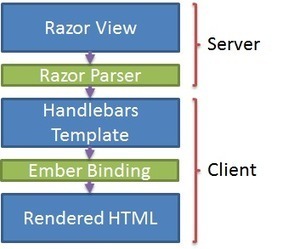
In our last post, we brought everything together to build composable blocks of tags driven off of metadata. We did this to make sure that when a concept exists in our application, it’s only defined once and the rest of our system builds off of this concept. This reduces logic duplication across several layers, ensuring that we don’t have to “remember” to do repetitive tasks, like a required field needing an asterisk and data attributes.

All of this works great because we’ve got all the information at our disposal on the server-side, and we can push the completed product down to the client (browser). But what if we’re building a SPA, using Angular or Knockout or Ember or Backbone? Do we have to revert back to our old ways of duplication? Or can we have the best of both worlds?

There tend to be three general approaches:

  • Just hard code it and accept the duplication
  • Include metadata in your JSON API calls, through hypermedia or other means
  • Build intelligence into templates

I’ve done all three, and each have their benefits and drawbacks. Most teams I talk to go with #1, and some go with #2. Very few teams I meet even think about #3.

No comment yet.
Scoop.it!

Node webkit and Angularjs - A MovieStub App

Node webkit and Angularjs - A MovieStub App | JavaScript for Line of Business Applications | Scoop.it

In this post, we will take a look at building Node webkit based desktop app using Angular js. By the end of this post, we are going to build a Movie Booking desktop application, where a user can see a list of movies and book tickets as per availability.

No comment yet.
Scoop.it!

Acceptance testing of Meteor Application using Selenium-Nightwatch and Velocity

Acceptance testing of Meteor Application using Selenium-Nightwatch and Velocity | JavaScript for Line of Business Applications | Scoop.it

I started by reading the documentation at the Github page of the Selenium-Nightwatch project and tried to install the package according to following instructions from the author. This is where my problems begun, since author stressed that it is required to run meteor with administrator privileges, what completely messed up build of all my packages and from this moment on I had to run all my meteor projects with administrator privileges. I shrieked in horror. 

Dukas Ferkas's comment, August 17, 2014 11:07 AM
I love to use this and to get the Dragon City hack from here http://juicyhacks.com/dragon-city-hack-dragon-city/ it is very simple and easy
Scoop.it!

Meteor is F***ing Awesome

Meteor is F***ing Awesome | JavaScript for Line of Business Applications | Scoop.it

Meteor blurs the line between client and server, and actually takes advantage of the fact that it’s all Javascript. Methods are functions that can be invoked from the client, the server, or both. With Meteor, you’re actually sharing big chunks of code between the client and server. While it’s possible to do something similar using ember/node, it’s difficult enough that most people don’t do it. This really changes how you build things. More client/server sharing = less code = less work and fewer errors.

Henrik Våglin's curator insight, August 17, 2014 7:40 AM

Yes it is, but I'll waiting for a 1.0 release before I'll take a serious look myself...

Scoop.it!

Polymer vs. X-Tag - Here's the difference

Polymer vs. X-Tag - Here's the difference | JavaScript for Line of Business Applications | Scoop.it

Let's face it. Web Components is the next big thing. To make Web Components work in all major browsers, we need polyfills to close the gaps. Luckily, the folks over at Polymer have developed such a set of polyfills to make Web Components work in the browsers today.

Whereas Polymer makes use of all four Web Components technologies, X-Tag only depends on the Custom Elements technology and gives the developer the right to opt in for Shadow DOM. And that's okay because that just underlines the different philosophies behind these two projects.

No comment yet.
Scoop.it!

PojoViz - Plain Old JavaScript Object Visualization

PojoViz - Plain Old JavaScript Object Visualization | JavaScript for Line of Business Applications | Scoop.it

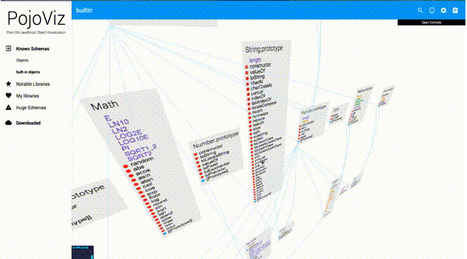
PojoViz is a tool to analyze the plain objects of a JavaScript library/framework by finding all the relationships found between the library entry point (typically a global variable) and the objects/functions linked to it.

No comment yet.
Scoop.it!

retext for analysing and manipulating natural language

retext for analysing and manipulating natural language | JavaScript for Line of Business Applications | Scoop.it

retext is an extensible natural language system—by default using parse-latin to transform natural language into a TextOM object model. Retext provides a pluggable system for analysing and manipulating natural language in JavaScript, NodeJS, and the browser. 

Rather than being a do-all library for Natural Language Processing (e.g., NLTK or OpenNLP), retext aims to be useful for more practical use cases (such as censoring profane words or decoding emoticons, but the possibilities are endless) instead of more academic goals (research purposes). retext is inherently modular—it uses plugins (similar to rework for CSS) instead of providing everything out of the box (e.g., Natural). This makes retext a viable tool for use on the web.

No comment yet.