


An opinionated set of React.js best practices to make components more readable, more robust and easily maintainable.


 Your new post is loading...
  Scoop.it! An opinionated set of React.js best practices to make components more readable, more robust and easily maintainable. 
No comment yet.
Sign up to comment
Scoop.it!

I want to show you an example of how fast you can produce a ready to use app working with Meteor. If you want to build a small but very functional app...
Scoop.it!

Meteor.js is a promising JavaScript framework, that also comes prepackaged with Cordova support, ideal for mobile development. If you’re a web developer who wants to release their work on iOS and Android (while harnessing the features of those platforms), you don’t have to learn a new language or entirely new concepts. You just need a basic grasp of Meteor, and then a basic grasp of details specific to mobile development.
Scoop.it!
Test driven development Quint tutorial javascript
Scoop.it!

Computed properties are built on top of the observer pattern, and let us take one or more properties and reactively transform or manipulate their data to return some new value. The computed property updates whenever one of their dependent values change, ensuring that relationships are always kept in sync.
Scoop.it!

The absolute best JavaScript tutorials videos on the Internet. Start learning AngularJS and ReactJS Today! React is the "V" in your MVC, but with the Flux Application Architecture you can add the "M & C" to easily wire up components into a working application. To get you started, we've published a series. We'll start with 5 (free) lessons as an introduction, and then move into building a real-world React Flux example application.
Scoop.it!

ES6 transpilers are actively being developed and are catching up to CoffeeScript in functionality. This post only covered a handful of the features that ES6 is bringing to JavaScript but you can find out more about what’s been covered and the other features here.
Scoop.it!

Marty is an implementation of the Flux architecture. It defines a set of rules about how to manage your applications state. Facebook invented Flux to help them build client-side web applications.
Scoop.it!

Webpack, for all its size and features is actually pretty flexible in its usage. You can use it in various ways as long as you’re willing to write a long enough config file. If you only use commonjs and don’t use webpack for managing any CSS or images, then you could, use it like browserify and maintain compatibility with node. But webpack doesn’t try to conform. Browserify on the other hand, being smaller and more established is easy to pick up. And if you conform to some of its conventions, you have write very little or no configuration to make it work. So, Browserify is much more likely to work with minimal configuration but will force you into a small set of conventions. Webpack on the other hand will always require some configuration to work for anything but the most basic case.
Scoop.it!

sails-sqlserver-adapter - Official Microsoft SQL Server Adapter for sails.js
Scoop.it!

In this talk Jafar Husain and Matthew Podwysocki explore the Reactive Extensions (Rx) library which allows us to treat events as collections. You'll learn about how Netflix uses Rx on the client and the server, allowing us to build end-to-end reactive systems. The speakers also contrast Rx with Promises, another popular approach to building asynchronous programs in Javascript.
Scoop.it!

In this blog post I will talk about the changes coming in Angular 2 that will improve its support for functional programming. Using a mutable domain model goes against our goal. Say we have a mutable domain model that backs up my component. And the component updates the model. Some other component, somewhere else, that happened to point it, will be updated. Instead we should model our domain using dumb data structures, such as record-like objects and arrays, and transform them using map, filter, and reduce.
Scoop.it!

From
muut

Main reasons: 1. We want our client application to be small. It’s unacceptable that the underlying framework is bigger than the application itself. 2. We want a small framework API that we understand thoroughly. We want to be able to make sense from the stack traces. All the popular frameworks come with too many API methods, properties, and personal flavors. Full control was especially important as we had a plethora of special needs on a fully embeddable forum software. To some extent we questioned whether anyone needed a framework at all. As long as the API (or model) is separated from UI the biggest troubles are gone. With events you can build isolated components and native pushState gives us the ability to deal with back button.
Jan Hesse's insight:
|
Scoop.it!

I recently went from app idea to working iOS prototype in an hour and fifteen minutes, thanks to the magic of Meteor and Cordova. hough I'm not a professional developer -- design is my job, while coding is just a hobby -- I've always preferred a code-heavy workflow, and am always looking for better ways to develop working prototypes quickly. Here's a step-by-step guide, with code samples, of how I've been using Meteor for rapid prototyping.
Scoop.it!

When doing real world web apps, there is a very common pattern: single source of truth shared by multiple clients. The best example of this is a chat: the message list, and the user list, must be readable and kept up to date for every connected client. Lets assume for a moment that all your clients are React apps executed in the same browser window. Then its easy: just use Flux! All clients will update their components every time the stores representing the message list and the user list is updated. Message posting will just be an action dispatch, as well as users joining or leaving a room. The problem is that all your clients are not in the same browser window. They actually are on different computers, on different hosts, and their only means of interacting with the server it through asynchronous communication (typically HTTP requests). This seems like a hard problem. Or is it?
Scoop.it!

Learn how to create a Emberjs and Ember-cli compatible REST API using Node.js, Express, and Mongoose.... The express-generator is great; however, it added a couple of things we will not be needing so we will remove them now. I am removing the following because this server will only be used as an API and it will not serve a frontend, you do not need to remove them but they are not in the scope of this tutorial.
Jan Hesse's insight:
Scoop.it!

The JavaScript APIs just don't make use of the great features of classical object-oriented programming. If TypeScript is going to produce frameworks and applications that go above and beyond, we need a set of tools that make use of the power of TypeScript, which includes techniques from OOP, functional programming, and APIs with public interfaces that provide static typing even if they use the awesome dynamic flexibility of JavaScript behind the scenes. Our goal with Classical is to provide a base class library for TypeScript that is browser agnostic, and provides you with the tools you need to truly use JavaScript for application scale development.
Scoop.it!

mini-meteor - Select Client-side components of MeteorJS Hypothesis: More people would try Meteor if they could evaluate its front-end behavior first, independently of its server components. The Solution
Scoop.it!
Sometimes in software development, we take giant leaps. Companies or startups, having learned hard lessons in production, found a way forward, and have shared their breakthroughs with the world. I believe this has happened again in 2015, this time with Facebook’s trio of React.js, Relay, and GraphQL.
Scoop.it!

React 0.13 has just been released into beta, a release I've been eagerly anticipating! This has been the release where finally they will be supporting ES6 classes to create React components. Fully supported, no messing about and jumping through hoops and hoping that breaking API changes don't drop in and catch you off guard.
Scoop.it!

Cody Lindley explains why enterprise JavaScript developers still need to care about ES3 and strategies for developers who want to use ES5/ES6 features today
Scoop.it!
Browserify uses the term entry file(s) to describe where it will start reading a dependency graph, and its output is referred to as a bundle. At its highest level, a Browserify bundle is simply an IIFE, or Immediately Invoked Function Expression. This is of course a simple mechanism to make code run as soon as it is loaded.
Scoop.it!
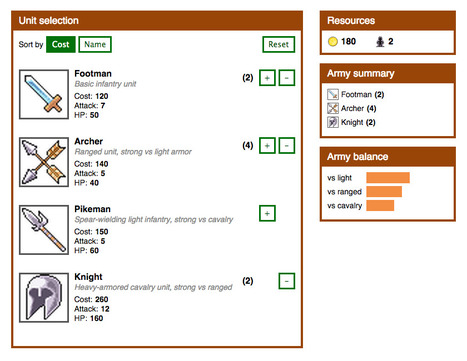
n this post we build a small example UI following a data-first approach. What the user sees is just a representation of a piece of data, the app state. And when she interacts with the interface, she is just applying transformations to that piece of data.
Scoop.it!
Sails.js v0.10.5 - Passport.js v0.2.1 - Waterline ORM v0.10... Due to the number of outdated examples about this subject that I've seen on the web, I might save your day by writing an updated, working one, by myself.
Scoop.it!

In this instalment, we will build on what we covered previously during the first part of the tutorial in order to create the logic of the Breeze application – loading and displaying current temperature information for various locations by making AJAX requests to the OpenWeatherMap API. We’ll also improve the Grunt workflow and briefly look at SCSS variables and mixins.
|






