JavaScript for Line of Business Applications
606.5K views | +4 today
JavaScript for Line of Business Applications
Keeping track of current JavaScript Frameworks that help design your clientside Business Logic Layers.
Curated by Jan Hesse
Beam to my Inbox:
Your new post is loading...

Popular Tags - Filter using the Funnel

Scoop.it!

Use React Native in Existing iOS App

Use React Native in Existing iOS App | JavaScript for Line of Business Applications | Scoop.it

React Native is a framework enables you to build application experiences on native platforms based on JavaScript and React. What's more exciting is, you can easily embed React Native powered views into your existing iOS Application.

In this tutorial, I will guide you through steps to add React Native to your iOS Application.

Ken Hui's curator insight, April 4, 2015 9:25 AM

It looks interesting. New way for hybird and rich text format.

Scoop.it!

Containers and Components in Angular 1

Containers and Components in Angular 1 | JavaScript for Line of Business Applications | Scoop.it

In this post, I want to explore a different approach to writing directives in Angular 1. As we know, building applications in Angular 2 is going to be different from what we’re used to in Angular 1. For example,ng-controller will be gone, and components will be the building blocks of applications.

What exactly is a component? It is essentially a thing that encapsulates an internal state and manages external interactions. The interactions could be with the user or with other components.

Since I’ve been working heavily with React recently, I want to see how we can borrow some ideas from there and apply them to Angular 1 directives.

In particular, I want to explore the idea of Containers and Components in Angular 1.

No comment yet.
Scoop.it!

Asynchronous Processing with TypeScript and Generic Promises

Asynchronous Processing with TypeScript and Generic Promises | JavaScript for Line of Business Applications | Scoop.it
Promises make asynchronous processing simple, consistent and easy to use. And, with TypeScript and Promises.TypeScript providing support for generic Promises, you get both type safety and IntelliSense support.
No comment yet.
Scoop.it!

Writing client-side ES6 with webpack

Writing client-side ES6 with webpack | JavaScript for Line of Business Applications | Scoop.it

Notable webpack features include:

  • Supported module formats: AMD, CommonJS
    • Via loader (plug-in): ES6
  • Supported package managers: Bower, npm
  • Loaders for non-code: CSS, templates, …
  • On-demand loading (chunked transfer)
  • Built-in development server
No comment yet.
Scoop.it!

Web Components in Angular, Ember, and React.

Web Components in Angular, Ember, and React. | JavaScript for Line of Business Applications | Scoop.it

So why would you want to put a Web Component in an app built with one of these frameworks? Web Components let you create elements that apps can interface with in the same way that they already interface with native elements. That means that a Web Component can be reused anywhere, in any framework.

That’s the theory, at least.

Let’s try it out. We’ll just be looking at Custom Elements, the heart of Web Components. 

No comment yet.
Scoop.it!

Barbaric Basics: Web Workers

Barbaric Basics: Web Workers | JavaScript for Line of Business Applications | Scoop.it

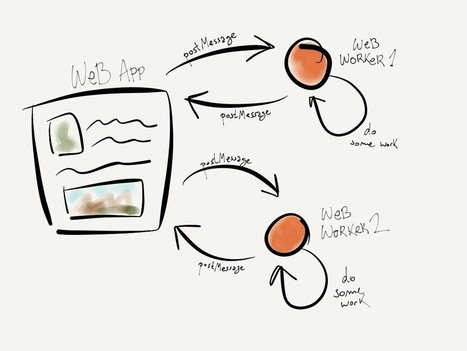
Web Workers allows you to spawn worker threads to run computation heavy pieces of javascript asynchronously and independently from your web application and the normal javascript runtime lifecycle. In practice, you will instantiate a WebWorker from your website and communicate with it back and forth through messages.

No comment yet.
Scoop.it!

Comparing Angular 1.x & 2.0

The Obsorne Effect The Angular team faces a problem. How do you talk the great new features of Angular 2.0 under development without damaging use of the current 1.x? This effect is often called the Obsborne effect, named...
No comment yet.
Scoop.it!

Build a Cloud-hosted, Web-Based Blob Copy Utility using Node.js

Build a Cloud-hosted, Web-Based Blob Copy Utility using Node.js | JavaScript for Line of Business Applications | Scoop.it

The goal is simple. Present a web form that allows a user to type in a URL. A username and password also accepted.

When the user clicks perform copy, the image pointed to by the URL will be copied to azure blob storage through a streaming mechanism.

We will build a blob copy utility using Node.js, hosted in Azure. We will host this application in Azure websites.

No comment yet.
Scoop.it!

ES6 Feature Guide: Arrow Functions

Inspired by their prevalence in modern Javascript, the arrow provides a shorthand for declaring anonymous functions. Let's take a look....
No comment yet.
Scoop.it!

Js.Edgar - Lightweight Spy/Mock Library for JavaScript

Js.Edgar - Lightweight Spy/Mock Library for JavaScript | JavaScript for Line of Business Applications | Scoop.it

This library is meant to create, manage, and direct spies for testing JavaScript.

Js.Edgar is built to be lightweight and flexible; it should work with any testing framework. Specifically, the tests for this library are written in QUnit, so integration with that framework has been well-documented. As such, all major examples will show how to utilize Js.Edgar within QUnit.

No comment yet.
Scoop.it!

A Bet on Web Components and Ember.Component Synchronicity

A Bet on Web Components and Ember.Component Synchronicity | JavaScript for Line of Business Applications | Scoop.it

This article is a brief overview of both Web Components and Ember Components as well as a comparison of the two. You will see examples of blurring the lines between native Web Components and Ember components.

With the Ember 2.X Evolution under way, you will have a new generation of first class citizens for your DOM, Ember.Components. Perhaps this overview will help you to design your Ember Components with future standards in mind, learn how to use native Web Components in synchronicity with Ember Components, and learn how to upgrade a native Web Component to an Ember.Component.

No comment yet.
Scoop.it!

An introduction to reactive programming

An introduction to reactive programming | JavaScript for Line of Business Applications | Scoop.it

Can we do better? Can we combine the simplicity of synchronous code with the efficiency of the asynchronous approach? It turns out we can. Futures are an abstraction that allow us to express the effect of latency in asynchronous computations, encapsulate event-handling code, and use higher-order functions such as map, reduce, and filter, to compose clean and readable asynchronous code.

We will explore this by looking at a web-scraping word count example. First, we’ll write simple synchronous code and consider how this code may look rewritten with a callback-based asynchronous framework such as Node.js or Netty. Then, we’ll use promises to turn callback-based building blocks into functions returning futures, allowing us to compose code using functional programming constructs.

No comment yet.
Scoop.it!

Ionic Framework, Cordova and Yeoman - Loved One Notifier

Ionic Framework, Cordova and Yeoman - Loved One Notifier | JavaScript for Line of Business Applications | Scoop.it

Ionic Framework, Cordova and Yeoman - Loved One Notifier. Automatically notify your loved ones that your battery is about to die.

In this post, we will be building an Android app using Ionic Framework, Cordova and Yeoman. The app we are going to build is called Loved One Notifier.

We will be using Yeoman Ionic generator to scaffold and develop the app. We will be using Ionic Framework as the UI layer for the app. And finally we will be using the following plugins to interact with the device.

  • battery-status
  • contacts
  • plugin.sms
  • local-notification
No comment yet.
Scoop.it!

AngularJS for ASP.NET MVC Developers

Web Development: AngularJS for ASP.NET MVC Developers by Miguel A Castro

When using ASP.NET MVC, you need to to know how to set Angular up with regards to modules, controllers, and services. And the truth is that not the entire site needs to be one giant Single-Page-Application. I’ll show how to design an ASP.NET MVC site so that it includes pockets of SPA that use Angular, taking advantage of binding, routing, and even back-button support - all while remaining on the client.

No comment yet.
Scoop.it!

AngularJS Best Practices

AngularJS Best Practices | JavaScript for Line of Business Applications | Scoop.it

I’ve been spending a lot of time building AngularJS front ends lately. I’ve tried to follow a number of style guides and best practices that have been published, but I found each had warts that bothered me to no end. As a result, I’ve pulled together my own variation of a best practice guide. I borrow heavily from others here, but this combination has worked incredibly well for me.

No comment yet.
Scoop.it!

An introduction to Sails.js, a real-time MVC-framework

An introduction to Sails.js, a real-time MVC-framework | JavaScript for Line of Business Applications | Scoop.it
Let me tell you the truth. There is a true secret lodge of JavaScript fans in our magazine. As soon as we, including the chief editor, the managing editor, and yours truly, catch the sight of one more interesting JS-framework, we immediately get excited and start to write an article about it. Having broken the resistance of our hardcore guys (this was easy, as their health had been undermined by coding on C and nights spent with the disassembler), we introduce one more useful material for you to evaluate. Let me introduce Sails.js, which is able to please even the hardened fans of Node.js, because developing with the use of Sails.js on the server is completely trouble-free.
No comment yet.
Scoop.it!

React.js: Communication between Components with Contexts

React.js: Communication between Components with Contexts | JavaScript for Line of Business Applications | Scoop.it
In this blog post we present a small but illustrative example on how to use React.js contexts in Components communication.
No comment yet.
Scoop.it!

Horror: Migrating Angular-UI-Router to Angular New Router

Horror: Migrating Angular-UI-Router to Angular New Router | JavaScript for Line of Business Applications | Scoop.it

Although Google said it would be very simple and smoothly to migrate from Angular 1.x to this new router and then easy to go forward to Angular 2.0, I found a lot of problem if I'm using Angular-UI-Router.

In this post I would like to introduce what I did, what I suffered and the resolutions. But please keep in mind that Angular New Router is still in development phase. The code and API is being changed very often. So it's recommended by Google and the community, NOT to be used in any production application.

No comment yet.
Scoop.it!

Dynamically Render Components in Ember.js 1.11

Dynamically Render Components in Ember.js 1.11 | JavaScript for Line of Business Applications | Scoop.it
The dynamic {{component}} helper in Ember.js 1.11 can help you organize a single page web app by dynamically rendering components based on bound properties.

In this post I’ll describe how my team solved the problem of dynamically binding different components based on typed data and also describe a great new helper that is coming in Ember.js 1.11, {{component}}.

No comment yet.
Scoop.it!

Ember Services and Dependency Injection

Ember Services and Dependency Injection | JavaScript for Line of Business Applications | Scoop.it
Did you know Ember has the concept of services? and dependency injection? You did? Oh... Well, I feel silly for not knowing this sooner. Until now I've been creating a "service" for my ajax calls like this: // app/models/store....
No comment yet.
Scoop.it!

Meteor JS 1.0 Building an app from scratch

Meteor JS 1.0 Building an app from scratch | JavaScript for Line of Business Applications | Scoop.it

In this tutorial we're going to build a simple app that allows you to record the scores of your foosball matches (you play foosball at work right?).

Current chapters:

No comment yet.
Scoop.it!

Improving the Angular Single-Page Application Loading Experience

Improving the Angular Single-Page Application Loading Experience | JavaScript for Line of Business Applications | Scoop.it

Single-page applications are notorious for a large, upfront loading hit. Angular is no exception. But it doesn’t stop there at the initial loading. API calls for data, sometimes massive amounts, are likely to be requested on route changes in the application. Leading to more, you guessed it, waiting. Just don’t make your users hold their breathe. Keep them engaged and improve your Angular single-page application loading experience.

Response times in any application need to be snappy, especially in an era of instant gratification and proliferation of distractions. Keeping a user’s attention is critical. Continuous feedback on the response state of the application should be provided to the user.

No comment yet.
Scoop.it!

The Evolution of Web Components: Video

The Evolution of Web Components: Video | JavaScript for Line of Business Applications | Scoop.it

Mike covers the road to native web components (learn what you can do today with this technology), whereas Jay reveals the solutions he’s working on and discusses the coveted universal web component format.


Stef finishes off by covering the history, state, and plan of web components in ember.js.

No comment yet.
Scoop.it!

TWEE.IO | MVC framework for Node.js and io.js based on Express.js with sockets and extensions support

TWEE.IO | MVC framework for Node.js and io.js based on Express.js with sockets and extensions support | JavaScript for Line of Business Applications | Scoop.it
TWEE.IO | MVC framework for Node.js and io.js based on Express.js with sockets and extensions support
No comment yet.
Scoop.it!

Introducing React Native: Building Apps with JavaScript

Introducing React Native: Building Apps with JavaScript | JavaScript for Line of Business Applications | Scoop.it
React Native by Facebook is an open-source framework allowing you to build fully native iOS and Android apps in JavaScript. Learn how in this tutorial.

If you have only ever written applications in Objective-C or Swift, you might not be particularly excited about the prospect of using JavaScript instead. Although, as a Swift developer, the second point above should pique your interest!

Through Swift, you’ve no doubt been learning new and more functional ways to encode algorithms, and techniques that encourage transformation and immutability. However, the way in which you construct your UI is very much the same as it was when developing with Objective-C: it’s still UIKit-based and imperative.

Through intriguing concepts such as a virtual DOM and reconciliation, React brings functional programming directly to the UI layer.

This tutorial takes you through the process of building an application for searching UK property listings.

No comment yet.