JavaScript for Line of Business Applications
606.5K views | +3 today
JavaScript for Line of Business Applications
Keeping track of current JavaScript Frameworks that help design your clientside Business Logic Layers.
Curated by Jan Hesse
Beam to my Inbox:
Your new post is loading...
Popular Tags - Filter using the Funnel

Scoop.it!

Web-client development with Ember.js and Windows Azure Mobile Services - Part 4

Web-client development with Ember.js and Windows Azure Mobile Services - Part 4 | JavaScript for Line of Business Applications | Scoop.it

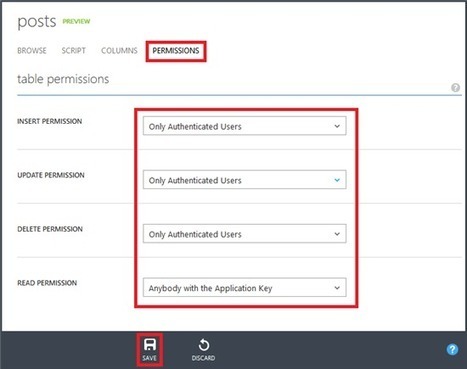
In the previous posts (1, 2, 3) I covered creating an Ember.js-based single page application, then wiring it up to Windows Azure Mobile Services for data storage. But currently it allows everyone to post anonymously. I at least want some basic authentication so I can verify the user is a real person and maybe hold them accountable for things they post.

Windows Azure Mobile Services makes it trivially easy to set up authentication using Facebook, Google, Microsoft account (formerly LiveID), or Twitter as the authentication provider.

No comment yet.
Scoop.it!

Generate Knockout Viewmodels using T4 templates

Generate Knockout Viewmodels using T4 templates | JavaScript for Line of Business Applications | Scoop.it

Use a T4 template to generate Knockout-viewmodels based on .NET classes.

This article describes a solution to this problem by using T4 templates to generate the JavaScript Knockout models automatically based on the .NET classes. The resulting Knockout models are extendable so as to be able to add additional functions and (computed) properties client-side. Finally, I also added an IsDirty feature that can indicate if the model has been modified since it's data was set.

No comment yet.
Scoop.it!

Web-client development with Ember.js and Windows Azure Mobile Services

Web-client development with Ember.js and Windows Azure Mobile Services | JavaScript for Line of Business Applications | Scoop.it

Last week I created a new single page application using Ember.js as the client framework (see Part 1 and Part 2). Today, I finish up the application by adding Windows Azure Mobile Services for data storage.

Mobile Services is a preview feature of Windows Azure, so you may need to enable the preview for your account. Once you've done this, perform the following steps to create a new service and get the HTML and JavaScript code to add a client to the application.

No comment yet.
Scoop.it!

Obviel - Object/View/Element for jQuery

Obviel is a client-side web framework. Obviel helps you build dynamic, rich client-side web applications in JavaScript.

The core principle of Obviel: For a JavaScript *object* you render a *view* on an *element*: Ob-vi-el

Obviel’s core is a simple extension to jQuery. It adds a render function that is used to render objects on DOM elements:

No comment yet.
Scoop.it!

Polymer- library for the web built on top of Web Components

Polymer- library for the web built on top of Web Components | JavaScript for Line of Business Applications | Scoop.it

Polymer is a new type of library for the web, built on top of Web Components, and designed to leverage the evolving web platform on modern browsers.


Polymer is comprised of two efforts:

- A set of core platform features (Shadow DOM, Custom Elements, MDV). Initially, these core features will be enabled with a set of polyfills. As browsers begin to implement these new primitives, the polyfill platform layer becomes smaller and better over time.

- A next-generation web application framework built upon these core technologies called the Polymer.


No comment yet.
Scoop.it!

Promise-Based Validation

Promise-Based Validation | JavaScript for Line of Business Applications | Scoop.it

The concept of “Promises” has changed the way we write asynchronous JavaScript. Over the past year, many frameworks have incorporated some form of the Promise pattern to make asynchronous code easier to write, read and maintain. For example, jQuery added $.Deferred(), and NodeJS has the Q and jspromisemodules that work on both client and server. Client-side MVC frameworks, such as EmberJS and AngularJS, also implement their own versions of Promises.


But it doesn’t have to stop there: we can rethink older solutions and apply Promises to them. In this article, we’ll do just that: validate a form using the Promise pattern to expose a super simple API.

Nicolas Maubourguet's curator insight, June 7, 2013 4:13 AM

A nice first intro, but careful, these are not Promise/A+ but still, some perspective for form validation are still making a point.

Scoop.it!

JavaScript Regular Expression Enlightenment

JavaScript Regular Expression Enlightenment | JavaScript for Line of Business Applications | Scoop.it

I have had a love/hate relationship with regular expressions in the past. Reading or writing a regular expression typically made me feel like I was toying with a broken Rubiks Cube. However, after I would fiddle an expression into submission, almost by accident, and it did its job, I would become enamored with its brevity and power.

No comment yet.
Scoop.it!

Effortless Abstraction with Ember.js

Ember.js has gotten a lot of attention recently for being confusing or hard to get started with. I’ll definitely admit that getting started with Ember took more than its fair share of code-reading, as the guides and documentation didn’t provide enough detail for building real-world apps, but for the most part, I’ve been amazed at how easy it is to build sophisticated applications with Ember. This post explores one critical feature of Ember that enables this: pervasive data binding.

No comment yet.
Scoop.it!

Writing an Ember.js App From Scratch (Part 1) | Drew Schrauf

Writing an Ember.js App From Scratch (Part 1) | Drew Schrauf | JavaScript for Line of Business Applications | Scoop.it

I’ve recently been using Ember.js to streamline my javascript workflow. While I feel that it has cut right down on development time and I’m sure that maintenance will be a tonne easier, the ramp up time to becoming familiar and productive with it is certainly a lot longer than the old jQuery approach. The thought process for planning out an app is certainly a lot more involved but the resulting architecure virtually removes the capacity for spaghetti code.

No comment yet.
Scoop.it!

Backbone.js for large scale applications – UI Architecture

Backbone.js for large scale applications – UI Architecture | JavaScript for Line of Business Applications | Scoop.it

I’ve realized that Backbone.js implements a certain concept of the well known and used design pattern – MVC.
When I started working on Echoes Media Center I wanted to apply best practices in the architecture of this application – one that I can make use for any application. I wanted to find a good and solid application framework.
After reading several articles, I decided to brainstorm the concept of MVC and have a more thorough look into it – to see how I can use it wisely enough.
I took the very simple concept that Backbone.js applied to Models and Views.

No comment yet.
Scoop.it!

Mobilizing Salesforce.com and SharePoint Using KidoZen LOB APIs

Mobilizing Salesforce.com and SharePoint Using KidoZen LOB APIs | JavaScript for Line of Business Applications | Scoop.it

One of the killer features of KidoZen is the mobile line of business(LOB) APIs. This capability extends our mobile backend as a service (mBaaS) layer by enabling the integration with corporate system whether those are hosted on-premise or using a SaaS models. Using our line of business APIs developers can build enterprise-ready mobile apps that seamlessly integrate with corporate systems without having to figure out the intricacies using a super simple and mobile-first model.

No comment yet.
Scoop.it!

Web-client development with Ember.js and Windows Azure Mobile Services - Part 2

Web-client development with Ember.js and Windows Azure Mobile Services - Part 2 | JavaScript for Line of Business Applications | Scoop.it

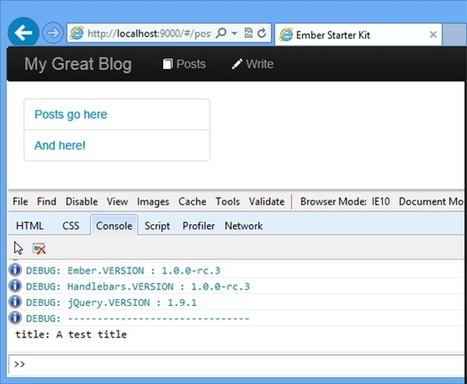
Today I continue building the application started in Part 1 by adding navigation and some basic routes and templates.


At this point, the application has a few static pages, a controller to handle submission of new forms, but that's about it. In the next post I'll wire up Windows Azure Mobile Services to store blog posts, change the posts.hbs to display a list of posts, and add a route and template to handle displaying individual posts.

No comment yet.
Scoop.it!

Infographic - Why you should consider using Ember.js

Infographic - Why you should consider using Ember.js | JavaScript for Line of Business Applications | Scoop.it
Read the entire content here. (Why you should consider using Ember.js http://t.co/Vrm1X3qM6z)
No comment yet.
Scoop.it!

Web-client development with Ember.js and Windows Azure Mobile Services - Part 3

Web-client development with Ember.js and Windows Azure Mobile Services - Part 3 | JavaScript for Line of Business Applications | Scoop.it

Last week I created a new single page application using Ember.js as the client framework (see Part 1 and Part 2). Today, I finish up the application by adding Windows Azure Mobile Services for data storage.

Mobile Services is a preview feature of Windows Azure.

To wire Mobile services to Ember, I used ember-model. Why? It provides a basic framework with the assumption that you will bring your own data access; you just implement the create/save/etc. functions that are already stubbed out.

No comment yet.
Scoop.it!

Ember.js + Rails

Ember.js + Rails | JavaScript for Line of Business Applications | Scoop.it

I recently created my first web application using Ember.js and Ruby on Rails. I just wanted to write a little bit about the process, and give some information about the problems I encountered, and how I solved them.

The biggest difference between Ember then and now is the size and activity of the community. There are so many Ember resources out there now, I almost feel resentful… I had to learn Ember without screencasts and tutorials… Everybody today is so spoiled! But I digress, the point of all this is that, I’m not really an Ember newbie.

I am however, a Rails newbie. I learned Rails for the project I’m going to describe. This brings me to what I think is a very important point. Ember.js is not hard to learn. Rails is not hard to learn. Hell, Cocoa (Touch) is not hard to learn. Object-Oriented Programming is hard to learn and MVC is hard to learn. If you’re struggling to learn a framework, it’s probably not because the framework is hard to learn. It’s probably because you don’t have a clear understanding of the paradigms or structural forms that the framework employs.

No comment yet.
Scoop.it!

Building JavaScript Web Apps With MVC & Spine.js

Building JavaScript Web Apps With MVC & Spine.js | JavaScript for Line of Business Applications | Scoop.it

JavaScript developers wishing to add more structure to their code often look for simple ways to apply the popular MVC architecture pattern to their applications. Utilizing a client-side MVC framework can be useful for such code organization and today we’ll be looking at Spine.js, a recently released solution that assists with this task.


You may be familiar with some existing projects that provide a similar solution – for example Justin Meyer’s JavascriptMVC – which is perfect for larger projects (and addresses more concerns), SproutCore, Rebecca Murphey’s dojo MVC template and Jeremy Ashkenas's Backbone.js – a worthy solution to achieving this for small to middleweight projects, in particular when creating SPAs (single-page applications).

No comment yet.
Scoop.it!

Web Components!

A tectonic shift for web development!Building blocks of Web Components:

Shadow DOM - mortar/glue

HTML Templates - scaffold/blueprint

Custom Elements - toolbelt

No comment yet.
Scoop.it!

Promises and Deferred objects in jQuery and AngularJS

Promises and Deferred objects in jQuery and AngularJS | JavaScript for Line of Business Applications | Scoop.it

Futures (more commonly named promises in JS land) are ubiquitous in JavaScript to the point where we almost don't recognize them any more. AJAX, timeouts and whole Node.JS are built on top of asynchronous callbacks. Nested callbacks (as we will see in just a second) are so hard to follow and maintain that the callback hell term was coined. In this article I will explain how promises can improve readability and modularize your code.

No comment yet.
Scoop.it!

Promise Pipelines in JavaScript

Promises, also know as deferreds or futures, are a wonderful abstraction for manipulating asynchronous actions. Dojo has had Deferreds for some time. jQuery introduced its own Deferreds in version 1.5 based on the CommonJS Promises/A specification. I’m going to show you some recipes for working with jQuery Deferreds. Use these techniques to turn callback-based spaghetti code into elegant declarative code.

No comment yet.
Scoop.it!

glue: a deliberately simple JavaScript application and middleware framework

glue: a deliberately simple JavaScript application and middleware framework | JavaScript for Line of Business Applications | Scoop.it

Glue is a deliberately simple JavaScript application framework, built on top of Liquid.js and jQuery. The library lets you build an application from modules. Each module is stylable with Liquid Markup. And modules communicate with the rest of the aplication through events and through shared getter and setter properties.

The philosophy behind Glue is simplicity and it’s right there in the name: It’s about building modular apps with HTML, CSS, Liquid – and glueing them together with as little JavaScript logic as possible.

No comment yet.
Scoop.it!

Writing an Ember.js App From Scratch (Part 2) | Drew Schrauf

Writing an Ember.js App From Scratch (Part 2) | Drew Schrauf | JavaScript for Line of Business Applications | Scoop.it

In part 1 of this tutorial we began to make a very simple todo app which used Ember to handle all of the logic. If you haven’t read it yet, check it out!

Our little todo app is now displaying a couple of prepopulated Todo items with a little counter at the bottom that shows the number of incomplete items. Obviously, a todo app isn’t very useful if you can’t add your own items to it so that’s what we’ll dive into next.

No comment yet.
Scoop.it!

Thorax: Backbone + Handlebars

Thorax: Backbone + Handlebars | JavaScript for Line of Business Applications | Scoop.it

An opinionated, battle-tested Backbone + Handlebarsframework to build large scale web applications.

Thorax is used to build some of the biggest Backbone applications in the world but it's easy to get started.

No comment yet.
Scoop.it!

Epoxy.js : Elegant Data Binding for Backbone

Epoxy.js : Elegant Data Binding for Backbone | JavaScript for Line of Business Applications | Scoop.it
Epoxy is an elegant and extensible data binding library for Backbone.js designed to hook view elements directly to data models. (Finally tried Epoxy.js - its like a comfy Knockout-style blanket to wear while trying to understand Backbone.
No comment yet.
Scoop.it!

Dynamic Binding in Ember.js Using Observers

Dynamic Binding in Ember.js Using Observers | JavaScript for Line of Business Applications | Scoop.it
Creating bindings in Ember.js at run-time can be challenging. A pair of observers, instead of a direct binding, alleviated some of our problems.
No comment yet.
Scoop.it!

Web-client development with Ember.js and Windows Azure Mobile Services - Part 1

Web-client development with Ember.js and Windows Azure Mobile Services - Part 1 | JavaScript for Line of Business Applications | Scoop.it

Over the next few blog posts I'll go through the process of creating a single page blogging application using Ember.js that uses Windows Azure Mobile Services for data storage, and then deploy it to a Windows Azure Web Site.


Single page applications normally have an .html page that acts as a container for the JavaScript that is the brains of the application. This JavaScript is responsible for generating the information displayed in the browser based on templates, and handles routing you between 'pages' (really just loading different templates) and communicating with data sources such as a remote REST API to retrieve data used by the templates.

Ember.js provides an model-view-controller (MVC) approach to designing a single page application, where the model and controller are implemented in JavaScript and the view is implemented in Handlebars, a templating language.

No comment yet.