

Implementing jQueryUI Drag and Drop functionality in AngularJS is easier than ever by codef0rmer

JavaScript for Line of Business Applications
606.5K views |
+0 today

Keeping track of current JavaScript Frameworks that help design your clientside Business Logic Layers.
Curated by
Jan Hesse
 Your new post is loading...
  Scoop.it! There’s been a lot of great feedback and suggestions thrown out and I wanted to offer up what I felt were goodbooks/resources to carry you through the learning process. While I list a number of books in the Big List page that I created, narrowing it down into specific levels makes a lot of sense. Note that some resources will overlap between levels. That should be expected as some books cover a wide breadth of language features. Also, I am NOT covering blogs in this post, only books (print and online).  Scoop.it! 
From
substack

So you're using the same language on the browser and the server. Great! You can get the benefits of fast initial page loads server-side that are easily indexed by search engines while simultaneously rendering realtime and on-demand content browser-side for a rich, responsive user experience! This sounds really great, but now you might be thinking: * How do I load the shared code in both environments without making a mess?
Scoop.it!

Originally I wrote a feed reader using AngularJS with a back end based on the Slim Framework and the SimplePie feed parser, but during writing the app it became more and more complex since I exceeded the point where an app fits into one or two tutorials. Therefore, the app discussed here is a radical stripped down version of the originally developed feed reader using the Google Feed API instead. The subscribed feed get saved using the JavaScript localStorage API.
Scoop.it!

I’ve been doing a lot of work with web sockets lately, in my Backbone applications. And I’ve fallen in to a pattern that I really like, where my Backbone application doesn’t actually know anything about web sockets. All it knows is that I’m using an event aggregator (like I always do) and that it publishes and subscribes to various events. The web sockets, then, sit off to the side. They’re decoupled from my actual application and I can replace the socket implementation without having to worry about my app’s functionality.
Scoop.it!

A guide to creating your first AngularJS application. This part will show you how to create the HTML, CSS & AngularJS taking data from a JSON object.
Scoop.it!

Authentication with Ember is difficult. I have spent a couple of weeks trying out different approaches and failing time and again. With the help of Ryan Florence and Brad Humphrey, I have finally been able to understand how it should work and also have built a simple application which uses it. My goal in this article will be to build a simple Ember application with a RESTful backend (in Rails) which provides authentication and user registration. We will also set all requests to pass the access token to our backend for authorization.
Jan Hesse's insight:
Part 2 and 3 within the post
Scoop.it!

By design, Handlebars templates don’t allow complex expressions. You are given an {{#if}} block helper, but it can only evaluate whether something is “truthy” (aka true, a non-empty string or array or other value that is notundefined or null.) Ember gives you a great tool out of the box to do this easily called computed properties. I’ve written about them before, but in a nutshell they allow you to create a function that transforms one or more properties into another single property.
Scoop.it!

AngularJS provides support for testing directives. Testing directives that use inline templates -- html that is embedded within the directive's code -- is a straightforward process. What isn't straightforward is testing a directive that uses an external html template.
Scoop.it!

From
medium
You’re about to build your first real-time application and are excited about it. You start researching the different kind of open source frameworks that should make it a breeze for you, but you’re overwhelmed by the possibilities. Should you choose SockJS, Engine.IO or maybe just use pure WebSockets. It’s a hard decision to make as you know you’ll be locked in with that framework as you’re building your application on top of that API. But do you really need to be locked in?
Jan Hesse's insight:
Abstraction for Engine.IO, Socket.IO,WebSockets, Browserchannel and SockJS.
Scoop.it!

From
vole
Vole is a web-based social network that you use in your browser, built on the power of Bittorrent, Go and Ember.js Vole feels and behaves like the web apps you're used to, but it works completely differently. Instead of the web browser sending your data to a central server, it connects to your local machine, saving your data to a folder on your computer. This folder is shared with other Vole users by giving out a read-only key that allows them to see a stream of your posts, updated live on their computers. By exchanging keys with your friends or people who you'd like to follow, you can form a network that is self-supporting and self-controlled.
Scoop.it!

A number of people, myself included, have a hard time getting started with test driven development (TDD). The issue lies in that it’s difficult to wrap your head around something that is rather non specific in its implementation and it is usually described as “writing your tests before you write your code”. When developers hear “Write your tests before you write your code”, then they look at their previous test suite they wonder… “How can I possibly write this without having written the code first?
Scoop.it!
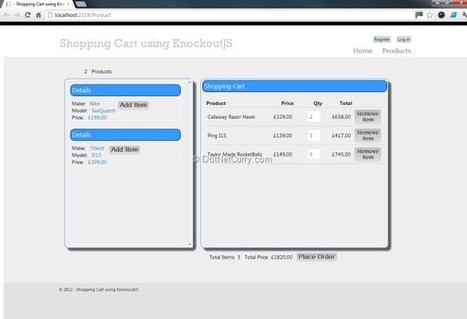
Gregor Suttie introduces KnockoutJS, a JavaScript library that bring tons of richness to your ASP.NET MVC web application with features like ‘Declarative Bindings’, ‘Dependency Tracking’, ‘Templating’
|
Scoop.it!

So, I’ve decided to contribute an Activator Template to TypeSafe (will submit soon, promise!). Having recently become more and more involved in Elasticsearch, I saw a great opportunity to put together a neat “reactive” application combining Play & Akka with the “bonsai cool” percolation feature of Elasticsearch. Then, to put a cherry on top, use AngularJS on the client-side to create a dynamically updating UI. What I came up with is slightly contrived – a very basic real-time log entry search tool – but I think it provides a really nice base for apps that want to integrate this bunch of technologies.
Scoop.it!
I'm asked regularly about books and online resources to get up to speed on JavaScript. Seems like everyone wants to get in on the JS action and with good reason; it's a great language to know if you're interested in exciting career opportunities. It's also pretty fun to play with.
With JavaScript's increased popularity, the number of books, blogs and tutorials about the language have grown exponentially and while I can't possibly know all of them, I've found some gems which I really like and would like to share those with you.
Scoop.it!

In this tutorial I will use the HTML5 browser local storage along with Angular JS. This storage is very useful for making applications work in offline mode and quickly shift to online mode.
Scoop.it!

Ben Nadel looks at creating a data-silo for ngModel bindings and how the layer of indirection has a longer-term payoff. The two-way data-binding in AngularJS is very powerful, especially when there is a direct mapping of input-data to view-model-data. But, when the data mapping requires some translation, interpretation, or validation, you need to get your hands a little dirty - you need to get more involved in how data changes are propagated within your Controller(s).
Scoop.it!

The second part of our AngularJS tutorial explaining how to use AJAX to pull in data, create a REST API using Laravel & then join them both together.
Scoop.it!
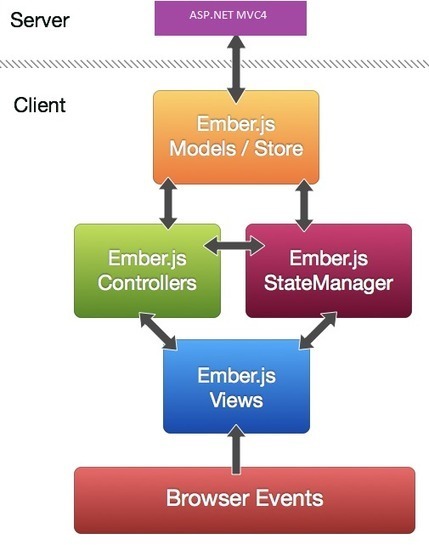
Ember.js is a powerful JavaScript MVC framework to create complex web applications that eliminates boilerplate and provides a standard application architecture, it supports UI Bindings, Composed Views, Web Presentation Layers, and plays nicely with others. In order to create a real-time interaction web application, I add a SignalR hub and REST service with ASP.NET MVC.
Scoop.it!

In the coming weeks, I’ll be speaking at SenchaCon and ThatConference about building Windows 8 apps using Ext JS. Although these presentations cover the same concepts, their content is slightly different (based upon the target audience of each conference). Because I don’t expect everyone to have a strong background in either, I thought I would list all of the relevant resources here rather than having 30 links at the end of each slide deck.
Scoop.it!
With a 9 developers team, code organization is mandatory.

Brian Petro's curator insight,
July 8, 2013 11:00 PM
Cool presentation for organizing large AngularJS projects.
Scoop.it!
Scoop.it!

Ever since the change to resource and route a lot of people are confused about the meaning of the two and how they affect naming. Here’s the difference: * resource - a thing Let’s say we have a model App.Post and we want to show a list of posts and a new post form. There are many ways you can go about this, so let’s start with the simplest.
Scoop.it!
From
hawkins
Here is how to sort a table using Ember. I personally think this is kind of awkward. Defining an array of column objects is awkward. You could define a isSortedXXXAsc and isSortedXXXXDesc for each column, but I think this is worse. It adds more logic into the template and makes things more brittle. This example is slightly brittle because you must reorder the columns property and the markup to do display the table--but no logic changing is required. That being said, here's how it works.
Scoop.it!

From
mrbool
In this course we will explore kendo UI in details. We will talk about each widget and see how it works. We will start with the html part and initializing the widget. Once we get that up and running, we start experimenting with the properties and functions. For the events, we will log them to div under the widget to see what events are triggered and when.
|






