


It is with great pleasure that I release to you today Durandal 2.0 . This release represents a significant advancement in the framework's core capabilities and ease of use. With a modular architecture, a new router, greater consistency in design,...


 Your new post is loading...
  Scoop.it! It is with great pleasure that I release to you today Durandal 2.0 . This release represents a significant advancement in the framework's core capabilities and ease of use. With a modular architecture, a new router, greater consistency in design,... 
No comment yet.
Sign up to comment
Scoop.it!

Organize and run your entire JS testing system with a single tool using Node.js
By eliminating repetitive tasks and friction points, Venus lets you focus on writing tests instead of running them. Already have JavaScript testing in place? Perfect! Venus is designed to orchestrate and automate existing tools like Mocha, Jasmine and QUnit.
Venus is a testing tool for JavaScript (JS), which simplifies running unit tests. When you are developing a browser-based project in JS, you'll want to create unit tests and run them frequently. Typically, you'll write a unit test using some library, such as Mocha or Jasmine. These libraries let you define testcases (or "specs" if you are following a BDD style), and provide APIs for writing assertions.
Scoop.it!

In this article, I am trying to implement HTML table as a grid with pagination using knockout.js. This is the easiest way to get page wise data from server using ASP.NET Web API (or WCF service) and display them as a grid. * Define a PagedObservable * Define a ViewModel * Define a View * Web API Controller
Scoop.it!

This guide, the first in a two part series, was adapted from a popular slideshow by Christian Heilmann, a Web Evangelist at Mozilla. Though JavaScript has a few notoriously tricky features, it's more important than ever in software development. This list of best practices uses code samples and side-by-side examples to help you write more readable, efficient code. Part 2: http://www.thinkful.com/learn/javascript-best-practices-2/
Scoop.it!

From
tech

Back with our last episode we learned about AngularJs unit testing by getting our environment setup and created two simplified tests. You know what I hate about posts like that? The example is so trivial and never would exist outside of a simple getting started guide. On that note lets expand things to include additional scenarios. In any AngularJs application chances are you are going to have to deal with ajax calls with $http. Lets exapand our SimpleService to include a bit of $http magic.
Scoop.it!

Backbone is one of the most popular JavaScript based frameworks to date. It is a simple yet powerful way to create interactive JavaScript applications with data bindings to a back-end server. Instead of having to constantly synchronize data between your client and server though, why not have all the data there when it happens? Users should not have to wait to see updates to their model’s data so we decided to tackle this problem by integrating Backbone.js with PubNub. Our integration allows developers to create a Backbone model or collection and have them synchronize with every other client instance of those models or collections in real-time. This will give any Backbone application a better user experience when working with collaborative, social, or any type of multi-user interface. It works by taking all of the create, update, and delete methods that are spawned by Backbone and propagating them across the PubNub real-time network.
Scoop.it!
AngularJS is an insanely productive approach to developing rich front-end JavaScript applications. I'm currently writing an interactive book about AngularJS, with versions in both JavaScript and CoffeeScript, and it turns out (no surprise) that CoffeeScript is a great way to develop AngularJS applications.
Scoop.it!

Jasmine is a unit testing framework for JavaScript. Its syntax encourages behavior-driven development and looks similar to RSpec’s syntax. To get started with Jasmine we only need to download the latest version of the Jasmine Standalone. In this screencast we’ll walk you through creating a little application using behavior-driven development with Jasmine.
Scoop.it!

On my current project we are using knockout.js and displaying large tables (20-30 columns) of data. These tables need to be sortable by almost all columns. After not being able to find a good full post or article on how to implement such a thing, and after we implemented our own solution, I thought I would write my own post on how do do it.
Scoop.it!

Jordan Walke implemented a complete React project creator called react-page. It supports both server-side and client-side rendering, source transform and packaging JSX files using CommonJS modules, and instant reload. Why Server Rendering? Why React?
Scoop.it!

Through the first 3 parts of this series we now have a scalable voting application that can process votes for events via SMS or voice and display the real-time progress of voting. However, there is currently no web interface for an administrator. Creating events or modifying them require making changes directly to the documents in CouchDB. In this blog post, I will walk through the process of creating a simple web interface for administrators using AngularJS.
Scoop.it!

Since $resource is targeted for REST based services, it has to be configured with the service URL and a few of other optional settings to get it work. $resource is not a part of Angular’s core module. To use $resource in an Angular JS application, the module ngResource has to be injected into the module depending on it. $resource can be configured to perform all of its operations on a single URL or even the URL can be over-written in the action configuration, if required. To consume a Web API OData service, we need to use the second approach as the URL differs based on the operation we will be performing.
Scoop.it!

Have you ever had a change break your site? Even when the tests pass? * Testing functionality is hard * Testing UI is even harder What if every time you commit, you got a visual diff of every web page that changed? It is surprisingly easy to do. All we need is a headless browser and a testing environment.
|
Scoop.it!
Hacker News comments on the article "MongoDB Days" here: http://gaiustech.wordpress.com/2013/04/13/mongodb-days/
Last week I attended MongoDB Day London. Now MongoDB itself is a technology that I’m fairly interested in, I can see where it would have its uses. But the problem is the people! They all talk like this: * Some problem that just doesn’t really exist (or hasn’t existed for a very long time) with relational databases * MongoDB * Profit! So anyway, since it’s free‡, there’s no reason not to evaluate MongoDB, and see if it suits your use cases. But just remember that these kids think they’re solving problems that IBM (et al) solved quite literally before they were born in some cases, and the features are probably already there in your existing database/technology stack (I have used Oracle for my rebuttals just because I am most familiar with it, but I expect the same is true for SQL Server and DB/2 as well). Talk to your friendly local DBA…
Scoop.it!

During the last two months, our team has been using AngularJS, a JavaScript UI framework, to develop a user interface for the next-generation document management system. We also utilized Grunt for building a client application and Karma for automating unit tests. The back-end part was developed with the Java technology stack. With this tool, JavaScript development becomes really fast. A single person can bring out 1–2 significant features a day. Not less important, AngularJS is also good for prototyping. This framework makes it is possible to find the right balance between a code quality and velocity of the development process.
Scoop.it!
The Built in bindings are built into knockout.js and facilitate binding to attribute for elements. We can use multiple bindings separated by commas.
Scoop.it!
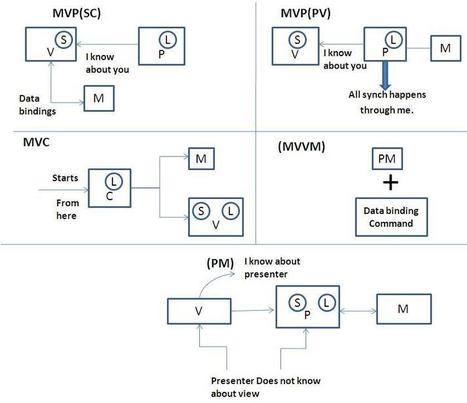
This article will compare four important architecture presentation patterns i.e. MVP(SC),MVP(PV),PM,MVVM and MVC. Many developers are confused around what is the difference between these patterns and when should we use what. This article will first kick start with a background and explain different types of presentation patterns. We will then move ahead discussing about the state , logic and synchronization issues. Finally we will go in detail of each pattern and conclude how they differ from each other.
Scoop.it!

From
tech
As JavaScript-centric web applications continue to become the standard, and the browser continues to evolve into a full-featured web application platform, developers need powerful debugging tools to help quickly troubleshoot issues and fix them efficiently. Issues can range from HTML/CSS browser inconsistencies, JavaScript exceptions, and a myriad of performance issues that range from DOM access to network latency. There a number of tools that web developers can use to help make debugging front end applications less painful. In this tutorial, we will walk through the top tools available and how to use these tools by addressing some of the most common issues faced in modern web application. This is a beginner to intermediate level tutorial for web developers getting started with debugging the web, or programmers coming from other languages who want to better understand how to troubleshoot client side JavaScript, the DOM, performance, and network calls. As JavaScript-centric web applications continue to become the standard, and the browser continues to evolve into a full-featured web application platform,...
Scoop.it!

There are a lot of great sets of directives available that are based onTwitter Bootstrap’s markup and CSS and AngularJS. Some examples are AngularStrap and AngularUI, but neither of them has a directive that supports the Bootstrap’s tabs and lazy data loading. So when the page with the tab directive is initially loaded, all the data, even of the not-active tabs, are loaded. Here is how I solved the lazy data loading with Twitter Bootstrap’s markup and AngularJS.

jharaphula's comment,
January 20, 2016 12:20 PM
There are several controls to create a web page. Tab is one among them. In many cases we required a tab view. Lets talk about an example where I have 3 sessions to display parallel in my page. Here I can choose a tab view. If you are working with the latest technology AngularJS then look at this demo where I created a dynamic tab view http://jharaphula.com/example-to-create-dynamic-tab-using-angularjs-bootstrap
Scoop.it!

After a few episodes about testing your web frontend JavaScript code with Jasmine, we will show you how to test node.js applications with Jasmine today. We’ll use the excellent jasmine-node package to run unit tests from our console. It’s even possible to run your tests automatically every time you save a file. In this screencast we will show you how!
Scoop.it!

There is still no best answer to client-side package managers and dependency management. We still have to cobble together the solutions that work best in the context of each project, but at least we’re not downloading js/css manually through the browser, using wget or writing bash scripts to download/update our client-side dependencies. We have better options.
Scoop.it!

There is no shortage of resources on how to use the various browser dev tools, and new tools are added daily. They are amazing. As someone who learned JavaScript years ago, I envy new developers for these tools. To set a breakpoint in a browser, inspect all values in the environment and walk up the call stack has been transformative. That said, your strongest debugging tool is the one between your ears. All the arcane debugging knowledge in the world is no substitute for understanding what you’re coding. To write code is to make mistakes. The best developers you’ve ever met have been responsible for bugs. They have sat at their computers, scratched their heads and wondered, “Well why is it doing that?” Where Bugs Come From
Scoop.it!
Ben Newman made a 13-lines wrapper to use React and Meteor together. Meteor handles the real-time data synchronization between client and server. React provides the declarative way to write the interface and only updates the parts of the UI that changed. This repository defines a Meteor package that automatically integrates the React rendering framework on both the client and the server, to complement or replace the default Handlebars templating system. The React core is officially agnostic about how you fetch and update your data, so it is far from obvious which approach is the best. This package provides one answer to that question (use Meteor!), and I hope you will find it a compelling combination.
Scoop.it!
HTTP requests from Javascript are traditionally bound by the Same Origin Policy, which means that your ajax requests must have the same domain and port. The common ways to get around this are JSON-P, Proxying and message passing via <iframe>s. These all have their quirks, but the thing they generally have in common is legacy browser support. CORS stands for Cross-Origin Resource Sharing. It is a more robust way of making cross-domain requests supported by all but the lowest grade browsers (IE6 and IE7).
Scoop.it!

This article describes how to use document.register to define custom elements in HTML. Custom Elements allow web developers to define new types of HTML elements. The spec is one of several new API primitives landing under the Web Components umbrella, but it's quite possibly the most important. Web Components don't exist without the features unlocked by custom elements...
|




