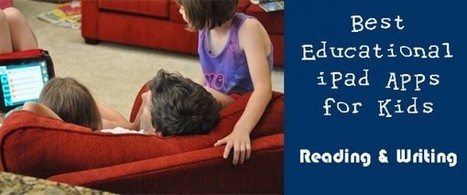
"As I started a go-to list of the best educational iPad apps for kids, the list got so long, I split up my posts into categories. So, today we’ll start with my favorite iPad apps for literacy — reading and writing for toddlers, preschoolers, and elementary-age kids. Also, I’ve included special needs iPad app resources at the end of this post."
This is a great list of apps used to promote literacy at the early childhood and elementary level. All of the apps look like an exciting way to promote literacy. They all look like games kids would enjoy. I'm excited to try "ABC joined up" to practice handwriting and First Words for spelling practice.
"Take a picture. Rename it. Make it smaller. Upload it to Facebook. Repeat.
"Kind of like a Rube Goldberg machine, except you do all the work.
"Wappwolf makes that chore (and about 30 others) a simple one-step process with a little help from Dropbox. Meaning if you don’t have a Dropbox account, go get one now. We’ll wait.
"Ok, now consider the aforementioned Facebook problem. With Wappwolf, you could create a specific folder in Dropbox called “Facebook photos.” Then, using Wappwolf’s step-by-step process, create a rule that says, “Every time I add a photo to that folder, rename it with today’s date, reduce it to 640x480, and upload it to Facebook.” Drag a bunch of photos in and poof: You’re done.
"
Other things Wappwolf can automate: emailing attachments to people, converting documents to Kindle ePub, password protecting files, uploading items to Evernote, converting to PDF, and plenty more otherwise laborious tasks.
"Plus, Wappwolf just brought their automation features to Google Drive, and plans for SkyDrive and box are in the works.
"So all this free storage space can start doing the work for you."
"Are you an NYC-area teacher already tinkering with the "Flipped mastery model" of instruction? Would you be interested in joining an informal network of other NYC educators interested in problem solving and sharing around the problems of practice that arise when trying to implement a technology-enabled, personalized mastery model in your classroom or school?
"This blender aims to launch a sustained community of practice around the implementation of a personalized mastery model that uses digital resources (video, online content, etc.) to "flip" the mechanism for direct instruction into the online space. While there is no "one way" to do flipped instruction, leaders in the community of practice have defined it as a set of teaching strategies that optimize the use of classroom time and information systems to allow for a learning model in which individualized assessment of outcomes, rather than a fixed dedication of time, determine student pacing and progress in the course."
"The popularity of the iPad in our schools continues to grow, and with it, the proliferation of related web articles, tips, how-to’s, and so on. This week we searched out some excellent free Internet based web sites and resources dedicated to the use of the iPad in the instructional setting."
"While the iPad’s potential in formal learning environments is clear, there is a practical side to its implementation that is not often recognized until after they’re purchased. Logistics here are usually left to an over-worked school or district IT person—or worse, to the classroom teacher. At $500 each for the 16GB iPad 3, thirty iPads would be in the ballpark of $15,000—a huge responsibility financially. But did you know that iPad storage can also impact classroom management?
"Teachers and administrators are, to put it lightly, pushed for time as it is. So while you’re focused on the best apps for personalizing instruction, the best social media platforms to use with middle-school learners, or the best cloud-based word processors to maintain digital portfolios, where do you turn?"
"Evansville (Indiana) science teacher Brian Bennett describes the Flipped Classroom as an ideology, not a methodology:
'Video itself will not help kids achieve more in your class. The flipped classroom is about making connections with learners and differentiating your instruction. If videos are a part of that multi-faceted plan, great. If they are not, still great.'
"Sams seems to concur: “Anyone who blindly adopts ‘The Flipped Classroom’ (or inquiry, or lecturing, or unschooling, or whatever) model and never modifies it to meet the needs of his or her students will blindly lead his or her students into educational ruin.”
Entering Phase Three
Moving a lecture online changes where that information is consumed, not necessarily the degree of student engagement or its effectiveness. Curricula provider Mathalicious critiqued Khan Academy as “one of the most dangerous phenomena in education today.” That argument is not directed at the site itself, but centers around the negative impact Khan may have on innovation. The Khan style of teaching is the same step-by-step process that students have seen for generations:
'Khan Academy is great for what it is — a supplemental resource; homework help — but we’ve turned it into something it’s not. Indeed, something it was never intended to be.'
"For Fred Singer, CEO of Echo360, the Flipped Classroom movement represents an important progression toward “Phase Three” of education reform: blended learning. Meaning, the digital form moves beyond simply augmenting face-to-face teaching into a peer role where online and offline interaction directly supports learning goals. State legislators are coming closer to endorsing blended learning as a required experience."
"Edshelf hopes to become a go-to site where teachers can recommend to one another what’s worked for them, and it’s building a directory of educational materials that have been reviewed for educators by educators. Apps and websites are reviewed based on student engagement and pedagogical effectiveness, as well as on how hard these tools are to learn."
"I was using portfolios with limited success and spending a lot of time on them, until Evernote came into the picture.
"When I first started researching options, I was coming across a lot of companies that were really expensive, charging a lot for each student’s use. I also knew that we needed an app for mobile devices that would make it easy to capture and document paperwork and I wasn’t finding that in most of the tools I was evaluating. Evernote was free, had an app for virtually every device, and we could get started right away.
"After creating accounts for the students [learn more about how to get set up in the Portfolio Forum discussion] capturing and organizing information became insanely easy. Here is how we are using Evernote in the classroom:"
Description by MIT's Technology Review (April 2011)
"A new online video search tool launched this week makes it easier to search the content of video lectures by automatically transcribing words used in the lecturer's visual aids.
"TalkMiner was created by researchers at Fuji Xerox Palo Alto Laboratory (FXPAL), in California, to help students and professionals search the ever-expanding online archives of video lectures and presentations. "It gives you a good shot at finding something that wasn't mentioned in the title or abstract but is buried deep inside the video," says Larry Rowe, president of FXPAL....
"TalkMiner overcomes this by skimming videos to find the speakers' presentation slides. It analyzes the footage once per second for telltale signs of a presentation slide, such as its shape and static nature; captures the slide image and compensates for any skewed angles; and uses optical character recognition (OCR) to detect the words on the slides. These words are then indexed into TalkMiner's search engine, which currently makes available 15,000 videos from institutions such as Stanford University, the University of California, Berkeley, and TED."
"Instructional rigor is one of the most discussed topics in education today. But there is much debate over what rigor is and is not. Let's look at seven myths, then a concrete definition of the actual meaning."
"Checking curriculum or lessons for rigor includes lessons for all students; rigor is not limited to gifted or college bound programs. Look for different ways that content can be presented and analyzed. Ask questions about the activities such as:
Are the activities inquiry or project based, requiring students to form their own answers?
Do students use the results of their answers to explore ways they can make a difference in the world around them?
Do lessons contain elements from different disciplines, encouraging students to make connections with previous knowledge?
Are students asked to examine their own emotions concerning dilemmas or to take a position on a controversial topic?"
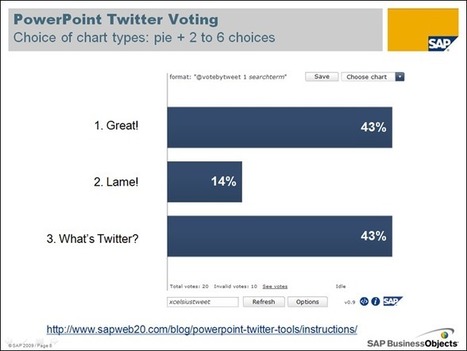
"...We just stumbled across a new tool that’s designed to incorporate live tweets into your presentation. What could be better than that? While these tweets may not all be perfect and some may not be professional / appropriate, it’s a great tool to know about.
"It’s called SAP Web 2.0 it’s as simple to use as PowerPoint. In fact, you just add in a slide that is supplied to you and that’s it. Quite simple. Click here to check out the instructions page on how to use SAP Web 2.0."
60 years ago...OMG. One-room schoolhouse in the city. Is this funny or tragic? The stereotypes are incredible. But, is this worse or better than "Are You Smarter Than a Fifth Grader"? -JL
"A national resolution to urge education administrators to rely less on standardized testing is gaining a wave of support in South Florida.
"The Palm Beach School Board was the first school board in the state to endorse the petition that asks state governments and education boards to:
develop a system based on multiple forms of assessment which does not require extensive standardized testing, more accurately reflects the broad range of student learning, and is used to support students and improve schools."
"With the integration of the iPad into the instructional environment, teachers and students have discovered many new ways in which the device can expand and enhance the learning environment. With the iPad, the Apple TV can offer a flexible, complete, and cost efficient alternative to the traditional interactive boards populating our classrooms."
Be sure to read the comments following the article. They offer a great deal of additional, important information. -JL
The Getty Research Portal is a free online search gateway that aggregates descriptive metadata of digitized art history texts, with links to fully digitized copies that are free to download. Art historians, curators, students, or anyone who is culturally curious can unearth these valuable sources of research without traveling from place to place to browse the stacks of the world’s art libraries. There will be no restrictions to use the Getty Research Portal; all anyone needs is access to the internet.
"For the past several months, I have been working a few days a week as a S.T.E.M. consultant at a school in Los Angeles. The goal is to improve the quality of teaching in the school and I am doing a lot of modeling in classrooms. A couple of weeks ago, I began using robotics in the 5th grade class. I have lots of objectives for using my favorite robotics materials, Pico Crickets, but here are three big ones. I could list a bazillion sub-skills and affective objectives, but I will spare those details.
"Specific science, engineering, mathematics and programming concepts come to life in a tactile fashion.
Students develop important habits of mind and inquiry skills by tinkering, invention and complex open-ended project work.
You can learn an awful lot about individual student learning styles, talents and prior knowledge by working alongside them during problem-solving activities. You also learn a lot about their prior educational experiences."
Wonderful and detailed description of how a class has gone about working with Pico Crickets. I enjoyed reading this a great deal. -JL
A motorized car was quickly enhanced by the ability to make it GO and STOP by making a loud noise. One or two sessions of adjusting the sensor tolerance to account for ambient noise and the toy car would stop and start on command! Friction, gearing, and stable construction techniques were encountered along the way. Some of the programmings needed my help because the software runs much quicker than a loud sound.
"Strix, the same clever team that brought us the Ransom Note Generator, has released The Stencil Generator. It allows you to upload any photo (or even provide an image URL) and create a stencil for internet graffiti, or to print and cut for an actual piece of art.The app thankfully includes a white point selector that allows you to choose how much contrast you want in your image."
Robin Good: Polkast is a free iOS and Android app which allows you to connect directly to your remote computer and instantly access all your files, videos, photos and music you have on it.
Polkast does not use any "cloud storage" type of solution to achieve this, but simply connects your mobile device or Windows 7 PC to your selected "home/work" Mac/PC, and then gives you direct access to all of your files through an organized system.
Notability is optimized for the new iPad! It powerfully integrates handwriting, PDF annotation, typing, recording, and organizing so you can take notes your way! Discover the freedom to capture ideas, share insights, and present information in one perfect place on iPad.
"True instructional rigor, however, is centered around student learning. Rigor is creating an environment in which each student is expected to learn at high levels, each student is supported so he or she can learn at high levels, and each student demonstrates learning at high levels."
"Whether adapting an existing lesson or creating a new one, keep in mind Bloom’s taxonomy. While examining the lesson, ask questions such as, “Are students asked to apply their knowledge to solve a similar situation,” “Are students asked to relate this information to something else,” “Are students asked how they would improve something,” or “Can they explain why they made certain choices.” Also consider how student centered the work will be and look for ways for students to interact with each other while learning.
"Once teachers understand what rigor is, they may find that it is already present in some of their activities. The challenge then becomes identifying where, tweaking it to be more effective and finding more places in the curriculum to use it. Bloom's taxonomy, especially the cognitive and affective domains, gives a starting place for understanding rigor using a familiar set of categories."
Some thoughtful and creative ways to end of the last weeks of school with engaging and meaningful acitivities. Something for all grade levels and subjects here. -JL
To get content containing either thought or leadership enter:
To get content containing both thought and leadership enter:
To get content containing the expression thought leadership enter:
You can enter several keywords and you can refine them whenever you want. Our suggestion engine uses more signals but entering a few keywords here will rapidly give you great content to curate.


 Your new post is loading...