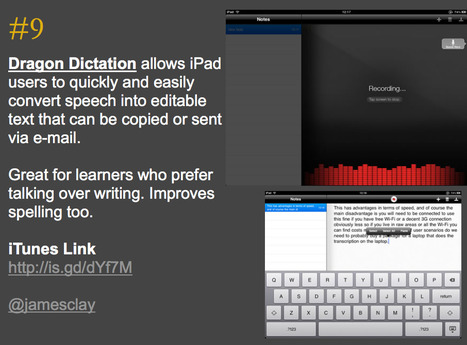
"One of the things that really excites me about the iPad is the ability of the students to show their learning. I am not talking about the end product here, I am talking about the act of learning that can be shown by students recording their processes. It is often about the student putting the information they have learnt into a context. It is this contextualisation that helps the students create meaning. Here is a perfect example from a young 1st grade student who talks us through his investigation into transport. This example was shown on a recent school visit as one way a student could document their own learning. Our Lady of the Angels, Rouse Hill is an exemplar school combining principles of contemporary pedagogy with contemporary learning spaces."
Tom Barrett has developed a great series of crowd-sourced slide shows on a wide variety of educational topics...primarily, but not entirely, for elementary-level teachers. This creative collection focuses on using iPads in the classroom. Viewers are sure to find something useful here. Keep up the great work Tom! -JL
"After a number of years of teaching history chronologically, I made the curricular decision to shift to a thematic approach. I am privileged to work in schools that allow me the flexibility to make these types of classroom decisions.
My rationale for this change was grounded in a number of gut-check teacher experiences but also in the writings of Sam Wineburg, Eric Foner, David Perkins, and James Loewen. America has never excelled at knowing its own past. As I watched the school days pass, I observed that students participated and engaged, but still did not meaningfully retain the information. Something had to give. I ditched chronological teaching."
AP courses are content heavy and are dictated by the College Board. Thus, teachers often find the most efficient way to "get through" the content is in the traditional lecture-style setting. AP veteran teacher and BIE National Faculty member, Dayna Laur, will take you through the process in which project-based learning allows your students to master AP content rather than merely memorize it. Strategies for maximizing student learning through project-based learning will be discussed, as will ways in which you can align College Board demands with 21st Century learning. Hear ideas on various projects for a variety of AP content areas and get ready to start implementing your own!
"Episode 3.01 is all about gaming in education. Call it "gamification" or "serious fun" or whatever else you like, we just know it's wicked cool. Featured innovations include: using Minecraft in the classroom, GameStar Mechanic, NYC Haunts, and an interview with Lucien Vattel from GameDesk. Plus we do a little hacking."
"Rubik's cube provides an easily accessible, hands on introduction to group theory. Learn about how you can use simple group theory to efficiently solve any Rubik's cube!"
This Learnist site offers solutions and game theory papers for enthusiasts of varying skill levels and ranges of intellectual interest. -JL
Robin Good: If you are looking for a free video conferencing solution, here is my selection of the top 15 (and more) solutions available right now online.
I have personally checked each one of them, and while you may not like each one, they all guarantee the ability to video conference with more than two people (FlashMeeting is the only exception I have included) without you needing to pay anything for it.
Some, as good as Vidyo or Zoom.us may provide HD quality video and even full support for mobile platforms. Others, like MeBeam or Sinfor offer bare-bone ad-supported solutions that have zero frills but can do the job if you need an immediate, zero-cost solution.
"Net Power & Light, based in San Francisco, is making its debut with technology it calls Spinthat turns online education into a group activity, even if the participants are on opposite sides of the globe.
"The company has released three free iPad apps that allow users to create virtual gatherings where they can all watch educational content together from sources such as Harvard, Stanford University, TED and the National Geographic Channel. Users can also fast-forward to the best parts, pause the program so the group can debate a particular point via videoconferencing, or jump to a different clip."
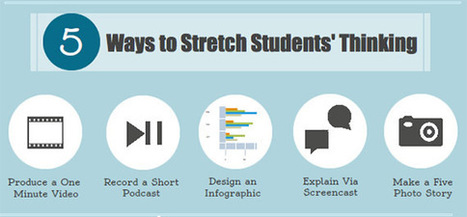
"Experts maintain that regular opportunities to engage in activities requiring use of higher order thinking skills can significantly improve student achievement as measured on standardized tests. My own experience as a classroom teacher, site administrator, and professional development provider supports this assertion.
"To this end, mobile apps and Web 2.0 tools can facilitate implementation of activities requiring students to use skills at the top three levels of Bloom’s Revised Taxonomy--analyzing, evaluating, and creating. Here are five examples of activities that target these levels of the taxonomy and can be used with students across grade levels in a variety of content areas. Teachers of very young children can implement these ideas as whole class projects."
"When Alliance College-Ready Public Schools launched Blended Learning for Alliance School Transformation (BLAST) at three high schools in 2011 and 2012, we were confident that the integration of technology into our college preparatory curriculum would help us individualize instruction for all students. What we didn’t fully appreciate was the impact of this powerful model on teachers at every level of experience.
"Once the year began, we quickly discovered that the demands of blended learning essentially transformed all teachers into novices. We saw that teachers with more experience often faced steep learning curves as they struggled to unlearn certain ingrained habits and practices, and that true first year teachers were just as likely to develop effective blended learning practices as those with more years in the classroom."
"The following presentation by gramener.com explores some of the ways text can currently be disaggregated, from the now familiar word clouds, all the way to some very complex-looking–and less traditional–text visualizations.
"As huge stores of data are archived–and analyzed–the potential is literally unlimited, especially as human readers better understand the tools and how they might be used, and we collectively refine the software itself that makes it all happen.
"Personal learning networks are a great way for educators to get connected with learning opportunities, access professional development resources, and to build camaraderie with other education professionals.
"Although PLNs have been around for years, in recent years social media has made it possible for these networks to grow exponentially.
"Now, it’s possible to expand and connect your network around the world anytime, anywhere. But how exactly do you go about doing that?
"Check out our guide to growing your personal learning network with social media, full of more than 30 different tips, ideas, useful resources, and social media tools that can make it all possible."
Apps, case studies, reviews, articles, lessons and more from a variety of hand-picked sources. Anderson is a leader in district ed tech implementation and specializes in social media. -JL
CHANGING TEACHING PRACTICES in secondary history classrooms requires teachers to first change their attitudes and views towards teaching history. This was a key finding that emerged from the analysis of changes that took place in the teachers' classrooms during the course of our Teaching American History grant project that was successful in changing teachers' views and attitudes. What follows is a summary of the teachers' practices, ideas, and attitudes about teaching history before participating in the program, the professional development activities that took place with the goal of changing these attitudes and practices, and a summary of the new ideas and practices that were documented after the program. Key curriculum elements in the program that are believed to have produced the most significant changes in attitudes and classroom instruction will be highlighted.
AP courses are content heavy and are dictated by the College Board. Thus, teachers often find the most efficient way to "get through" the content is in the traditional lecture-style setting. AP veteran teacher and BIE National Faculty member, Dayna Laur, will take you through the process in which project-based learning allows your students to master AP content rather than merely memorize it. Strategies for maximizing student learning through project-based learning will be discussed, as will ways in which you can align College Board demands with 21st Century learning. Hear ideas on various projects for a variety of AP content areas and get ready to start implementing your own!
Create an interactive online lesson with this brilliant site. Upload and curate all the resources for a lesson in one place and access them with one click. The site works with Office files, PDFs, flash files, small videos file, images, Youtube videos, internet links and even connects to Google Drive and Dropbox. Then simply share the link with anyone who need to use view it.
Megan Chapman has assembled an excellent and extensive collection of websites focused primarily on Informational Reading and Literature in the middle school grades 6-8. Additional ELA standards areas and lower grades are also addressed. Collection consists primarily of videos, quizzes, and activity sheets. A wonderful job, which is sure to grow in size and be helpful to teachers, students, and parents. -JL
Blended learning means offering a combination of face-to-face and online learning opportunities to learners. Blending these learning opportunities can contribute to personalizing learning. However, blended learning is not the only approach that personalizes learning. Personalizing learning starts with the learner. This means that learners have a stake in their learning by taking responsibility for their learning. When they own and drive their learning, they are more motivated to want to learn. In a learning environment that starts with the learner, teacher and learner roles change.
More than 50 free webinars from ASCD; including presentations by Robert Marzano, Art Costa and Bena Kallick, Grant Wiggins, Carol Tomlinson, Heidi Hayes Jacobs, Jonathan Bergmann and Aaaron Sams, and Judy Willis. Many presentations include hard copy support materials. Many presentations are focused on CCSS, but many can be found on additional topics such as the Flipped Classroom, Technology in Teaching, Motivation, Assessment, Evaluation, Differentiation, and Supervision. - JL
"Often students are called upon to make presentations for class projects, and many are eager to break out of the mold of the standard PowerPoint and do something really special. These are 8 unique online presentation tools that will help your students do exactly that. From zooming presentations to animations to timelines, there's a little something for every great idea here."
"This paper revises the preliminary blended-learning taxonomy that we introduced in “The rise of K–12 blended learning,” published in January 2011, and its follow-on report, “The rise of K–12 blended learning: Profiles of emerging models,” published in May 2011. Its most notable change is the condensing of the six blended-learning models to four. Numerous education experts provided feedback to help us arrive at the four models. The following is a discussion of some of the rationale behind the changes."
Two videos of conferences presentations by Catlin Tucker (one in which she is joined by Colt Briner) setting out ways to use Collaborize Classroom (or other online educational platform) to promote student engagement and achievement. Numerous useful tips make these videos a worthwhile investment of time. Althought the videos are hosted on the Collaborize Classroom site and feature this product, the strategies and techniques are applicable using almost any online hosting platform of this type.-JL
To get content containing either thought or leadership enter:
To get content containing both thought and leadership enter:
To get content containing the expression thought leadership enter:
You can enter several keywords and you can refine them whenever you want. Our suggestion engine uses more signals but entering a few keywords here will rapidly give you great content to curate.


 Your new post is loading...