Your new post is loading...

|
Scooped by
Jim Lerman
October 11, 2012 3:44 PM
|
By Kim Forston Summary by SmartBrief on EdTech "The slide-based multimedia application Nearpod can help teachers keep students focused during lessons, says high-school technology director and teacher Frederico Padovan. The iPad app pushes slideshows to each student's tablet and even warns the teacher if the student is not following along. "It keeps them focused because now, instead of looking at a projector and using iPads for other things, students are forced not to steer away, because they will miss the presentation," Padovan said." This does look like quite a versatile app and appears to represent a next step beyond SmartBoards. The challenge to teachers will be to keep classrooms student-centered. -JL
|
|
Scooped by
Jim Lerman
October 11, 2012 12:50 PM
|
By Larry Ferlazzo "Though the origin of this popular adage is unclear, one thing is clear: using photos with English Language Learners (ELLs) can be enormously effective in helping them learn far more than a thousand words -- and how to use them. "Usable images for lessons can be found online or teachers and students can take and use their own. "The activities presented below connect to multiple Common Core Standards including the following ELA Standards: "Integrate and evaluate information presented in diverse media and formats, including visually, quantitatively, and orally. Develop the topic with relevant, well-chosen facts, definitions, concrete details, quotations, or other information and examples. Use precise language and domain-specific vocabulary to inform about or explain the topic." Most of these techniques are useful for language development in any setting. -JL
|
|
Rescooped by
Jim Lerman
from :: The 4th Era ::
October 10, 2012 10:22 AM
|
"The Knight Center for Journalism in the Americas is launching its first “massive open online course” or MOOC, a new kind of e-learning program designed for a large number of students – it is free and accessible to anyone from anywhere in the world with an Internet connection. The first Knight Center MOOC will be Introduction to Infographics and Data Visualization, taught in English by Alberto Cairo, an internationally renowned expert who teaches at the University of Miami."
|
|
Scooped by
Jim Lerman
October 10, 2012 10:05 AM
|
Comic Master allows you to create your own short graphic novel. Review by Jason Tomaszewski for Education World "A single flash-based page comprises the entire site. Users encounter a different version of the page after completing tasks and entering information. As such, there is no real navigation.Users will, however, appreciate the well-designed, interactive nature of the page. As they create comics, users get a sense that they are working alongside the likes of Bob Kane or Stan Lee. "The imagery is all spot-on, and the controls are very easy to use. ComicMaster goes out of its way to avoid association with any known comic properties or companies such as DC or Marvel, but the figures and illustrations are all on par with those of the major players. "The popularity of comic-book heroes is apparent from recent box-office returns, and ComicMaster takes advantage of that popularity by having students create their own heroes and craft original stories for them. "Users go through a step-by-step process that begins with selecting a cell layout and ends with a completely colored comic strip. While the site provides options in terms of character appearance and background design, the story is completely in the hands of students. They can create any kind of scenario, from drama to comedy."
|
|
Scooped by
Jim Lerman
October 10, 2012 9:45 AM
|
By Maryllen Weimer, Ph.D. "I don't think the researchers' finding that peer assessment didn't improve learning outcomes is a mandate to abandon use of peer assessment in groups. Rather it challenges us to explore the use of peer assessment. How do we make sure it contributes positively to overall group functioning and encourages individuals to accept their responsibilities? How can it be used so that it develops the feedback skills of individual members? And finally, are there approaches to peer assessment that do promote, not compromise, the learning experiences of group members? "
|
|
Scooped by
Jim Lerman
October 9, 2012 10:36 AM
|
From the website "As part of a project for the PARCC consortium, the Institute for Learning (IFL) at the University of Pittsburgh, was asked to develop English language arts classroom task sets for Grades 3, 6 and 10 that are aligned to the new CCSS and that will prepare students for the new PARCC assessments. We would like you to visit these websites to learn about these classroom task sets. Then, please take a survey about the usefulness of this classroom task set. Your feedback will be used to improve future versions." These are well-designed learning units based on the ELA CCSS and PARCC assessments. As such, for teachers interested in retooling for the PARCC asssessments, the units should prove quite helpful. For curriculum designers, the units offer an interesting template for how to revise local or state curriculum in a practical format, while focused on the new requirements. -JL
|
|
Scooped by
Jim Lerman
October 8, 2012 2:16 PM
|
Posted by Katie Kepi "Students, teachers and the public turn to their librarians for help researching everything from technology to genealogy to homework help and lesson plans. Even if your library is equipped with subscriptions and memberships to top of the line databases and online journals, you’ve probably had to get creative during a patron’s requested search for something unfamiliar. "Next time, though, you can turn to one of these 50 search engines, designed to pull from the Web only the information you really need."
|
|
Scooped by
Jim Lerman
October 8, 2012 8:53 AM
|
By Katherine Schulten "If you’ve been reading this blog for a while now, you may remember that last year at this time we were enthusiastic participants in a collaborative push to get as many people as possible to take to Twitter on Oct. 20, the annual National Day on Writing, and post messages with the hashtag #WhyIWrite. "Thousands did, and it was a thrilling and memorable day for us, as students, teachers, novelists, poets, historians, journalists, comedians and ordinary citizens of all kinds posted thoughts to a vigorous stream. "So, of course, we’re doing it again, except this time our wise collaborator, The National Writing Project, suggested that the hashtag be #WhatIWrite, and that, because Oct. 20 is a Saturday, the day to post to Twitter be Friday, Oct. 19. "So along with the National Writing Project and the National Council of Teachers of English, we invite you (and your students, and everyone else you know) to post on Oct. 19, with the hashtag #WhatIWrite."
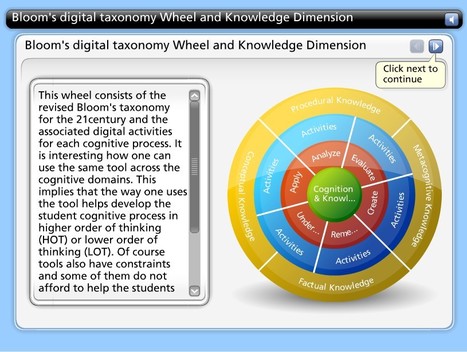
Bloom's digital taxonomy Wheel and Knowledge Dimension
This is quite a clever and helpful device to tie together a large number of ideas about Bloom's Taxonomy in the Cognitive Domain. I highly recommend that interested readers visit the website and play with it. It's done quite well (although it would be even better if the few misspellings were attended to). Access it at http://eductechalogy.org/swfapp/blooms/wheel/engage.swf But this gets me up on my soapbox because it highlights quite a significant oversight, in my opinion. When Benjamin Bloom wrote his original work, he spoke of 3 domains, not just one. All 3 were, and are, of roughly equal importance in educating young people. The other 2 are the Affective Domain and the Psychomotor Domain. These correspond roughly to what, in today's parlance, might be called Social and Emotional Learning (Affective) and Mental and Physical Health (Psychomotor). Too much (or too little) emphasis on any one of the domains almost guarantees a lack of balance in childrens' learning and development. We can see this in the pejorative, hurtful names students call their peers when one of the domains assumes an unblanced priority over the others. Cognitive imbalance can lead to students being called eggheads or nerds, Affective imbalance to students being called geeks or loners, and Psychomotor imbalance to students being called dumb jocks or crazies. It seems to me that the standards movement and the high-stakes testing movement have come to represent an educational environment that is seriously out of balance...with far too much emphasis on the Cognitive Domain, and too little on the Affective and Psychomotor. We have too many students who excel in one domain, and too few who are well rounded in two or three, as well as too many who do not reach their potential in any. Furthermore, the emphasis on the separation of the Cognitive from the Affective and Psychomotor, has created structural imbalances in the operation of schools (read allocations of time, financial and material resources, personnel, and intellectual energy) that work to the detriment of our young people and our communities.The drive toward home schooling and charter schools can be viewed as two manifestations of this structural imbalance...increasing numbers of parents view schools (especially public ones) as unsuitable places to send their children and clamor for alternatives that offer a better balance among the 3 domains. This is a great graphic organizeer, but it represents only an exaggeratedly large part of a much more important whole. -JL
Via Gust MEES, Paulo Simões, Shary Lyssy Marshall, Lynnette Van Dyke, Freddy Håkansson, Katharina Kulle, Rui Guimarães Lima
|
|
Scooped by
Jim Lerman
October 6, 2012 8:58 PM
|
Posted by Katie Lepi "The fundamentals that define a great teacher don’t differ much whether classes are taught in the online setting or off, but there are certain things that need greater emphasis and gain greater importance when a teacher is working with students who aren’t in a traditional classroom setting. "Knowing how to highlight these things to help students reach their potential and get more out of a course is what separates online teachers who are good from those who are great. "Read on to learn what it takes to excel at teaching online and gain a new understanding of what really separates great online educators from the pack."
|
|
Scooped by
Jim Lerman
October 6, 2012 8:45 PM
|
Australian teacher Jenny Luca provides an unusually lengthy and detailed account of her venture into PBL with fellow teachers and her class. What I find so interesting is the way she weaves together her personal experience with numerous resources that others will find useful. I also enjoyed how Luca discussed using the Future Work Skills diagram (above) with her students as a springboard for timely reflection. -JL "What’s been incredibly encouraging is the spoken feedback I’m getting from students. I’ve heard some say they are enjoying the challenge of thinking, of directing their own learning, of working with people they don’t normally mix with. One student stayed back after class to tell me how much she was enjoying learning this way and that she’d never thought it would be possible to work like this in an English classroom. Many are excited about their ideas and are genuinely interested in seeing them come to fruition and sharing their artifact with others. Most of them have structured manageable tasks, but some have been ambitious. I’ve made a point of saying to them repeatedly that it’s the collaborative work and process that is important here, and if what they come up with falls short of their plans due to time restraints, it’s still possible to do very well on this task if they have done what is expected from them. As teachers, we decided to weight collaboration most heavily for their assessment and the students know this. They’ve been provided with the assessment breakdown so they know what they are working towards."
|
|
Scooped by
Jim Lerman
October 6, 2012 8:25 PM
|
By Connie Malamed "Higher order thinking goes beyond memorizing and recalling facts and data. It even goes beyond comprehension. Higher-order thinking refers to cognitive processes that involve analytical, critical or creative thinking.... "Because test items must be aligned with learning objectives, you’ll need to include higher-order thinking skills from the start. And yes, these may be better measured through open ended questions, essays and discussions. But if you find yourself needing to use multiple choice tests as a necessity, you can make the best of this situation with these three approaches."
|
|
|
Scooped by
Jim Lerman
October 11, 2012 12:53 PM
|
By Doug Keely "Dance in science, pop art in Spanish, or photography in math -- there’s no end to the ways arts can be integrated into other curricula. Educators from Bates Middle School, in Annapolis, Maryland, share arts-integrated lessons and resources that you can use in your school."
|
|
Scooped by
Jim Lerman
October 11, 2012 12:11 PM
|
From the website "As the world is becoming increasingly connected, the nature, use, ownership, and purpose of knowledge are changing in profound ways. Our goal as educators is to leverage these connections and changes as powerful means to improve teaching and learning in our schools. "We recently tackled the hot topic of Project Based Learning in a free webinar we offered during Connected Educator Month. We’d like to share this recording with you! The free recording for the webinar session is here. "We’ve also put together a full page of curated resources about PBL for you here."
This is a great tool for designing web based lessons that draw on a number of different sources. You can sequence materials, add tasks and worksheets, videos from YouTube and documents from your dropbox. This is a really useful tool for creating engaging web based lessons.
Via Nik Peachey, Rui Guimarães Lima
|
|
Scooped by
Jim Lerman
October 10, 2012 10:13 AM
|
Review by Jason Tomaszewski for Education World "Shakespeare can be pretty heavy even for the seasoned academic, so introducing the dramatic pioneer to elementary-aged students is a bold undertaking. Fortunately, the Folger Library pulls it off. "Site offerings like Cool Facts and Who Am I introduce younger students to Shakespeare’s unique literary style while offering fun tidbits about his life and work. Likewise, Shakespearian dialogue allows students to perform in some of the more famous roles. "Students can explore much more here, from reading excerpts of plays to coloring Shakespearian illustrations. "From the academic to the playful and everything in between, the Folger Library’s Shakespeare for Kids is a tremendous resource."
|
|
Scooped by
Jim Lerman
October 10, 2012 9:59 AM
|
Review of site by Jason Tomaszewski, for Education World "Since the advent of the movie reel, educators have used films to reward students or expand lessons. TeachWithMovies now gives educators access to good-quality lesson plans designed specifically for films. "The site’s nearly 400 classroom-ready resources are tailored to fit everything from English to science classes and include full lesson plans as well as more informal lesson guides. The content is very well done, meaning teachers can simply grab a lesson plan and head to class. "This is a paid site, and while a bit of free content is available, those seeking full lesson plans and guides must subscribe to TeachWithMovies for an $11.99 annual fee. Given the quality of the materials here, that price is certainly reasonable."
|
|
Scooped by
Jim Lerman
October 9, 2012 5:54 PM
|
By Shelley Wright "A little over a year ago I wrote a postabout the flipped classroom, why I loved it, and how I used it. I have to admit, the flip wasn’t the same economic and political entity then that it is now. And in some ways, I think that matters. "Here’s the thing. When I recently re-read the post, I didn’t disagree with anything I’d said. Yet my brief love affair with the flip has ended. It simply didn’t produce the tranformative learning experience I knew I wanted for my students . "When I wrote that post, I imagined the flip as a stepping stone to a fully realized inquiry/PBL classroom. And the flip’s gradual disappearance from our learning space hasn’t been a conscious decision: it’s simply a casualty of our progression from a teacher-centred classroom to a student-centred one."
|
|
Scooped by
Jim Lerman
October 8, 2012 3:18 PM
|
By Andrew Marcinek Two of the things I like about this post are the positve mention Marcinek makes of Net Texts and Notability...two very powerful apps that didn't live before the iPad did and now extend its functionality to a significant degree. His dispelling of myths is also an important discussion; schools should not just "do" technology to be cool or up to date, there need to be compelling educational reasons. -JL
|
|
Scooped by
Jim Lerman
October 8, 2012 8:59 AM
|
By Katherine Schulten #NaNoWriMo "We also want to highlight another idea for student writing today, with a guest post from a teacher named Jennifer Ansbach who, for the last seven years, has had her students participate in November’s National Novel Writing Month (or NaNoWriMo, as the cool kids call it), which provides teachers with resources to teach novel writing in the classroom through its Young Writers Program. "We were interested in this idea after we read a piece this summer in The Times’s Room for Debate blog that asked, “Can School Performance Be Measured Fairly?” "One of the nine experts who weighed in included a high school student, Julia Fox, who wrote about her NaNoWriMo experience, contrasting writing a novel with preparing for standardized tests:"
“Personal Learning Networks are systems that help learners take control of and manage their own learning. This includes providing support for learners to: 1) set their own learning goals 2) manage their learning; managing both content and process 3) communicate with others in the process of learning and thereby achieve learning goals Here are some ways that educators are using their PLNs: - Professional development – learn from content-area specialists
- Locate resources for your classroom, such as free websites and software
- Get lesson plan ideas from master teachers
- Learn about new technology and how to integrate it into your teaching
- Find collaborative solutions
- Find interesting links to education news How should you start your personal learning network? What are other teachers doing to learn from one another? Why isn't there a simple and easy-to-implement guide to building your very own PLN? Now there is ...
Via Informatics, sofipapadi
|
|
Scooped by
Jim Lerman
October 6, 2012 9:09 PM
|
By Paul Paradis There is a lot to like about Learnist, the new social learning tool launched by Grockit. Paradis, who functions in the corporate training sector, analyzes what he sees as of some its more attractive qualities. Learnist is growing in popularity very rapidly and I received my user account only this week. Yet, I can see why people are getting excited. It certainly appears to have great potential. -JL
|
|
Scooped by
Jim Lerman
October 6, 2012 8:52 PM
|
By Wesley Fryer An illustrated step-by-step guide, suitable for personal use or for sharing with others. -JL
|
|
Scooped by
Jim Lerman
October 6, 2012 8:30 PM
|
By Jane Hart Since 2007, Hart has been polling learning professionals around the world about their choices of best tools to "create or deliver learning content/solutions for others, or a tool for [their] own personal or professional learning. This site presents the results of her 2012 poll, release in early October. -JL
|