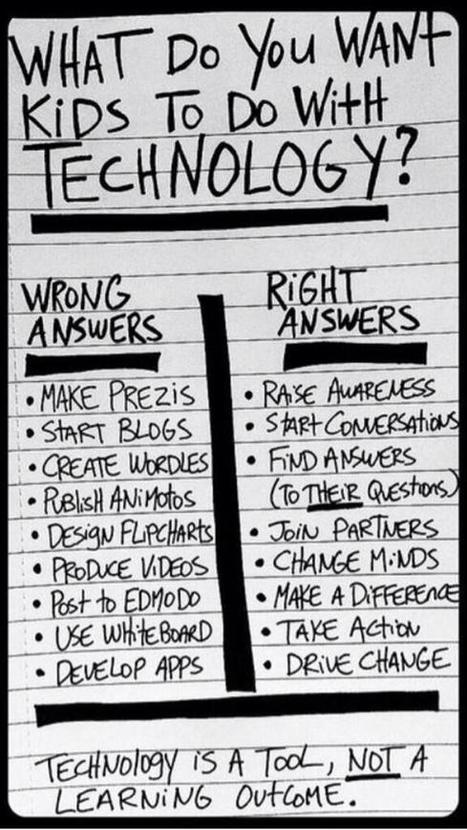
The rigid teacher-centered instruction does not fit in the 21st century classroom, Educational Technology and Mobile Learning reports. Learning now is more open and networked.

 Your new post is loading...
 Scoop.it! The rigid teacher-centered instruction does not fit in the 21st century classroom, Educational Technology and Mobile Learning reports. Learning now is more open and networked. 
No comment yet.
Sign up to comment
Scoop.it!
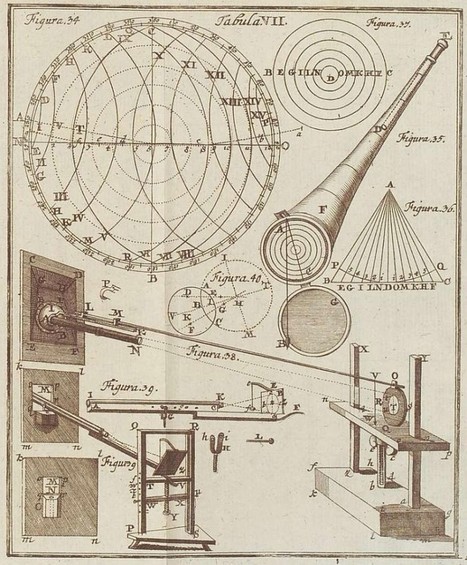
Graphics, charts, diagrams and visual data representations have been published on books, newspapers and magazines since they've existed, not to mention old maps and scientific illustrations...
Despite the lack of tools such as the ones we have at our disposal nowadays, they are as inspiring and important as the best contemporary visualizations. Visit the article link for a gallery of vintage visualizations... Via Lauren Moss

Charlley Luz's curator insight,
July 20, 2013 10:26 AM
muito legal, os Infográficos antes de existir a internet. 35 exemplos de infográficos no papel :) Achei falta do Marcha para Moscou do Minard http://www.datavis.ca/gallery/re-minard.php ; 
Leoncio Lopez-Ocon's curator insight,
July 20, 2013 2:57 PM
El brasileño Tiago Veloso, fundador de Visual Loop, nos ofrece 35 interesantísimas representaciones visuales de distintos fenómenos y eventos que permiten hacer un paseo por la historia de la ilustración científica.
Scoop.it!
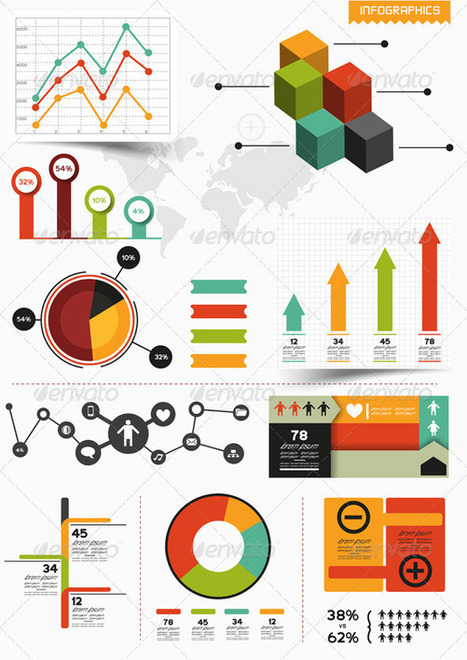
Information graphics or infographics are graphic visual representations of information, data or knowledge intended to present complex information quickly and clearly. The process of creating infographics can be referred to as data visualization, information design, or information architecture. In newspapers, infographics are commonly used to show the weather, maps, site plans, charts and graphs for statistical data.
These infographic element kits are all editable vector shapes in organized file formats, for use in presentation, print files or web site graphics. Via Lauren Moss
Scoop.it!

Donna Farren's curator insight,
July 10, 2013 2:02 PM
This is one of the best graphics I have seen on Ed Tech since I started in the field 10 years ago.
Scoop.it!

"It's summer time and the livin's easy, but that doesn't mean that the learning has to stop--or be boring! Here's a collection of creativity inspiring school tools that fight the brain drain and keep things fun."
Scoop.it!

Every era demands--and rewards--different skills.
"In different times and different places, we have taught our children to grow vegetables, build a house, forge a sword or blow a delicate glass, bake bread, create a soufflé, write a story or shoot hoops. Now we are teaching them to code.
"We are teaching them to code, however, not so much as an end in itself but because our world has morphed: so many of the things we once did with elements such as fire and iron, or tools such as pencil and paper, we can now wrought in code. We are teaching coding to help our kids craft their future.
"In this collection, we share perspectives on coding from a university professor's vantage (MIT's Mitch Resnick describes why learning to code is like learning to learn) to an elementary school's point of view (Sheena Vaidyanathan describes the program for sixth graders in Los Altos, Calif.), and other points in between.
"You can learn to code on your own by dipping into one of the 40 tools for learning to code that EdSurge's Kris Hattori has compiled (check out the bottom of this page). Or you can pack your kids off to summer coding camp, as Tony Wan explains."

Tekiela Gallagher's curator insight,
February 5, 2021 5:17 PM
The best quote in this article ~ "We should always teach children to bake bread, feed the goats and wield a hammer. But throwing in a little Java could take them a long way, too." demonstrates our need to not just forget about the tried and true but also keep the doors open to new methods of learning. This article offers tools to do just that.
Scoop.it!
by Kate Meersschaert
"Plug & Play CS Curriculum
Scoop.it!
by Linda Cui
"As one of the fastest-growing social networks, Pinterest's popularity can be attributed to its ease of use and vibrant Pinboards. Recently, a number of similar social curation sites developed specifically for students and teachers have popped up, emulating Pinterest in key ways while focusing on learning. In some cases, they have even made improvements. Here are five such sites that could be contenders for the title "Pinterest of Education":
Jim Lerman's insight:
Guess which one is my favorite?
Scoop.it!

From
twitter

Here's a 17 min video answering day 1 questions from Kansas State U participants this week http://wfryer.me/3vw ; made with @explainevrythng
Jim Lerman's insight:
Freyer gives answers to a number of important questions about implementing a school-based iPad program.
Scoop.it!

by Anne Collier
"Reporters and reviewers write about Minecraft as if it’s just like any other videogame. Even this highly readable piece about its creator (Markus Persson, aka “Notch”) and its parent company (Mojang) by Harry McCracken in Time magazine doesn’t cover what makes it different from other games specifically for its kid (and parent) players. But he does bring out this extraordinary differentiating factor: F “No less lofty an authority than the United Nations sees Minecraft as a tool to improve human life. Last September, its U.N.-Habitat agency teamed up with Mojang to launch a program called Block by Block. It will use Minecraft to digitally reimagine 300 run-down public spaces in the next three years, giving people who live near them the chance to chime in on how they might be improved. First up: a dilapidated park in Nairobi’s business district and parts of its Kibera slum” (Kibera is home to some 1 million people – seethis)."
Jim Lerman's insight:
via Raising Modern Learners
Scoop.it!

This page will serve as the portal page to many of my technology resource support sites. Use the navigation bar on the left to view the pages. Via Mariette Martineau
Jim Lerman's insight:
A true pioneer in tech integration for learning.
Scoop.it!

Can intelligence be changed? This article explores this issue, looking at work by Carol Dweck (and colleagues). It looks at "fixed mindsets" and "growth mindsets" and student whom have "growth mindsets" engage "in adaptive behaviors, such as focusing on mastering concepts and developing new strategies after making mistakes." Students with "fixed mindsets showed decrements in performance when faced with negative feedback or failure." Additional information is found in the article. Via Beth Dichter
Scoop.it!

by Larry Ferlazzo
"The Pajarao Valley Unified School District has an excellent collection of resources on Professor Carol Dweck’s work, and it’s been on The Best Resources On Helping Our Students Develop A “Growth Mindset” list for quite awhile.
"However, they created another related resource that, for some reason, I discovered is not on that list. It’s an exceptional PowerPoint presentation on how to provide feedback to students that promotes a growth mindset. And, in an added bonus, a portion of it speaks directly to parents.
"I’m adding to to both The Best Resources For Learning How To Best Give Feedback To Students and to The Best Ideas On How Parents Can Help Their Kids Succeed Academically." Via Dr. Tom D'Amico (@TDOttawa)
|
Scoop.it!

Sometimes the toughest step in building a new website or redesign can be the conceptual ones. Selecting a color palette is one of them that can be tough if you don’t have the right tools. So where do you start?
It all comes down to basic color theory and the color wheel. That same tool that teachers used in school really is the basis for how designers plan and use color in almost every project from the simplest web page to expansive brands with multiple sites and campaigns... Via Lauren Moss
Scoop.it!
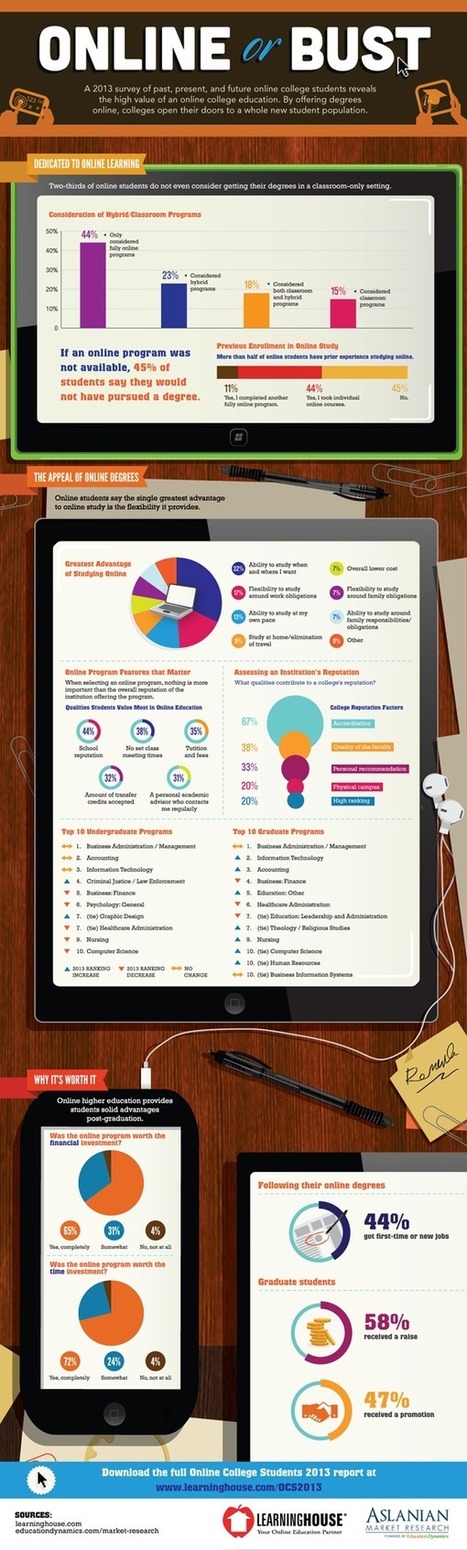
The Online College Students 2013: Comprehensive Data on Demands and Preferences report reveals the value of an online degree. Via Lucas Gruez, Donna Farren
Scoop.it!

by Nick Gidwani
Forecasting the next decade in higher education
"It was nearly two years ago that Clayton Christensen, the Harvard Business School Professor and authority on disruptive innovation, announced that higher education would be the next industry disruptedby technology and the Internet. Since then, we have seen the rise of the MOOC, which has presented an alternative model of higher education that could very well represent the future of how we educate our workforce.
"Given the massive disruption of the publishing world over the last decade, the evolution of journalism can give us some real hints about the robustness of MOOCs and where higher education may be headed in the next decade."
Jim Lerman's insight:
Gidwani makes it all sound so easy to understand that I found myself thinking, "Why haven't I said that? I see everything he does." Yes, his conclusions make a great deal of logical sense; the professoriate is about to undergo a huge and painful transformation. But that's only the beginning.
One thing I haven't seen many people comment on is the huge amount of debt being accumulated by the mid-tier institutions -- the public colleges and universities that produce our nation's teachers, nurses, middle managers, counselors, accountants, social workers, graphic artists, designers, health specialists, police, network administrators, database managers, fire fighters and the like. So many of these schools are running up mountainous deficits, in the hundreds of millions, that they are never going to be able to pay off. When the bills come due, there's going to be a bloodbath that won't have much to do with who is doing the teaching or how. These empty campuses of tomorrow will litter the landscape as surely as the abandoned factories (and shuttered newspapers) that haunt our rust belt cities now.
Scott McLoed is fond of saying (and I paraphrase) that the industrial revolution made possible extreme reductions of repetitive physical labor, while the digital revolution is making possible extreme reductions of repetitive cognitive labor. The higher education institutions that will flourish in the foreseeable future will be those that focus deliberately on interdisciplinary problem solving of a non-routine sort. Pattern recognition, collaboration, lateral thinking, and creativity will trump knowledge silos, linearity, algorithms,.and hierarchical specialization.

Terry Elliott's comment,
July 12, 2013 6:47 AM
Interesting article, but his reliance on no less a towering mass of intellectual pandering as Thomas Friedman is sad. I mean Friedman isn't even as good as a broken clock.

Jim Lerman's curator insight,
July 12, 2013 7:47 PM
One thing I haven't seen many people comment on is the huge amount of debt being accumulated by the mid-tier institutions -- the public colleges and universities that produce our nation's teachers, nurses, middle managers, counselors, accountants, social workers, graphic artists, designers, health specialists, police, network administrators, database managers, fire fighters and the like. So many of these schools are running up mountainous deficits, in the hundreds of millions, that they are never going to be able to pay off. When the bills come due, there's going to be a bloodbath that won't have much to do with who is doing the teaching or how. These empty campuses of tomorrow will litter the landscape as surely as the abandoned factories (and shuttered newspapers) that haunt our rust belt cities now.
Scott McLoed is fond of saying (and I paraphrase) that the industrial revolution made possible extreme reductions of repetitive physical labor, while the digital revolution is making possible extreme reductions of repetitive cognitive labor. The higher education institutions that will flourish in the foreseeable future will be those that focus deliberately on interdisciplinary problem solving of a non-routine sort. Pattern recognition, collaboration, lateral thinking, and creativity will trump knowledge silos, linearity, algorithms,.and hierarchical specialization.
Scoop.it!

"TELL ME A STORY," says every child. Daniel Willingham, Professor of Psychology at University of Virginia, shares in his blog a new study suggesting that "putting to-be-learned material in a story format improves learning outcomes." So we thought it'd be good to dig through our s'cool tools for those that help kids tell their own stories."
Scoop.it!

"We at Getting Smart are still basking in an ISTE afterglow… we’d like to share 10 great tools that we were introduced to there and the reasons they are so worth taking the time to master this summer. These are the tools that will transform your classroom in the fall because you will notice the definite threads that run throughout all these applications… real-time, collaborate and creative! Those words together are sure to build a lot of excitement around exactly how educational technology is developing and transforming what school looks like!"
Scoop.it!

by Kit Eaton
"Many of today’s most popular tablets are finger-friendly, of course. But for a host of note-taking apps, the devices, like their fictional cousins, work best when paired with a stylus.
"My favorite of these stylus-friendly options is Noteshelf, a $6 iPad app by Ramki. Its main interface is an empty page ready for you to write on, with controls in an icon bar at the top of the screen. You can choose from many predefined types of digital paper, including plain and ruled pages, and even one designed for musical notation."
Jim Lerman's insight:
Eaton describes 6 apps for note-taking on iOS and Android devices.
Scoop.it!

from the website
“Where are we meeting?” can be a hard question to answer.
Scoop.it!

by Nick Stat
"One of the most startling moments for tech junkies during the Boston Marathon bombing last April was the fact that Vine videos were some of the most sharable and informative updates, due mainly to the way news outfits could throw them into breaking stories and livestreams.
"Now, nearly three weeks after launching its own video offering, Instagram has enabled the same embeddable function for both its photos and videos.
"It's not clear what effect the move may have on the apparent decline in Vine's popularity vis-a-vis Instagram microvideo. But Instagram, which is cruising towards its third birthday this fall and still growing consistently since Facebook acquired it last December, now holds an enviable position in the world of social media."
Scoop.it!

by Mike Allton
"Have you noticed some people on Google+ doing the same annoying thing, over and over? For most, it's not on purpose. It's not their fault that they don't know any better. But the fact is, there's something they're expected to do, or expected not to do, and they're messing it up. "Sociologically, we refer to these as Norms, and there are four different kinds of norms: Folkways, Mores, Laws and Taboo. Unfortunately, while Laws and Taboo are generally documented, Folkways and Mores are less understood and often poorly communicated. As a result, particularly in developing environments like social networks, it's difficult to grasp at first what is and isn't expected of you. "Here are some of the most common mistakes people make on Google+, and what they should be doing differently. See if you can spot a few you recognize."
Scoop.it!
Full webcast from the RSA event on Monday 8 July 6pm BST. An edited HD video of the event will be available in the near future. At the event, one of the worl...
Jim Lerman's insight:
58-minute recording of Dweck's presentation.
Scoop.it!

We showed that kids who have the growth mindset intervention were 40% less likely to retaliate and 2-3 times as likely to engage in pro-social behavior than students who did not receive the training. Via Shary Lyssy Marshall, Mel Riddile
|