


The best sites for online teaching job openings and online adjunct faculty positions from GetEducated, helping online teachers get hired for the past 13 years
Via HJackson

 Your new post is loading...
 Scoop.it! The best sites for online teaching job openings and online adjunct faculty positions from GetEducated, helping online teachers get hired for the past 13 years Via HJackson
Scoop.it!

All of these are online for free and the links to volumes: Via HJackson
Scoop.it!

by Richard Byrne
"One of last month's most popular posts was 18 Google Earth & Maps Lessons for K-12. In response to that post I received a bunch of requests for more information about Google Earth and Google Maps including how to create placemarks and tours. I've shared these directions in the past, but it's worth sharing them again for folks who are thinking about trying a Google Earth or Google Maps-based lesson in their classrooms."
Scoop.it!

by Miguel Guhlin
Today, we have the potential to tap into a flow of conversation, a web-based learning ecology, that we can learn from 24 hours a day, 7 days a week. Who you choose to follow in that conversation is YOUR PLN. We’ll explore some of the workflows.
Jim Lerman's insight:
Great collection of resources and apps to help those who wish to build or expand their Personal Learning Network. Guhlin is one of the best sources on the web.
Scoop.it!

This short article is geared more towards elementary educators but I think the main idea of it is still pertinent to high school educators--that kids should understand how their brains work so that they can understand how they learn. The term we used to throw around in education classes was "metacognition." Also, I'm a big believer in telling teens about how their brains work in order to make the point that it is dangerous to expose them to various toxic substances. Via Heather Perkinson, Bob Zavitz
Scoop.it!

Thinglink image providing resources for digital citizenship - ThingLink (Digital Media Literacy provides resources for information accessing http://t.co/YQKEZZm6...)... Via Joyce Valenza, Cynthia Alvarado
Scoop.it!

http://www.youtube.com/watch?v=A0edKgL9EgM&feature=share&list=UUsooa4yRKGN_zEE8iknghZA For educators looking for new ways to introduce ideas to stude Via Cynthia Alvarado 
Cynthia Alvarado's curator insight,
January 4, 2013 10:45 AM
Great examples of short videos that can replace lecture.
Scoop.it!
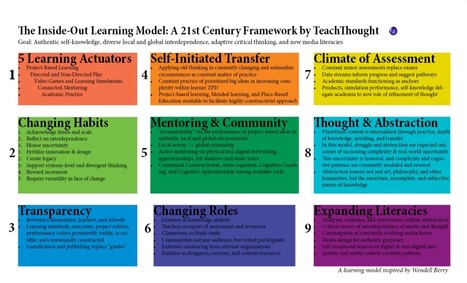
by Terry Heick
"As a follow-up to our 9 Characteristics of 21st Century Learning we developed in 2009, we have developed an updated framework, The "Inside-Out Learning Model.
The goal of the model is simple enough–not pure academic proficiency, but instead authentic self-knowledge, diverse local and global interdependence, adaptive critical thinking, and adaptive media literacy. By design this model emphasizes the role of play, diverse digital and physical media, and a designed interdependence between communities and schools.
"The attempted personalization of learning occurs through new actuators and new notions of local and global citizenship. An Inside-Out School returns the learners, learning, and “accountability” away from academia and back to communities. No longer do schools teach. Rather, they act as curators of resources and learning tools, and promote the shift of the “burden” of leanring back to a more balanced perspective of stakeholders and participants.
"Here, families, business leaders, humanities-based organizations, neighbors, mentors, higher-education institutions, all converging to witness, revere, respond to, and support the learning of its own community members.
"The micro-effect here is increased intellectual intimacy, while the macro-effect is healthier communities and citizenship that extends beyond mere participation, to ideas of thinking, scale, legacy, and growth."
Scoop.it!

The Gradual Release Of Responsibility Model In 6 Simple Words: A Useful Learning Model Via Grant Montgomery, Bob Zavitz
Scoop.it!
IATEFL 2013 presentation http://collablogatorium.blogspot.com.br/2013/03/contentcuration.html Via Paula Silva, catspyjamasnz 
John Slifko's curator insight,
June 17, 2013 11:32 AM
The Euro American Masonic Open Forum will use content curation for active engagement with students, facully, and other contributors and learners in the years ahead. The subject matter concerns all aspects of Freemasonry and wider civil society around the world since the seventeenth and eighttenh centuryies. 
Fabrizio Bartoli's curator insight,
July 13, 2013 4:15 AM
Content curation for efl teachers. Great share, thanks.
Scoop.it!


Ken Morrison's curator insight,
July 12, 2013 1:36 PM
In This corner, Twitter's Vine.....facing off against Facebook's Instagram. Who will win? For me, the key takeaway is that Vine will attract people who are a bit turned off by the polished and filtered images that we all tend to present on Facebook, etc. Without filters, this author feels that Vine is in a unique position.
Scoop.it!
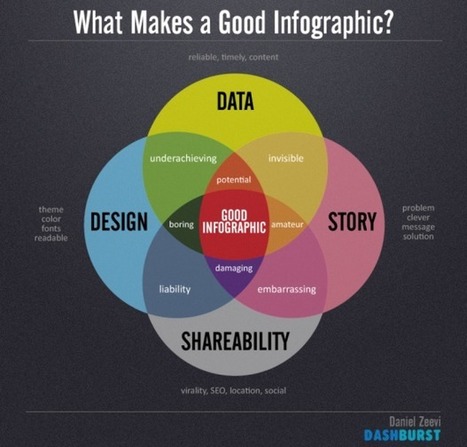
Let's talk about ways you can make your own infographics - but first - let's discuss WHY you'd want to make some infographics for teachers and students! Via Ana Cristina Pratas |
Scoop.it!

The flipped classroom is one type of active learning environment. It’s dynamic, it’s engaging, and it's “messy”. Here are five strategies to get going. Via EDTECH@UTRGV, HJackson
Scoop.it!

Posted by Katie Lepi
"Have you ever wondered why you need to be a member of the top 4 social networks: Facebook, Twitter, LinkedIn, and the whole host of other social networking sites that your friend invite you to be a part of? Maybe you should only join Facebook. Or maybe Google+ would be the better option. Doesn’t everyone end up connected in all of the same places anyway?
"Well, the short version of the answer is no. But this handy infographic takes a look at who is using which social networks and for what. Think of it as a handy guide to which social network is best for doing what and when. Keep reading to learn more. What Site Is Best For What?Facebook: Best for interacting on a more personal level with your contacts.Twitter: Use it to address customer service concerns in front of a large audience.LinkedIn: Best for showing off your professional accomplishments.Google+: Use it to start conversations with groups.
Scoop.it!

Free Arts Integration Lesson Plans - Download one (or more) today! These Arts Integration lesson plans connect with Common Core and STEM
Scoop.it!
How often do we teach students how to formulate good, in-depth questions? Use these 6 steps to help boost your students’ ability to ask better questions and drive their own learning. Via Joyce Valenza, Cynthia Alvarado
Scoop.it!

Cynthia Alvarado's curator insight,
January 4, 2013 9:38 AM
Great hints about entry level software to create your own digital games .
Scoop.it!

Just as blocks have no inherent curricular power other than experience in making big things by stacking smaller things in the right order, the ability of computer-controlled pixels to convey important knowledge depends entirely on what (and how) they are used. That’s where teachers come in…and why some are beginning to use an inexpensive online game to teach everything from philosophy to biology: Minecraft.
Via Nik Peachey, Cynthia Alvarado 
Peter Fruhmann's curator insight,
July 11, 2013 3:42 AM
An appealing concept: a game that could help teachers and pupils / students with not only conveying knowledge but also with the development of social skills and collaborative storytelling. Interesting article, there is also the mentioning of the developmet of a wiki for educational purposes. 
Tracy Bodzioch Feighery's curator insight,
July 11, 2013 10:17 PM
I am interested in learning more about integrating gaming into curriculum to teach 21st Century Skills.
Scoop.it!

Research proves that formative assessment strategies like higher-order questions and increased wait time increases student engagement. Read our latest blog post. Via Grant Montgomery, Bob Zavitz
Scoop.it!

"Education is increasingly occurring online or in educational software, resulting in an explosion of data that can be used to improve educational effectiveness and support basic research on learning. In this course, you will learn how and when to use key methods for educational data mining and learning analytics on this data." Workload: 6-8 hours/week Starts 9/5/2013 (10 weeks long) .
Scoop.it!


Lynn O'Connell for O'Connell Meier's curator insight,
April 23, 2013 4:02 PM
Soon we'll need a curation site to curate the curation tools. 
Erica Anderson's curator insight,
May 21, 2013 12:44 PM
A new list of curation tools, Listly looks really interesting. 
Andrea Walker's curator insight,
May 22, 2013 2:15 AM
A new list, I'm working on getting to know Feedly!
Scoop.it!

by Beth Kanter
"Yesterday, I did a free NTEN Webinar called “The Unanticipated Benefits of Content Curation: Reducing Information Overload” based on my feature article in the NTEN Change Journal in June with the same title. (You can register and download the issue here for free and listen to the webinar recording here) The main idea is that good curation skills can build staff expertise and avoid the pain of information overload. I covered the basics of content curation, how it differs from social sharing, the art and practice of curation, a frameworks to get started, examples of nonprofits using curation, the tools, and some techniques for minimizing information overload and managing attention. I pulled together a curated summary of the tweets and resources on Storify that you can view here."
- See more at: http://www.bethkanter.org/nten-curation/#sthash.ONKb5dUc.dpuf Via catspyjamasnz 
Maria Richards's curator insight,
July 8, 2013 6:35 PM
Any reduction ininformation overload is VERY welcome! 
Kim Flintoff's comment,
July 14, 2013 9:56 PM
"Information overload" - libraries and bookshops have always contained overwhelming quantiities of data, just as a phonebook used to - but most people never felt compelled to engage with all of it... has that changed?

Helena Andrade Mendonça's curator insight,
July 16, 2013 11:35 AM
Ótima apresentação sobre curadoria de conteúdos digitais.
Scoop.it!
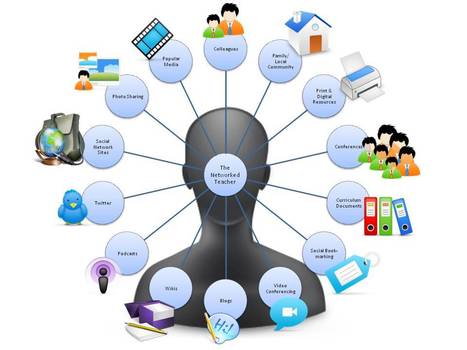
A wonderful visual depiction of how educators can tap into their networks to expand and continually improve their teaching practice from a trove of rich resources. Illustrated by Langwitches, the image refers to Alec Couros’s original post exploring question, “What does the network mean to you?” Via Anne Whaits 
Leslie Minton's curator insight,
July 17, 2013 11:49 AM
Great visual of how networks are created to support how best to utilize them in education. 
Lara Strickland's curator insight,
August 13, 2013 8:06 AM
Depicts exactly what I am exploring at the moment as part of my #H812 studies and MA in Online and Disctance Education. Chosen however not to 'network' Facebook as I tend to use it socially rather than professionally. |







add your insight...